

Payhip is a legitimate checkout for ebooks, templates, courses and memberships, rated 4.6 out of 5 in 553 Payhip reviews on Trustpilot. Its free plan takes 5% a sale, pays out to your own payment accounts, and collects and pays most VAT and sales tax on digital sales to the EU, UK, US and Canada.
The weak spot is the 1-star pile. 48 of the 68 one-star reviews written in English describe a store that was closed, deleted or locked, often without warning. Payhip publicly answered 28 of those 68, and 22 of its answers blame copyright problems or resold PLR content. Sell only work you made yourself, keep proof of it, and Payhip is a low-cost, well-reviewed option.
You are about to put an ebook, a template pack or a course on Payhip. Before you do, you want 2 answers. Will it handle the fiddly parts of selling? And will your store still be there next year?
The review sites ranking for this search mostly answer the first question. None of the 5 I checked mention a single closed store. Closed stores are the most common story in Payhip’s 1-star reviews.
This Payhip review takes the 5 jobs a seller needs a checkout to do, from taking the money to keeping the store open. It scores Payhip on each one, using Trustpilot, Reddit and Payhip’s own pricing and help pages.
Key Takeaways
- Legit and cheap to start. The free plan carries every feature for 5% a sale. Plus is $29 a month for 2%, Pro $99 for 0%.
- Tax is its best job. Since 1 July 2026 Payhip also pays US and Canadian sales tax, on top of EU and UK VAT.
- The real risk is a closed store. 48 of 68 English 1-star reviews describe one. Where Payhip replied, most answers cite copyright or PLR.
- Subscriptions need Stripe. Recurring billing only runs through Stripe, and Payhip has no one-click upsell or downsell after checkout.
- Best fit: sellers of their own ebooks, templates and courses who want tax handled and no post-purchase funnels.
Is Payhip legit? What 553 Trustpilot reviews show
Payhip is a legitimate company based in London. A Payhip staff member wrote on Reddit that it has been running since 2011, and it holds a 4.6 TrustScore from 553 reviews on Payhip’s Trustpilot page. Payhip says more than 130,000 sellers use it.
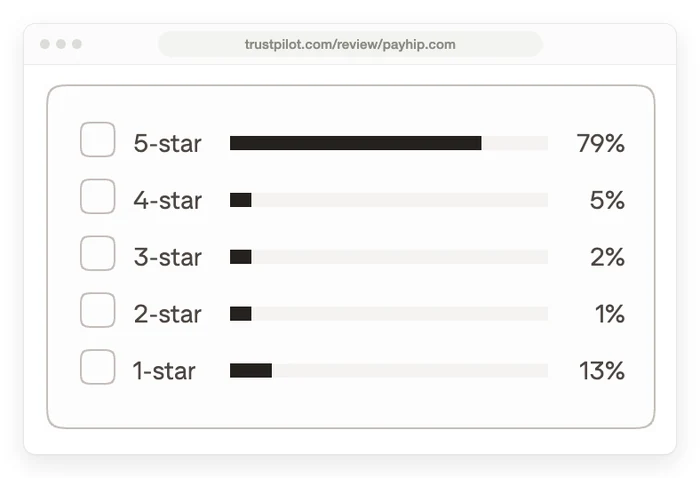
The average hides how split those reviews are. 79% are 5 stars and 13% are 1 star, with few in between.
Still deciding what to sell, and at what price? The Online Selling Mistakes Challenge is a free 5-day email course on 5 common pricing and checkout mistakes solo sellers make.
The 5-star reviews are mostly about support and ease. “Excellent customer support, very helpful and patient with a million questions, especially as a new business owner,” wrote a new seller in South Africa in October 2026. A seller in Australia wrote of about 3 years on the free plan “with no reminders to upgrade”.
The 1-star reviews are mostly about 1 thing, and it gets its own section below.
I have run a checkout called Zaxaa since 2013, and I now also run CartMango, which competes with Payhip. The 5 jobs below are the ones I would check on any checkout.
Job 1: Putting your product on a page people can pay on
Payhip gives every plan a hosted store, product pages and a checkout. Buyers can pay without making an account.
Payhip supports 13 payment processors, and most sellers can connect PayPal plus 1 other, such as Stripe. Payhip added 11 of those gateways in 2025, including Square, Mollie, Mercado Pago, Paystack and Razorpay, and in 2026 it switched on Apple Pay, Google Pay and more than 100 other methods through Stripe. Older reviews that say Payhip only works with PayPal and Stripe are out of date, and so is Google’s AI summary for this search, which repeats that line.
The store builder gets good marks for ease. Sellers report a few limits:
- Language. A seller in Portugal found in December 2025 that if your buyers speak a language Payhip does not offer, the cart, checkout, login and register pages cannot be translated into it, only the custom pages you build.
- Custom domains. A seller in Germany wrote in May 2026 that a custom domain was still not connected after several days.
- Where you live. Payhip only works where one of its processors does. A seller in Bangladesh gave it 1 star in August 2026 because Payhip was not available there.
Payhip also runs a marketplace, where listing is free. Do not count on it for sales. A seller who had used both Payhip and Gumroad said in an r/digitalproductselling thread that their marketplaces “typically don’t provide enough traffic” to sell much. Every buyer is one you bring yourself.
Subscriptions only run through Stripe
Recurring billing on Payhip needs Stripe connected. Payhip’s help centre says its recurring payment option “is only available when Stripe is enabled as the payment processor,” and only on bundles, memberships, courses and coaching, not on a plain download.
When a card fails, Payhip sends the buyer 3 emails over 20 days, then cancels the subscription and removes access.
Job 2: Handling VAT and sales tax
Payhip collects and pays digital VAT for EU and UK buyers. Since 1 July 2026 it also collects and pays US and Canadian sales tax, so most sellers never file these taxes themselves.
The UK government says digital services sold to UK consumers are liable to UK VAT, and Payhip’s help centre notes the rule applies whatever country the seller is in. The EU has charged VAT on digital sales by the buyer’s location since 2015.
Payhip covers each region in a different legal role. It acts as your reseller for EU and UK VAT, as a “marketplace facilitator” in the US and as a “digital platform operator” in Canada. For those buyers, the law treats Payhip as the one who owes the tax, so it files and pays instead of you, and Payhip says it charges nothing extra for the US part.
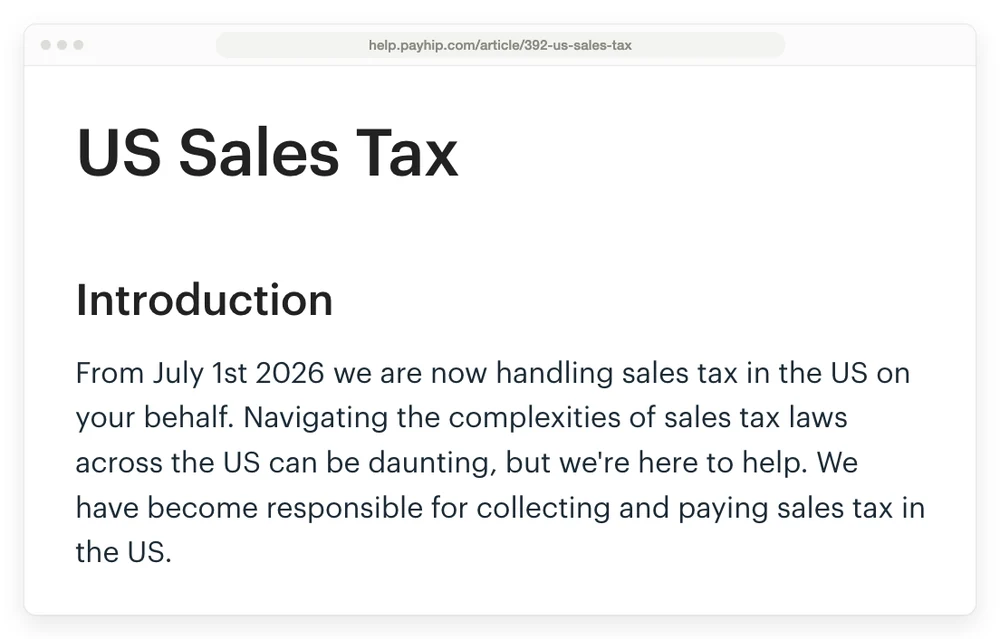
The change is new, and some ranking reviews still describe the old setup. One says US sales tax is the seller’s job, and another says Payhip is still rolling out its tax tools.
3 gaps remain, all from Payhip’s own pages:
- Quebec. In Canada, Payhip handles GST, HST and PST, but you still collect and pay Quebec’s QST yourself if you are required to.
- A physical presence in a US state. If you have one where Payhip pays the tax for you, that state may still expect a “zero dollar return” from you.
- Everywhere else. For other countries, Payhip can add a tax at checkout, but it passes that money to you and you pay it.
Here is how VAT changes what you keep, using Payhip’s own example. You sell a $10 ebook on the free plan to a buyer in France, where VAT is 20%. With VAT added on top, the buyer pays $12, Payhip keeps its 5% of the $10 plus the $2 of VAT, and you receive $9.50 before PayPal’s fee. If you choose to include VAT inside your $10 price, you receive $7.91 instead.
Job 3: Getting paid, and Payhip’s fees per sale
Payhip’s fees are 5% of each sale on the free plan, 2% on Plus at $29 a month and nothing on Pro at $99 a month. Your payment processor charges its own fee on top of that on every plan. Payhip lists monthly prices only, with no yearly option on its pricing page.
Free is the cheapest Payhip plan below about $967 a month in sales, Plus up to $3,500, and Pro above that.
| Plan | Price | Payhip’s cut | Cheapest at |
|---|---|---|---|
| Free | $0 | 5% | under about $967 a month in sales |
| Plus | $29 a month | 2% | about $967 to $3,500 a month |
| Pro | $99 a month | 0% | over $3,500 a month |
Stripe charges 2.9% + 30¢ per successful payment on domestic cards, per Stripe’s pricing page. So a $10 sale on Payhip’s free plan leaves you $8.91: $0.50 goes to Payhip and $0.59 to Stripe. We walk through the full per-sale math and the upgrade points in our Payhip pricing breakdown.
The payout itself is quick. Payhip’s pricing page says it deposits each sale “immediately after a transaction has been completed,” because the money goes into your own PayPal or Stripe account rather than a Payhip balance. Payhip’s Stripe help page adds that Stripe then pays your bank daily by default. Apart from a check on your first payment, there is no holding period on Payhip’s side.
2 things can slow or shrink a payout:
- Your first sale. Payhip’s help pages say a first PayPal payment goes through an automatic approval that may delay it, and a first Stripe payment stays pending for a few days while Stripe approves your account.
- Processor fees. A seller in the same Reddit thread complained of being “double charged fees: One fee for Payhip and second fee when you transfer money to your Paypal.” Payhip’s help pages say the processor’s fees go to PayPal or Stripe, not to Payhip.
Job 4: Selling more to each buyer
Payhip offers a discounted add-on before checkout and a discount on a second product after it, but no one-click upsell or downsell.
The tools it does have are useful for a small catalogue:
- Cross-sells. When a buyer adds a product, Payhip can prompt them to add a second one at a discount.
- Upgrade discounts. After a purchase, the buyer is offered a special price on another product, and the same offer goes into the receipt email. Taking it means a second, separate checkout.
- Cart abandonment emails. Added in 2026, off by default. Payhip emails buyers who leave checkout, with an optional discount.
- Coupons, affiliates and referrals, plus revenue splits with collaborators paid through PayPal since 2025.
What is missing is the post-purchase funnel: a one-click offer right after payment, and a cheaper fallback offer when the buyer says no. If that is part of your plan, look at checkouts built around it. CartMango, which I run, has order bumps on every plan and upsells and downsells after payment from its $20 a year Gold plan. ThriveCart and SamCart also do this, and we put Payhip next to the first one in Payhip vs ThriveCart.
Job 5: Keeping your store open, the job ranking reviews skip
Payhip can close a store without warning when it decides the content breaks its rules. That is what 48 of the 68 one-star reviews written in English describe: a store closed, deleted or locked. That is about 9% of all 553 reviews. The sellers who report it lose the store and its sales, and several say they could not get their data back.
Why Payhip closes stores
Payhip’s help page on banned products says that selling content against its terms means you “risk getting your Payhip account permanently deleted without prior notice.” The list includes copyright infringement, get-rich-quick content, file sharing, gambling and debt products. A Payhip staff member put it plainly in an r/selfpublish thread: Payhip has “a strict policy against copyrighted or PLR content” and “violations do lead to permanent account removal.”
PLR means private label rights: ebooks, templates and courses sold with permission to resell them as your own.
Payhip’s public replies to closed sellers repeat those 2 reasons. Of the 28 one-star reviews it answered, 12 replies cite PLR and 10 cite copyright. The rest name malware, get-rich-quick ebooks, unlicensed IPTV, a PayPal country rule and, twice, abuse aimed at Payhip’s support team. A reply to a November 2024 review states the rule outright: “We have not allowed the sale of PLR products as stated in our terms for over 5 years.”
The word PLR appears in neither Payhip’s public list of banned products nor its terms of use, which were last updated in February 2018. Treat PLR, resell rights and master resell rights products as banned anyway, because the replies show that is how Payhip enforces it.
When the seller says the work was original
Some closures are disputed, and from outside nobody can tell who is right. A US seller called popsonline wrote in March 2026 that Payhip said they sold PLR/MRR content, “which isn’t true as I sell ebooks with no resale rights.” Another US seller, K J, wrote that their account was deleted while selling ebooks they wrote themselves, licensed so buyers could photocopy them, and Payhip’s reply cited its PLR rule. A seller in Belgium summed up the frustration in July 2024: “The system itself is really good, but what’s the use if your account gets arbitrarily closed overnight?”
What happens to the money
In several of the copyright and PLR cases, Payhip says the money went back to the buyers. Payhip’s reply to a closed seller’s 2024 review reads: “Your account was closed, and the money was refunded to buyers.”
A seller in Italy wrote in May 2026 that Payhip went as far as “reversing the funds that were already processed and deposited into my PayPal account.” A seller in Germany added in January 2023 that after the refund, “I had to pay the Fees”. A US seller wrote in June 2026 that the account was taken down the morning after the first sales came in.
What support is like
Payhip’s support works by email at [email protected], 24 hours a day, and aims to reply within 24 hours. There is no phone line. The 5-star reviews say that works well when you are in good standing: “I emailed the company on a Saturday and received a response Sunday with step-by-step instructions,” wrote a seller in September 2026. Many of the closed sellers describe the opposite, emails that stop getting answered.
4 habits that protect you
- Sell only what you made, and keep the drafts and source files that prove it.
- Skip Payhip for PLR, resell rights or master resell rights products, whatever the license you bought says.
- Keep your own copies of every file. Payhip’s terms say backups are your job.
- Export your customer list regularly, so a closed store does not also cost you your buyers.
If you sell memberships, plan for leaving too. Payhip’s recurring payments stop when you leave Payhip, so you may need to ask members to sign up again.
Payhip vs CartMango, job by job
Payhip wins the tax job outright and hosts courses today, CartMango takes no cut of any sale and keeps your subscriptions if you leave, and both pay out straight to your own accounts.
| Job | Payhip | CartMango |
|---|---|---|
| Price | Free plan at 5% a sale, Plus $29 a month at 2%, Pro $99 a month at 0% | Free right now. From November, about $0.83 to $2.50 a month billed yearly ($10 to $30 a year), 0% a sale |
| Taking the money | 13 processors, usually PayPal plus 1 other. Subscriptions need Stripe | Stripe and PayPal on every plan. One-time and subscription selling on every plan |
| Tax | Collects and pays EU and UK VAT plus US and Canadian sales tax, except Quebec QST | Does not file tax for you. You stay the seller of record |
| Getting paid | Straight to your own PayPal or card processor. A first payment can wait for approval | Straight to your own Stripe or PayPal |
| Selling more | Cross-sells, a discount after purchase, cart abandonment emails. No one-click upsell or downsell | Order bumps on every plan. Upsells, downsells and cart abandonment from the $20 a year Gold plan |
| Courses | Hosts courses, memberships and coaching on every plan | Not yet, planned for October 2026 |
| Closures and leaving | Can delete a store without prior notice over banned content, PLR included. Recurring payments stop if you leave | Subscriptions keep paying you if you leave |
Payhip has no yearly billing, so its prices stay monthly above, while CartMango bills yearly only. CartMango loses the tax and course rows outright.
Who Payhip suits, and who should pick something else
Payhip suits a seller of original ebooks, templates, courses or memberships who wants tax handled and a free way to start, and it is the wrong pick for anyone selling resold or PLR products.
Payhip fits you if:
- You create your own products and can prove it.
- Many of your buyers are in the EU, UK, US or Canada, and you never want to file their tax yourself.
- You sell under about $967 a month, where the free plan is the cheapest Payhip option.
- Your courses or memberships are simple, since Payhip hosts both on every plan.
Look elsewhere if:
- You sell PLR, resell rights or anything you did not create.
- You want one-click upsells and downsells after checkout.
- Your members pay by PayPal and you want subscriptions.
- Your buyers speak a language Payhip’s checkout does not offer.
For other options, our list of Payhip alternatives covers 7 of them, and Gumroad vs Payhip puts it next to Gumroad. If courses are the main product, Payhip vs Podia is the closer match.
Payhip review FAQ
Is Payhip safe and legit?
Yes. Payhip is a London-based company that has run since 2011 and holds a 4.6 TrustScore from 553 Trustpilot reviews. Buyers pay through PayPal or a card processor like Stripe, and the money goes straight to the seller’s own account. Refunds come from the seller, except when Payhip closes a store and refunds buyers itself. For sellers, the main risk is a closed store over copyright or PLR rules.
What are the disadvantages of Payhip?
Going by the 1-star reviews, the biggest is that Payhip can close a store without prior notice over copyright or PLR content and refund the buyers. Smaller ones: the free plan takes 5% a sale, subscriptions need Stripe, there is no one-click upsell or downsell, and support works by email with no phone line. One reviewer also found the checkout could not be translated into a language Payhip does not offer.
How much does Payhip take per sale?
Payhip takes 5% per sale on the free plan, 2% on Plus at $29 a month and 0% on Pro at $99 a month. Your payment processor charges separately, for example Stripe’s 2.9% + 30¢ on US cards. On a $10 sale on the free plan, you keep about $8.91.
Which is better, Payhip or Shopify?
For digital products, Payhip is the simpler start: a free plan, a store built for files and courses, and VAT and sales tax handled for you. Shopify is built for physical stock and needs an app to deliver digital files. We compare the costs at real sales volumes in Payhip vs Shopify.
Is Payhip free?
Payhip’s free plan has no monthly fee and includes every feature and unlimited products. Each sale still costs 5% to Payhip, plus your payment processor’s own fee on top. Plus and Pro lower or remove Payhip’s cut for a monthly fee.
Keeping the 5% instead
The short Payhip review: its 4.6 comes from easy setup and quick email support, and tax is the job it does best. The cost to watch is the free plan’s cut. On $500 of monthly sales, 5% comes to $25 a month before card fees.
If you would rather keep that cut, CartMango takes 0% of each sale and pays straight into your own Stripe or PayPal. It is free right now, and paid plans start in November from $10 a year. You handle your own tax, and the subscriptions you create keep paying you if you ever leave.
About the Author

👋 I’m Welly, founder of CartMango (the site you’re on), a checkout platform for digital product sellers. We’ve previously processed $179M+. I also run BirdSend (email marketing tool, 3.1B+ emails sent). On the side I show other non-techie digital sellers how I use AI workflows to automate 50%+ of my operations. Find me on LinkedIn.
Related Reading
- Payhip pricing: every plan, what you keep per sale, and when upgrading pays off
- Payhip alternatives: 7 options if this Payhip review rules it out for you
- Gumroad vs Payhip: the 2 checkouts side by side on fees and features
- Is Sellfy legit?: the same trust check on another digital checkout