

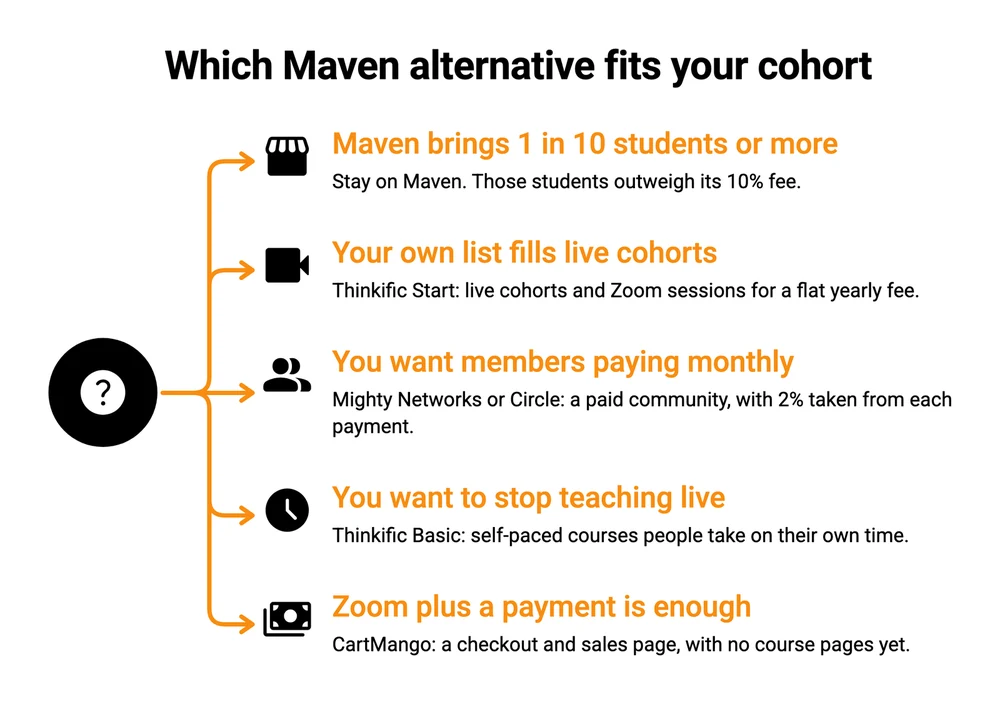
For instructors leaving Maven, the live cohort marketplace at maven.com, Thinkific runs live cohorts for a flat yearly fee, Mighty Networks and Circle suit a paid community, and CartMango takes payment for a plain Zoom class. These Maven alternatives beat staying only if Maven brings you fewer than 1 in 10 students.
Maven keeps 10% of every paid seat, including ones you sell yourself, and instructors keep less on growth program sales. Its own example leaves $510 of a $1,000 seat sold through an affiliate. Prices use yearly billing where offered: Thinkific’s live cohort plan is $82 a month. CartMango is free until October 2026, then $10 a year, but hosts no course pages yet.
You ran a live cohort on Maven, the course marketplace at maven.com, not the Java build tool. It filled. Now you are wondering whether the 10% Maven keeps from every seat still earns its place.
Maven publishes most of the numbers you need. Its help center says its own channels bring in about 30% of enrollments on average.
The other 70% or so arrive some other way. Maven credits a sale to the instructor whenever it cannot tell where the student came from.
So this guide covers 3 things: what Maven keeps on each kind of sale, the 1 figure in your dashboard that says whether leaving saves money, and which tool fits each instructor who leaves.
Key Takeaways
- Maven’s 10% applies to every paid seat. That includes students who came through your own link, and Stripe’s card fee comes on top.
- Some Maven sales cost far more than 10%. On a $1,000 seat sold by a Maven affiliate at 15% off, Maven’s own example leaves the instructor $510.
- Check your enrollment sources before leaving. If Maven’s channels bring you fewer than 1 student in 10, its fee costs you more than those students are worth.
- Thinkific Start runs live cohorts with Zoom sessions and attendance tracking for $82 a month billed yearly, with no Thinkific cut on Thinkific Payments.
- CartMango takes the payment and hosts the sales page, nothing more. It is free until October 2026, then from $10 a year, and hosts no course pages yet.
What Maven charges instructors
Maven charges instructors nothing upfront and keeps 10% of every paid enrollment, with Stripe’s card fee on top. Its help center works it through on a $1,000 course: Maven takes $100, Stripe takes $26.40, and the instructor gets $873.60 (Maven’s getting paid guide). The 10% applies to each paid student, whether they found you through Maven’s catalog or through a link you posted on LinkedIn yourself.
Pricing a cohort is where plenty of instructors lose money before any platform touches it. If you want the other usual leaks named plainly, the Online Selling Mistakes Challenge covers the 5 most common ones in 5 days of emails.
Maven also sets a price floor: $200 for any paid offering.
Its pricing guide says live cohort courses typically sell for $800 to $2,450, scaled by live hours and projects (Maven’s pricing guide).
The sales where you keep less than 90%
Every course on Maven is enrolled in its Student Growth Program the moment you publish it. Through that program Maven can discount your course, sell it through affiliates and sell seats to companies, and each route leaves you less than 90% of your list price.
On a $1,000 Maven seat, the instructor keeps $900 when the student comes through their own link, $630 in a 30%-off site-wide sale and $510 when a Maven affiliate sells it, all before Stripe’s card fee.
| Sale route | Student pays | Maven’s cut | Other cut | You keep |
|---|---|---|---|---|
| Your own link | $1,000 | $100 | None | $900 |
| Team of 10+ seats | $750 | $75 | None | $675 |
| Site-wide sale | $700 | $70 | None | $630 |
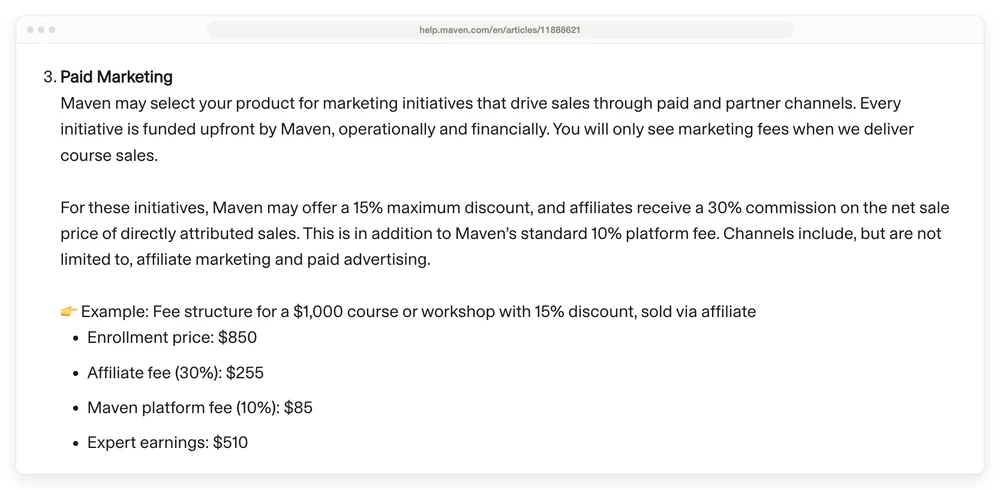
| Affiliate sale | $850 | $85 | $255 to the affiliate | $510 |
| Company subscription | Set by Maven | 50% of the pool | None | 50%, shared by enrollments |
The team row uses the 25% discount Maven applies at 10 or more seats.
The site-wide row uses 30%, the most Maven’s policy guidebook says it will take off your listed price for a promotion.
The affiliate row is Maven’s own worked example, exactly as its help center prints it:
Read the whole Student Growth Program guide if you teach on Maven today, because a few lines in it move the math more than the headline fee does.
- You can only leave the program once a year. Maven runs an annual opt-out window. For 2026 the deadline was September 11.
- Opting out keeps the 10% fee in place. It switches off the discounts, affiliate sales, company seats and scholarships.
- Company subscription seats pay 50/50. When companies buy seat plans across Maven’s catalog, Maven splits that money evenly with instructors, paid out quarterly.
- Maven may give away up to 2 full scholarships per cohort. It uses them for word of mouth with newsletters and influencers.
2 of Maven’s own pages also disagree with each other. Its policy guidebook says you “can opt out at any time” and that discounts plus affiliate fees “will never exceed 30% off your listed price”. The Student Growth Program guide says opting out happens once a year, and its affiliate example takes $405 off a $1,000 list, $150 of discount plus $255 to the affiliate, before Maven’s fee. If either rule decides your plans, get Maven’s answer in writing.
None of the page 1 guides for this search mention the $510 example. Most quote 10% and stop there. Ruzuku’s comparison puts Maven’s share at “typically 10-20%” on marketplace-sourced students, which has it the wrong way round. Maven’s 10% applies to every paid seat, including the ones you sell yourself, and the extra cuts depend on the sale route, such as an affiliate or a site-wide promotion.
What decides whether leaving Maven saves you money
Whether leaving Maven saves money comes down to 1 figure: the share of your enrollments that Maven’s own channels brought in. Maven splits your enrollments by source in your earnings dashboard.
Say you sell $20,000 of seats a year on Maven, so the 10% fee is $2,000.
- Maven brought 30% of those sales, its own average. That is $6,000 of seats. Leaving saves $2,000 in fees and loses $6,000 of sales. Stay.
- Maven brought 5%. That is $1,000 of seats. Leaving saves $2,000 in fees, loses $1,000 of sales, and leaves $1,000 to cover a new platform. Thinkific Start costs $978 a year, so you come out $22 ahead. Barely worth the move.
- Maven brought almost nothing. Every student came from your list or your posts. Leaving saves close to the full $2,000, and a $978 platform leaves you about $1,000 better off each year.
So the line sits at about 1 student in 10. Above it, Maven’s marketplace pays for its fee. Below it, you pay 10% on students you found yourself, and your yearly sales decide whether the saving covers a new platform.
Your dashboard can flatter your own share, though. Maven credits a sale to you whenever it cannot tell where the student came from, so your own share can look bigger than it is. Maven’s fix is its Share button, which adds tracking codes to your links, so use it for a full cohort before deciding anything.
Getting onto Maven’s marketplace also takes work first. A course only gets reviewed for listing after it reaches 100 leads on its interest list or 2 paid enrollments (Maven’s listing rules). Maven describes its own discovery as “an accelerant, not a replacement” for your marketing.
If Maven’s own channels bring you more than 1 student in 10
Stay on Maven.
If its catalog, emails and trending placements bring you more than 1 student in 10, those students are worth more than the whole 10% fee, and no alternative below replaces them. That usually describes an instructor with a small audience, or a topic Maven’s learners already browse for.
Maven also helps with company sales, including procurement, contract review and vendor approval, which a solo instructor would otherwise handle alone. If company training is where your cohorts are heading, Disco and Teachfloor both pitch their plans at organisations. Disco’s Organization plan costs $399 a month billed yearly for up to 500 members, while Teachfloor lists no yearly rate and says its Startup plan starts at $89 a month, with custom quotes beyond that.
What to do instead of leaving:
- Share only tracked links, so your enrollment sources show the real split.
- Put the next opt-out window in your calendar if the growth program’s discounts bother you. Maven says the 2027 deadline gets announced in late 2026.
- Price for the routes you cannot control. If a 30%-off site-wide sale would sink your margin, your list price is too low.
What you give up by staying: the bigger cuts on growth program sales, and Maven’s refund policy instead of your own. A monthly membership is also missing from Maven’s list of what you can sell, which covers free taster lessons, cohort courses, 1-day workshops, resources and services.
If most of your students found you before they found Maven
Thinkific’s Start plan is a close like-for-like move. It includes live cohorts and coaching, unlimited Zoom sessions, bookable calendars and attendance tracking, for $82 a month billed yearly, which is $978 a year.
There is no Thinkific cut when you take payments through Thinkific Payments, which charges 2.9% per card much like Stripe. Connect your own Stripe or PayPal instead and Thinkific adds a gateway fee that varies by plan. At $9,780 a year in course sales, Maven’s 10% equals Start’s $978. Above that, Thinkific costs less, and the gap grows with every seat.
This is the instructor Maven’s own math works against.
A Maven instructor wrote in a 2023 r/Entrepreneur thread that after 12 cohorts they had taught 325 students at about $1,000 each, with almost nothing spent on ads. By their account, the students came from LinkedIn posts, a weekly newsletter, webinars and a 9-day email sequence. At that size, Maven’s 10% comes to roughly $32,500, charged on a funnel the instructor built and ran themselves.
If your list does the selling, the launch plan for a course carries over to any platform.
If you also want email, funnels and a website on the same bill, Kajabi’s Basic plan costs $143 a month billed yearly, or $1,716 a year. It includes 5 products, 2,500 contacts, unlimited marketing emails and funnels, with no Kajabi cut on Kajabi Payments and 2% on an outside processor. The full Kajabi price ladder shows where the higher plans start, and our course platform comparison shows what each one keeps per sale.
What you give up: Maven’s marketplace, its trending placements and its emails to learners. Every seat is yours to fill, and our guide to selling online courses covers where those students come from.
If you want members paying you after the cohort ends
Mighty Networks or Circle, because both sell ongoing memberships around courses and events, and a monthly membership is not on Maven’s product list. When a cohort ends on Maven, the next thing you can sell there is another cohort, a workshop, a resource or a service.
Mighty Networks’ Launch plan costs $79 a month billed yearly, charged as $950 a year, and it adds a 2% transaction fee on top of Stripe. It covers community, courses and events in the same space. Details are in our Mighty Networks pricing breakdown. If you want no transaction fee at all, GroupApp’s Build plan costs $57 a month billed yearly, $684 a year, with a 0% fee and room for 1,000 members.
Circle’s Professional plan costs $89 a month billed yearly, with a 2% transaction fee on top of Stripe. Circle publishes no yearly total, so 12 months at that rate is $1,068. At $20,000 a year in sales, that puts Circle Professional at $1,468 all in and Mighty Networks Launch at $1,350. Both are still cheaper than Maven’s $2,000, and both keep charging 2% on every membership payment for as long as it runs. The Circle pricing guide covers the Business plan and its 1% fee.
What you give up: the 2% never stops, and a community only pays if people show up after week 2.
If you want to stop teaching live at set hours
Thinkific’s Basic plan is a low-cost way off the live calendar. It costs $40 a month billed yearly, which is $475 a year, and it sells self-paced courses with video lessons, quizzes and a community. Live cohort tools start on the Start plan, so Basic is for a course people take on their own time.
Live cohorts run on your students’ clock. Maven schedules events in your time zone and converts them for each student, but it cannot move the hour. Its Classic course format runs 2 to 3 live sessions a week.
I know that trade from a single night. I gave a live training at an online email marketing summit, and my slot landed at 2am my time, because I live on the opposite side of the world from most of the US speakers. More than 80 people were watching at the peak. The sleep I lost was worth it, and the talk brought in 68 new subscribers in the 5 days after. A cohort asks for that same trade 2 or 3 times a week, for weeks.
Maven has started offering self-paced versions of cohorts to a first group of instructors, so check whether yours qualifies before moving anything. Its own self-paced design guide says a stack of old Zoom recordings fails every one of its tests.
If going self-paced is the plan, check first whether an evergreen course suits you.
If a Zoom link and a payment are all you need
CartMango covers the instructor whose cohort already lives on Zoom, with materials in a shared doc, who only needs to get paid. It is my own product, and it does that job and nothing past it. You build the sales page in Mini Pages, CartMango hosts it, and the button goes straight to your checkout.
CartMango takes Stripe and PayPal, handles coupons and pay-what-you-want pricing, and charges 0% of your sales. Each buyer lands in your email tool, whether that is Kit, ActiveCampaign, beehiiv or BirdSend, where an automation can send your Zoom link and schedule. CartMango is free until October 2026, then $10 a year for the Silver plan.
CartMango leaves out a lot of what Maven does. It has no marketplace, so nobody browses into your course. It hosts no course pages, no progress tracking and no community. CartMango’s course hosting and community are in development and planned for October 2026 on the $30 a year Platinum plan.
If you want nothing between you and your card processor at all, a Stripe Payment Link also works for a Zoom class. Stripe charges its standard card fee and no platform fee (Stripe pricing). A payment link gives you a payment and a receipt, and the sales page and the welcome email with your Zoom link are yours to set up somewhere else.
Where leaving Maven goes wrong
Leaving Maven goes wrong in a handful of predictable places, and most of them are jobs Maven was doing in the background.
- You cannot run half a cohort on Maven. Maven’s policy guidebook says students in a Maven-hosted course must pay through Maven unless Maven approves an exception. Move a whole course, not part of a class.
- EU VAT becomes your job, or your new platform’s. Maven collects and pays VAT for EU students on your behalf. With CartMango or any checkout where you are the seller, that filing is yours.
- Refunds become your policy. Under Maven’s satisfaction guarantee, students on courses of 4 weeks or longer can get a full refund through the end of week 2, and Maven makes the call. Off Maven, you write the rule and you pay it out.
- Payment plans need replacing. Maven offers Klarna payment plans on courses under $1,000 when the student is in the same country as your Stripe account.
- Growth program deals keep running after you opt out. Promotions already agreed carry on until they finish.
Before any of that, export your lists. Maven’s Students tab lets you export your student lists, including your waitlist, and that list is what your next platform runs on.
Maven alternatives side by side
At $20,000 a year in course sales, Maven’s 10% comes to $2,000, against $978 for Thinkific Start, $1,350 for Mighty Networks Launch with its 2% cut, and $10 for CartMango, which hosts no course.
| Situation | Pick | Price, billed yearly | At $20,000 in sales | The catch |
|---|---|---|---|---|
| Maven brings you 1 in 10 students or more | Stay on Maven | $0 upfront | $2,000 | Growth program sales cost more |
| Your own list fills the cohort | Thinkific Start | $82 a month | $978 | You find every student |
| You also want email and funnels | Kajabi Basic | $143 a month | $1,716 | 5 products on this plan |
| Members pay after the cohort | Mighty Networks Launch | $79 a month | $1,350 | 2% of every payment |
| Same, on Circle | Circle Professional | $89 a month | $1,468 | 2% of every payment |
| You want to stop teaching live | Thinkific Basic | $40 a month | $475 | No live cohort tools |
| Zoom plus a payment is enough | CartMango | Free until October 2026, then about $0.83 a month | $10 | Course hosting: not yet, planned for October 2026 |
CartMango is the only row that hosts no course, and it is there for instructors who already teach on Zoom and only need to get paid.
Card processing applies on every row, around 2.9% plus 30 cents a sale, so it is left out of the comparison. The Mighty Networks and Circle rows add their 2% to the yearly plan price.
FAQ
How much does a Maven course typically cost?
Maven’s own pricing guide says live cohort courses typically sell for $800 to $2,450, depending on live hours and projects, and workshops usually run $200 to $1,000 or more. The minimum price for any paid offering on Maven is $200. The instructor sets the price, and Maven can still discount it through its growth program, by up to 30% in a site-wide sale or 25% on a team of 10 or more seats.
Does Maven take 10% or more?
Maven takes 10% of every paid enrollment, plus Stripe’s card fee. On sales its Student Growth Program drives, the instructor keeps less: $630 of a $1,000 seat in a 30%-off site-wide sale, $510 when an affiliate sells it, and half the pool on company subscription seats.
Can I opt out of Maven’s Student Growth Program?
Yes, during Maven’s annual opt-out window. The 2026 deadline was September 11, and Maven says it will announce the 2027 date in late 2026. Opting out stops the discounts, affiliate sales and company seat deals, but the standard 10% fee stays. Maven’s guidebook says you can opt out at any time, so confirm with Maven in writing.
Can I take my Maven students with me?
Yes. Maven’s Students tab lets you export your student lists, including your waitlist. What you cannot do is take payment off Maven for a course still hosted there.
Is there a cohort-based AI course on Maven?
Yes. AI has its own section in Maven’s course catalog, with subtopics such as agentic AI, AI workflows, AI evals and coding with AI. Maven also names AI among the fields where its courses perform best.
Which courses sell best on Maven?
Maven says its courses perform best in professional skills, technology, product, marketing, leadership and AI, for students mostly 5 to 15 years into their careers. Outside those topics, expect fewer marketplace students.
A cohort that already runs on Zoom
Most of the Maven alternatives above swap Maven for another platform and another monthly bill, which makes sense when you need what they bundle.
If your class already runs on Zoom and your students already know where to find you, the piece left is taking the payment. CartMango covers that part with a hosted sales page and a checkout that keeps 0% of each seat, and every buyer lands straight in your email list.
About the Author

👋 I’m Welly, founder of CartMango (the site you’re on), a checkout platform for digital product sellers. We’ve previously processed $179M+. I also run BirdSend (email marketing tool, 3.1B+ emails sent). On the side I show other non-techie digital sellers how I use AI workflows to automate 50%+ of my operations. Find me on LinkedIn.
Related Reading
- Mighty Networks alternatives: the tier on each rival that matches Mighty Launch, priced on the same yearly basis
- Thinkific alternatives: 6 platforms priced live after Thinkific’s 10% rise
- Kajabi alternatives: 8 options priced all-in, including the hidden Kickstarter tier
- The best course platform: what each course platform keeps per sale