

Gumroad vs Shopify turns on volume and tax. Gumroad fits a new seller: $0 a month, 10% plus $0.50 per direct sale plus card fees, and it files sales tax for you. Shopify Basic fits steady sales: $29 a month billed yearly plus card fees, cheaper past about $232 a month on a $20 product.
On Shopify you register for and file sales tax yourself on most stores. Gumroad’s Discover marketplace can add buyers later, at 30% of each sale with card fees included. CartMango is a third route: free right now, from $10 a year once paid plans start in November, 0% a sale plus Stripe’s card fee. All figures come from each platform’s own US pricing pages.
You are choosing between 2 ways to pay for a checkout. Gumroad takes a share of every sale. Shopify charges a flat monthly bill and adds only card fees per sale.
Which one costs less depends on your price and your monthly revenue, because Gumroad’s $0.50 fee hits small sales hardest. Switching also hands you a job Gumroad’s fee was covering: filing sales tax and VAT.
Below are the fees each platform takes from a $20 and a $100 sale, the switch point for your price, what the tax filing changes, and 5 seller situations with a pick and a catch for each.
Key Takeaways
- Gumroad charges nothing monthly. It takes 10% plus $0.50 per direct sale, card fees extra, and files sales tax as merchant of record.
- Shopify Basic is $29 a month billed yearly. Per sale it adds only card fees, but on most stores you file the sales tax.
- Shopify’s yearly price moves the switch point. On a $20 product, Shopify Basic billed yearly gets cheaper at about $232 a month in sales.
- Gumroad costs $0 until you sell. Its Discover marketplace can add buyers later, at 30%, once you pass $100 in sales.
- CartMango takes 0% a sale. It is free right now, from $10 a year once paid plans start in November, and tax filing is yours.
Still setting your price and checkout? The free Online Selling Mistakes Challenge covers the common ones by email over 5 days.
Gumroad vs Shopify fees on a $20 and a $100 sale
Gumroad takes $13.70 of a $100 direct sale once card fees are counted, Shopify Basic takes $3.20 plus its $29 monthly plan, and CartMango takes nothing beyond Stripe’s $3.20 card fee and a plan from $10 a year.
| Platform | Monthly cost | Platform cut | Card fee | Who files sales tax |
|---|---|---|---|---|
| Gumroad | $0 | 10% + $0.50 a direct sale, or 30% on a Discover sale | 2.9% + $0.30 on direct sales, included in the 30% on Discover | Gumroad |
| Shopify Basic | $29 billed yearly, $39 month to month | 0% with Shopify Payments, 2% with another provider | 2.9% + 30¢, or 3.5% + 30¢ on Amex and business cards | You, on most stores |
| CartMango | About $0.83 billed yearly ($10 a year), free right now | 0% | Stripe’s 2.9% + 30¢ | You |
I run CartMango, so weigh its row with that in mind. It takes no cut on any plan, but like Shopify it leaves the tax filing with you, and it has no marketplace.
Gumroad’s fee page says its 10% plus $0.50 does not include the card processing fee, which is why the $100 sale costs $10.50 to Gumroad plus $3.20 to the card network. On a $20 download, Gumroad takes $3.38 ($2.50 to Gumroad, $0.88 in card fees) and Shopify takes $0.88.
3 smaller details move these numbers.
- Shopify’s other card rates. It adds 1% on international cards and charges 3.5% plus 30¢ on American Express and business cards.
- Gumroad’s volume discount. Once your paid sales in a calendar month reach $20,000, Gumroad drops to 5% plus $0.50 for the rest of that month.
- Stripe’s rates. CartMango passes through Stripe, which lists 2.9% + 30¢ for domestic cards on its pricing page, plus 1.5% for international cards.
For every line of Gumroad’s fees, including refunds and payouts, see the full Gumroad pricing breakdown.
What splits Gumroad sellers from Shopify sellers
3 questions decide this for a digital-only seller: do buyers already know you, how much do you sell each month and at what price, and will you file your own sales tax returns?
If you also ship physical goods, Shopify wins outright.
Your answers point to one of the 5 situations below.
If nobody knows your name or your product yet
Gumroad is the better start when nobody knows you yet, because it costs $0 until you make a sale, while Shopify Basic bills $29 a month from the first month. That fits a first ebook or template pack with no email list and no following, where the first month might bring 2 sales or none.
Below about $232 a month in sales on a $20 product, Gumroad’s 10% plus $0.50 stays cheaper than Shopify’s plan anyway. You also skip building a store, which a seller in a 2021 r/Entrepreneur thread described plainly: “Basically I treat Gumroad as a fire and forget platform for digital products where I just upload something and hopefully get paid. While I treat Shopify like a full fledged store/business.”
Discover, Gumroad’s marketplace, is a later bonus rather than a day-1 reason. It recommends products to people browsing Gumroad, but it lists you only after your balance reaches $100 from genuine sales and its risk team reviews the account. That review takes about 3 weeks on average after you cross $100, and each product also needs 1 sale, a category and ratings switched on. Discover buyers also cost more. Gumroad keeps $6 of a $20 Discover sale, card fee included, against $3.38 on a sale from your own link.
Shopify is cheap to test too, at 3 days free and then $1 a month for 3 months.
Its catch for this seller is traffic: a new store gets no visitors except the ones you send.
If you never want to file a sales tax or VAT return
Gumroad is the pick if you never want to file a sales tax or VAT return, because it has been the merchant of record on every sale since January 1, 2025, meaning Gumroad is the legal seller. It collects and pays sales tax, VAT and GST worldwide, and the tax settings disappear from your dashboard. That fits a seller whose buyers sit in many US states and several countries, with no accountant and no wish to learn tax rules.
Shopify works the other way on most stores. Shopify Tax calculates and collects the right tax at checkout. It is free until your store passes $100,000 in sales, then 0.35% of each taxed US order on Basic, capped at $0.99 an order (Shopify Tax pricing).
Registering with each state and filing the returns stays your job. Shopify’s own EU help page says you can’t use Shopify to remit or file your taxes for you.
Shopify has added 1 exception, and it is small. Some stores can now have US sales tax collected and paid through Shopify’s Shop marketplace. Shopify’s help page lists it as early access for selected US stores opened after October 27, 2026 that use Shopify Payments. An older store, or one outside the US, files its own.
EU buyers bring EU VAT into it as well. The EU’s VAT One Stop Shop lets a seller register in 1 member state and declare those sales for every EU country. On Shopify, that registration and the returns are yours to handle.
Gumroad’s catch is cash timing. It pays out once your balance reaches $100, holds each sale at least 7 days on the weekly, monthly and quarterly schedules, and reviews new accounts over 1 to 3 weeks. US sellers can take instant payouts for a 3% fee after 60 days and 1 normal payout. Sellers report longer holds than the stated ones, which our Gumroad review covers in detail.
If Gumroad’s cut already tops $29 a month
Shopify Basic on yearly billing is the cheaper pick once Gumroad’s cut passes $29 a month. That fits a seller with steady sales who has started to notice the 10%.
The math is short. Card fees on a standard US card are the same 2.9% plus 30¢ on both platforms, so they cancel out. What is left is Gumroad’s 10% plus $0.50 a sale against Shopify’s flat $29 a month.
On yearly billing, Shopify Basic costs less than Gumroad’s cut at about $193 a month in sales for a $10 product, $232 for a $20 product, $264 for $50 and $276 for $100.
| Product price | Gumroad cut per sale | Switch point, $29 yearly billing | Switch point, $39 monthly billing |
|---|---|---|---|
| $10 | $1.50 | About $193 a month | $260 a month |
| $20 | $2.50 | $232 a month | $312 a month |
| $50 | $5.50 | About $264 a month | About $355 a month |
| $100 | $10.50 | About $276 a month | About $371 a month |
Cheaper products cross sooner because Gumroad’s $0.50 is a bigger slice of a small sale. On a $20 product, Shopify gets cheaper from your 12th sale of the month. At $300 a month in sales of a $20 product, Gumroad’s cut is $37.50. Shopify Basic is $29 on yearly billing but $39 month to month, so the billing choice alone decides which one is cheaper at that level.
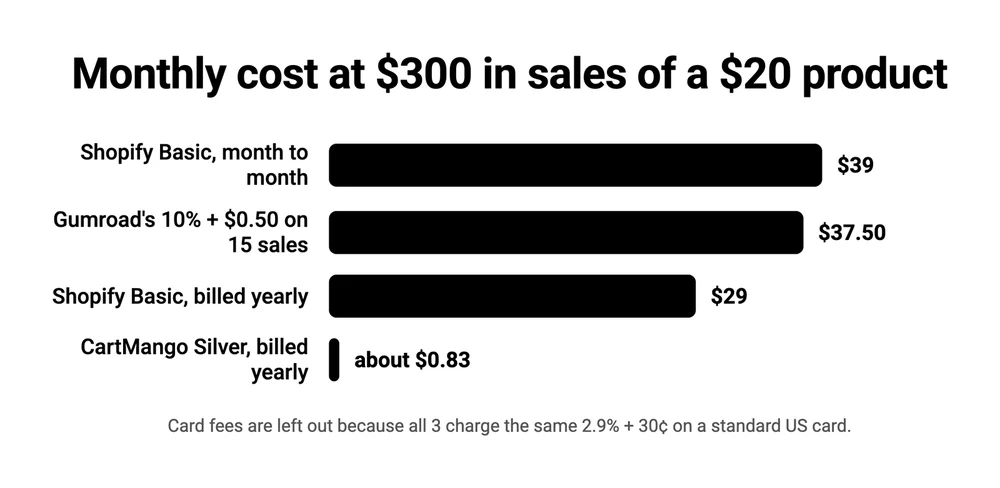
Card fees are left out because all 3 charge the same 2.9% + 30¢ on a standard US card.
The estimate Google shows is much higher: its AI Overview for this search says Shopify becomes cheaper once revenue passes roughly $400 to $1,000 a month.
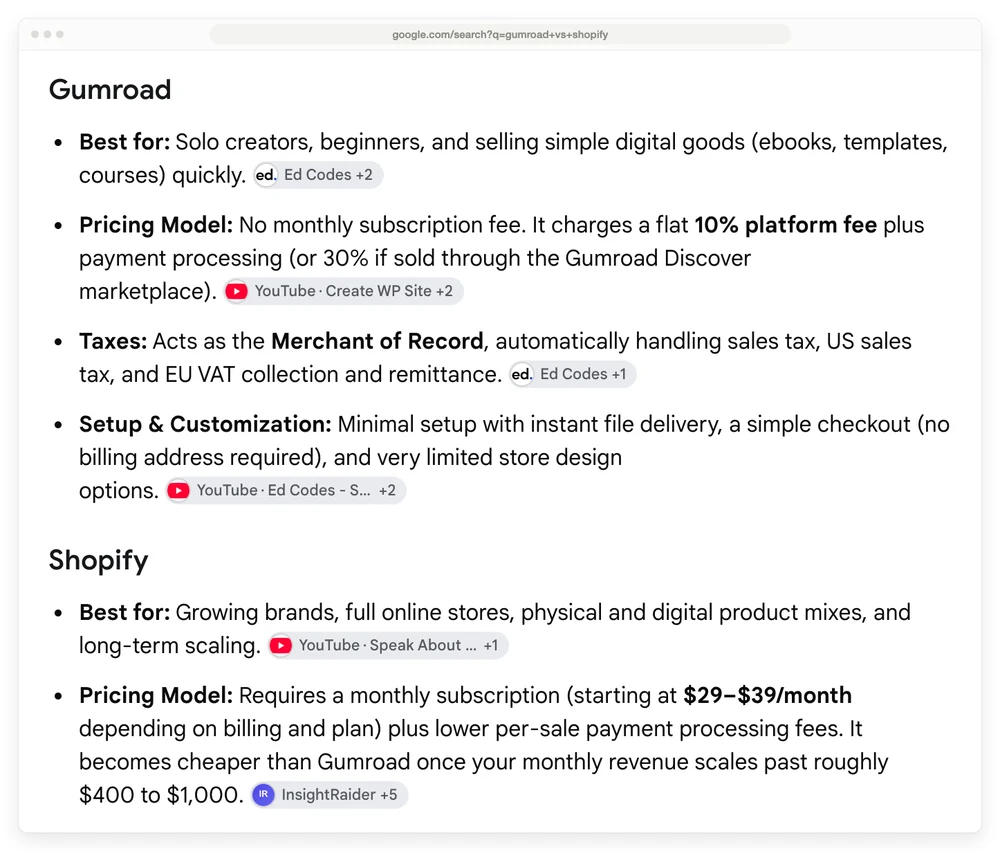
The AI Overview Google shows for this search. Read the last line of the Shopify pricing bullet.
The $400 end matches $39 set against a flat 10%, which gives about $390. The AI Overview shows no working for the $1,000 end. On Shopify’s yearly price with Gumroad’s $0.50 counted, the highest line in the table above is about $276.
A few things push the real line up a little.
- International cards. Shopify adds 1% on them, while Gumroad lists a single 2.9% plus $0.30 rate. If every buyer paid with an international standard card, the $20 line would sit nearer $252 a month.
- Amex and business cards. Shopify charges 3.5% plus 30¢ on these, which raises the line a little more for sellers with many business buyers.
- Another payment provider. Skipping Shopify Payments adds 2% a sale on Basic.
Digital delivery adds no cost. Shopify’s own Digital Products app is free, rated 4.8 from 1,460 reviews, and sets download limits and emails access links after purchase.
At $1,000 a month in sales of a $20 product, Gumroad’s cut is $125 and Shopify Basic is $29, so Shopify saves about $96 a month before you count the tax filing from the section above. If $96 a month buys less than the hours your sales tax and VAT returns take, staying on Gumroad is a fair call at that level.
The $10 Silver plan on CartMango breaks even with Gumroad’s direct cut at the 4th $20 sale of the year. Like Shopify, it leaves the tax filing to you.
If you want 0% taken from each download without running a store
CartMango, the checkout I run, fits a seller who wants 0% taken from each download and no store to manage. That is someone selling a few digital products to buyers they already reach through email, YouTube or social media.
CartMango takes 0% of each sale on every plan, so you pay only Stripe’s or PayPal’s card fee. Mini Pages hosts a simple sales page with the checkout behind its button, so you need no website, much like a Gumroad product page. Order bumps come on every plan, so a buyer can add a second product before paying.
What it costs: free right now. Once paid plans start in November, Silver is $10 a year for 10 products with order bumps. Gold is $20 a year and adds upsells, downsells and cart abandonment. Platinum is $30 a year and adds affiliates.
Like Shopify, CartMango is not a merchant of record, so sales tax and VAT are yours to file. It has no marketplace either, so every buyer is one you bring.
It is built for digital products, not shipped ones. And a checkout embedded on your own website is planned, not live yet.
Gumroad still beats it for the seller in the first 2 situations above. Shopify beats it on themes, apps and physical stock.
If T-shirts, prints or other stock are on your roadmap
Shopify Basic is the pick if you plan to ship T-shirts, prints or other stock alongside your downloads. It is built around stock: inventory across up to 10 locations, shipping labels you buy and print inside Shopify, and shipping discounts of up to 87%. Digital files go out through the free Digital Products app, which can attach a file to a physical variant, so a print can come with a downloadable version. It is also a full website, with themes, your own domain name and connections to thousands of apps, which matters if search traffic or a brand site is part of the plan.
Gumroad does accept physical products, and its tax help page covers how it handles parcels shipped into the EU. It is still built for files first. CartMango is built for digital products, so it is the wrong pick here.
The cost is the same $29 a month billed yearly plus card fees, and the same catch: sales tax filing is yours. Our ThriveCart vs Shopify comparison shows how a checkout tool and Shopify split the same jobs.
Which one fits, by situation
Gumroad fits 2 of these 5 situations, Shopify Basic fits 2 and CartMango fits 1, and every pick carries a catch.
| Your situation | Pick | What it costs | The catch |
|---|---|---|---|
| Nobody knows you yet | Gumroad | 10% + $0.50 a direct sale plus card fees, 30% on Discover | Discover opens after $100 in sales and a review |
| You never want to file tax | Gumroad | 10% + $0.50 a direct sale plus card fees | $100 payout minimum and a 7-day hold |
| Gumroad’s cut tops $29 a month | Shopify Basic | $29 a month billed yearly plus card fees | Tax filing moves to you |
| Downloads only, 0% cut | CartMango | Free right now, from $10 a year, plus card fees | Tax filing and traffic are yours |
| Physical stock coming | Shopify Basic | $29 a month billed yearly plus card fees | Downloads need the free Digital Products app |
FAQ
How much does Shopify take from a $100 sale?
On the Basic plan with Shopify Payments, Shopify takes $3.20 from a $100 sale on a standard US card (2.9% plus 30¢). It takes $3.80 on an American Express or business card and $4.20 on an international card. The $29 monthly plan, billed yearly, comes on top, and using a provider other than Shopify Payments adds 2%, or $2 on that sale.
Is Gumroad better than Shopify?
Gumroad is the better start for a new seller of digital files with no audience and no wish to file tax returns. Once Gumroad’s 10% plus $0.50 per sale passes $29 a month, which happens at about $232 a month in sales on a $20 product, Shopify Basic costs less, as long as you take on the sales tax filing.
Do people actually make money on Gumroad?
Gumroad sellers do earn: the counter on Gumroad’s homepage showed about $2 million earned by its sellers in a single week. That is a total across every seller, not a typical income. A new seller’s first $100 still has to come from buyers they bring, since Discover only lists products after that point.
Who competes with Shopify for selling digital products?
Checkout tools built for downloads compete with Shopify for digital-only sellers. Before card fees, Gumroad charges 10% plus $0.50 a sale, Payhip’s free plan takes 5% a sale, and CartMango takes 0% for $10 to $30 a year once paid plans start in November. Our Gumroad alternatives guide compares more options.
Does Shopify need a paid app to sell digital downloads?
Shopify does not need a paid app for downloads. Its own Digital Products app is free and rated 4.8 from 1,460 reviews. It attaches files or links to products, sets download limits and emails access links after purchase. Gumroad builds delivery in, along with license keys, which matter mostly to software sellers.
Can I move my Gumroad subscribers to Shopify?
Gumroad subscribers’ billing does not move with you, so members have to sign up again on the new checkout. On Shopify that means installing its free Subscriptions app first. You can take the customer data, since Gumroad’s payout reports include it as a downloadable CSV, and email your members the new link.
A cut per sale or a plan per month
On the cost side, the Gumroad and Shopify picks above come back to 1 trade: a cut that grows with your sales, or a monthly plan that does not.
CartMango sits outside that Gumroad vs Shopify trade for digital products. It hosts the sales page and the checkout, keeps 0% of each sale, and costs nothing right now, then from $10 a year once paid plans start in November, so you pay the card fee and a yearly plan, nothing per sale.
About the Author

👋 I’m Welly, founder of CartMango (the site you’re on), a checkout platform for digital product sellers. We’ve previously processed $179M+. I also run BirdSend (email marketing tool, 3.1B+ emails sent). On the side I show other non-techie digital sellers how I use AI workflows to automate 50%+ of my operations. Find me on LinkedIn.
Related Reading
- Gumroad pricing, line by line: why the 10% plus $0.50 is not the whole bill
- Gumroad vs Stripe: what Gumroad’s cut buys over a plain payment processor
- ThriveCart vs Shopify: a checkout against a full store, job by job
- Gumroad vs Etsy: 2 marketplaces, 2 different rules on emailing your buyers
- Best Gumroad alternatives: 7 options with lower fees or more control