

ThriveCart vs Shopify puts a checkout against a whole store. Shopify is the stronger pick for physical stock, with inventory and shipping from $29 a month billed yearly. ThriveCart is the stronger pick for files, courses and coaching, with an order bump and 1-click upsells from $37 a month billed yearly.
That ThriveCart price is its $444 a year Standard plan, $47 month to month, or $495 once for a lifetime license. Neither takes a platform cut on a basic sale on Stripe Connect+ or Shopify Payments. CartMango covers the digital checkout side too: free right now, from $10 a year once paid plans start in November, 0% a sale plus Stripe’s card fee.
If you sell digital products, maybe with the odd physical one, you are choosing between paying for a checkout and paying for a whole store, and the yearly bills sit about $100 apart before any apps.
Much of what ranks for this search describes how ThriveCart used to sell, before it put subscription plans at the front of its pricing page.
So below, I redo the cost math with today’s prices and compare both tools on the 6 jobs a solo seller needs done: taking the money, adding to the order, delivering, billing again, bringing buyers in and collecting sales tax.
Key Takeaways
- ThriveCart now leads with subscriptions. Standard costs $47 a month or $444 a year after a 30-day trial, and $495 once still buys a lifetime license.
- Shopify Basic costs $39 a month, or $29 billed yearly. That buys a whole store, with stock tracked across up to 10 inventory locations.
- Neither takes a cut of a basic sale on Stripe Connect+ or Shopify Payments. ThriveCart’s tax collection costs 0.5% per taxed sale, while Shopify’s is free until $100,000.
- An order bump inside Shopify’s checkout needs Shopify Plus. Basic stores add upsells after payment through apps, from free plans to $34.99 a month.
- CartMango is free right now, then $10 to $30 a year from November. CartMango puts order bumps on every plan and upsells on its $20 a year plan.
ThriveCart vs Shopify pricing, side by side
ThriveCart vs Shopify pricing, billed yearly, works out to $37 a month for ThriveCart Standard and $29 a month for Shopify Basic. Billed monthly, it is $47 against $39.
Before you pay $444 or $348 a year for either one, it helps to know where solo sellers lose money first. The Online Selling Mistakes Challenge walks through 5 common selling mistakes by email, free.
ThriveCart pricing now runs on 2 self-serve subscription plans, with a lifetime license on the side and a custom Enterprise tier above. Standard is $47 a month or $444 a year. Pro+ is $87 a month or $804 a year, and adds multiple order bumps, an affiliate center and dunning (the emails that chase failed card payments). The lifetime license is $495 once, and a separate Pro+ checkout still charges $790 up front plus $295 a year. Both plans start with a 30-day free trial.
Shopify pricing runs from Basic at $39 a month or $29 a month billed yearly, to Grow at $105 or $89, and Advanced at $399 or $359. Shopify prints no yearly total, so the $348 below is 12 months of $29. Its trial is 3 days free, then $1 a month for 3 months.
Paid yearly, ThriveCart Standard costs $444 and Shopify Basic $348, while CartMango’s 3 plans run $10 to $30 a year once paid plans start in November.
| Plan | Paid yearly | Per month, yearly | Month to month | Bump + upsell | Cut per sale |
|---|---|---|---|---|---|
| ThriveCart Standard | $444 | $37 | $47 | 1 bump + upsells | 0%, plus add-on fees |
| ThriveCart Pro+ | $804 | $67 | $87 | Several bumps + upsells | 0%, plus add-on fees |
| ThriveCart lifetime | $495 once | n/a | n/a | 1 bump + upsells | 0%, plus add-on fees |
| Shopify Basic | $348 (12 x $29) | $29 | $39 | Upsell via app, bump needs Plus | 0% on Shopify Payments, 2% on other processors |
| CartMango | Free now, then $10 to $30 | about $0.83 to $2.50 | Yearly only | Bump from $10, upsell from $20 | 0% |
CartMango is the checkout I run, so weigh its row knowing who wrote it. It is built for digital products, coaching and consulting, and its plans cap what you can sell: 10 products and 2 GB of files on the $10 plan, 25 products and 10 GB on the $20 plan, unlimited on the $30 plan. ThriveCart Standard allows unlimited products.
The ThriveCart side of the page-1 comparisons I could read is out of date. Google’s summary for this search lists ThriveCart as a one-time fee of around $495 with no monthly fees. The 5 page-1 articles I could read in full also describe ThriveCart as a one-time purchase, at $495 or, on 1 older page, $690, and none of them prints the $47 or $444 price.
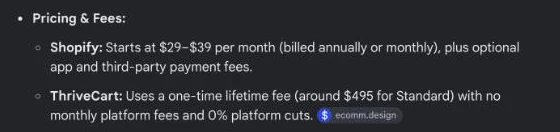
The AI Overview Google shows for this search. Read the ThriveCart line: it describes the lifetime license as the only way to pay.
2 of those articles also say ThriveCart has no free trial. Its pricing page offers 30 days.
What each costs over 3 years
Over 3 years of plan fees, the $495 lifetime license costs less than ThriveCart Standard ($1,332) or Shopify Basic ($1,044), and CartMango’s $20 Gold plan costs $60.
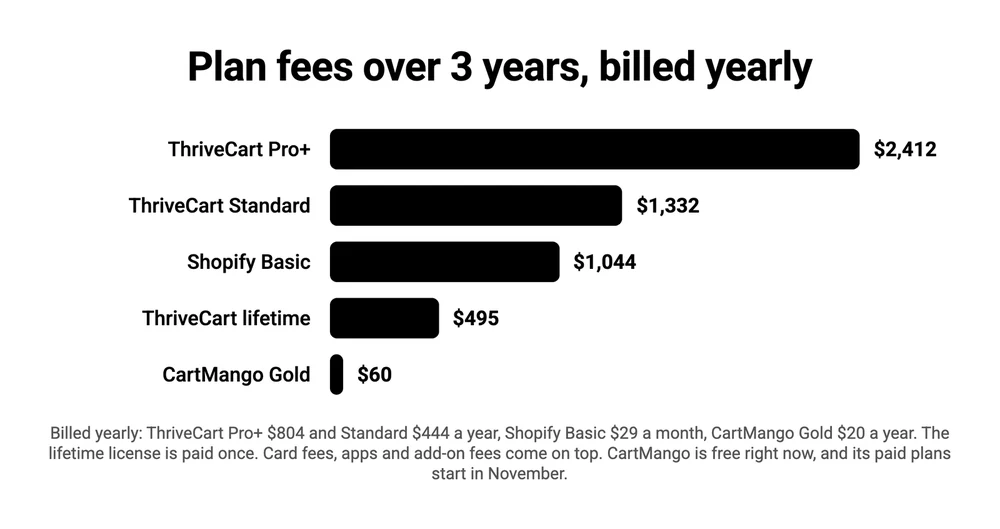
Plan fees only, before card fees, apps and add-on fees.
The lifetime license costs what about 13 and a half months of Standard does, so it pays off if you keep ThriveCart past that point. Lifetime accounts pay higher add-on fees, though: 0.25% on subscription bumps, 8% of the first payment a retention offer saves, and 0.25% on prices shown in the buyer’s own currency, against 0.10%, 5% and 0.10% on the Standard subscription.
If you want ThriveCart for courses, check the lifetime license first. ThriveCart’s pricing section says “Each ThriveCart subscription license gives access to a ThriveCart Academy plan”, so ask what the $495 license includes before you pay it.
Taking the money: what each keeps from a $100 sale
On a $100 US card sale, ThriveCart on Stripe Connect+, Shopify on Shopify Payments and CartMango on Stripe each leave you about $96.80 before plan fees. None of the 3 takes a platform cut on that sale, and each passes on a 2.9% plus 30 cent card fee, so the differences sit in the extras.
ThriveCart’s fee page says “0% to ThriveCart” and that you pay processor fees only, then lists a second set of charges further down. Tax collection costs 0.5% per eligible sale on Standard and 0.35% on Pro+.
On the Standard subscription, a subscription bump costs 0.10%, prices shown in the buyer’s own currency (Advanced Adaptive Pricing) cost 0.10%, and a retention offer takes 5% of the first payment it saves. The same page lists 0.5% extra for accounts not on Stripe Connect+, which our ThriveCart vs Stripe breakdown explains.
Shopify charges 2.9% plus 30 cents on a standard US card through Shopify Payments on Basic, 3.5% plus 30 cents on premium cards, and 1% more on international cards. Use a processor other than Shopify Payments and Shopify adds its own fee on top of that processor’s: 2% on Basic, 1% on Grow, 0.6% on Advanced. On a $100 sale through an outside processor on Basic, that is $2 to Shopify.
CartMango takes 0% a sale, and the money lands straight in your own Stripe or PayPal account, at Stripe’s standard rate of 2.9% plus 30 cents or at PayPal’s own rate.
1 thing ThriveCart does that CartMango does not do yet: its checkout can be embedded right on your own web page. CartMango’s checkout opens on its own page today, and embedding is on its list of planned features.
Adding to the order: order bumps and 1-click upsells
ThriveCart includes 1 order bump plus 1-click upsells and downsells on its $444 a year Standard plan, while Shopify keeps the in-checkout order bump for Shopify Plus stores.
An order bump is the small “add this too” box on the checkout page. A 1-click upsell is the offer shown after payment, bought without retyping the card. ThriveCart Standard also brings A/B split testing and abandoned cart recovery, and Pro+ lifts the limit to multiple bumps. If you sell physical items too, note that ThriveCart’s help center says multiple bumps work only for digital bump products.
Shopify draws its line in its own help center. Its checkout apps table lists apps for the information, shipping and payment pages as Shopify Plus only, and Plus starts at $2,300 a month. Basic stores can run apps on the cart, the thank-you page and a page shown after payment.
A reply on the Shopify Community forum put it in 1 line: “Straight answer: without Plus, no app can put an offer inside the checkout itself.” It came in a store owner’s thread, from someone looking for a checkout upsell that works without Plus.
So the Basic route is an after-payment upsell app, and the price depends on the app. Upsell.com, formerly ReConvert, has a free plan for up to 50 orders or $50 of upsell revenue, and holds 4.8 stars from 3,136 reviews. AfterSell’s Post-Purchase plan costs $34.99 a month, billed every 30 days with no yearly option. With Basic billed yearly, that puts the upsell route at $29 to $63.99 a month, still with no bump on the checkout page itself.
CartMango puts order bumps on every plan and upsells on its $20 a year plan, about $1.67 a month for both.
Delivering the product: files, boxes or both
Shopify ships physical stock natively and delivers files through its own free Digital Products app. ThriveCart delivers files and can charge shipping on physical items. CartMango delivers digital products and services only.
Shopify’s Digital Products app is made by Shopify, costs nothing and holds 4.8 stars from 1,454 reviews. It attaches files or links to products, sets download limits, and can attach a file to a physical product. A Canadian shop selling DIY kits wrote in October 2026: “It’s perfect for our DIY kits, since we can attach a digital download of the instructions that fulfills when we send the customer the physical kit”. Stock is where Shopify is strongest, since Basic tracks inventory across up to 10 locations.
ThriveCart can sell physical products too. Its help center describes shipping options you set by location, with weight and size passed to Shippo or ShipStation for live rates, and fulfilment integrations such as Printful, Lulu and Kunaki. A buyer in a country with no shipping rate set cannot finish checkout, so test each country before you launch.
For courses, ThriveCart’s subscription plans include ThriveCart Academy, which hosts courses and communities, with member caps by plan that our ThriveCart for courses guide spells out. CartMango’s course hosting and community tools are not live yet, so a course seller who wants the course and the checkout on 1 bill has a real reason to pick ThriveCart today.
Billing the same buyer again
ThriveCart and CartMango both take subscriptions on every plan, while Shopify adds them through its free Shopify Subscriptions app.
ThriveCart Standard covers subscriptions, free trials, payment plans and buy now, pay later. Pro+ adds dunning and 1-click upgrades and downgrades for subscribers. Retention offers, the discount shown to someone about to cancel, cost 5% of the first saved payment on Standard and nothing on Pro+.
Shopify Subscriptions is made by Shopify and costs nothing to install. Its App Store rating is 3.8 stars from 897 reviews, with 19% of ratings at 1 star, well below the 4.8 on Shopify’s own Digital Products app.
CartMango includes one-time and subscription selling on all 3 plans. If you ever leave CartMango, the subscriptions you created keep billing into your own Stripe or PayPal account.
Bringing buyers in: storefront, search and affiliates
Shopify is the stronger tool for getting found. Every product gets its own page inside a store people can browse, with free themes and a blog built in, so a buyer who lands on 1 product can click around and fill a cart with 3 more. If you plan to rely on search traffic or a big catalog, Shopify is the pick.
ThriveCart sells from checkout pages, 1 offer at a time, plus the ThrivePages builder that now comes with Standard. CartMango does the same with Mini Pages, its simple sales pages. With either one, the buyers come from wherever you send them: your email list, your website, your social posts.
Affiliates are the other way to bring buyers in. ThriveCart’s affiliate center, with automatic payouts, sits on Pro+ at $804 a year. CartMango’s affiliate system sits on its $30 a year plan and covers up to 250 affiliates. Shopify sellers add an affiliate program through an app from the Shopify App Store.
Sales tax: 0.5% from the first sale, or free to $100,000
ThriveCart charges 0.5% of each taxed sale on Standard, or 0.35% on Pro+, to calculate and collect sales tax for you. Shopify Tax is free until a store passes $100,000 in sales, then charges 0.35% per taxed order on Basic, Grow and Advanced, capped at $0.99 an order.
The Shopify Tax pricing page splits stores by age. For stores created before May 13, 2026, the $100,000 resets each calendar year. For newer stores it is a lifetime total, and the fee applies only to orders from places where you switched tax collection on.
Run it on $40,000 a year of sales where tax is collected. ThriveCart Standard charges $200 a year for the tax work and Pro+ charges $140. A Shopify store created before May 13, 2026 pays nothing, because it stays under the yearly $100,000. A newer store pays nothing for its first 2 and a half years, then 0.35% per taxed order.
At volume the gap narrows. On $300,000 of taxed sales a year, ThriveCart Standard charges $1,500 and Pro+ $1,050. An older Shopify store pays 0.35% only on the $200,000 above its free $100,000, so $700 at most, and less once the $0.99 cap kicks in on orders above about $283.
None of the 5 page-1 articles I read mentions ThriveCart’s 0.5% tax fee. ThriveCart’s 0.5% and Shopify’s 0.35% both pay for calculating and collecting tax at checkout, and Shopify’s own tax page says filing and paying it is still your job. ThriveCart’s fee page lists the tax rate for Standard and Pro+ only, so ask which applies to a lifetime license. Our ThriveCart vs Leadpages comparison lists ThriveCart’s other add-on fees next to Leadpages’ plans.
CartMango’s plan table lists no tax tool. Sales go through your own Stripe or PayPal account, and the tax side stays with you.
All 6 jobs in 1 grid
ThriveCart and CartMango put bumps, upsells and subscriptions inside the plan, Shopify wins on storefront, search and shipping, and sales tax is the row where ThriveCart charges from the first taxed sale.
| Job | ThriveCart | Shopify | CartMango |
|---|---|---|---|
| Bump + upsell | 1 bump + upsells on Standard | Upsell app on Basic, bump needs Plus | Bump from $10, upsell from $20 a year |
| Digital files | Built in | Free Digital Products app | Built in, protected links |
| Physical shipping | Shipping rates, Shippo or ShipStation | Full store with stock tracking | Not offered |
| Subscriptions | Built in, dunning on Pro+ | Free Shopify Subscriptions app | Every plan |
| Storefront + search | Checkout pages and ThrivePages | Full store, themes, blog | Mini Pages sales pages |
| Affiliates | Pro+, $804 a year | App from the App Store | $30 a year plan, 250 affiliates |
| Sales tax tool | 0.5% Standard, 0.35% Pro+ | Free to $100,000, then 0.35% | Not on its plan table |
If the Shopify column is the one you keep nodding at, you probably ship things. If it is the other 2 columns, your business lives at the checkout, where ThriveCart costs $444 a year and CartMango $10 to $30 once paid plans start.
FAQ
How much does Shopify take from a $100 sale?
On Shopify Basic with Shopify Payments, a $100 sale on a standard US card costs $3.20, which is 2.9% plus 30 cents. Shopify adds no transaction fee on top when you use Shopify Payments. Through a different processor, Shopify adds 2% on Basic, which is $2 on that sale, before the processor’s own fee. The plan itself costs $39 a month, or $29 billed yearly.
Does ThriveCart take a percentage of sales?
ThriveCart takes 0% of a basic sale on a Stripe Connect+ connection, so you pay only the card processor. Its fee page lists add-ons that do take a percentage: 0.5% for tax collection on Standard (0.35% on Pro+), 0.10% on subscription bumps and on local-currency pricing on the Standard subscription, and 5% of the first payment a retention offer saves.
Is ThriveCart good?
ThriveCart is a strong pick for a seller who wants order bumps, 1-click upsells, subscriptions and course hosting in 1 checkout, without stacking apps. ThriveCart says 75,000+ businesses use it. It is a weaker fit if you need a browsable store or real stock counts, or if $444 a year is a lot for where your sales are today.
Is the ThriveCart lifetime deal still available?
Yes. The Standard lifetime license costs $495 once, linked from 1 line under ThriveCart’s subscription plans, and a separate Pro+ checkout charges $790 up front plus $295 a year. $495 equals about 13 and a half months of the $444 yearly plan. Our ThriveCart coupon code guide tests the discount codes that float around for it.
Can you use ThriveCart and Shopify together?
Yes, with Shopify as the store and ThriveCart as the checkout for digital offers, at $792 a year for Standard plus Basic before any apps. ThriveCart’s help center points to automation tools such as viaSocket for connecting outside apps. A 2020 Shopify Community thread asking how to link the 2 got its only reply 13 months later: “I wish someone had answered this question.”
Can ThriveCart sell physical products?
Yes. ThriveCart’s help center describes physical products as main offers, bumps and upsells, with shipping rates by location and live rates through Shippo or ShipStation. Multiple bumps work only with digital bump products. For a large catalog with stock spread across warehouses, Shopify is built for that job.
If what you sell never needs a shipping label
If every product you sell is a file, a coaching call or a consult, you would pay for Shopify’s store and stock tools and never use them, so the ThriveCart vs Shopify choice tilts to ThriveCart. Its $444 a year covers unlimited products, an order bump, upsells and subscriptions, and it is the better pick today if you also want to host courses. For a seller like that, I would put the money into the checkout every time, because the bump and the upsell are where the extra money per order comes from.
CartMango is the checkout I run, for the seller who sells files and calls and does not need course hosting yet. Order bumps come on every plan, upsells start at $20 a year, and CartMango takes 0% of each sale. It is free right now, and paid plans start at $10 a year in November.
About the Author

👋 I’m Welly, founder of CartMango (the site you’re on), a checkout platform for digital product sellers. We’ve previously processed $179M+. I also run BirdSend (email marketing tool, 3.1B+ emails sent). On the side I show other non-techie digital sellers how I use AI workflows to automate 50%+ of my operations. Find me on LinkedIn.
Related Reading
- ThriveCart vs Stripe: if ThriveCart vs Shopify leaves you on the ThriveCart side, what its $444 a year adds on top of Stripe
- ThriveCart for courses: what ThriveCart Academy includes on each plan
- ThriveCart vs PayKickstart: a flat plan price against a bill that grows with revenue
- ThriveCart coupon code: 11 coupon-site codes tested, and the 3 ways to pay that do work