
Gumroad vs Amazon KDP comes down to who brings the reader. KDP is stronger for reaching strangers and printing paperbacks, Gumroad for selling to readers you already have: per copy of a $9.99 ebook sold to a US buyer, Gumroad leaves $7.90 and KDP’s 70% royalty $6.89 on a 1 MB file.
Gumroad takes 10% plus $0.50 a sale plus the card fee, or 30% when its marketplace finds the buyer. KDP Select makes the ebook Amazon-only for 90 days at a time. CartMango (0% a sale plus Stripe’s card fee, free right now, from $10 a year once paid plans start in November) suits sellers with their own audience and leaves $9.40.
You have a finished ebook and 2 tabs open. One is the KDP dashboard, which lists your book where Amazon’s shoppers already search. The other is Gumroad, which hands you a link to share and the buyer’s email when someone pays.
Tick KDP Select at upload and the ebook can sell only through Amazon for 90 days at a time, renewing by itself. Selling the same file on Gumroad then breaks the rules.
So this post splits the choice into the jobs a book platform has to do. You get who does each job, what 1 copy pays at 5 different prices, and how to sell in both places without tripping that checkbox.
Key Takeaways
- Amazon lists you where readers search from day 1. Gumroad’s marketplace lists you only after $100 in sales and a risk review of about 3 weeks.
- Gumroad pays more per copy above about $4.06. For a 1 MB file, a $9.99 ebook leaves $7.90 there and $6.89 on KDP.
- Both take about 30% when they find the buyer. Gumroad’s marketplace keeps 30%, the same share as Amazon’s 70% royalty band before delivery costs.
- KDP’s 70% band now reaches $12.99. It rose from $9.99 on July 7, 2026, so a 1 MB $12.99 ebook earns $8.99, not $4.55.
- KDP Select locks the ebook to Amazon. Each term lasts 90 days and renews by itself, and the paperback stays free to sell anywhere.
- Of these 3, only Gumroad and CartMango give you buyers’ emails. KDP reports show sales and royalties, never the names of the people who bought.
Finding readers: Amazon lists you on day 1, Gumroad after $100
Amazon KDP lists a new ebook where shoppers already search from the day it goes live. Gumroad’s marketplace, called Discover, lists nothing of yours until you have made $100 in sales on your own.
If you are launching to an audience of zero, the Online Selling Mistakes Challenge, a 5-day email challenge, walks through the selling mistakes that quietly stall a first product.
Gumroad’s help page on Discover sets 3 account conditions. Your payout settings must be filled in. You need a balance of at least $100 from genuine sales, which rules out self-purchases and asking a housemate to buy. And you must pass a risk review, which it says takes about 3 weeks on average after you cross $100. That means every one of your first $100 in sales comes from you, through a newsletter, a social account, a podcast or a group you post in. After that, each product needs at least 1 sale, a category and ratings turned on before it shows in Discover.
Amazon also gives authors a second way to earn from its readers. Ebooks enrolled in KDP Select join Kindle+, Amazon’s reading subscription, and authors are paid a share of a monthly fund for the pages subscribers read. A banner across Amazon’s KDP help pages put total KDP Select author earnings at $71.1 million for October 2026.
CartMango, the checkout I run, has no marketplace at all, not even a Discover-style one. CartMango’s Mini Pages hosts your sales page, the button goes to your checkout, and every visitor is one you sent.
A few years ago an author and coach I was writing emails for found her book pirated almost word for word, her name still sitting in the description. She alerted Amazon and had it taken down. A few months later it came back, run through a content spinner this time, and the pirate still had not deleted her name.
A book listed where readers search can be copied and listed there too. It is another reason to keep a list of readers who know where the real book lives, covered in the section on knowing who bought.
What 1 copy pays you, and when the money lands
On a $9.99 ebook, Amazon KDP’s 70% royalty pays $6.89, Gumroad pays $7.90 on a buyer you send, and Gumroad pays $6.99 on a buyer its marketplace finds. Each platform takes its cut a different way, which is why the winner between KDP and Gumroad changes with the price, and each pays you on its own schedule.
Amazon’s 70% royalty band pays 70% of what is left after a delivery cost of $0.15 per megabyte comes off the list price, and it only applies to list prices from $2.99 to $12.99 on Amazon.com. Outside that band you get 35%, with nothing deducted. The full set of rates, including the file size where 35% starts paying more, is in our guide to KDP royalties.
Gumroad’s fee page lists 10% plus $0.50 on every sale through your own profile or links, and it says plainly that card processing (2.9% plus $0.30) is not included. Discover sales cost a flat 30%, processing included. Stack the direct fees and the real cut comes to about 12.9% plus $0.80 a sale. Big sellers get a break: once your paid sales in a calendar month reach $20,000, new direct sales that month cost 5% plus $0.50, and the count resets on the 1st.
For 1 copy of a 1 MB file sold to a US buyer before sales tax, with CartMango on a Stripe account, KDP leaves the least of the 4 routes at every price from $4.99 up, and CartMango leaves the most at all 5.
| Route | $2.99 | $4.99 | $9.99 | $12.99 | $14.99 |
|---|---|---|---|---|---|
| Amazon KDP | $1.99 | $3.39 | $6.89 | $8.99 | $5.25 (35%) |
| Gumroad direct | $1.80 | $3.55 | $7.90 | $10.51 | $12.26 |
| Gumroad Discover | $2.09 | $3.49 | $6.99 | $9.09 | $10.49 |
| CartMango | $2.60 | $4.55 | $9.40 | $12.31 | $14.26 |
The CartMango row takes 0% of the sale and leaves only Stripe’s standard 2.9% plus $0.30. It leaves out the plan, which runs $10 to $30 a year once paid plans start. At $9.40 against Gumroad’s $7.90 a copy, the $10 plan pays for itself by the 7th sale of the year.
The $9.99 limit you will still see quoted
Amazon moved the top of its 70% band from $9.99 to $12.99 on July 7, 2026, and its eBook List Price Requirements page says the old ceiling had stood since 2007. Not every comparison for this search has caught up. A Gumroad vs KDP guide from 2022 that ranks on page 1 for this search quotes the $9.99 window, and so does the summary Google shows above the results:
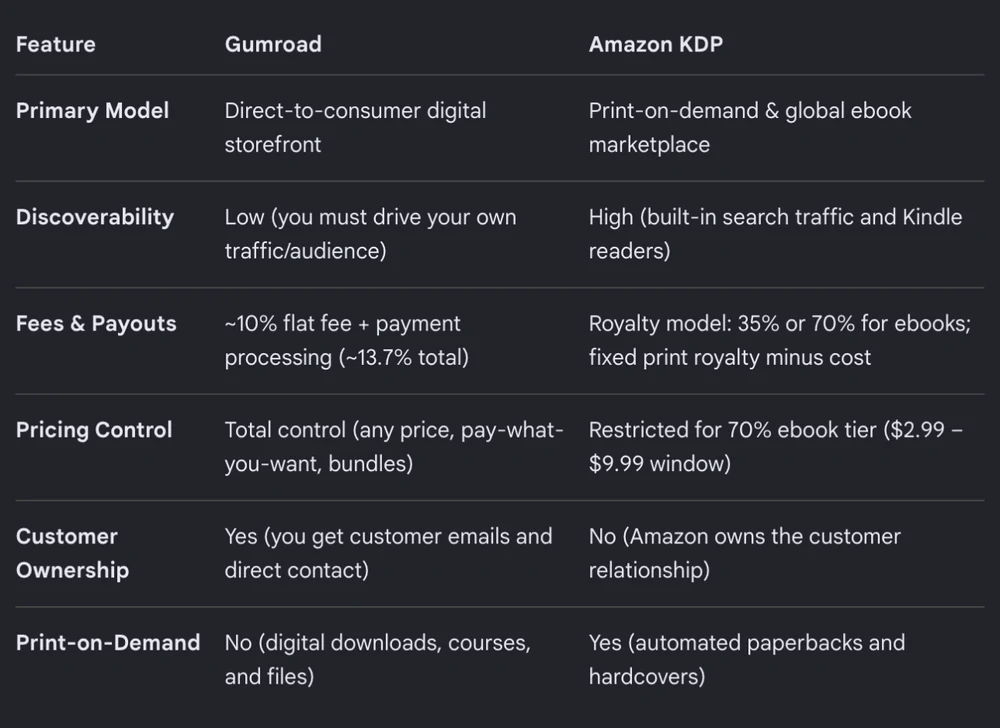
The summary Google shows on this search. Read the Pricing Control row, then the Gumroad fee in the row above it.
A $12.99 ebook used to sit on the 35% option and pay $4.55. On the 70% option with a 1 MB file it now pays $8.99.
The fee row needs a footnote too. “~13.7% total” is what Gumroad takes on a $100 sale, where the fixed $0.80 barely registers. On a $9.99 ebook the same fees come to $2.09, which is 20.9% of the price.
Where Amazon pays more per copy
Between $2.99 and about $4.06 for a 1 MB file, KDP’s 70% option beats a Gumroad direct sale. The fixed $0.50 plus the card’s $0.30 eat a cheap book, so a $2.99 ebook leaves $1.99 on Amazon and $1.80 on Gumroad, with 39.8% of the price gone to fees.
Above $12.99 the gap widens sharply. A $14.99 ebook drops to KDP’s 35% option and pays $5.25, while Gumroad still leaves $12.26.
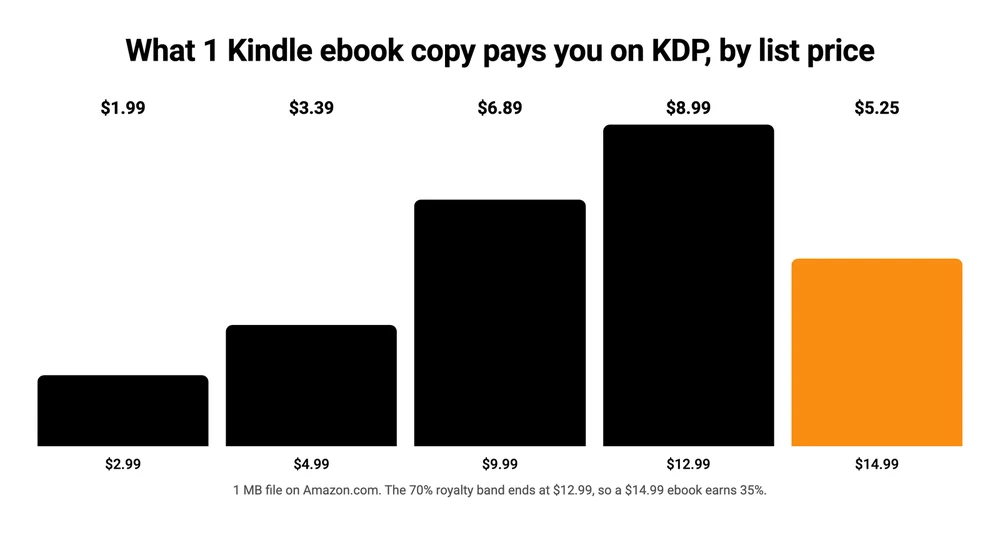
What 1 copy pays on KDP at each price in the table. Look at the last bar: a step past $12.99 and the royalty drops to 35%.
When the money reaches your bank
Amazon pays royalties about 60 days after the end of the month a sale was reported, so a January sale pays at the end of March, and its payment help page says only wire and check payments carry a minimum. Bank deposits have none.
Gumroad pays out on a schedule you pick, weekly, monthly or quarterly, but you need a $100 balance first, and on those schedules each sale sits in your balance for at least 7 days. US sellers can skip both by paying 3% for an instant payout. Its getting-paid page adds that a new account’s first review takes 1 to 3 weeks, usually after 3 to 4 sales and a balance over $100. Sellers’ own complaints about held payouts are collected in our Gumroad review.
CartMango sends the money straight to your own Stripe or PayPal account with no hold of its own, so the timing is whatever that account already runs on.
Tax is the other half of getting paid. Gumroad has been the merchant of record since January 1, 2025, so it collects and pays sales tax and VAT for you. Amazon collects tax as the store and works out your royalty after VAT. On CartMango you stay the seller of record, so the tax filing stays with you.
Printing paperbacks: KDP is the one that does it
Amazon KDP is print on demand: it prints and ships a paperback or hardcover only when a reader orders one. Amazon pays 60% at a list price of $9.99 or above and 50% at $9.98 or below, then subtracts the printing cost. Its own worked example, a 300-page black-ink paperback, earns $1.39 at $9.99 and $0.39 at $9.98.
Gumroad and CartMango do not print books. If a printed copy matters to your readers, that part of the job goes to Amazon.
Print touches the ebook decision in 2 ways. The Kindle edition has to be priced at least 20% below the print edition to keep the 70% rate, so an $11.99 paperback caps a 70% ebook at about $9.59. And KDP Select only locks the ebook. Amazon’s enrollment page says you can keep selling “print, video, or other formats of your title elsewhere,” so the paperback stays free to sell in any store you like. The full print math is in our KDP royalties guide.
Knowing who bought, so you can sell the next book
Gumroad gives you each buyer’s email address and Amazon KDP does not. KDP’s reports show units, royalties and pages read in Kindle+. They never show a name. When your second book comes out, you have no list of first-book buyers to email. Gumroad’s payout reports carry customer data along with the fee breakdown, so a reader who buys once is a reader you can write to.
CartMango also gives you the buyer. CartMango syncs each buyer into the email tool you connect: Kit, ActiveCampaign, Beehiiv and BirdSend natively, or about 3,000 more apps through Make.com. The CartMango sales page is built in Mini Pages, and the blocks worth putting on an ebook landing page are the same whichever checkout sits behind it.
That is the case for listing on Amazon even when you sell direct: list there to get found, and sell direct to the readers who come back. The full path from a finished manuscript to that first direct sale is in our guide to making and selling an ebook.
Selling the same ebook on Gumroad while it is in KDP Select
You cannot sell the same ebook on Gumroad while it is enrolled in KDP Select, because Amazon makes the Kindle edition exclusive to KDP for every 90-day term. Its enrollment page puts it in 1 line: “During the 90-day enrollment period, the Kindle eBook can only be distributed through KDP and public libraries.”
2 details make this easy to break by accident. Every term renews automatically unless you switch renewal off, so a box you ticked at upload keeps the ebook locked indefinitely. And the program’s reading subscription changed its name: Kindle Unlimited became Kindle+ in October 2026, so older guides that warn you about “Kindle Unlimited exclusivity” are describing the same lock.
What Select pays for the lock is a share of that monthly reading fund, plus Kindle Countdown Deals and free book promotions. If your readers mostly read through Kindle+, that share is where the money is. If they already know your name, the lock costs you the copies you could have sold direct.
One answer on Amazon’s own author forum is blunt. In a 2018 KDP Community thread asking whether the same ebook could sit on both, a member marked Top Contributor answered “Just be sure that the Gumroad price is no lower than the Amazon price” and told the author to “be sure not to sign up for Select.” Price matching is the likely reason for the first half. Amazon can sell your ebook below your list price to match another store, and if the matched price falls under $2.99 you drop to 35% on those sales.
That leaves 3 workable routes.
- Stay in Select. The ebook earns from Kindle+ reads and sells only on Amazon. On Gumroad you sell things that are not the Kindle book itself, like a video course or templates built from it.
- Go wide. Leave Select off and sell the ebook on Amazon, Gumroad and any other store, keeping your direct price at or above Amazon’s. The stores worth adding are cut down to 5 in our list of KDP alternatives.
- Split by format. Keep the ebook in Select and sell the paperback, plus an audio or video edition, wherever you want.
Gumroad vs Amazon KDP vs CartMango, job by job
Of the 3, only Amazon KDP lists the book in a marketplace from day 1 and prints it, while Gumroad ($7.90) and CartMango ($9.40) beat KDP’s $6.89 in the pay row below and hand you buyer emails.
| Job | Gumroad | Amazon KDP | CartMango |
|---|---|---|---|
| Marketplace listing | Discover, after $100 in sales and a risk review, at 30% | Amazon search, from day 1 | None, you send every visitor |
| Pays on $9.99 | $7.90 direct, $6.99 via Discover | $6.89 on the 70% option | $9.40, plus $10 to $30 a year |
| Prints books | No | Yes, 60% or 50% minus printing | No |
| Gives buyer emails | Yes | No | Yes, synced to your email tool |
| Same ebook elsewhere | Yes | Only with KDP Select off | Yes |
| Seller of record | Gumroad, which pays the tax | Amazon, as the store | You |
On CartMango, a copy that leaves $6.89 on KDP leaves $9.40, enough to cover the $10 yearly plan by the 4th copy.
Read it by the job you most need done. A first-time author with no audience needs the first row more than any other, which points at KDP. An author with a newsletter of a few thousand readers is paying Amazon 30% on readers they could have sold to directly, which points at a direct store for those readers.
With 1 book, pick 1 of the 3 routes in the KDP Select section before you upload. The same split between a store that finds buyers and one that keeps them runs through Gumroad vs Etsy.
FAQ
Why is Amazon shutting down KDP accounts?
I could not find a count of KDP account closures anywhere in Amazon’s help pages. Its Content Guidelines set out which books it will not sell, and they require you to disclose AI-generated text, images and translations, though AI-assisted work needs no disclosure. Every title you publish there sits inside 1 account you do not control, which is a good reason to keep a way of reaching readers outside it.
Do people actually make money on Gumroad?
Yes. Gumroad’s About page runs a counter of what its sellers earned the previous week, across every kind of product, and it read $2,004,370 when I checked. The catch for an author is the start: with no Discover listing until $100 in sales, a book on Gumroad sells only when you promote it.
Is Amazon KDP still profitable?
It can be, and 2026 improved the math on higher-priced ebooks. The July change to the 70% band means a $12.99 ebook now earns $8.99 instead of $4.55, and KDP Select authors shared $71.1 million in October 2026.
Is Gumroad worth it?
Gumroad is worth it when you already have readers and price above about $4. It costs nothing monthly, handles sales tax as merchant of record, and gives you buyer emails. It is a poor fit for books under about $4, where the fees take roughly a third of the price or more (39.8% of a $2.99 ebook), and for authors counting on a marketplace to find them.
Can I price my ebook above $12.99 on KDP?
Yes. Amazon lets you list a Kindle ebook at up to $200 on Amazon.com, but anything above $12.99 earns the 35% option. A $14.99 ebook pays $5.25 on KDP, so higher-priced books are where selling direct pays the most.
Where your direct readers can buy on CartMango
Gumroad vs Amazon KDP rarely ends with 1 winner. Amazon earns its 30% on the strangers it sends you. The readers who come looking for you afterwards can buy on a checkout that keeps their names, which is the job CartMango does.
On CartMango every buyer syncs into the email tool you connect, so the readers Amazon never shows you start building a list you can sell book 2 to, and CartMango takes 0% a sale on top of the card fee. It is free right now, with paid plans from $10 a year starting in November.
About the Author

👋 I’m Welly, founder of CartMango (the site you’re on), a checkout platform for digital product sellers. We’ve previously processed $179M+. I also run BirdSend (email marketing tool, 3.1B+ emails sent). On the side I show other non-techie digital sellers how I use AI workflows to automate 50%+ of my operations. Find me on LinkedIn.
Related Reading
- KDP royalties: every Amazon rate, the delivery cost per megabyte and when Amazon pays
- KDP alternatives: 21 places to sell an ebook, cut down to the 5 that pay 70%
- Gumroad review: what sellers say about payouts, holds and the $100 minimum
- Gumroad vs Etsy: the same choice as Gumroad vs Amazon KDP, made for digital downloads