
KDP royalties are 70% or 35% on Kindle ebooks, and 60% or 50% on paperbacks and hardcovers sold through Amazon. The 70% ebook rate applies to list prices from $2.99 to $12.99 on Amazon.com, and Amazon subtracts a delivery cost of $0.15 per megabyte before paying it.
Print royalties work differently. Amazon pays 60% at $9.99 or above and 50% at $9.98 or below, then subtracts the printing cost, so a 300-page paperback listed at $9.99 earns $1.39. Kindle Unlimited has no fixed rate at all: you take a share of a monthly fund, which was $71.0 million in July 2026.
On every royalty rate Amazon offers except 1, it subtracts a cost before your share is worked out. Which rate you land on, and what comes off it, is decided by your file size, your page count and the exact cent you price at.
The royalty option is a dropdown you set once at upload, and nothing prompts you to open it again. Amazon changed what sits behind that dropdown in July 2026, and Google’s own summary of the subject still has not caught up.
This guide runs the real numbers on all of it: what the 70% ebook option deducts per megabyte, the file size where 35% starts paying more, what a printed page costs, and how Kindle Unlimited pays when there is no rate to quote.
Key Takeaways
- 2 ebook rates, 1 price band. Amazon pays 70% on Kindle ebooks listed from $2.99 to $12.99 on Amazon.com, and 35% on everything outside that band.
- The $9.99 ceiling ended on July 7, 2026. It had stood since 2007, and Google’s own AI summary of this search still quotes the old number.
- The 70% rate is charged by the megabyte. Amazon deducts $0.15 per MB, so above roughly 33 MB the 35% option pays you more on the same book.
- 1 cent decides your print rate. A paperback at $9.99 earns 60%, the same book at $9.98 earns 50%, and printing costs come out after that.
- Kindle Unlimited has no rate. You take a share of a monthly fund, capped at 3,000 pages per reader per title.
- Money lands about 60 days after the sale month. A January sale pays at the end of March, and Expanded Distribution waits 90 days.
Getting the price band wrong is one of those errors you only find in a royalty report months later. If you want the other 5 that quietly drain a solo seller, the Online Selling Mistakes Challenge sends 1 a day for a week, free.
KDP royalties: 5 rates, and only 1 pays the full percentage
Which rule you land on is decided by format, list price and territory, all of it settled before a reader opens a single page. Only the 35% ebook option hands over its full stated percentage of the list price. Every other rate has a cost taken out first.
A $9.99 ebook pays $6.89 on the 70% option once a 1 MB delivery cost comes off, $3.50 on the 35% option, and the same title as a 300-page paperback at $9.99 pays $1.39 after $4.60 of printing. Every rate below comes from Amazon’s own digital book pricing page and its print equivalent, read at the source.
| Format | Rate | When it applies | Taken off first |
|---|---|---|---|
| Kindle ebook | 70% | List price $2.99 to $12.99 on Amazon.com, in about 40 territories | Delivery cost, $0.15 per MB |
| Kindle ebook | 35% | Any price outside that band, or any other territory | Nothing |
| Paperback | 60% | List price $9.99 or above on Amazon.com | Printing cost |
| Paperback | 50% | List price $9.98 or below | Printing cost |
| Paperback, Expanded Distribution | 40% | Bookstores, libraries and other retailers | Printing cost |
| Hardcover | 60% or 50% | Same $9.99 split. No Expanded Distribution | Printing cost |
| Kindle Unlimited | No fixed rate | Ebook enrolled in KDP Select, Amazon’s 90-day exclusivity program | Not applicable |
Hardcovers follow the paperback split exactly, at the same $9.99 line on Amazon.com.
The difference is Expanded Distribution, the 40% channel that pushes your book out to other retailers. Amazon does not offer it on hardcovers at all.
Outside the US the thresholds move. Amazon’s print split sits at 7.99 pounds on Amazon.co.uk, 13.99 dollars on Amazon.ca and Amazon.com.au, and 1000 yen on Amazon.co.jp.
The $9.99 ebook ceiling ended in July 2026
$9.99 was the ceiling on Amazon’s 70% option for 19 years. Price a Kindle ebook above it and you dropped to 35%. On July 7, 2026 Amazon moved that ceiling to $12.99.
Amazon’s own page states it plainly:
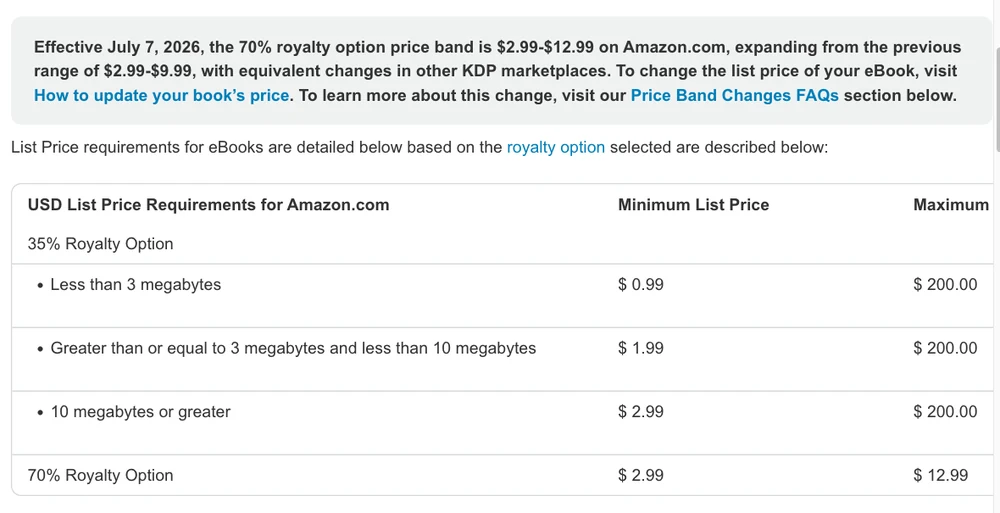
Amazon’s eBook List Price Requirements page. Read the highlighted line, then the last row of the table.
Amazon’s FAQ on the same page says the reason for the delay outright: that maximum “has been in place since 2007.”
The change is worth real money on a higher-priced book. A $12.99 ebook used to be stuck on the 35% option, paying $4.55, and on the 70% option with a 1 MB file it now pays $8.99.
That is $4.44 a sale, on the same file, at the same price, for doing nothing except republishing after a date.
The more common case is a book already sitting at $9.99 because that was the ceiling. Repriced to $12.99 it goes from $6.89 a sale to $8.99, which is $2.10 more per copy for a 1 MB file.
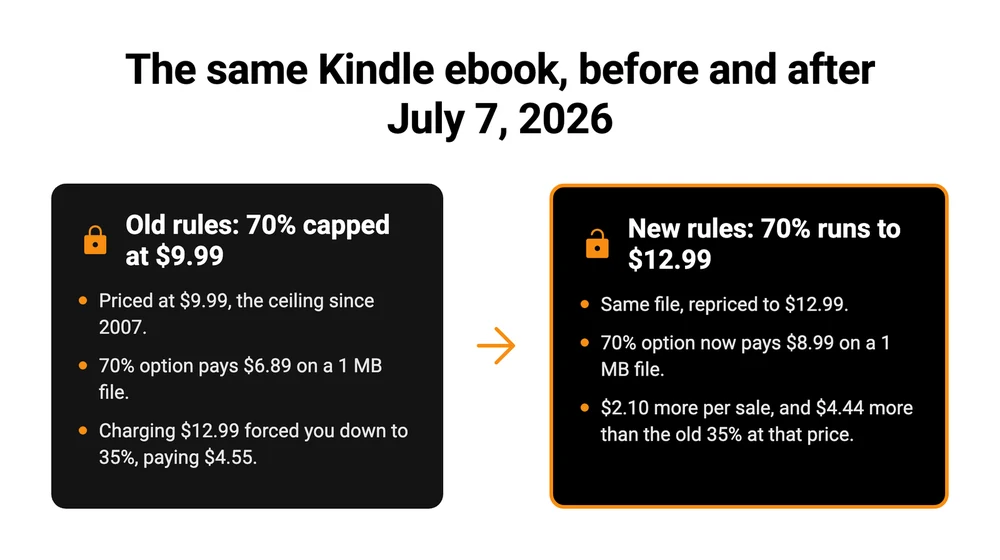
What the wider band is worth on 1 book. The reader pays $3 more, you keep $2.10 of it.
The authors who noticed spotted the same use for it straight away. In the r/selfpublish thread announcing it, a writer with 30 published novels called it a long-needed change and predicted the main use would be box sets and omnibus editions. A commenter underneath had been sitting on exactly that: a trilogy waiting to be bundled, held back because the old ceiling was too low for 3 books.
Google itself has not caught up. Its AI Overview for this search still describes the 70% band as $2.99 to $9.99:
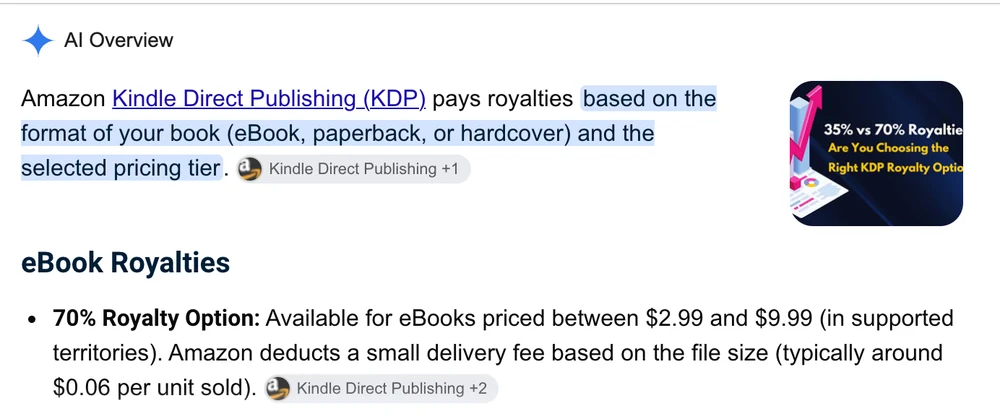
The AI summary Google shows on this search. Read the price range in the first bullet, and the delivery-fee figure beside it.
Page 1 of that search is almost all Amazon’s own help pages, and those are right, because Amazon writes them. The 1 independent guide sitting among them is a royalty calculator from Kindlepreneur whose title carries the word UPDATED. It still prints the retired band, and the string $12.99 does not appear anywhere on the page.
The summary’s other number does not come from Amazon either. It says the delivery fee is “typically around $0.06 per unit sold”, and no Amazon page states that figure anywhere. What Amazon publishes is a rate: $0.15 per megabyte. $0.06 is what a 0.4 MB file costs, which is a plain-text novel with a cover and nothing else in it. A book carrying photographs, recipes or illustrations runs many times that, which is what the next section is about.
What the 70% option deducts before it pays you
The 70% option is the only Amazon royalty rate that charges you for the file itself. Amazon calls it a delivery cost, it is $0.15 per megabyte on Amazon.com, and it comes off the list price before the 70% is applied.
The formula on Amazon’s pricing page is short: 70% of (list price minus VAT minus delivery costs). VAT is sales tax in the countries that charge it, and it is zero on Amazon.com.
The 35% option deducts nothing. Amazon’s page says so in 1 line: “Not applicable, we don’t deduct Delivery Costs when calculating your Royalties.”
On a $9.99 ebook the 70% option beats the 35% option comfortably up to about 33 MB, and then loses to it.
At 50 MB the 35% option pays $3.50 against the 70% option’s $1.74.
| File size | Delivery cost | 70% option | 35% option |
|---|---|---|---|
| 1 MB | $0.15 | $6.89 | $3.50 |
| 3 MB | $0.45 | $6.68 | $3.50 |
| 10 MB | $1.50 | $5.94 | $3.50 |
| 25 MB | $3.75 | $4.37 | $3.50 |
| 33 MB | $4.95 | $3.53 | $3.50 |
| 50 MB | $7.50 | $1.74 | $3.50 |
The crossover sits at 33.3 MB. Below it, take the 70%. Above it, the option that pays you less per copy on paper is the one that puts more in your account.
Who actually has a 50 MB Kindle file? Anyone shipping a photography book, a cookbook, a children’s picture book, an illustrated workbook, or a coloring book. Those are the categories where the advice to always pick 70% quietly costs the author money.
Amazon rounds file size up to the nearest kilobyte, and charges a minimum of $0.01 no matter how small the file is.
Amazon.co.jp has a quirk of its own. There, Amazon deducts no delivery cost at all on books of 10 MB or more.
Compressing your images is the boring fix, and it is the right one. If your file is sitting just over the 33 MB line, a pass through an image compressor moves you back to the better rate without touching a word of the book. The same discipline applies to any file you sell, which is why it comes up in protecting an ebook from sharing and in selling PDFs too.
Paperbacks and hardcovers: 1 cent decides the rate
Print royalties are a percentage minus a printing bill, and both halves move.
Amazon publishes 2 worked examples on its Print Book Pricing Page, using the same 300-page black-ink paperback. At $9.99 it earns $1.39. At $9.98 it earns $0.39.
A 300-page black-ink paperback on Amazon.com costs $4.60 to print, so the list price has to clear $9.20 before the author sees a single cent.
| List price | Rate | Printing | Your royalty |
|---|---|---|---|
| $9.20 | 50% | $4.60 | $0.00 |
| $9.98 | 50% | $4.60 | $0.39 |
| $9.99 | 60% | $4.60 | $1.39 |
| $12.99 | 60% | $4.60 | $3.19 |
| $14.99 | 60% | $4.60 | $4.39 |
| $19.99 | 60% | $4.60 | $7.39 |
Look at the top row again. $9.20 is the minimum list price Amazon allows for that book, and Amazon’s printing cost page gives the formula behind it: printing cost divided by royalty rate. Run any book through that formula and the royalty at its own minimum list price comes out at exactly zero, every time, for every book. Amazon describes the floor as making sure “the royalties you earn are always enough to cover the cost to print your book”. Enough, in that sentence, means nothing left over.
Printing costs on Amazon.com work out like this for a regular trim size:
- Black ink, 24 to 110 pages: $2.30 flat, with no per-page charge at all.
- Black ink, 110 to 828 pages: $1.00 plus $0.012 a page.
- Premium color ink, 42 to 828 pages: $1.00 plus $0.065 a page.
Color is the one that catches people. At $0.065 a page it costs 5 times what black ink does, so a 100-page premium-color paperback costs $7.50 to print. Amazon will not let you list that book below $12.50, and at $12.50 your royalty is zero. Price that same book at $14.99, which feels like plenty to ask for a picture book, and the royalty works out at $1.49 a copy.
On that $9.99 paperback, Amazon’s cut is 40%, which is $4.00. The printing bill is $4.60. The printer takes more of that book than Amazon does.
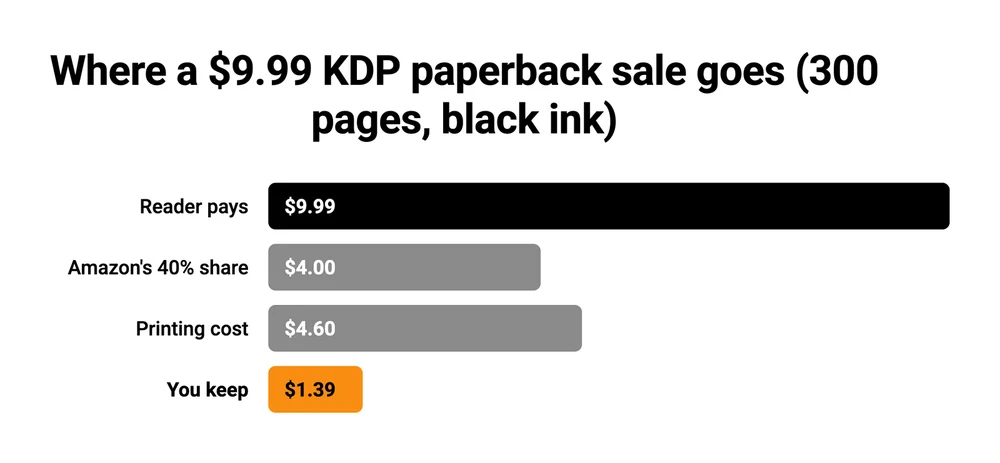
That same paperback, 300 pages, black ink. The middle bar is Amazon. The bar under it is the printer.
All of which is an argument for working out your floor before you fall in love with a price, the same habit that makes pricing a digital product less painful.
Kindle Unlimited pays from a pot, not a rate
Kindle Unlimited has no royalty rate. Amazon does not publish one, because one does not exist.
What exists is the KDP Select Global Fund, a pot of money Amazon sets each month. Your share is the number of pages Kindle Unlimited subscribers read in your book, divided by the pages read in every enrolled book that month, multiplied by the fund. Amazon’s own site footer put the July 2026 fund at $71.0 million, and its Kindle Unlimited royalty page works the division through with examples.
That structure has 3 consequences.
You are paid for first reads only. If a subscriber reads your book twice, Amazon counts the pages once. Amazon’s page is explicit that this holds even after your enrollment period ends.
There is a ceiling per reader. Amazon caps you at 3,000 Kindle Edition Normalized Pages per title per customer, so a very long book stops earning partway through.
And your rate is set by other authors. A month where everyone reads more pages without the fund growing is a month where your per-page earnings fall, even if your own readership is identical.
Getting into Kindle Unlimited means enrolling the ebook in KDP Select, and KDP Select is exclusive. Amazon’s enrollment page states that your ebook “must remain exclusive through the remainder of the title’s current 90-day participation period”, and that enrollment renews automatically unless you opt out.
So Kindle Unlimited costs you every other store, 90 days at a time, on a subscription you have to remember to cancel.
The conditions that quietly drop you to 35%
Choosing the 70% option is not the same as keeping it. Amazon’s pricing page lists several conditions, and 4 of them catch ordinary books.
Your ebook must be priced at least 20% below the print edition. If you list a paperback at $11.99 and the Kindle at $9.99, that is a 17% gap and the ebook does not qualify.
Public domain content is 35% only. Books that consist mostly of public domain material are ineligible for 70%, whatever you price them at.
Price matching can move you. Amazon reserves the right to sell your book below your list price to match another retailer, and if the matched price falls under the 70% minimum, you earn 35% on those sales.
Brazil, Japan, Mexico and India need KDP Select. In those 4 stores the 70% option is only available on ebooks enrolled in KDP Select. Outside Select they pay 35%.
One more line sits at the bottom of that same page. If your book stops meeting the 70% requirements, Amazon says it can “adjust previously reported or paid Royalties” down to 35%.
That covers royalties it has already reported and already paid out.
Amazon writes the rules and Amazon changes the rules. A ceiling that held for 19 years and then moved inside a single week is the friendly version of that.
My own start in online business was AdSense arbitrage, a numbers game built on earning more from the ads on a page than the visitors to it cost. Trying to game the system, which is what it was. I have used the same phrase for it ever since, a cat and mouse game, and the way I described that game at the time was that you are constantly worried whether the account gets shut down tomorrow.
When the money actually reaches your bank
Royalties are paid monthly, roughly 60 days after the end of the month the sale was reported. Expanded Distribution waits 90 days.
A sale in January is paid at the end of March, a sale in April at the end of June, and so on right around the year. Amazon publishes the full calendar.
| Month you earn it | When Amazon pays it |
|---|---|
| January | End of March |
| April | End of June |
| July | End of September |
| October | End of December |
So a book that launches in January, sells well in January, and is meant to fund something in February does not.
The first payment lands at the end of March, roughly 90 days after launch day.
The threshold only bites on 2 of the 3 payment methods. Amazon’s payment threshold page puts direct deposit at $0, so a $4 month is simply paid as $4. Checks and wires are the ones that need $100 on Amazon.com before anything moves.
That $100 has a catch if you take checks. Your royalties accrue separately in each Amazon marketplace, and each one has to clear its own threshold in its own currency. Earn $60 in the US and 60 pounds in the UK and neither pot pays out. Amazon keeps a running total and pays 60 days after the end of whichever month the total finally clears.
After the payment date, direct deposit takes 1 to 5 business days to land, or 7 to 10 if your bank is in India. A check can take up to 30 days to reach the address on your account.
What the same ebook pays if you sell it yourself
Amazon’s rates look steep next to a plain card fee, and the comparison is fair as long as you say what Amazon gives you for the difference.
On a $9.99 ebook, Amazon’s 70% option leaves you $6.89 and its 35% option leaves you $3.50. The same file sold through a checkout of your own costs you the card processing and nothing else, which at Stripe’s standard rate of 2.9% plus $0.30 comes to $0.59 on that sale.
| Route for a $9.99 ebook | What comes off the top | You keep |
|---|---|---|
| Kindle, 70% option, 1 MB file | Amazon’s 30% plus $0.15 delivery | $6.89 |
| Kindle, 35% option | Amazon’s 65% | $3.50 |
| Paperback at $9.99, 300 pages | Amazon’s 40% plus $4.60 printing | $1.39 |
| CartMango, card fee only | Stripe’s 2.9% plus $0.30 | $9.40 |
Read that last row knowing it is my own product. CartMango is the checkout I build, it takes 0% of a sale, and payouts land in your own Stripe or PayPal account rather than passing through us.
Own-checkout tools that take a percentage on top of the card fee land below $9.40. Gumroad charges 10% plus $0.50 with card processing stacked on top, which works out nearer 12.9% plus $0.80 on a direct sale (Gumroad’s real per-sale cost). Our roundup of platforms to sell ebooks has the rest.
What Amazon charges that $2.51 a sale for is traffic.
Amazon has readers browsing right now. Your own page has whoever you send to it, which on launch day is your email list and nobody else.
Nothing says you have to pick one. Amazon can carry the discovery, the direct page can carry the readers who already know your name, and the bundles and formats Amazon will not let you build get sold where you set the terms. That is the same split covered in making and selling an ebook, and the marketplace-versus-direct math behind it is worked through in selling on Etsy and in stock photo royalty rates.
FAQ
Is KDP royalty 35% or 70%?
Both, depending on price and territory. Amazon pays 70% on Kindle ebooks listed from $2.99 to $12.99 on Amazon.com and sold into roughly 40 supported territories. Everything else earns 35%, including sales outside those territories, prices outside the band, books made mostly of public domain content, and any ebook priced less than 20% below its own print edition. The 70% option also has a delivery cost deducted from it, which the 35% option does not.
How much royalties do you get from Amazon KDP?
Ebooks earn 70% or 35% of list price, with a delivery cost of $0.15 per megabyte deducted from the 70% option only. Paperbacks and hardcovers earn 60% at $9.99 and above or 50% at $9.98 and below, minus printing. Expanded Distribution pays 40% minus printing.
How much does Amazon KDP pay per book?
On a $9.99 ebook with a 1 MB file, the 70% option pays $6.89 and the 35% option pays $3.50. On a 300-page paperback listed at $9.99, Amazon’s own worked example pays $1.39 after $4.60 of printing costs. Drop that same paperback by 1 cent to $9.98 and the rate falls from 60% to 50%, so it pays $0.39 instead. Page count and file size move both figures, so run your own numbers rather than a general one.
How long does it take to receive royalties from KDP?
About 60 days after the end of the month in which the sale was reported, and 90 days for Expanded Distribution. A sale in January is paid at the end of March. Direct deposit then takes 1 to 5 business days, or 7 to 10 for banks in India.
Do I have to join KDP Select to earn royalties?
No. KDP Select only affects Kindle Unlimited earnings and the 70% rate in Brazil, Japan, Mexico and India. It requires your ebook to stay exclusive to Amazon for a 90-day term that renews automatically, so it changes where else you are allowed to sell your ebook.
Does Amazon pay for Kindle Unlimited pages read?
Yes, from the KDP Select Global Fund, which was $71.0 million in July 2026. Your share is your pages read divided by everyone’s pages read that month. Only a reader’s first pass through your book counts, and Amazon caps each reader at 3,000 pages per title.
The one rate nobody else sets for you
Every number above was set by somebody else. KDP royalties are Amazon’s to define: the bands, the delivery cost, the printing bill, the size of the fund, and the day a 19-year-old ceiling moves. Amazon puts your book in front of readers who were never going to find your website on their own, and that is worth paying for. Know exactly what each rule costs you, and keep 1 place where the rate is yours to set.
That is the whole idea behind CartMango. CartMango takes no cut of a sale, payouts go straight into your own Stripe or PayPal, and a Mini Page gives you somewhere to sell the file without building a website first. Nothing there replaces KDP royalties on the books you keep with Amazon. It just means the next thing you sell does not have to be priced around somebody else’s rate card. CartMango is free until October 2026, and plans start at $10 a year after that.
About the Author

👋 I’m Welly, founder of CartMango (the site you’re on), a checkout platform for digital product sellers. We’ve previously processed $179M+. I also run BirdSend (email marketing tool, 3.1B+ emails sent). On the side I show other non-techie digital sellers how I use AI workflows to automate 50%+ of my operations. Find me on LinkedIn.