

GoHighLevel and ClickFunnels both charge $97 a month, or $970 a year, for their entry plans. ClickFunnels suits a solo seller building funnels and courses. GoHighLevel suits an agency running client accounts, and it is the only one of the 2 that sells you the phone system and the texting.
ClickFunnels Launch includes 50,000 emails a month in its $97. GoHighLevel bills email at $0.675 per 1,000 from a prepaid wallet, so the same sending adds $33.75 a month, plus separate rates for texts and phone numbers. This GoHighLevel vs ClickFunnels comparison prices both from their own pricing pages, job by job.
Both of these platforms will happily sell you a plan today. Neither will tell you what you will pay in month 3.
Page 1 of Google is not much help either. 6 of its 8 results have money riding on the answer.
2 sell a rival funnel builder. 1 is GoHighLevel’s own website. 1 is a site that discloses it earns a commission on GoHighLevel signups. 2 more carry affiliate or deal links.
The 2 neutral results are both Reddit threads, and the top one is 3 years old.
The guides that do compare prices compare stickers. Perspective prints the same 2 numbers in both columns and calls that a full comparison.
So this post runs it differently. It works through the 4 jobs you need one of these platforms to do, judges both against each, then prices a 5th job that page 1 skips entirely.
Key Takeaways
- The prices match twice. GoHighLevel Starter and ClickFunnels Launch both cost $970 a year, and GoHighLevel Unlimited and ClickFunnels Optimize both cost $2,970.
- Only one of those is the whole bill. ClickFunnels publishes no per-unit rate. GoHighLevel bills email, texts, phone numbers and AI from a separate wallet.
- The email gap is $405 a year. GoHighLevel charges $0.675 per 1,000 emails, so sending what ClickFunnels Launch includes costs that much on top.
- ClickFunnels caps what GoHighLevel counts. ClickFunnels limits courses to 3, 6, 10 or 20 by plan. GoHighLevel publishes no course cap and no contact cap.
- Page 1 is not neutral. 6 of the 8 results ranking for this search have a commercial interest in the answer you reach.
The 2 prices that match to the dollar
Put both price cards side by side and the same 2 numbers turn up on both.
GoHighLevel sells 3 self-serve plans. ClickFunnels sells 4. Between them, 4 of those 7 plans sit on only 2 numbers.
Before you compare plan prices at all, it is worth knowing where a small digital business usually loses money, and it is almost never the software bill. The Online Selling Mistakes Challenge is a free 5-day email course covering the 5 mistakes that catch solo digital sellers most often.
GoHighLevel Starter and ClickFunnels Launch both cost $970 a year, and GoHighLevel Unlimited and ClickFunnels Optimize both cost $2,970 a year, so 4 of the 7 self-serve plans across the 2 platforms sit on just 2 price points.
| Yearly price | GoHighLevel | ClickFunnels | What you get |
|---|---|---|---|
| $970 | Starter | Launch | GoHighLevel: 3 sub-accounts, unlimited contacts, unlimited users. ClickFunnels: 1 workspace, 2 team members, 10,000 contacts, 50,000 emails a month, 3 courses |
| $1,970 | no plan | Scale | 5 workspaces, 5 team members, 75,000 contacts, 300,000 emails a month, 6 courses |
| $2,970 | Unlimited | Optimize | GoHighLevel: unlimited sub-accounts, rebill usage to clients at cost. ClickFunnels: 10 workspaces, 10 team members, 150,000 contacts, 750,000 emails a month, 10 courses |
| $4,970 | Agency Pro | no plan | SaaS Mode, automated sub-account creation, rebill usage with your own markup |
| $5,997 | no plan | Dominate | 20 workspaces, 20 team members, 400,000 contacts, 1.2M emails a month, 20 courses. Annual billing only |
Every figure there is the annual price, because that is how both companies sell their cheapest rate and both publish the yearly total themselves. Both price the year at 10 times the month, so paying up front costs 10 months on either platform.
On monthly billing the numbers are $97, $297 and $497 at GoHighLevel, and $97, $197 and $297 at ClickFunnels, with Dominate having no monthly option at all. GoHighLevel gives you 14 days free on any plan and says so on its pricing page. ClickFunnels offers a free trial without naming a length there, and backs it with a 30-day money-back guarantee.
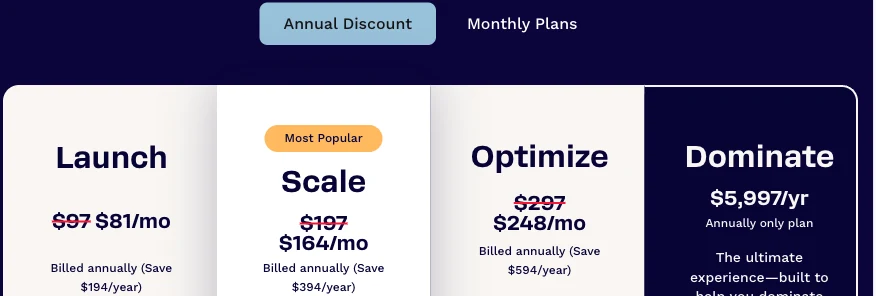
Notice what ClickFunnels shows by default. The annual tab is preselected, so the first number you see on Launch is $81 a month, not $97. The $81 is $970 divided by 12 and rounded up. Quote the $81 back at yourself and multiply by 12 and you land on $972, which is $2 more than the real price.
That is a small thing. The next one is not.
Job 1: get a page in front of people
ClickFunnels was built for this job and it shows. The page editor is the product, the templates are the reason people bought it in the first place, and a funnel is a first-class object rather than a folder of pages.
GoHighLevel has a funnel and website builder too. It is flexible, it takes custom CSS, and it is included on every plan including the $97 Starter. It is also not the reason anyone buys GoHighLevel, and the editing experience reflects that.
For domains, ClickFunnels Launch gives you 5 custom domains and every plan above it gives unlimited. GoHighLevel does not cap domains by plan.
A small ClickFunnels charge worth knowing: buy a domain through ClickFunnels rather than bringing your own and it is $20 a year, every year the domain stays in the account. Bringing your own domain costs nothing.
If a landing page is genuinely the whole job, neither of these is the cheap way to do it. CartMango, which I run, hosts a sales page through its Mini Pages editor and links it straight to a checkout. Payhip and Gumroad host product pages too. None of the 3 replaces what GoHighLevel and ClickFunnels do beyond that page.
Our breakdown of what a lead capture page costs across 7 tools runs the same live-pricing exercise on that one piece.
Job 1 goes to ClickFunnels, and not narrowly.
Job 2: take the money on that page
Taking a payment is the job where GoHighLevel and ClickFunnels are hardest to tell apart.
Both do an order bump on the checkout form. Both do a one-click upsell after payment, where the buyer adds something without re-entering a card. Both do a downsell when the upsell is declined. GoHighLevel documents all 3 in its own help portal, and ClickFunnels has sold order bumps and 1-click upsells as headline features for a decade.
Neither takes a percentage of what you sell. ClickFunnels answers this directly on its own pricing page: asked whether it takes a percentage of your sales, it says no, and that you will keep every penny you make. GoHighLevel’s pricing page lists no platform commission either.
Your payment processor still takes its cut on both. Stripe charges 2.9% plus 30 cents on a US domestic card, and that is the same on either platform because both hand the transaction to your own processor.
So on this job, honestly, it is a tie. If it is the only job on this list you actually need, a dedicated checkout does it without the funnel builder, the CRM or the phone system attached. CartMango does all 3. Gumroad does bumps and upsells but no true conditional downsell, and Payhip does bumps with no upsells at all.
Job 2 is a tie.
Job 3: chase the people who did not buy
Follow-up is where most comparisons of these 2 overstate the gap.
GoHighLevel is a CRM first. You get pipelines you can drag a lead through, a shared inbox that pulls email, texts and calls into a single thread, booking calendars, and a workflow builder that branches on what someone did. WhatsApp is there too, as a $10 a month add-on per sub-account rather than part of the $97.
ClickFunnels is closer than page 1 admits. Its Opportunities app runs sales pipelines, in its own words helping you track and manage every lead through each stage of your funnel. Its MessageHub app runs an SMS inbox next to email and social.
GoHighLevel supplies its own phone line and sells you the numbers and the messages. ClickFunnels expects you to bring your own Twilio or Bandwidth account, and its help centre lists exactly that as a requirement for an SMS inbox.
So texting is not free on either one. GoHighLevel puts it on your software bill, at rates its own guide says match Twilio’s with a 10% discount on US and Canada traffic. ClickFunnels puts it on a separate Twilio invoice you set up and manage yourself.
Calling is where they genuinely part. GoHighLevel sells voice minutes at $0.0166 outbound. The words phone and call do not appear anywhere on ClickFunnels’ CRM page.
Worth reading alongside this if recovering a lost sale is the specific thing you are trying to fix: our roundup of cart abandonment software narrows 16 options down by what your checkout can actually feed.
Job 3 goes to GoHighLevel, by less than page 1 suggests, and with a bill attached that the next section prices.
Job 4: deliver what they bought
Both platforms host courses and both run a community.
ClickFunnels counts them. Courses are capped at 3 on Launch, 6 on Scale, 10 on Optimize and 20 on Dominate, and contacts are capped at 10,000, 75,000, 150,000 and 400,000. Its community feature is native and documented in its own help centre, so any guide telling you ClickFunnels has no community is describing an older version of the product.
GoHighLevel lists Courses and Communities under core features on every plan and puts no number beside either. Its pricing page shows no contact cap and no user cap at any tier. What it counts instead is sub-accounts: 3 on Starter, unlimited above that.
Those are 2 different philosophies about what you are buying. ClickFunnels sells you a size. GoHighLevel sells you a number of businesses.
For a solo seller with 1 business and 1 catalogue, GoHighLevel’s uncapped everything is worth more than it looks, and its sub-account ladder is worth nothing at all. Page 1 mostly does not mention that, because page 1 is written for agencies.
This is the job CartMango does not do today. It takes the payment and delivers the file or the subscription behind a protected link, and it has no course player and no community yet, so on this row it is not in the running.
If course hosting is the main event rather than a side feature, the honest comparison is a different one. Our head-to-head on ClickFunnels vs Kajabi covers the platform built for exactly that, and Kajabi pricing has the full tier breakdown.
Job 4 goes to GoHighLevel on limits, and to ClickFunnels on polish.
GoHighLevel vs ClickFunnels: the job page 1 skips
The 5th job is working out what the bill will be, and it is the one page 1 leaves alone.
GoHighLevel’s $97 buys the software. It does not buy the sending.
Texts, emails, phone numbers, call minutes and AI usage all come out of an Agency Wallet, which is a prepaid balance funded by your card. GoHighLevel’s own billing guide describes the mechanic plainly: when the wallet balance drops below a minimum you set, it automatically charges the card on file to refill it.
The rates are published, just not on the pricing page. They live in a support portal, across several articles.
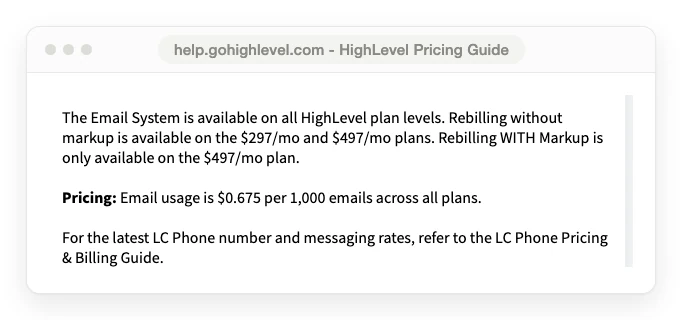
A light month of 1 phone number, 2,000 texts and 5,000 emails adds $30.08 to GoHighLevel Starter’s $97 software bill, while on ClickFunnels Launch the email is included and the rest lands on a separate Twilio invoice you set up yourself.
| What you send | GoHighLevel rate | A light month | ClickFunnels Launch |
|---|---|---|---|
| 5,000 emails | $0.675 per 1,000 | $3.38 | included, up to 50,000 a month |
| 2,000 text segments | $0.00747 a segment | $14.94 | you bring Twilio or Bandwidth |
| Carrier fees on those texts | about $0.0040 a segment, plus a 5% markup | $8.40 | billed by your own provider |
| 1 local phone number | $1.15 a month | $1.15 | rented from your own provider |
| A2P campaign registration | up to $2.10 a month, plus a 5% markup | $2.21 | billed by your own provider |
| On top of the software bill | $30.08 | $0 |
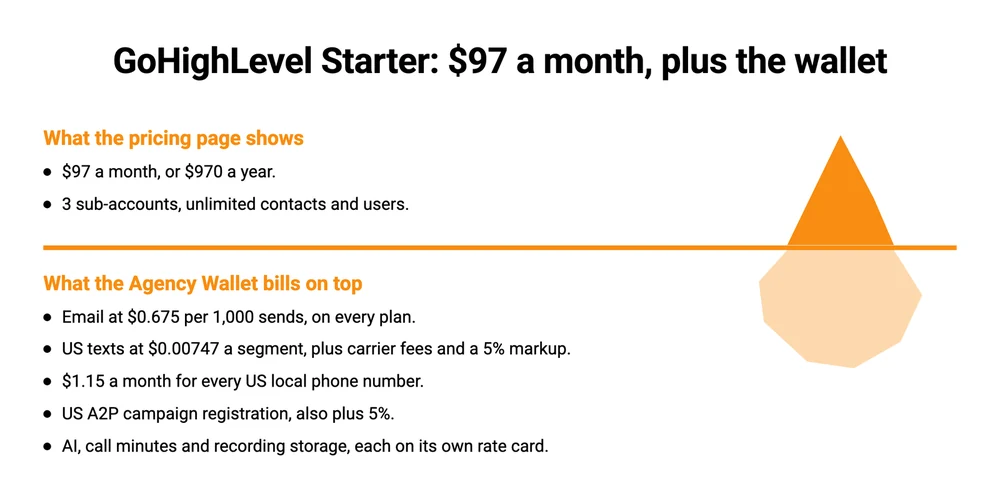
The carrier line needs a word. Those fees come from the recipient’s mobile network, not from GoHighLevel, and they run $0.0035 to $0.0050 a segment depending on who you are texting. GoHighLevel’s phone billing guide then adds a fixed 5% markup to them at sub-account level, in its own words, regardless of whether your agency has re-billing enabled. The same 5% applies to A2P registration, which is the Campaign Registry process every US business has to go through before it can text mobile numbers.
Now do the like-for-like version. ClickFunnels Launch includes 50,000 emails a month. Send the same 50,000 through GoHighLevel Starter and that is $33.75, so Starter costs $130.75 a month against Launch’s $97. On annual billing the gap is $405 a year on top of an identical $970 sticker.
In a thread on r/agency titled “gohighlevel pricing keeps creeping up once you add usage fees”, the poster writes that after a year and 12 client accounts, “i budgeted for one number and I’m consistently 30-40% over that now”. A reply in the same thread puts it more plainly: “those platforms are masters at the slow creep where the base price is just the entry ticket and then every little thing you actually need to run an agency tacks on another 20-50 bucks a month”.
A moderator on that thread pushed back, and he has a point: “there’s usage fees on literally everything”, he wrote, asking how the poster had not accounted for them.
The rates are published. They are just missing from the guides that rank for this search.
3 of the 5 written guides I read give no rate at all, and the other 2 give one that is wrong.
Beginners meet the wallet sooner than that. In a separate r/gohighlevel thread, someone still on the trial describes being charged about $31 before sending anything: “the $20 automatically charged if you wanted to use their tool for email marketing and sms which was not mentioned, no warnings”, plus $11 for a domain transfer.
A commenter who says he used to work at GoHighLevel replies that the auto-charge is usually $10 during the trial, and adds: “they don’t tell you about the charges unless asked only the subscription”. The original poster corrects him on the amount: “It’s not $10, it’s $20 now. They’ve adjust the minimum wallet amount.” So 2 people who use the product daily disagree about the size of the first automatic charge, and both are describing something no comparison guide mentions.
A single page-1 guide does try to price this, and it is worth looking at what happened. GHL Experts, whose own footer calls it an independent GoHighLevel affiliate, runs a table called “The Hidden Costs of Communications” with a column for each platform.
Every row marks ClickFunnels as needing a third party: SMS, local phone number, inbound call, outbound call. Then the email row prints the same figure in both columns, roughly $0.675 per 1,000, which is GoHighLevel’s own published rate.
ClickFunnels publishes no per-email rate on its pricing page or in its help centre. Its plans include a monthly send allowance instead.
So the guide that reaches hardest for the metered layer copies a GoHighLevel number into the ClickFunnels column and erases the difference it was trying to show.
The other wrong rate belongs to BloggingX, which puts GoHighLevel’s email at $0.01 per broadcast email. GoHighLevel’s own figure is $0.675 per 1,000, which works out at $0.000675 an email, so that guide is out by roughly 15 times. The same page also says GoHighLevel sells 2 plans when it sells 3 plus an Enterprise tier, and that the Starter plan gives you unlimited accounts when the live plan card says 3 sub-accounts.
For the full rate card, including AI, call recording storage and the add-ons priced per sub-account, we broke it down separately in GoHighLevel pricing. If you want to see how a different all-in-one handles the same problem, Kartra pricing charges a percentage on its entry plan instead of metering usage.
This job goes to ClickFunnels, because a number you can predict is worth something on its own.
Which one a solo digital product seller should pick
GoHighLevel Unlimited costs $2,970 a year, and what it buys over Starter is unlimited sub-accounts. If you have no clients, that is $2,000 for a number you will never reach.
Prep is easy to over-buy, and I know that trade from my own sales calls. Slides and talking points built days ahead, for meetings nobody had booked, while the morning-of version does the same job.
Across the 5 jobs, ClickFunnels wins the page and the bill, GoHighLevel wins the follow-up, taking the money is a tie, and delivery splits: GoHighLevel on limits, ClickFunnels on polish.
| The job | GoHighLevel | ClickFunnels |
|---|---|---|
| Get a page in front of people | Capable, included on every plan, rougher to build in | Built for it, better templates and editor |
| Take the money | Order bumps, 1-click upsells, downsells, no platform cut | Order bumps, 1-click upsells, downsells, no platform cut |
| Chase the people who did not buy | CRM, pipelines, email, texts and calls, all sold by GoHighLevel | CRM, pipelines, email and an SMS inbox, texting on your own Twilio account, no calling |
| Deliver what they bought | Courses and community with no published cap | Courses capped at 3 to 20 by plan, native community |
| Know what the bill will be | Plan fee plus metered sending from a prepaid wallet | Plan fee, and no published per-unit rate |
Read that last row against the 4 above it, because it flips the answer for anyone without clients.
The row GoHighLevel wins, it wins by a distance. It also wins it as an agency platform, and the 2 things it hands you alongside, unlimited sub-accounts and rebilling client usage, are worth exactly nothing to someone with no clients.
Pick ClickFunnels if you sell your own products, your follow-up is email, and you want to know in January what you will pay in December.
Pick GoHighLevel if you will genuinely text or call leads, or if you will run accounts for other businesses. Then budget for the wallet from day 1 rather than discovering it.
If you have landed here because the bill is the problem rather than the features, both sides have a roundup: GoHighLevel alternatives prices 7 options against the metered charges, and ClickFunnels alternatives prices 8 at the same 10,000 contacts.
FAQ
Why are people leaving ClickFunnels?
The honest answer is that page 1 of this search carries very little current evidence either way. The top Reddit thread is 3 years old and its highest-voted answer has been scrubbed by a delete tool. The complaint that does recur in it is the 2.0 rebuild, with 1 commenter writing that ClickFunnels “is going down hill ever since V2”. The documented pressure point today is simpler: ClickFunnels caps contacts, courses, workspaces and team seats on every plan, so growth forces a whole-tier upgrade.
Is there anything better than GoHighLevel?
Better at what it does, not really, if you need a CRM, multi-channel messaging and client sub-accounts on 1 bill. That is a lot of software for $97. The question worth asking instead is whether you need that bundle. A solo seller with 1 business pays for sub-accounts, rebilling and a phone system and may never switch any of them on, which is why the cheaper answer is usually a smaller tool rather than a better big one.
What is better than ClickFunnels?
The answer changes by job. For funnels plus a CRM and texting on 1 bill, GoHighLevel. For selling courses, Kajabi is the direct rival. For just a checkout with order bumps and upsells, a dedicated cart like CartMango costs a fraction of either.
ClickFunnels is hard to beat at the specific thing it was built for, which is building and testing a sales funnel quickly.
How much does GoHighLevel cost per month?
$97 for Starter, $297 for Unlimited and $497 for Agency Pro, or $970, $2,970 and $4,970 paid yearly. Those are software-only prices. Texts, emails, phone numbers, call minutes and AI come out of a prepaid wallet on top, so a light month on Starter lands nearer $127 and a busy agency month runs well above the plan fee.
Does ClickFunnels charge usage fees like GoHighLevel does?
No per-unit rate is published on ClickFunnels’ pricing page or in its help centre. Each plan includes a monthly email allowance and a contact ceiling instead. The one recurring extra charge I could find documented is $20 a year for a domain bought through ClickFunnels, which you avoid by bringing your own.
Texting is the exception. ClickFunnels routes it through your own Twilio or Bandwidth account, so those messages are billed by that provider instead of landing on your ClickFunnels bill.
What happens if you outgrow a ClickFunnels plan limit?
ClickFunnels does not publish this. Its pricing page and help centre both state the limits without saying whether exceeding a limit triggers an overage charge, a forced upgrade or a hard stop. Ask support before you plan around it. The risk runs the opposite way from GoHighLevel: one platform grows your bill quietly, the other stops you and makes you buy a tier.
The much smaller version of this problem
Both of these platforms are built to run a marketing operation. If you re-read the 5 jobs above and only 1 of them is genuinely yours, taking the money, then GoHighLevel vs ClickFunnels is the wrong question, and the price gap between those 2 and a plain checkout is enormous.
That is the job CartMango does. Order bumps, 1-click upsells, downsells, subscriptions and a hosted sales page, with no cut of your sales, and your recurring payments stay yours if you ever leave. It does not host a course or run a community today. Both of those are targeting October 2026.
About the Author

👋 I’m Welly, founder of CartMango (the site you’re on), a checkout platform for digital product sellers. We’ve previously processed $179M+. I also run BirdSend (email marketing tool, 3.1B+ emails sent). On the side I show other non-techie digital sellers how I use AI workflows to automate 50%+ of my operations. Find me on LinkedIn.
Related Reading
- GoHighLevel pricing: the full rate card, the Agency Wallet, and the 5% markup its own 2 billing pages disagree about
- ClickFunnels alternatives: 8 options priced at the same 10,000 contacts
- ClickFunnels vs Kajabi: for readers whose real question is course hosting
- Kartra pricing: another all-in-one, charging a percentage instead of metering usage