

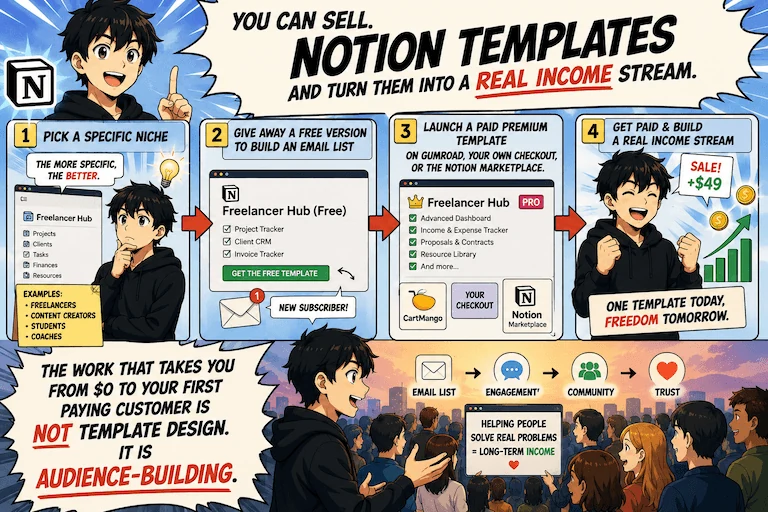
You can sell Notion templates and turn them into a real income stream. Start by picking a specific niche, give away a free version to build an email list, then launch a paid premium template on your own checkout or the Notion Marketplace. The work that takes you from $0 to your first paying customer is not template design. It is audience-building.
Thomas Frank, a Denver-based YouTuber, crossed $1,000,508 in Notion template revenue in 2022 selling two templates priced between $49 and $179. Business Insider verified the number with documentation. He started with about 10,000 subscribers on the niche YouTube channel that drove the sales, not millions. The path is real, but it is not the path most blog posts describe.
This guide walks through what actually sells, how to price, the four places to sell with honest fee math, what to do for marketing, and the mistakes that kill template sales before they start. By the end, you will have a usable plan for your first 30 days.
Key Takeaways
- The market is not saturated. Notion’s user base keeps expanding, and template demand grows with adoption. Frank’s verified $1M run rate in 2022 proves the ceiling is high.
- Audience first, template second. Frank’s first paid template sold $15k/month on a YouTube channel with only 10,000 subscribers. The pre-work was eleven years of free content.
- Bundling outperforms single-template selling 3 to 1. Frank’s bundle (Creator’s Companion + Ultimate Brain at $179) outsold every other edition by a wide margin.
- Pick one sales channel, master it, then add channels. Notion Marketplace, Etsy, Gumroad, & your own checkout each fit different sellers. There is no single best answer.
- Support is the moat copiers cannot copy. Frank spent six weeks doing customer support himself before hiring. That work is what kept refunds low and word-of-mouth high.
Before going further, if you want the free 5-day primer on the biggest revenue leaks solo digital creators are missing right now (most of which apply directly to template sellers), grab the free 5-day Online Selling Mistakes Challenge. It is written from data across $179M in processed digital product sales.
Can you actually make money selling Notion templates?
Yes. Notion’s own terms allow it, third-party platforms permit it, and verifiable case studies exist at every income tier. One creator shared on Reddit that they had earned $901 from Notion templates over 14 months across 14 products, a realistic low-end baseline.
Frank’s breakdown from his publicly shared 2022 thread gives the most documented data point:
- Ultimate Brain (the all-in-one productivity template): $760,000
- Creator’s Companion + Ultimate Brain bundle: $298,000
- Creator’s Companion Ultimate Tasks edition: $86,000
- Creator’s Companion Base edition: $17,000
- Best single month (May 2022): $100,000
He launched Creator’s Companion on Gumroad in 2021 for $140. With a niche YouTube channel of about 10,000 subscribers, the template made roughly $15,000 a month with what he describes as “minimal marketing.” Ultimate Brain launched in April 2022 at $49 and pushed annual revenue past seven figures.
A realistic middle tier sits somewhere between $500 and $5,000 a month for sellers with smaller audiences who treat templates as a side business. That range is what most platform marketing posts estimate, but no one publishes verified medians because most creators do not share their numbers. Treat Frank’s $1M as a real ceiling, not a typical result. Treat the $500 to $5,000 range as plausible for a 6 to 18 month build.
Is selling Notion templates saturated in 2026?
No. Two reasons.
Notion’s user base keeps growing year over year, which means net new buyers enter the market every quarter. The pie expands. Notion crossed 100 million users in 2024, and the base has kept growing since.
The second reason is structural. Frank put it bluntly in his Business Insider interview: “The people who copy templates do not understand the guts of them. So, they are not going to be able to do things like provide active support or add new features because they do not understand the tool as well as somebody who built it from scratch.”
What is saturated is the surface layer, the cheap, lookalike, low-support templates. What is wide open is the layer underneath: templates that solve a specific operational problem for a specific buyer, supported by a creator who actually answers questions.
What types of Notion templates sell best?
Five categories carry most of the revenue you see in public data.
Business systems & project management. Frank’s Creator’s Companion sits here at $140. It is a YouTube production pipeline turned into a template. The buyers are people running a defined operation, and the template removes the painful setup work.
All-in-one productivity (second brain style). Frank’s Ultimate Brain at $49. Broad appeal, lower price point, higher volume.
Habit & personal development trackers. Smaller average order value, often $9 to $25, but lower competition for tight niches like sobriety tracking, weightlifting programs, or ADHD systems.
Content calendars & creator tools. Editorial calendars, social media planners, podcast prep systems. Buyers are creators, which means they are easier to reach through creator channels.
Finance, budget, and academic trackers. Strong on Etsy because the buying intent there is “I want a template for X life area.” Higher discovery, lower margins because of fees.
The category does not matter as much as the specificity of the problem. A generic “productivity template” struggles. A “Notion system for solo podcasters who release weekly” wins.
Here’s a full walkthrough of building a sellable Notion template with AI, no manual design work:
How to create a Notion template that people actually buy
Start with a specific problem
Niche down ruthlessly. Frank’s two flagship templates serve people running content businesses & people building a second brain. Both are specific roles, not generic life-improvement.
Pick the operational job your template does, then write it as one sentence: “This template helps [specific person] do [specific job] without [specific pain].” If you cannot finish that sentence, you do not have a sellable template yet.
Design for the first five minutes
The buyer must understand what the template does in the first five minutes of opening it. A confused buyer refunds. A confused buyer also does not refer friends.
Build the template’s landing page or marketplace listing around a screenshot tour, not a feature list. Show the system in use, not the boxes it has.
Include documentation
Frank spent six weeks doing customer support himself after launching Ultimate Brain. That work is what taught him which parts of the template confused buyers most. Documentation is the substitute for sitting next to each buyer.
A short Loom video plus a single FAQ page solves about 80% of support tickets before they happen.
Build a free version first
Frank’s email list of around 50,000 was built by giving away two free templates (a video tracker and a task manager) before he ever charged for anything, per his Business Insider interview. The free version is the funnel. The paid version is the monetization.
If you sell a paid template without a free version, you are selling to cold traffic. Conversion is brutal.
Where to sell Notion templates: the four channels, with honest math
There are four legitimate places to sell Notion templates as of 2026. Each fits a different stage and seller type.
Notion Marketplace
Notion’s official creator marketplace. Pros: it sits inside the Notion app, so discovery is built into where buyers already are. Cons: Notion only pays creators in a limited set of countries, takes a cut of sales, and you do not own the customer relationship. If you live outside Notion’s payout list, this channel does not even exist for you.
Etsy
Yes, selling Notion templates on Etsy is allowed under both Notion’s terms and Etsy’s policies. Etsy’s strength is built-in search traffic from buyers actively shopping for templates. The trade is fees (listing fees plus transaction fees plus payment processing, which compounds), competition from copy-paste sellers, and a buyer base that expects $5 to $25 pricing.
Etsy fits well if you sell low-priced templates in shopper categories (planners, budget trackers, student systems) & you can compete on listing photography.
Gumroad
Where Frank launched. Simple, fast to set up. Current fee as of 2026 is 10% + $0.50 per transaction (direct sales through your profile or links). Important context: as of January 1, 2025, Gumroad became a Merchant of Record, which means they handle all sales tax, VAT, & remittance worldwide on your behalf. That removes a real administrative headache for international sellers.
The Gumroad audience is meaningfully different from Etsy’s: more creator-facing, more comfortable with $40-$200 templates, less price sensitive.
Gumroad fits if your buyer is a creator, professional, or business buyer, you want to launch fast without building your own checkout, & you value not dealing with sales tax yourself. The trade is that you give up some margin & you do not fully own the buyer relationship. For evaluation help once revenue gets serious, see the post on the best Gumroad alternative.
Your own checkout (the long-term play)
Higher take rate, you own the customer email, you control upsells & order bumps, you decide refund policy. The downside is you bring the traffic yourself, no built-in marketplace audience.
This is the right move once you have an audience. A self-hosted checkout running on something like the CartMango platform keeps roughly all of the revenue versus losing 5-10% per sale to marketplace fees & processing. Over a $50,000 year, that is $2,500-$5,000 in difference. Over Frank’s $1M, that is $50,000-$100,000.
Worked fee math on a $49 template (verified rates, US, 2026)
The pattern holds: marketplaces give you discovery, your own checkout gives you margin. The per-sale delta looks small ($3-4 on a $49 template), but it compounds. On $50,000 in annual revenue, that is roughly $3,000-$4,000 difference. On Frank’s $1M year, it would be $60,000-$80,000.
One caveat on the table: Gumroad’s new Merchant of Record status removes tax compliance work for you, which has its own dollar value if you sell internationally. The 89% take rate looks worse than your own checkout at 96.5%, but you are not paying an accountant or a sales-tax-automation service either. Run the math against your own volume & geography.
For deeper grounding before you pick, the post on how to price digital products covers the pricing decision separately from where to sell.
How to price your Notion templates
Anchor on three tiers.
$9-$25 entry tier. Single-use templates, narrow scope, low support overhead. Etsy buyers live here.
$29-$69 mid tier. Multi-feature systems with documentation, light support. Ultimate Brain at $49 is the reference point.
$99-$199 premium tier. Full systems with active support, deeper customization, sometimes a community. Creator’s Companion at $140 & the $179 bundle anchor this tier.
Two specific lessons from Frank’s data:
Bundling beats discounting. The Creator’s Companion + Ultimate Brain bundle outsold every single edition by 3 to 1 and raised average order value. Build the bundle deliberately.
Price stability beats price experimentation early. Frank held Creator’s Companion at $140 from 2021 through 2023 and beyond. His reasoning, from the Business Insider interview: “If I do not have to raise prices, I can get better distribution and bring in more sales at the same price.”
If you are stuck on what to charge, start lower than you think and raise once you have testimonials.
How to market Notion templates
Four channels do almost all of the work for template sellers. You do not need all four. You need one that fits your strengths.
A niche YouTube channel
Frank’s secondary channel, Thomas Frank Explains, hit $1M in template sales with 116,000 subscribers at year-end 2022 per his published year-in-review. His main channel of 2.8 million subscribers was idle the whole year. Niche beats reach.
A weekly tutorial channel that genuinely teaches Notion will outperform a general productivity channel for template sales. Your videos function as long-form demos of the template’s capabilities.
Free templates as lead magnet
Frank’s free Video Product Tracker & Ultimate Tasks templates built his 50,000-person email list before he ever charged for anything. Give the smaller version of the system away. Sell the bigger version.
Twitter / X & Reddit
Notion power users congregate on r/Notion & on Notion-Twitter. Show up, answer questions for months without selling, and the audience builds. Pitching cold rarely works in either community.
SEO content as compounding asset
Frank’s biggest content moat is a 42,000-word free reference guide on every Notion formula function. It took four months of full-time work. It still drives traffic three years later. Long-form SEO content is slow, but the half-life is measured in years.
If you want a structured way to think about audience-building before you launch, this post on promoting digital products walks through the common mistake most creators make.
Common mistakes that kill template sales
Six failures show up in almost every post-mortem on a Notion template that did not sell.
- Selling without offering support. Buyers refund when they get stuck. Refunds kill margins faster than anything else.
- Pricing too low because you feel guilty. Cheap templates attract bargain-shoppers. A $49 template outsells a $9 template on total revenue almost every time, because the buyer who pays more refers friends, leaves reviews, & treats the template seriously.
- No documentation in the template. A confused buyer is a refund waiting to happen.
- Selling a category, not a problem. “Productivity template” loses. “Weekly content pipeline for solo YouTubers” wins.
- Skipping the free version step. Cold traffic on a $49 template converts at fractions of a percent. Build the list first.
- Looking at competitor templates. Frank’s exact rule: “My strict rule for myself is to not look at other people’s templates to avoid any, even unintentional, copying.” Build from the problem, not from what others built.
Is it legal to sell Notion templates on Etsy?
Yes, it is allowed under both Notion’s terms of service and Etsy’s policies, as long as the template you sell is your own original work and you deliver it through Notion’s standard share-link-with-duplicate-enabled flow.
What you sell on Etsy is technically a digital file (a PDF instruction sheet, plus the Notion share link). The buyer duplicates the linked Notion page into their own workspace. Both platforms permit this.
Concerns about Notion templates being “copies” do not apply: each buyer gets their own duplicate. You retain the master, the buyer gets a working copy.
Your first 30 days: a starter plan
Week 1: Pick a single specific problem you have solved with Notion. Write the sentence: “This template helps [person] do [job] without [pain].” Audit which Notion templates already exist for that problem. Identify what they miss.
Week 2: Build a free version covering the basic problem. Build a paid version covering the full version with documentation. Record a 3-minute Loom of the template in use. Set up one channel: Notion Marketplace if eligible, Gumroad if not, or your own checkout if you already have list size.
Week 3: Launch on one channel. Write three pieces of free content (tutorial, walkthrough, write-up) that teach the problem your template solves. Post them in r/Notion, on X, and on your own site or YouTube channel.
Week 4: Reach out to 20 people in your target niche directly. Offer the paid template free in exchange for honest feedback. Collect testimonials. Iterate the template based on what confused them. Now you have customer voice for the sales page rewrite.
The template you ship in week 2 will be rough. The version four or five weeks later, refined by real buyer feedback, is the one that converts. Start ugly. Ship anyway.
For sellers who do not have an existing website, the post on selling digital products without a website covers the no-domain path.
The compounding bet
Frank’s $1M in 2022 did not come from his templates. It came from eleven years of audience-building before the first paid template. The templates were the monetization layer on top of trust that already existed.
That is the model. The template is the artifact. The product is your knowledge, distilled into a Notion file, plus the support you provide when buyers get stuck.
Pick a problem you actually understand. Build the smallest version that works. Give it away. Let people use it, ask you questions, find the rough edges. Then build the bigger version & charge for it. That is the entire playbook, compressed.
About the Author

👋 I’m Welly, founder of CartMango (the site you’re on), a checkout platform for digital product sellers. We’ve previously processed $179M+. I also run BirdSend (email marketing tool, 3.1B+ emails sent). On the side I show other non-techie digital sellers how I use AI workflows to automate 50%+ of my operations. Find me on LinkedIn.
Related Reading
- How to create a digital download that sells: the format & delivery decisions that come before the marketing
- How to price digital products (PPF Method): the pricing decision in depth, separate from where to sell
- 8 ways to protect digital downloads: how to handle the piracy question on duplicatable products like Notion templates
- How to promote digital products: the critical mistake most first-time creators make
- The best Gumroad alternative: when you outgrow Gumroad fees & need a lower-cost checkout