

Starter, Pro and Premium are Zenler’s 3 plans, priced at $47, $97 and $277 a month when you pay for a year up front, or $57, $117 and $347 month to month. Zenler pricing has no transaction fees on any plan, and a 30-day free trial comes before the first bill.
The plan to read closely is Starter. It stops at 5 courses, 1 site, 500 people and 5,000 emails a month, with no memberships, bundles or custom domain. Going past any of those limits, or wanting a membership, means Pro at $1,164 over a year. Stripe, PayPal or Razorpay still charge their own card fees on every sale.
A Zenler guide on the first page of Google says the Starter plan costs $67 a month and keeps 5% of every sale. Another says Zenler has a free plan that takes 10%. A third still calls the whole platform a beta.
None of those match what Zenler charges today. Zenler rolled out new plans, early customers kept their old rates, and the old numbers kept ranking.
Budget off the wrong page and you can be out by more than $500 a year on the Pro plan alone.
Below are the numbers Zenler shows now, read off its own pricing page and help center, plus what the $47 plan leaves out and how to spot a stale Zenler price.
Key Takeaways
- 3 plans, no per-sale cut. Zenler costs $47, $97 or $277 a month billed yearly, or $57, $117 or $347 monthly.
- Starter has hard limits. It caps you at 5 courses, 500 people and 5,000 emails a month, with no memberships, bundles or custom domain.
- Page 1 is out of date. All 4 third-party pages on Google’s first page show at least 1 Zenler price or fee that is gone.
- The trial may need a card. Zenler’s homepage says no card is needed. Its help center says a card is required and billing starts after 30 days.
- Card fees still apply. Stripe charges 2.9% plus 30 cents on a US card, so a $200 course sale costs $6.10 while Zenler takes $0.
Zenler pricing: what each plan costs
Zenler has 3 plans: Starter at $47 a month, Pro at $97 and Premium at $277 on yearly billing. Month to month, the same plans cost $57, $117 and $347.
The plan price is only one line in what a course business costs to run. Pricing, checkout and follow-up mistakes can quietly cost more than the platform does, and I walk through the 5 most common ones in a free email course called the Online Selling Mistakes Challenge.
Paying yearly makes Zenler Starter $564 over 12 months, Pro $1,164 and Premium $3,324, which saves $120, $240 or $840 against monthly billing.
| Plan | Monthly billing | Yearly billing | 12 months, billed yearly | Courses | People |
|---|---|---|---|---|---|
| Starter | $57/mo | $47/mo | $564 | 5 | 500 |
| Pro | $117/mo | $97/mo | $1,164 | Unlimited | Unlimited |
| Premium | $347/mo | $277/mo | $3,324 | Unlimited | Unlimited |
Zenler only prints per-month prices and never shows a yearly total, so the fourth column is 12 months at the yearly rate.
The other limits climb in the same 3 steps:
- Sites: 1, 3 or 10.
- Communities: 1, 20 or unlimited.
- Emails a month: 5,000, 100,000 or 500,000.
- Marketing funnels: 2, 100 or unlimited.
- Live sessions: 10, 100 or 300.
- Custom domains: 0, 3 or 10.
- AI credits: none on Starter, 1,500 on Pro, 3,500 on Premium.
Every figure above comes from Zenler’s pricing page, including the comparison table further down it.
Some Zenler customers pay less than this, and a new account cannot join them. Zenler’s own blog says “The old $54/month grandfathered promotion ended on August 31 and is no longer presented as a live offer.” Customers who got in early kept their rate, and 1 long-time user on Trustpilot lists “subscription pricing doesn’t increase (locked in for life)” as a pro, so a friend’s price may not be your price.
Does Zenler take a cut of your sales?
Zenler takes no cut of your sales on any plan. The comparison table on its pricing page lists transaction fees as 0 on Starter, Pro and Premium.
Your payment processor still charges. Zenler’s features menu lists one-off and subscription payments through Stripe, PayPal or Razorpay, and each of those takes its own fee. On Stripe’s standard pricing, a US card costs 2.9% plus 30 cents, and an international card adds 1.5%. So a $200 course sale works out like this:
- Zenler’s fee: $0.
- Stripe, US card: $6.10.
- Stripe, international card: $9.10.
That 0% is where Zenler looks good next to the course platforms it usually gets compared with. Teachable’s $29 Starter plan keeps 7.5% of each sale, and Podia’s $42 Mover plan keeps 5%.
Checkout-only tools skip the per-sale cut too. CartMango, the checkout I run, takes 0% on every plan, and it is built for selling files, subscriptions and other digital products, with no course hosting yet.
What the $47 Starter plan leaves out
Zenler’s Starter plan leaves out memberships and bundles, a custom domain, live chat and AI agents, and it caps you at 500 people. The top of Zenler’s own comparison table shows most of it.
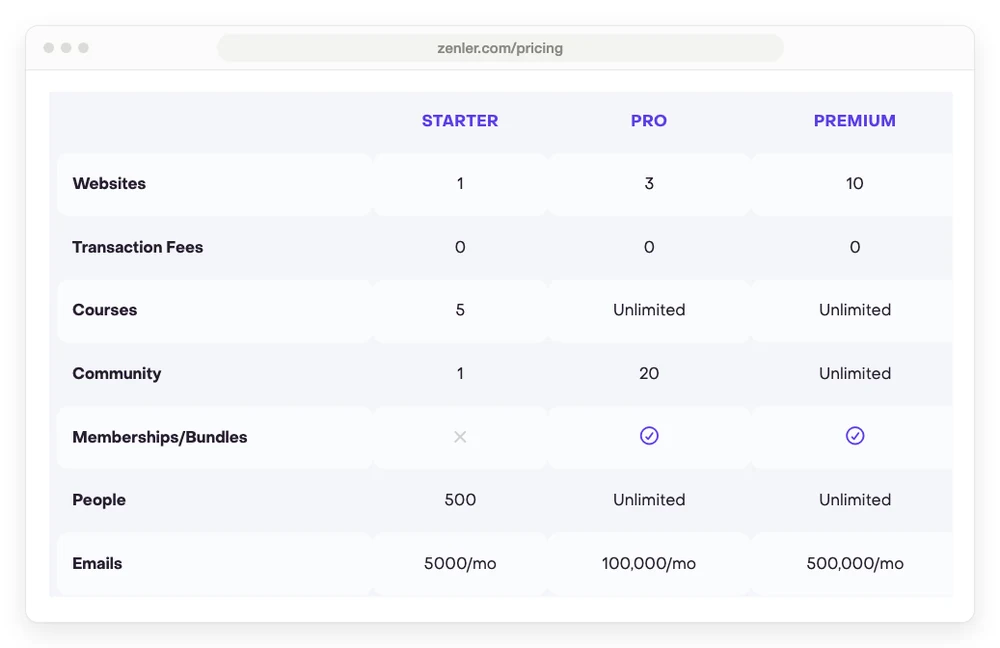
That table sits a scroll away from an FAQ answer on the same page that reads: “The difference between plans is scale – more sites, more emails, more live sessions – not locked features.” Memberships and bundles are a locked feature on Starter, and so are live chat, a custom domain and AI agents.
Zenler’s homepage goes further. It says other platforms get dearer as you grow, then adds “Zenler doesn’t work that way. Unlimited students, no transaction fees, one predictable price.”
The pricing page’s own FAQ is narrower: “Pro plans support unlimited people with no per-student fees.” On Starter, the People row reads 500.
Zenler’s pricing page does not define a “person”. Its help center describes the People tab as every user on your site, “including Site Admins, Instructors, Student, Affiliates, Lead, Assistants, and Support staff.” If the Starter cap counts the same way, the email leads from a free download fill it just as fast as paying students.
2 more Starter limits change how a business looks from the outside:
- No custom domain. Your school lives on a Zenler address like mysite.zenler.com, the format Zenler’s own trial guide uses.
- No memberships or bundles. You cannot package several courses into 1 membership or bundle offer until you move to Pro.
Why other Zenler prices on Google don’t match
Most other Zenler prices you will find come from before the current Starter, Pro and Premium plans. I read every result on the first page of Google for this search.
The 4 web pages that are not Zenler’s own all show at least 1 number Zenler no longer charges, from a $297 top plan to a free plan that keeps 10%.
| Page | What it says | What Zenler shows now |
|---|---|---|
| Teachery, a rival course platform | Starter $67 with a 5% fee, Pro $97 with 2%, Business $297 with 0% | Starter $47 or $57, no Business plan, 0% on every plan |
| SupplyGem | A free plan with a 10% fee, Pro $69, Professional $197 a month | No free plan on the pricing page, Pro $117 a month |
| Course Platforms Review | Pro $647 a year, Premium $1,447 a year, “Still in beta” | Pro $1,164 a year, Premium $3,324 |
| EzyCourse, a rival course platform | $57, $117 and $347 up top, then “$67/month for the Pro plan” and “$197/month” for Premium lower down | Pro $117 and Premium $347 month to month |
EzyCourse gets closest. Its plan headings match the live page, and the old numbers show up only in its “is it worth it” section.
The stale numbers trace back to a few real changes:
- The name. Zenler used to go by New Zenler. newzenler.com now redirects to zenler.com, and all 4 of those guides still use the old name.
- The old offer. Zenler’s $54 a month grandfathered deal ended on August 31. $54 a month comes to $648 a year, within $1 of the $647 Pro price 2 of these pages still print.
- The new plans. Replying to a review on Trustpilot, Zenler wrote that a customer’s access problem “occurred during the rollout of our new pricing plans.”
- The beta label. A Trustpilot reviewer who has been with Zenler for 6 years writes that the company “referred to it as being in Beta for 5+ of those years.”
So when you land on a Zenler price anywhere else, check it against 5 signs of an old page:
- It lists 2 plans instead of 3.
- It names a Business or Professional plan.
- It mentions a free plan with a per-sale fee.
- It puts a transaction fee on any plan.
- It quotes $54 a month, $647 a year or $1,447 a year, or calls Zenler a beta.
Is there a free Zenler plan?
Zenler’s pricing page offers no free plan, only a 30-day free trial of the paid plans.
Zenler’s homepage says the trial comes with “No credit card required.” Zenler’s own trial guide in its help center says the opposite: “A credit card is required at sign-up to activate the trial.”
The same guide says “Billing begins after the trial period ends if the plan is not canceled,” and the card is charged for the plan you picked when you started. So put the trial’s end date in your calendar the day you sign up.
To cancel before the 30 days are up, the guide gives this path: Dashboard, then My Account, then Upgrade, then Cancel Plan. In a reply on Trustpilot, Zenler points to Account Settings, then Billing. 1 reviewer wrote that the cancel section “took me about 3 hours to find.”
Free accounts did exist once. The same guide says “Existing free-plan users can activate the trial,” which fits the free plan SupplyGem describes. It is not on the pricing page now.
The guide also says paid plans “come with a 30-day money-back guarantee during the current beta phase.” Neither the pricing page nor the homepage uses the word beta.
Which Zenler plan should you pick?
Pick Starter only if you sell 5 or fewer courses, to under 500 people, from a Zenler web address, with no memberships or bundles. Move to Pro the day any one of those stops being true.
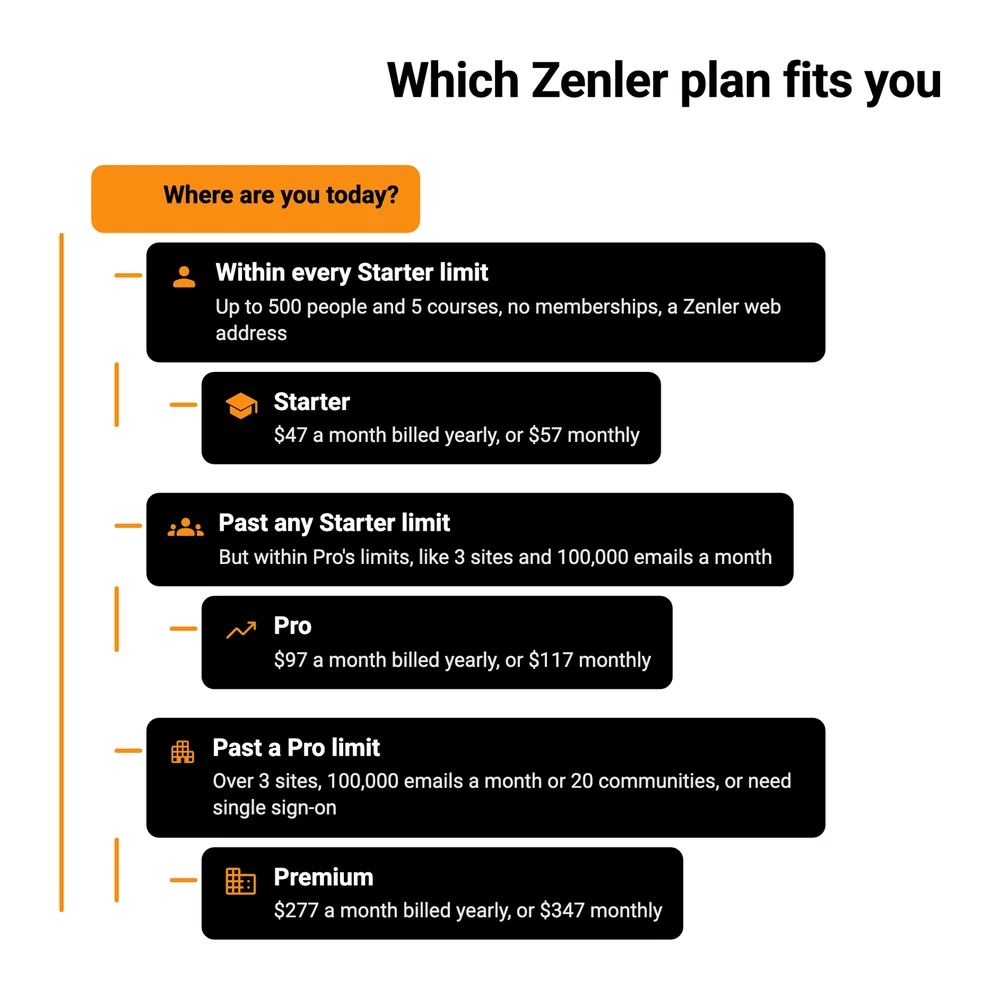
Pro fits most working course businesses. It is $97 a month on yearly billing, or $600 a year more than Starter, and it removes the people cap, the course cap and the membership block in 1 step. To see how that $97 stacks up at the same stage elsewhere, real course platform fees covers 7 platforms and where each one crosses over.
Premium is for businesses that have outgrown Pro on a specific number:
- More than 3 sites.
- More than 100,000 emails a month.
- More than 20 communities or 100 live sessions.
- Single sign-on, or more than 20 instructors and course admins.
If none of those is true for you today, Premium’s extra $2,160 a year buys room you are not using.
When I started taking a lot of sales calls for a service I ran in 2022, I would prep slides and talking points days ahead, for problems that had not shown up yet. Now I prep the day before, or the morning of. The problems I worried about mostly never came, and the ones that did were smaller than I had pictured.
Apply that to Zenler. Start on the plan that fits the business you have today, and upgrade the week a real limit shows up.
The exception is moving over an existing audience. Count before you choose. A list of 1,000 students is already twice Starter’s cap.
And if what you sell is not a course at all, a whole course platform may be more tool than you need. A PDF, a template pack or a paid subscription can sell from a checkout-only tool. CartMango, which I run, is free until October 2026 and then starts at $10 a year, with no per-sale fee.
CartMango does not host courses yet, and its course hosting and community features are planned for October 2026, on the $30 a year plan.
What Zenler’s price doesn’t cover
4 costs sit outside the 3 plan prices.
The branded mobile app. Zenler sells an app with your own name on the App Store and Google Play as an add-on. Its feature page says Zenler builds it, submits it and keeps it running, but neither that page nor the pricing page shows a price.
AI credits. Starter has none. Pro includes 1,500 credits and Premium 3,500, and the pricing page does not list a price for more.
A separate email tool, for some users. Every plan includes email, but 1 user in a r/Teachable thread who moved to Zenler wrote: “I don’t use Zenler for my email system. I use Mailerlite so I haven’t tested that. I export my email list from Zenler each month and import it into Mailerlite and send out from there.”
Another commenter in the same thread said that “Emails are not being sent out for hours (or AT ALL) from marketing funnels or new student enrollments.” If you end up paying for your own email tool, add that bill to Zenler’s price.
Support. Live chat starts on Pro. In a Trustpilot reply, Zenler says it does not offer phone support but runs “live support desks/drop-ins/office-hours and email and chat support”. Its Trustpilot page shows a 4.3 score from 394 reviews.
Still weighing other course hosts? Each course platform’s cut lines up what 6 of them keep per sale.
Zenler pricing next to Kajabi, Teachable and Podia
Billed yearly, Zenler’s $47 Starter plan costs more than Teachable’s $29 Starter and Podia’s $42 Mover, and about a third of Kajabi’s $143 Basic.
Zenler Starter is the only one of these 4 entry plans that keeps 0% of each sale on every processor, against 7.5% on Teachable, 5% on Podia and 2% on Kajabi with an outside processor.
| Platform | Entry plan, billed yearly | Cut on that plan | Entry plan cap | Cheapest plan with no cut |
|---|---|---|---|---|
| Zenler | Starter, $47/mo | 0% | 5 courses, 500 people | Starter, $47/mo |
| Kajabi | Basic, $143/mo | 0% on Kajabi Payments or PayPal, 2% on other processors | 5 products, 2,500 contacts | Basic, $143/mo, on Kajabi Payments or PayPal |
| Teachable | Starter, $29/mo | 7.5% | 5 products | Builder, $69/mo, on teachable:pay or its Monthly Payment Gateway |
| Podia | Mover, $42/mo | 5% | 100 email subscribers | Shaker, $84/mo |
Check the cap column before the price. Podia’s Mover plan holds 100 email subscribers and Kajabi’s Basic holds 2,500 contacts, while Zenler Starter stops at 500 people. Kajabi also keeps 1% on Growth and 0.5% on Pro when you run sales through your own Stripe account, so on Stripe it never reaches 0%.
Each of these has its own deep-dive: Kajabi’s current entry price against Circle, Teachable pricing and Podia pricing.
FAQ
How do I cancel Zenler?
Zenler’s help center gives the path as Dashboard, then My Account, then Upgrade, then Cancel Plan. In a Trustpilot reply, Zenler also points to Account Settings, then Billing. Cancel before day 30 of a trial and you are not charged, and after the trial ends without a plan, your site stays intact but locked until you upgrade.
What is the Zenler app?
The Zenler app is a free iPhone, iPad and Android app from Zenler Ltd that lets students open any Zenler site and take its courses, quizzes and community on their phone. It is separate from the branded mobile app add-on, which puts your own name in the app stores and has no public price.
Is Zenler still in beta?
Zenler’s pricing page does not call it a beta. Its trial guide still offers a 30-day money-back guarantee “during the current beta phase,” and an older review on Google’s first page still calls the platform a beta, next to prices Zenler has since replaced.
Can I still get Zenler for $54 a month?
No. Zenler’s own blog says the $54 a month grandfathered promotion ended on August 31 and is no longer offered. Customers who locked it in earlier keep it, but new accounts start at $47 a month on yearly billing.
Does Zenler charge per student?
No. Zenler has no per-student fee on any plan. Starter caps you at 500 people in total, and Pro and Premium remove the cap, so on yearly billing the cost of growing past 500 is the jump from $564 to $1,164 a year.
Paying for course tools you won’t open
Zenler pricing makes sense when you will use what the plans bundle: courses, a community, live sessions, funnels and email on 1 bill. At $97 a month on yearly billing, Pro covers a lot for a business that runs on all of it.
It makes less sense if what you sell is an ebook, a template pack or a paid subscription, because most of Zenler’s $564 Starter year then goes on course tools you will not use. CartMango is a checkout built for that seller, free until October 2026 and then $10 a year, with order bumps on every plan and no per-sale cut. Start selling there, and come back to Zenler pricing if you ever build a course.
About the Author

👋 I’m Welly, founder of CartMango (the site you’re on), a checkout platform for digital product sellers. We’ve previously processed $179M+. I also run BirdSend (email marketing tool, 3.1B+ emails sent). On the side I show other non-techie digital sellers how I use AI workflows to automate 50%+ of my operations. Find me on LinkedIn.
Related Reading
- Kajabi vs Circle: Kajabi’s current $143 entry plan and the 2% it keeps on an outside processor
- Teachable pricing: every plan, including the 1 missing from the pricing page
- Podia pricing: the 3 plans and the email caps behind each one
- The best course platform: 6 course platforms priced by what each keeps per sale
- LMS for online courses: real fees for 7 platforms and where each one crosses over