

For buyers, a Teachers Pay Teachers alternative is a membership library such as Twinkl, Education.com or Super Teacher Worksheets, or the free OER Commons. For sellers, it is a teacher marketplace such as Classful or Amped Up Learning, or a checkout such as Payhip or CartMango for buyers you bring yourself.
All 4 selling options leave at least as much of a $3 sale as TPT Premium’s $2.40. TPT’s own fee page sets that bar: a Basic Seller pays $29 once and earns 55% minus 30 cents per resource, or $1.35 of $3, and a Premium Seller pays $59.95 a year and earns 80%. Etsy, Gumroad and a new author on Tes keep less than $2.40.
Type this search into Google and 2 different teachers land on the same page. One wants worksheets without paying per download. The other made the worksheets and is tired of watching close to half the price go somewhere else.
Most guides on page 1 come from a company that ranks its own product first. The 2 that state TPT’s cut say 45%, or 25% to 45%. TPT’s own fee page has 6 numbers, and none of those guides mentions the $29 one.
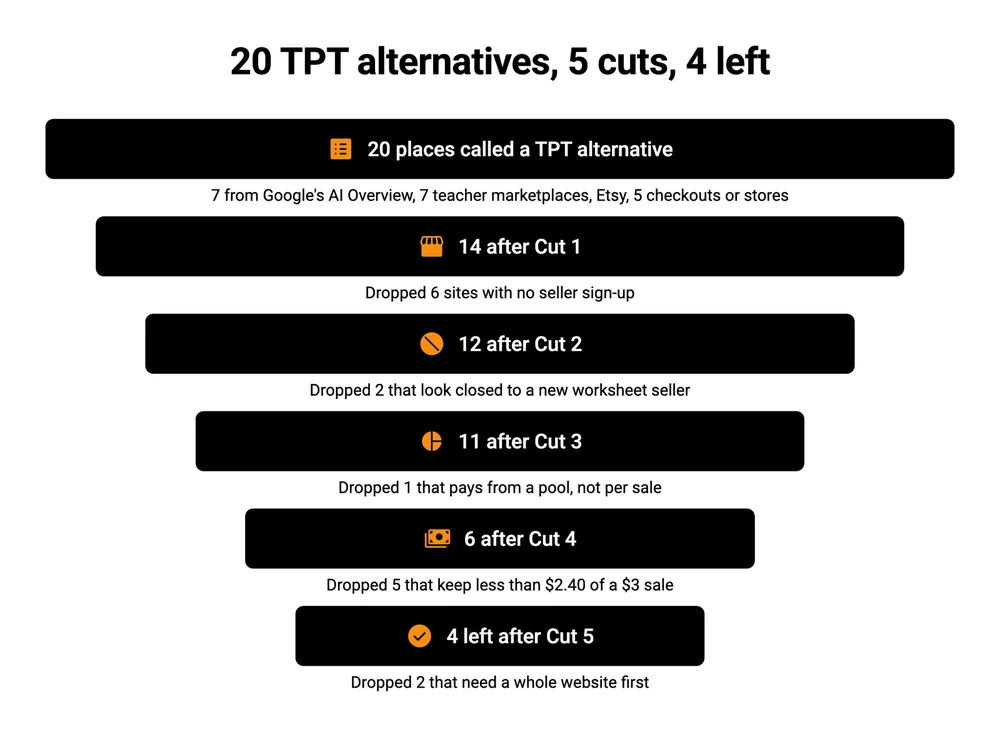
This guide takes 20 places called a TPT alternative and removes them 1 cut at a time. Buyers get their list in Cut 1. Sellers get the 4 that are left, what each keeps of a $3 sale, and the 1 cut I’d skip.
Key Takeaways
- TPT’s real numbers: a Basic Seller pays $29 once and keeps 55% minus 30 cents per resource. Premium costs $59.95 a year and keeps 80%.
- The AI Overview is a buyer’s list: 6 of the 7 sites Google names have no seller sign-up that I could find. Tes is the exception.
- The $3 test removes 5 options: Tes, Gumroad, Teacha, Classmade and Etsy each keep less of a $3 sale than TPT Premium’s $2.40.
- 4 options pass every cut: Amped Up Learning, Classful, Payhip and CartMango, which I run. None shows an audience the size of TPT’s.
- Dropping TPT is the 1 cut to skip: keep it for the buyers it finds, and send the buyers you find yourself to a checkout that keeps more.
Start here: the 20 Teachers Pay Teachers alternatives you will run into
The 20 Teachers Pay Teachers alternatives in this guide come from 4 places, and 6 of the 20 are for buying only. If you are here to buy, Cut 1 is your list.
A note for anyone already selling: the platform’s cut is only 1 of the ways a sale gets lost. The other common ones are covered in the Online Selling Mistakes Challenge, a free 5-day email course on the 5 mistakes solo sellers make most and how to fix each.
Here are the 20.
- Named in Google’s AI Overview (7): Twinkl, Education.com, Tes, Super Teacher Worksheets, ReadWorks, BetterLesson and OER Commons.
- Teacher marketplaces (7): Made By Teachers, Amped Up Learning, Classful, Teach Simple, Boom Learning, Teacha and Classmade.
- General marketplace (1): Etsy.
- Your own checkout or store (5): Payhip, Gumroad, Shopify, WooCommerce and CartMango.
CartMango is mine, so read its numbers the way you’d read any founder’s and check them against the others.
TPT itself is left out of the 20 because it is what every option gets measured against.
What TPT takes, read off its own fee page
TPT pays a Basic Seller 55% of each sale minus 30 cents per resource. It pays a Premium Seller 80%, with a 15 cent fee only on orders under $3.
Those figures come from TPT’s Seller Fees and Payout Rates page. The same table lists what each membership costs: a one-time, non-refundable $29 for Basic and $59.95 a year for Premium.
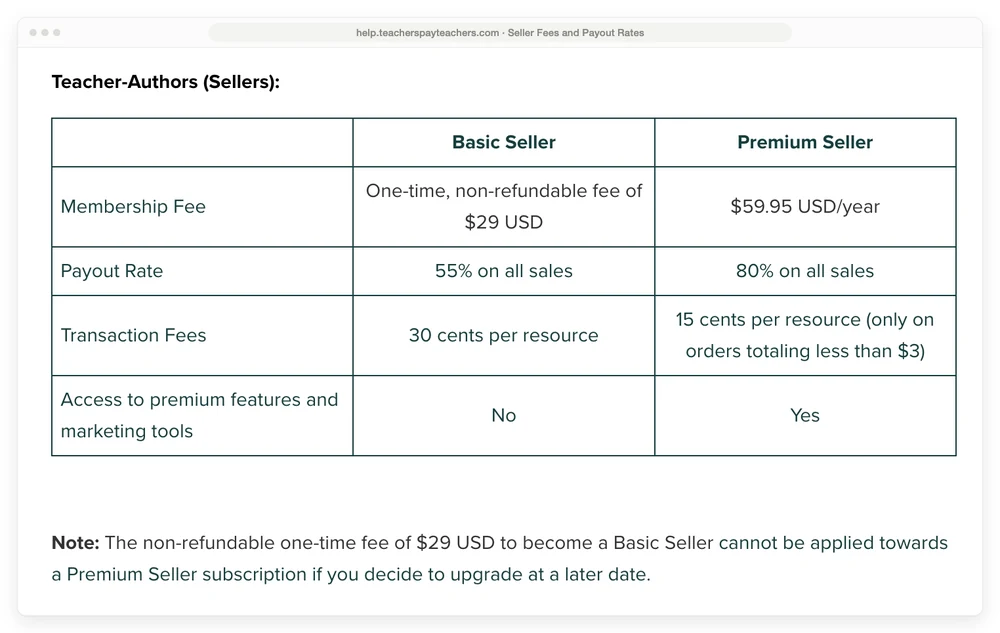
TPT’s Terms of Service say the payout rate is applied to the sale price “before any Transaction Fees or Shipping Charges are applied”, and that earnings are then “reduced by the full amount of any Transaction Fees that apply”. So a Basic Seller’s $3 worksheet pays 55% of $3, which is $1.65, minus 30 cents, or $1.35.
The 45% people quote is the Basic rate with the 30 cents and the $29 left off. In an r/Internationalteachers thread about selling outside TPT, the person who started it wrote that TPT charges “a full 45% for anything you list on there”. Another commenter wrote that with the yearly membership “they only take like 10%”. TPT’s table says 20%.
2 of the guides ranking for this search miss in their own way. Payhip’s page puts TPT’s commission at 25% to 45%, where TPT’s table gives 20% on Premium. Twinkl’s guide says registration is free for teachers looking to sell, where the Basic column shows $29.
Cut 1: set aside the 6 sites that are for buying only
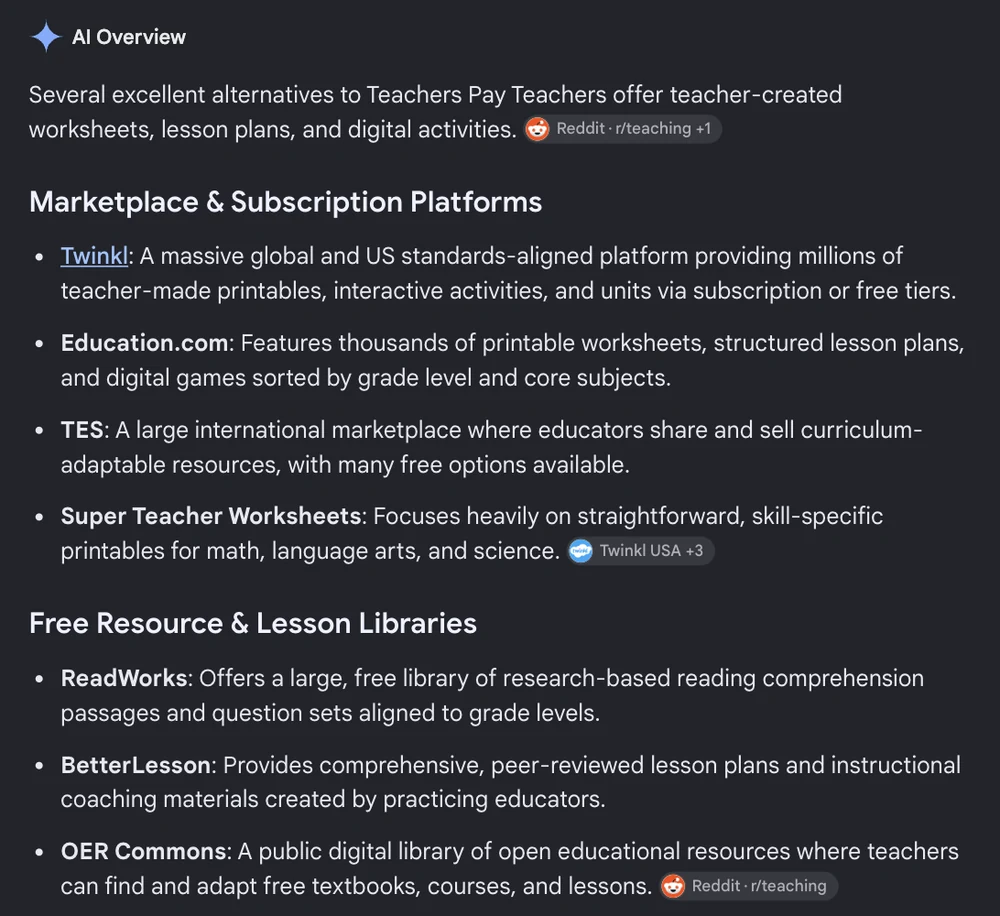
Cut 1 removes Twinkl, Education.com, Super Teacher Worksheets, ReadWorks, BetterLesson and OER Commons, because I could not find a seller sign-up on any of them. These are libraries. You pay a membership or download for free, and the site decides what goes in.
This is also the list Google hands you:
If you are here to buy resources
Buyers leaving TPT have 3 kinds of alternative: a flat membership, a free library, or another teacher marketplace.
- A flat membership. Super Teacher Worksheets is $24.95 a year for 1 teacher. Education.com is $15.99 a month or $119.88 a year. Twinkl sells a membership too, but I could not read a US price for it, so check its pricing page.
- A free library. OER Commons calls itself “free for everyone, forever”. ReadWorks is a nonprofit, and BetterLesson, a teacher training company, publishes free lesson plans.
- Another teacher marketplace. Tes, Classful and Amped Up Learning sell single resources made by teachers, the way TPT does. Teach Simple is a subscription that pays its contributors out of your fee.
On price alone, try the free libraries first. Of the 2 memberships priced here, Super Teacher Worksheets costs about a fifth of Education.com’s yearly rate.
Education.com’s footer calls it a division of IXL Learning, and TPT’s footer lists Education.com under the IXL family of brands, above an IXL Learning copyright line. A move from TPT to Education.com keeps you with the same owner.
Back to sellers
I found no way for a teacher to open a shop on any of the 6. The 1 outsider page I found on Twinkl is a partnerships page for companies and organisations, and OER Commons takes submissions but no prices.
Tes stays in, since it pays authors a royalty. That leaves 14.
Cut 2: drop the 2 that look closed to a new worksheet seller
Cut 2 removes Made By Teachers and Boom Learning, because Made By Teachers looked closed to new sellers and Boom Learning sells a different product.
- Made By Teachers blocks the network I work from, so I read an archived copy of its seller page. That copy is headed “Seller Applications Are Temporarily Paused” and said the site was “not accepting new seller registrations at this time”. Open the page yourself before you rule it out, since it may have reopened.
- Boom Learning sells Boom Cards, its own interactive decks, and its seller help pages cover nothing else that I could find. If you make Boom Cards, keep it on your list. Its 15% store fee leaves $2.55 of a $3 sale before PayPal’s payout fee, which beats TPT Premium.
That leaves 12.
Cut 3: drop the 1 that cannot tell you what a sale pays
Cut 3 removes Teach Simple, because Teach Simple pays contributors from a shared monthly pool instead of paying per sale. Teachers subscribe, and contributors split the pool by points earned when members download their resources. Its contributor page says so in 1 line: “There is no fixed dollar amount per download.”
It can still be worth joining. Teach Simple says it is not exclusive and charges no listing fees, so a resource can sit there and on TPT at once. You just cannot put it in a table of what a $3 resource earns, and you need a $50 balance before you can ask for a payout.
That leaves 11.
Cut 4: the $3 test, which removes 5 more
Cut 4 removes any option that keeps less of a $3 sale than TPT Premium does. That takes out Tes, Gumroad, Teacha, Classmade and Etsy.
I picked $3 because TPT and Tes both draw their own line there: TPT Premium adds 15 cents on orders under $3, and Tes adds 20 cents on resources priced under $3. Flat fees are what hurt at this price. Etsy’s 2 flat charges are 45 cents of its 74 cent bill on a $3 worksheet.
On a $3 sale, 5 options keep less than TPT Premium’s $2.40, from Tes at $1.80 to Etsy at $2.26, and 4 keep as much or more, from Amped Up Learning at $2.40 to CartMango at $2.61.
| Where you sell | Fees per sale | Keep of $3 | Keep of $10 |
|---|---|---|---|
| TPT Basic | 45% + $0.30 per resource | $1.35 | $5.20 |
| TPT Premium | 20% (+ $0.15 on orders under $3) | $2.40 | $8.00 |
| Tes, new author | 40% (+ $0.20 under $3) | $1.80 | $6.00 |
| Gumroad | 10% + $0.50, plus card processing | $1.81 | $7.91 |
| Teacha | 35% | $1.95 | $6.50 |
| Classmade, free plan | 15%, plus card processing | $2.16 | $7.91 |
| Etsy | $0.20 listing + 6.5% + 3% + $0.25 | $2.26 | $8.60 |
| Amped Up Learning | 10% to 20% | $2.40 to $2.70 | $8.00 to $9.00 |
| Classful | 5% + 2.9% + $0.30 | $2.46 | $8.91 |
| Payhip, free plan | 5%, plus card processing | $2.46 | $8.91 |
| CartMango | 0%, plus card processing | $2.61 | $9.41 |
CartMango sits last in that table because CartMango adds no per-sale fee of its own. What CartMango lacks is a marketplace, so it has no buyers of its own. Card processing in that table means 2.9% plus 30 cents on a card payment, which is Stripe’s US card rate and the rate Gumroad’s fee page states.
3 of the 5 that fail have a second problem. Tes starts every author at 60% and only moves to 70% after £1,000 of sales in 12 months, then 80% after £6,000. Teacha pays every second month, and only once you’ve earned R500, a minimum its fee page gives in rand. Classmade’s homepage says “The first stores are being built right now”, and its Pro plan only drops the 15% for $29.99 a month or $299 a year.
Etsy is the close call. Etsy’s fees come to $0.74 on a $3 sale, but on a $10 bundle Etsy leaves $8.60, which beats TPT Premium’s $8.00. If most of what you sell is bundles, put Etsy back in, and read our guide to Etsy for digital products before you price them.
Amped Up Learning’s seller page says contributors earn “80%-90% commission on all their sales”, with 90% during its sales and no monthly fee. The page lists no separate processing charge. At 80% Amped Up Learning ties TPT Premium on a $3 sale without the $59.95, so it passes.
Shopify and WooCommerce pass on per-sale fees too. Shopify’s Basic plan lists a 2% fee for third-party payment providers, and WooCommerce’s pricing page says “no platform fees, no revenue share”. That leaves 6.
Cut 5: drop the 2 that need a whole website first
Cut 5 removes Shopify and WooCommerce, because both ask you to build and pay for a full store before the first worksheet sells. Shopify Basic is $19 a month on yearly billing. That is 12 payments of $19, or $228 a year, against $59.95 a year for TPT Premium.
WooCommerce itself is free to download, but it runs on hosting you pay for. WooCommerce’s own pricing page estimates $25 to $350 a month for most stores, and someone still has to set it up and keep it running.
Both are good tools for a seller with a catalogue, a brand and traffic of their own, and we have guides to selling digital products on Shopify and WooCommerce digital downloads for that stage. For someone testing whether their resources sell outside TPT, a full store is a second job.
That leaves 4.
What is left: 4 places to sell, and how to pick
The 4 options left are Amped Up Learning, Classful, Payhip and CartMango: 2 teacher marketplaces and 2 tools for selling on your own.
Amped Up Learning and Classful cost nothing up front, Payhip’s free plan takes 5% of each sale, and CartMango is free until October 2026, then from $10 a year.
| Option | What it is | Keep of $3 | Fixed cost | The catch |
|---|---|---|---|---|
| Amped Up Learning | Teacher marketplace | $2.40 to $2.70 | None | Its page tells you to email them to set up a store |
| Classful | Teacher marketplace | $2.46 | None | The 30 cent fee lands on every sale, so a $1 item keeps 62 cents |
| Payhip | Your own store | $2.46 | None on the free plan | Its marketplace lists a store only after $10 of sales and a review |
| CartMango | Your own checkout and sales page | $2.61 | Free until October 2026, then from $10 a year | No marketplace. Every buyer is one you bring |
CartMango is the only row here with a fixed yearly cost once its beta ends, and the only one with no marketplace at all.
Which of the 4 fits comes down to where your buyers are right now.
You have no audience outside TPT. Start with Classful or Amped Up Learning, which are marketplaces with their own search, and keep your TPT store open. Classful’s seller page says it will “collect and remit all sales tax on your behalf in every state”, and that you can sell the same products elsewhere.
You already send people from Pinterest, Instagram or an email list. Those clicks can go to Payhip or CartMango, where a sale of $3 or more costs less than it does on TPT Premium. Neither needs a website: Payhip gives you a store, and CartMango’s Mini Pages hosts a sales page that links to your checkout. Teaching resources are mostly PDFs, and our guide to selling PDFs covers pricing and delivery for that kind of file.
Between those 2, the fixed cost decides it. Payhip’s free plan costs nothing until you sell and takes 5% after, and its paid plans cut that to 2% for $29 a month or 0% for $99 a month. CartMango takes no percentage, is free until October 2026 and is $10 a year after that on its base plan, which is less than Payhip’s 5% once you pass $200 of sales in a year.
The 1 cut I would not make: dropping TPT itself
Dropping TPT is the cut I would not make, because none of the 4 options left shows an audience the size of TPT’s on its own pages. TPT’s About page counts more than 7 million educators and more than 1 billion resources downloaded.
So run the numbers on staying first. On a $3 resource, Premium pays $1.05 more per sale than Basic, which covers the $59.95 fee after 58 sales in a year. A brand-new seller pays either $29 or $59.95 to start, so the gap in year 1 is $30.95, or 30 sales.
Then send the buyers you bring somewhere cheaper.
When a teacher clicks your pin or your email and lands on TPT, TPT Premium keeps 20% of a sale you found. Through CartMango the same $10 bundle leaves $9.41, and through Payhip’s free plan $8.91, where TPT Premium leaves $8.00. A commenter in that Reddit thread made the case for keeping both: it “would still IMO be a good move to have a TPT account as well because a sale there is still extra $$ in your bank account”.
1 of the pages ranking for this search is a working example. Meg at The Teacher Studio retired after 33 years in the classroom, opened a shop on her own site, and kept her TPT store.
The reasons she gives are about her buyers. Her own shop can “accept purchase orders, so schools can pay directly”, and she writes that she keeps hearing from teachers who hit roadblocks buying on TPT, and guesses a district rule may be behind some of them.
Bringing the buyers is the hard half, and I say that from doing it. When I started BirdSend, the email tool I also run, I got the first users by cold email. I did the whole cold-email routine myself for about a year, and some of the replies were things like “stop the emails you moron”.
A marketplace fee buys you out of that work. Your own checkout only pays off once you have somewhere to send people from, so if you don’t yet, start with promoting what you already sell.
FAQ
Is TPT too saturated?
Crowded, yes. TPT’s About page counts more than 7 million teacher-created lessons, so a new resource has a lot of neighbours. The same page counts more than 7 million educators. Treat the crowd as a reason to pick a narrow grade and subject and to send your own traffic, more than a reason to leave.
Is Teachers Pay Teachers worth it?
Teachers Pay Teachers is worth it when its buyers find you, because none of the 4 options left in this guide shows an audience that size. On the Basic plan you keep $1.35 of a $3 sale after a one-time $29 fee. On Premium you keep $2.40 for $59.95 a year, which beats Basic after 58 sales of a $3 resource a year, or 30 in your first year.
How to make an extra $1000 a month as a teacher?
At TPT Premium’s 80%, earning $1,000 a month takes $1,250 of sales. That is 417 sales of a $3 resource or 125 sales of a $10 bundle, every month, so it takes a catalogue and steady traffic. For routes beyond selling resources, see these side hustle ideas for teachers and ways to build passive income for teachers.
Can you sell the same resource on TPT and somewhere else?
2 of the alternatives say yes in writing. Classful’s seller page answers “Can I sell my products elsewhere?” with a yes, and Teach Simple says it is not exclusive. Those are the other sites’ rules, so read TPT’s own terms for your account before you cross-list.
Do you need your own website to sell teaching resources?
No. Amped Up Learning and Classful give you a shop page inside their marketplace. Payhip gives you a store, and CartMango’s Mini Pages hosts a sales page that links to your checkout. CartMango does not send you visitors, and Payhip’s marketplace only lists a store after $10 of sales and a review, so plan on a pin, a post or an email to link from.
Where the buyers you find yourself should land
Keep TPT for the teachers who search there.
The buyers who come from your own pins, posts and emails are the ones a Teachers Pay Teachers alternative is for, because on those sales you already did the finding.
CartMango is the checkout I built for those sales. CartMango takes no percentage of the sale, hosts the sales page and delivers the file, and it is free until October 2026, then from $10 a year. CartMango will not find you a single buyer, so start it once you have somewhere to link from.
About the Author

👋 I’m Welly, founder of CartMango (the site you’re on), a checkout platform for digital product sellers. We’ve previously processed $179M+. I also run BirdSend (email marketing tool, 3.1B+ emails sent). On the side I show other non-techie digital sellers how I use AI workflows to automate 50%+ of my operations. Find me on LinkedIn.
Related Reading
- Passive income for teachers: 68 ideas, with teaching resources as only 1 of them
- Side hustle ideas for teachers: 71 ways to earn outside the classroom
- Etsy for digital products: what Etsy really takes at each price, and how to leave
- How to make printables to sell: niche, design, licence and where to list them
- Competitors of Etsy: 15 other places to sell, sorted by type