

Sellfy runs a ready-made shop with merch built in, Shopify runs a full store for physical stock, and CartMango handles digital products only at $10 a year. All 3 sell digital files, so the real split is what each charges as your sales climb. This comparison prices every plan live.
Sellfy sells physical products and print-on-demand merch on every plan it offers. Shopify hands over digital files through its own free app, at no extra cost. Both platforms cover both kinds of product, so sorting them into a digital box and a physical box only gets you part of the way.
If you carry real stock, or if you want a browsable shop with merch in it, the product still picks the platform for you. The sellers who get stuck are the ones in the overlap, and for them the deciding number is the bill. Sellfy raises your plan as your sales grow. Shopify charges the same at $500 a month of sales as at $50,000.
This guide prices both live, digs out the fee sitting behind Sellfy’s 0% headline, and shows what each one actually does when a buyer wants a file.
Key Takeaways
- Both platforms sell both kinds of product. Sellfy includes physical goods and print-on-demand on every plan. Shopify delivers digital files through a free first-party app.
- Sellfy prices you on your revenue. Starter allows $10,000 of sales a year, Business $50,000, Premium $200,000. Shopify sets no cap at any price.
- Sellfy’s 0% transaction fee has a footnote. Go past your cap without upgrading and Sellfy may charge a 2% overage fee on the amount above it.
- The Shopify price most guides quote is dead. Basic is $25 a month, or $19 billed yearly. 5 of the 6 comparisons ranking for this search still say $39 or $29.
- Setup effort is the honest trade. Sellfy has a store running in minutes. Shopify asks for a theme, an app and more decisions, then gives you far more room.
Before you weigh either platform, it helps to know where the money usually leaks. The free 5-day Online Selling Mistakes Challenge walks through the 5 that quietly cost solo digital sellers the most, and none of them is the platform you picked.
What Sellfy and Shopify actually cost
Shopify is cheaper to start and Sellfy is the only 1 of the 2 that limits how much you may sell.
Sellfy Starter is $29 a month with a $10,000 annual sales cap, Shopify Basic is $25 a month with no cap, and CartMango is $10 a year with no cap and no cut of your sales.
| Platform | Entry price | Sales cap | Cut per sale | Physical & POD |
|---|---|---|---|---|
| Sellfy Starter | $29 a month | $10,000 a year | 0%, then 2% above the cap | Yes |
| Shopify Basic | $25 a month | None | 0% on Shopify Payments, 2% on other gateways | Yes |
| CartMango Silver | $10 a year, free until October 2026 | None | 0% | No |
I should be upfront that CartMango is my own platform. That last row is the trade in miniature: CartMango costs about 70 cents a month against Sellfy’s $29, and CartMango is the only 1 of the 3 that cannot sell you a t-shirt.
Card processing sits on top of all 3 and goes to Stripe or PayPal, not to the platform. Stripe charges 2.9% plus 30 cents per successful card charge in the United States, and Sellfy’s own pricing FAQ quotes the same figure.
Both companies publish 2 prices, and the gap between them is easy to trip over. Sellfy’s pricing page loads on the yearly toggle by default, so the first number you see is $22, not $29.
Flip it to monthly and Starter is $29, Business is $79, Premium is $159. Billed yearly those become $22, $59 and $119 a month. Shopify does the same in reverse: Basic is $25 month to month and $19 if you pay for a year.
Every figure in this post is the month-to-month price, on both platforms, so the 2 sit on the same footing.
Almost every guide is quoting a dead Shopify price
This part is worth checking yourself. I opened all 6 comparison articles ranking on page 1 for this exact search and read what each says Shopify Basic costs.
5 of the 6 quote it at $39 a month, or in 1 case $29. Shopify’s own pricing page says $25 month to month, and $19 if you pay yearly. The 6th quotes $19 without mentioning that this is the yearly rate, so a reader comparing it against a monthly figure still walks away misled.
The top-ranking result of the lot has both platforms wrong at once. It lists Sellfy at $19, $49 and $99, and Shopify at $29, $79 and $299. Sellfy has no plan at any of those 3 numbers on either billing cycle.
There is a subtler version of the same problem. Several of these pages put Sellfy’s yearly rate next to Shopify’s monthly rate in the same table, without saying so, which quietly makes Sellfy look cheaper than a like-for-like comparison would.
Google’s own AI summary for this search repeats the stale figure too, and applies it to both platforms at once.
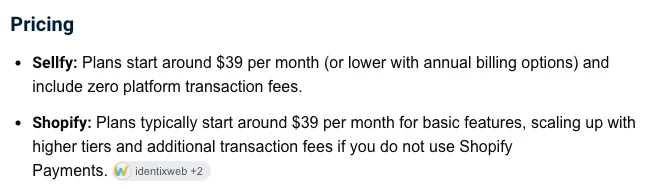
Read the 2 lines carefully. It puts Sellfy at “around $39 per month” and Shopify at “around $39 per month” in the same breath.
Sellfy has no $39 plan on either billing cycle. Shopify’s Basic plan is $25 month to month and $19 paid yearly. The summary also credits Sellfy with “upsells”, which needs a caveat covered further down.
A caution on that screenshot, and it applies to any AI summary you read. These things move: a second reading of the same search, minutes later from a different browser, returned a different set of results and no AI summary at all. Treat it as a snapshot, then go and read the pricing page.
What happens when you cross Sellfy’s sales cap
Sellfy ties your subscription to how much you sell, so a seller doing $12,000 a year pays $79 a month while the same seller on Shopify Basic still pays $25.
Every Sellfy plan carries an annual sales limit. Starter allows $10,000 of sales a year, Business allows $50,000 and Premium allows $200,000. Cross the line and you are expected to move up a plan.
A couple of the better guides do mention those caps. None of them quotes the next line in Sellfy’s own FAQ, which spells out what happens if you cross the cap and stay put. In its own words, “if the account has not upgraded, we may start to charge a 2% overage fee for the amount of revenue that has gone over the subscription plan limits.”
That deserves reading twice, because Sellfy markets itself on 0% transaction fees, and the AI summary above repeats that claim word for word. The zero holds inside your plan’s limit.
Outside it there is a percentage, and it lives in an FAQ answer rather than on the pricing table. Sell $15,000 on Starter without upgrading and the $5,000 above the cap can carry a $100 charge.
$10,000 a year sounds like a lot until you divide it. That is about $834 a month. A seller shifting 30 copies of a $28 template has already crossed it.
At $8,000 of sales Sellfy costs $348 a year against Shopify Basic’s $300, and by $60,000 the same seller pays Sellfy $1,908 while Shopify has not moved.
| Yearly sales | Sellfy plan | Sellfy per year | Shopify per year |
|---|---|---|---|
| $8,000 | Starter, $29 a month | $348 | $300 |
| $12,000 | Business, $79 a month | $948 | $300 |
| $60,000 | Premium, $159 a month | $1,908 | $300 |
2 things stop that table being a knockout blow, and both matter.
The first is that the 2 columns do not buy the same thing. Sellfy Business includes upselling, abandoned cart recovery, an affiliate program and 10,000 email credits a month. Shopify Basic includes none of that natively, so a fair reading is $948 against $300 plus whatever your app stack runs.
The second is that Sellfy’s yearly billing knocks 25% off. Business becomes $59 a month rather than $79, which narrows the gap without closing it.
What the table shows cleanly is the direction of travel. Shopify’s number sits still while your sales grow. Sellfy’s number climbs with them.
How each one hands a file to your buyer
Sellfy delivers digital files as a built-in part of the product, while Shopify delivers them through a separate free app called Shopify Digital Products that you install from its app store.
Both work. They just feel different on day 1.
On Sellfy you upload the file to the product and you are done. File size caps by plan, at 10GB on Starter, 15GB on Business and 20GB on Premium.
On Shopify the first line of the help documentation is “Install Digital Products from the Shopify App Store.” The app is made by Shopify, costs nothing, and Shopify’s documentation confirms there are no additional fees for selling digital products on your online store. 3 limits are worth knowing before you commit:
- Maximum file size is 5 GB, half of Sellfy’s smallest allowance.
- Links are whitelisted. You can sell access to a hosted page instead of a file, but only from Notion, Calendly, Acuity, Kajabi, Teachable, Thinkific, Google Drive or Docs, Dropbox, Canva, YouTube, Vimeo and Figma. Shopify’s documentation is blunt about the rest: “Links from any other website aren’t accepted.”
- Editing a file breaks old links. Shopify warns that if you edit or delete a digital file, any customer who already bought it loses access through their download link.
Subscriptions follow the same pattern on Shopify. Recurring billing arrives through a free first-party Shopify Subscriptions app rather than a switch in settings. Sellfy includes subscriptions on all 3 plans.
The app that sellers think was cancelled
A live piece of misinformation is floating around this exact decision, and it is worth clearing up.
In a thread on r/shopify, a seller adding digital designs to their store wrote that while researching file delivery, “I found that Shopify’s ‘Digital Downloads’ app was recommended… when I looked for it, I found that the app is being discontinued.” Another commenter went further and told them to use SendOwl or FetchApp instead, because the Shopify app was on its way out.
It is not. A longtime user pushed back in the thread with the plain version: “I’ve had the app for over 7 years without any issues.”
The app store listing settles it.
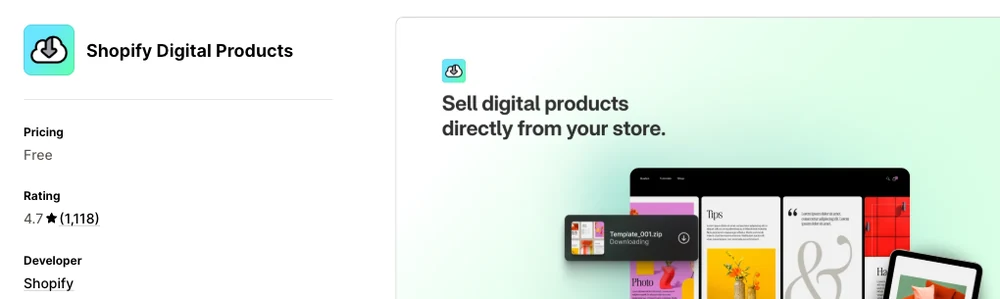
Free, rated 4.7 across 1,118 reviews, built by Shopify and carrying the Built for Shopify badge. The likely source of the confusion is a rename: the app used to be called Digital Downloads and is now called Shopify Digital Products, while the app store address still ends in digital-downloads.
Search the old name, find something that looks abandoned, draw the wrong conclusion. Worth the 2 minutes to check yourself before you rule out a platform over it. Our roundup of digital delivery systems covers the same ground across more tools.
What each one is genuinely better at
Each platform has a clear strength and a clear weak spot. Both sections below name the weak spot as well as the strength, because that is the half you will feel once you have committed.
Where Shopify pulls ahead
Shopify’s advantage is room to grow. There is no sales cap on any plan, so the $25 you pay in month 1 is the $25 you pay after a good year.
Inventory tracking, shipping rates, a point of sale system and a very large app store are all there when you need them, and print-on-demand plugs in through partners in that app store rather than being built in. If merch is the reason you are here, our breakdown of how to sell digital art compares the print-on-demand route against straight downloads with the fee maths on both.
Design is the other clear win. Shopify runs a whole theme store and lets you edit the underlying code, so a Shopify storefront can be made to look like almost anything.
The cost of all that is decisions. A Shopify store expects you to choose a theme, install apps and wire things together, which is why the honest version of “Shopify scales” comes with “and takes longer to set up”.
Support runs 24/7 live chat on Basic and Grow, and enhanced live chat on Advanced.
The number Shopify will not give you up front is its card rate. Its pricing page says only that “Shopify charges a small fee to allow you to accept major credit cards, such as Visa and Mastercard, as payment in your store. These fees vary depending on the plan that you choose.”
Sellfy names its figure in an FAQ. Shopify makes you go looking.
Where Sellfy pulls ahead
Sellfy’s advantage is speed, and it is a real one. A store with a product on it is genuinely a matter of minutes, and the marketing tools that Shopify sends you to the app store for are already switched on. Email marketing comes with credits included, at 2,000 a month on Starter and 50,000 on Premium.
Print-on-demand is built in on every plan rather than bolted on, so merch and digital files sit in the same store with no app to install.
Design is the flip side of that speed. Sellfy gives every plan a store editor, themes, a custom domain and the ability to apply custom code, which covers most sellers. What it does not give you is Shopify’s depth of themes, and removing the “Sellfy” branding needs the $79 Business plan.
Support is 24/7 email on every plan, with priority support reserved for Premium. There is no live chat at any tier.
2 further limits are worth knowing before you assume the built-in tools cover you.
Starter, the plan almost everyone starts on, does not include product upselling, abandoned cart recovery or the affiliate program. Those begin at Business, at $79 a month. Since 70.22% of online carts get abandoned on average, a figure Baymard calculates across 50 separate studies, abandoned cart recovery sitting behind the second tier is a real gap on the cheapest plan.
The other limit is the 1 the AI summary got loose with. Sellfy’s upselling happens on the shop floor: its own documentation describes the feature as offering customers deals “while they are shopping in your store”, working on the store page and on individual product pages.
The buyer sees that offer before they pay. On a checkout platform, upsells and downsells mean a separate step after the payment goes through, where you present a second product to someone who has already got their card out. Sellfy’s docs also confirm the feature “is not available in the Sell Downloads app, with the Starter plan or other discontinued plans.”
Which one fits what you sell
Work down these in order and most people land in the first 3 lines.
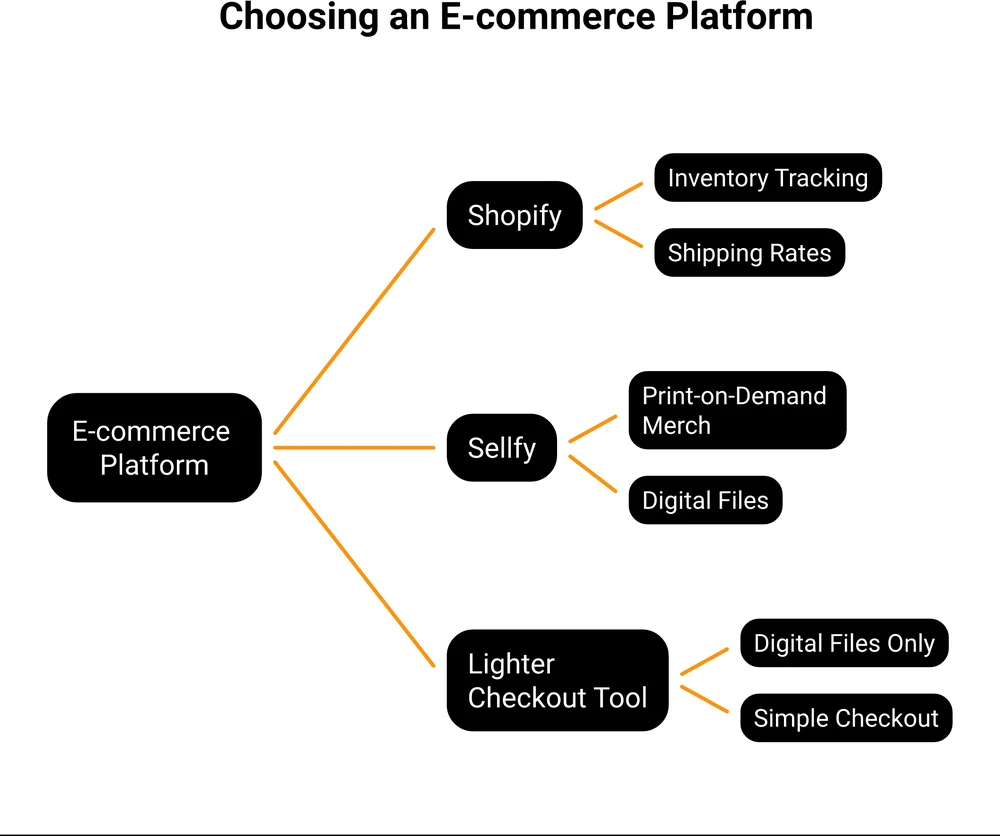
You sell physical stock, or want to. Shopify, comfortably. Inventory, shipping, retail and a decade of tooling built around moving objects.
You want a browsable shop with merch alongside your files, up and running today. Sellfy. Print-on-demand and digital sit in the same store, and you will be selling before a Shopify theme is chosen. Worth weighing against a marketplace too, since neither platform brings you buyers: our list of where to sell besides Etsy covers the trade between traffic you rent and a shop you own.
You are past $10,000 a year and everything you sell is a file. This is the interesting case, because $79 a month buys you a storefront, and a storefront is the part of Sellfy you are using least.
That last case is where a lighter tool is worth a look. Payhip, Gumroad and CartMango are all checkout-led rather than store-led, and all 3 cost a fraction of a Sellfy or Shopify plan. Their fee models differ a lot, so compare them properly: Gumroad takes 10% plus 50 cents of every sale, Payhip takes 5% on its free plan, and CartMango takes nothing per sale.
CartMango runs $10 a year on Silver and is free until October 2026, with order bumps on every plan and hosted sales pages called Mini Pages so you do not need a website of your own. Upsells, downsells and cart abandonment sit on the $20 Gold plan.
What CartMango does not do is the thing Sellfy and Shopify both do: no physical products, no inventory, no print-on-demand. If merch is part of your plan, this is the wrong shelf and 1 of the other 2 is your answer.
For the wider view of that category, we compared the main options for an online store for digital products, and there is a separate walkthrough on selling without a website.
Sellfy vs Shopify FAQ
How much does Shopify take from a $100 sale?
On a $100 digital sale through Shopify Payments, Shopify’s own platform cut is nothing. Use a different gateway such as PayPal and Basic adds 2%, so $2. Card processing is separate and goes to the processor, and Shopify does not publish its card rate on its pricing page. On Sellfy the platform takes nothing inside your cap, and at Stripe’s US rate of 2.9% plus 30 cents a $100 sale costs you $3.20 in processing.
Can I make money on Sellfy?
Yes, and the plan you need is set by how much you make. Starter at $29 a month covers up to $10,000 of sales a year with no platform commission, then Business is $79 and Premium is $159. Sellfy may apply a 2% overage fee on revenue above your cap if you do not upgrade, so the arithmetic that matters is subscription plus processing.
Is Sellfy a good platform?
For a solo seller who wants a working shop today, mixing digital files with print-on-demand merch, it is one of the fastest ways to get there. The 2 things people underestimate are the annual sales cap and how much sits behind the Business tier, including upselling, abandoned cart recovery and the affiliate program. Judge it on the plan your revenue puts you on rather than on the entry price.
Is there anything better than Shopify?
Better depends entirely on what you are selling. Shopify is hard to beat for physical inventory at scale, with inventory tracking, shipping rates and a point of sale system built in. If everything you sell is a digital file, a full store is more machinery than the job needs, and a checkout platform like Payhip, Gumroad or CartMango costs a fraction of a Shopify plan. For a comparison inside that lighter category, see our Sellfy alternative breakdown and our look at whether Sellfy is legit.
Does Shopify charge extra for digital products?
No. The Shopify Digital Products app is free, made by Shopify, and Shopify’s documentation states there are no additional fees for selling digital products on your online store. What you get instead of a fee is a set of limits: a 5 GB maximum file size, a closed list of providers for link-based products, and broken download links for past buyers if you edit or replace a file.
When the bill stops tracking your sales
Pick between Sellfy and Shopify on what you sell and how fast you want to be live, and you will do fine either way. Both are real platforms with real sellers on them.
Either way you are buying a shop. Sellfy charges more for it as you sell more. Shopify keeps the price flat and asks you to build the rest out of apps. Held against your own numbers, Sellfy vs Shopify comes down to how much shop you are willing to fund.
If the answer is not much, CartMango is $10 a year, free until the beta ends in October 2026, takes nothing per sale, and hands your buyer the file.
About the Author

👋 I’m Welly, founder of CartMango (the site you’re on), a checkout platform for digital product sellers. We’ve previously processed $179M+. I also run BirdSend (email marketing tool, 3.1B+ emails sent). On the side I show other non-techie digital sellers how I use AI workflows to automate 50%+ of my operations. Find me on LinkedIn.
Related Reading
- Sellfy vs Payhip: the same cap-versus-commission question against a cheaper rival
- Gumroad vs Sellfy: a per-sale cut weighed against a monthly plan
- Digital product pricing: how to set the price your platform then takes a slice of
- Protect digital downloads: 8 ways to stop your files being passed around