
You can sell poetry online in 2 ways. Sell single, unpublished poems to paying literary magazines, where Poetry magazine pays $500 a poem and Rattle pays $200 in print. Or turn your poems into an ebook, PDF chapbook or print and sell it through Amazon KDP, Etsy or your own checkout.
After fees, a $7 poetry ebook leaves you about $4.80 on Amazon KDP, $5.88 on Etsy, $5.30 on Gumroad (10% + $0.50), $6.15 on Payhip’s free plan (5%) and $6.50 on CartMango, which I run (0% per sale, free right now, from $10 a year once paid plans start in November). But 3 of 5 paying magazines checked here refuse poems already posted online.
I’m no poet. In a 2022 email to my list I admitted I’m “VERY bad at describing details”. My whole description of a mountain view stopped at “The mountain air is so fresh” plus 1 more adjective.
What I do know is selling things online. And poets get a rough deal on the selling side. Pay rates that a big magazine has already replaced still sit on page 1 of Google for this search.
So this post splits selling poetry into 5 jobs. 4 are the obvious ones: getting paid for a single poem, turning poems into a product, finding readers and taking the money.
The 5th is the one most guides skip: getting paid twice for the same poem.
Key Takeaways
- Posting a poem can cost you the sale. Poetry magazine, AGNI and Palette Poetry refuse poems that have appeared online. Rattle accepts poems you posted yourself.
- Magazines pay per poem. Poetry magazine pays a flat $500 per text poem, Rattle $200 in print, The Threepenny Review $200 and Palette Poetry $50.
- Old rates still circulate. 2 guides on page 1 and a Google answer still quote Poetry’s retired rate of $10 a line.
- Etsy’s poetry results are crowded. On its first page of digital “poetry book” listings, only 16 of 56 were the seller’s own poems, and 21 were tools for writers.
- The platform decides your ebook margin. On a $7 poetry ebook you keep $4.80 on Amazon KDP, $5.88 on Etsy and $6.50 on CartMango.
Getting paid for a single poem
Literary magazines pay for single poems, from $50 at Palette Poetry to a flat $500 at Poetry magazine, published by the Poetry Foundation. That is real money for something that might be 14 lines long, and some of the hardest money in poetry to get.
If you plan to sell a collection of your own as well, it helps to know where first-time sellers lose money before you set anything up. That is what the Online Selling Mistakes Challenge covers, 1 mistake a day for 5 days, free.
Poetry says on its submission page that it receives more than 100,000 poems a year and can take up to a year to reply. Here is how the 5 paying magazines checked for this post compare.
Poetry pays the most of the 5, at $500, and only Rattle says it takes a poem you have already posted.
| Magazine | Pays per poem | Cost to submit | When it reads | Takes poems already posted online? |
|---|---|---|---|---|
| Poetry | $500 flat for a text poem | Free | All year except June 15 to September 15 | No, any online appearance counts as published |
| Rattle | $200 in print, $100 online | Free | All year | Yes, if you only posted it yourself |
| The Threepenny Review | $200 | No fee listed | January 1 to April 14 | Not stated, and no previously published work |
| AGNI | $50 a page, up to $300 | $3 online, waived on request | September 1 to December 15, and January 15 to May 31 | No, including websites and social feeds |
| Palette Poetry | $50 a poem, up to $150 | Free for Featured Poetry | All year | No, a blog or social media post counts |
Contests are the other paid route. Rattle enters every free submission for its annual Neil Postman Award for Metaphor, a $2,000 prize, while Palette’s Ouroboros Prize charges a $20 reading fee.
The Poetry rate 2 page-1 guides still get wrong
Poetry changed how it pays, and some of page 1 has not caught up. In January 2025 its page offered “$10/line with a minimum payment of $300 per poem”. By December 2025 the minimum was $400. From its March 2026 issue it pays a flat $500 for every text poem, according to archived copies and the live one.
2 of the guides ranking on page 1 still quote the per-line rate. So does a Google answer on the same results page.
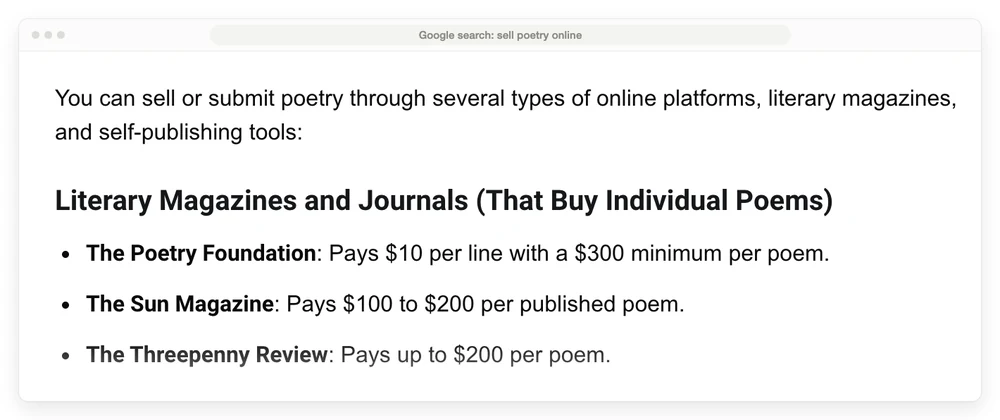
Google’s answer under “What is the best website to sell poems on?”. Look at the Poetry Foundation line: that per-line rate is 2 versions old. Google’s main AI Overview on the same page gives the correct $500.
A 60-line poem earned $600 under the old rate and earns $500 now, while anything under 50 lines earns more.
AGNI has the same problem: a page-1 guide and that Google answer say $40 a page, while AGNI pays $50, up to $300.
What poets say about the money
In a 2021 r/writing thread, a commenter described a friend who was a Yale Younger Poet. When the company that writes the SAT paid her $500 for a poem, “it was 5 times as much as her highest prior payment. She had whole books that only paid her $500.”
A reply further down, from someone who used to submit by post, put the cost side bluntly: “this is costing me more in postage than I get back every year.” Reading fees do the same job today. At AGNI’s $3, 30 submissions cost $90 before a single acceptance, unless you ask for the waiver.
So treat magazines as the place a poem earns credibility and its first payment.
Turning poems into something people buy
Poems reach paying readers in 4 forms: an ebook or PDF chapbook, a printed book, a single-poem print, and a custom poem. A chapbook is a short collection of poems, smaller than a full book.
- A PDF chapbook or ebook. Your poems laid out and exported as a PDF or EPUB. Making an extra copy costs nothing, and the file delivers itself. Our guide to making and selling an ebook covers the layout side.
- A printed collection. Usually through Amazon KDP’s paperback option, which prints each copy when it sells. Amazon pays 50% or 60% of the list price depending on the price, minus the printing cost, as our breakdown of KDP royalties shows.
- A single poem as a print or printable. Short poems work best. A poet in the r/writing thread above said you often end up using 1 or 2 lines on merchandise, while frames, canvas and greeting cards fit more.
- Custom poems. Weddings, memorials, anniversaries. You write to a brief, so you are selling a service, and you set the price per poem.
I wanted to know what poetry sells for as a download, so I read the first page of Etsy’s results for “poetry book” with the digital downloads filter on, in US dollars. There were 56 listings, and I sorted them by what each title says it is.
16 of the 56 were collections of the seller’s own poems, and 21 were tools for writers who self-publish.
| What the listing is | Listings | Median price | Price range |
|---|---|---|---|
| A collection of the seller’s own poems | 16 | $6.52 | $1.60 to $15.00 |
| A tool for writers (book templates, covers, social media templates, a guide, a workshop) | 21 | $7.79 | $4.84 to $180.00 |
| Something else (classic poems, teaching packs, quote pages, unrelated) | 15 | $4.97 | $1.87 to $14.08 |
| Hard to tell from the title, or a custom poem | 4 | n/a | n/a |
2 things come out of that sample. The 16 collections had a median price of $6.52, so a price in that range will not look out of place for a first download. And on this search, a buyer sees more tools for writers than collections of a seller’s own poems, so do not count on Etsy search alone to find your readers.
You do not need Etsy to sell a PDF chapbook. CartMango, Gumroad and Payhip all host a product page for you, take the payment and deliver the file, so a link in your bio is enough. CartMango’s sales page tool, Mini Pages, also means you do not need a website of your own, which our guide to selling without a website covers. For setting the number itself, see how to price digital products.
Finding readers who will pay
You reach poetry readers through 3 routes: social media, an email list and live readings. Poetry readers exist in real numbers. In 2022, 9.2% of US adults, about 22.4 million people, read poetry in the previous year, according to the National Endowment for the Arts, and 11.5% read or listened to it.
A product page on your own checkout gets only the visitors you send it.
- Social media. Posting on Instagram, TikTok or a blog is a cheap way to put poems in front of strangers. The cost is the magazine rule above: a poem you post there is published as far as Poetry, AGNI and Palette are concerned. Post the poems you do not plan to submit.
- An email list. Every reader who signs up is someone you can tell about your next collection. Substack is free until you charge for a newsletter, then keeps 10% of subscription revenue plus card fees. BirdSend, an email tool I also run, has no free plan: after a 7-day trial it costs $90 a year for up to 1,000 contacts, and it takes no cut of anything you sell.
- Readings and events. A commenter in the same Reddit thread who has sold a few hundred copies of a self-published book in person put it simply: “as many events as you go to is as many times as you have a chance to sell it at.”
Whatever you choose, collect emails. If an app changes its rules or closes your account, your followers stay behind, while your email list comes with you.
Taking the money and delivering the file
You keep between $4.80 and $6.50 of a $7 poetry ebook, depending on where it sells, a gap of $170 for every 100 copies.
On a $7 poetry ebook you keep $4.80 on Amazon KDP, $5.88 on Etsy, $5.30 on Gumroad, $6.15 on Payhip’s free plan and $6.50 on CartMango, card fees included.
| Where it sells | Platform cut | Card fee | You keep | Shoppers built in? |
|---|---|---|---|---|
| Amazon KDP, 70% option | 30%, plus $0.15 per MB delivery | Included | $4.80 | Yes, Amazon search |
| Etsy | $0.20 listing plus 6.5% | 3% plus $0.25 | $5.88 | Yes, Etsy search |
| Gumroad, your own link | 10% plus $0.50 | 2.9% plus $0.30 | $5.30 | Only through Discover, at 30% |
| Payhip, free plan | 5% | 2.9% plus $0.30 | $6.15 | No |
| CartMango | 0% | 2.9% plus $0.30 | $6.50 | No |
CartMango is mine, so check that row against the others. From November it also costs from $10 a year, so on $7 ebooks it comes out ahead after about 9 sales a year against Gumroad, 17 against Etsy and 29 against Payhip’s free plan. Below 29 sales a year, Payhip’s free plan keeps more.
The KDP row assumes a 1 MB file sold on Amazon.com, and a text-only poetry file is often smaller, which costs a little less. Amazon pays 70% of what is left after the $0.15 per MB delivery cost, per its digital book pricing page. The Etsy figures come from its fees policy and US card rate. If one of Etsy’s Offsite Ads brings the sale, add 15% and you keep $4.83.
Gumroad’s own help center says its 10% plus $0.50 “does not include” card processing, and a sale through its Discover marketplace costs a flat 30% instead. The card fee on the last 3 rows is the standard US rate of 2.9% plus 30 cents that Stripe publishes.
Amazon and Etsy put your book in front of shoppers who are already searching. Gumroad, Payhip and CartMango mostly leave finding readers to you, and their own cut of a $7 sale is $1.20, $0.35 and $0, before card fees.
Gumroad, Payhip and CartMango all protect the download link after a sale. It still helps to protect the ebook itself with your name on every page.
The job most guides skip: getting paid twice for the same poem
You can sell the same poem twice: first to a magazine, then inside your own collection, in that order.
Reverse the order and most of the magazine route closes. Rattle says outright that it will not take poems from books or collections available to the public, and Poetry, AGNI and Palette refuse anything that has appeared online.
The guides on page 1 list magazines and selling platforms side by side. The longest of them tells poets to start a blog, sell on Etsy and self-publish a chapbook, a few screens after listing magazines that reject anything posted online. Here is what each magazine’s own guidelines say about a poem that has already been out in the world.
- Poetry: “Work that has appeared online for any reason, including social media posts, is considered previously published and should not be submitted.”
- AGNI: it will not consider work already published “on an app, a website, a social media feed, online video, or a publicly accessible virtual community.”
- Palette Poetry: “If your poem has been published in a journal, on a blog, or on social media, it is not eligible.”
- Rattle: poems “may be self-published on social media, blogs, or message boards, but cannot have been published in books, magazines, or similar collections available to the public.”
- The Threepenny Review: it does not print “material that has previously been published elsewhere” and does not consider simultaneous submissions.
Once a magazine has published the poem, the rights usually come back to you. Most of these magazines buy first rights, which Rattle defines as being “the first publisher to present the poems to the public”, and AGNI buys “first worldwide serial rights”. The Threepenny Review says “the copyright then reverts to the author immediately upon publication”, while Palette holds first publication rights for 3 months before they revert.
So the order that pays twice runs like this. Keep your strongest poems off social media and off any page you sell. Submit them to magazines that pay, starting with the free ones. Post and sell the rest. Once you have enough published poems for a collection, and any holding period has passed, put them in an ebook or paperback. Credit each magazine where a poem first appeared, then sell it yourself.
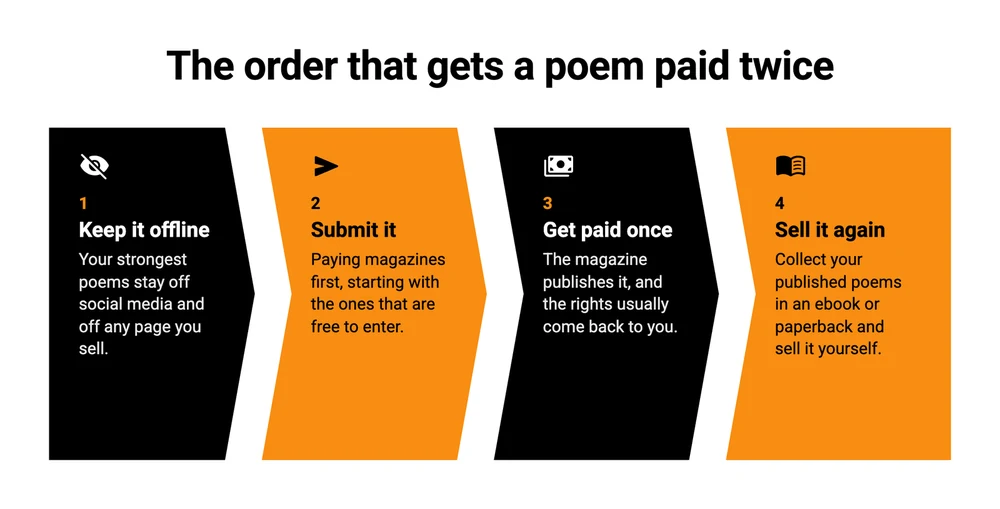
Skip the first step and you lose the first payment and the magazine’s readers. The poem can still go into your collection, and if it has only been on your own social media or blog, Rattle will still read it.
How each way to sell poetry online handles the jobs
No single route does every job. Magazines are the only route here that pays per poem, Amazon and Etsy show your book to shoppers by default, Gumroad does so only through its 30% Discover marketplace, and on a $7 ebook the per-sale fees run from $2.20 on Amazon KDP down to $0.50 in card fees on CartMango.
| Route | Pays per poem | Brings readers | Takes the money and delivers | Still open to magazines after? | Fees on a $7 ebook |
|---|---|---|---|---|---|
| Literary magazines | $50 to $500 | Yes, its own readers | They pay you | No, but you can reprint it in your own book | Free to $3 a submission |
| Amazon KDP | No | Yes, Amazon search | Yes | Unlikely, a book counts as published | $2.20 |
| Etsy | No | Yes, Etsy search | Yes | Unlikely | $1.12 |
| Gumroad | No | Only through Discover, at 30% | Yes | Unlikely | $1.70 |
| Payhip | No | No | Yes | Unlikely | $0.85 |
| CartMango | No | No | Yes | Unlikely | $0.50, plus from $10 a year once paid plans start in November |
The mix that covers every job is 2 routes. Magazines for the poems you are proudest of, and a single place to sell the collection, chosen by whether you need the shoppers or already have readers. To compare ebook platforms in more depth, start with platforms to sell ebooks or the KDP alternatives roundup.
FAQ
What is the best website to sell poems on?
For a single unpublished poem, Poetry magazine pays the most of the 5 magazines checked here, at $500, and Rattle and The Threepenny Review pay $200. For a finished collection, Amazon KDP and Etsy bring shoppers but take $2.20 and $1.12 of a $7 ebook. Payhip and CartMango leave you more of each sale, but you bring every reader yourself.
Can I make money selling poetry?
Yes, in modest amounts. As a commenter in the r/writing thread above put it, “almost no one makes a living as [a poet]”. Magazines pay $50 to $500 a poem, and the poetry collections in the Etsy sample above had a median price of $6.52. The realistic plan combines 2 routes: magazine payments for your best work and a collection sold to readers you found yourself.
Can I sell a poem I wrote, and do I need to copyright it first?
Yes, and you do not need to register anything first. In the US your poem is protected by copyright “the moment it is created and fixed in a tangible form”, according to the US Copyright Office. Registration is voluntary, though you have to register a US work before you can sue someone for copying it.
Can I self-publish my poetry?
Yes. You can sell a PDF chapbook or ebook through your own checkout or Etsy, or publish a paperback through Amazon KDP, which pays 50% or 60% of the list price minus printing. Rattle will not take a poem that is already in a book, and Poetry, AGNI and Palette refuse poems that have appeared online, so publish the collection after the magazines have had their turn.
How do I get my poetry noticed?
Start with paying magazines that are free to enter, such as Rattle and Palette Poetry’s Featured Poetry, since a magazine credit puts your poem in front of its readers. Then build your own readers with the poems you post on social media, live readings and an email list, which is where a collection eventually sells.
Is there still a market for poetry?
Yes. The National Endowment for the Arts found that 9.2% of US adults, about 22.4 million people, read poetry in its 2022 survey, and 11.5% read or listened to it. That is a real audience, but plan on reaching your readers directly rather than waiting for browsing shoppers to find you.
Selling the collection after the magazines have had their turn
If you sell poetry online in the order above, you end up with the poems magazines took and paid for, plus the ones you posted along the way. Together they make the collection you sell yourself, and the platform you pick decides how much of each copy you keep.
CartMango is built for that part. It hosts the page, takes the payment and delivers the file, and CartMango takes no cut of your sales, so on a $7 ebook only the $0.50 card fee comes off. CartMango is free right now, with paid plans from $10 a year starting in November.
About the Author

👋 I’m Welly, founder of CartMango (the site you’re on), a checkout platform for digital product sellers. We’ve previously processed $179M+. I also run BirdSend (email marketing tool, 3.1B+ emails sent). On the side I show other non-techie digital sellers how I use AI workflows to automate 50%+ of my operations. Find me on LinkedIn.
Related Reading
- How to sell PDFs: what PDFs sell for and what you keep on each route
- How to make and sell an ebook: from manuscript to a file buyers can download
- KDP royalties: every Amazon rate, the delivery cost and what a paperback pays
- Etsy for digital products: the full fee math before you sell poetry online through Etsy
- Platforms to sell ebooks: when you are ready to compare ebook stores