

Payhip suits a seller who wants a store live today for 5% a sale, Shopify one with physical stock at $25 a month or $19 billed yearly, and CartMango one that needs only a checkout at $10 a year. Payhip vs Shopify turns on when a percentage stops beating a subscription. Every price below was read at the vendor’s own page.
I went to check what Shopify charges before writing this, expecting a 2 minute job. The subscription price took 10 seconds. The card processing rate took 20 minutes and I still could not find it.
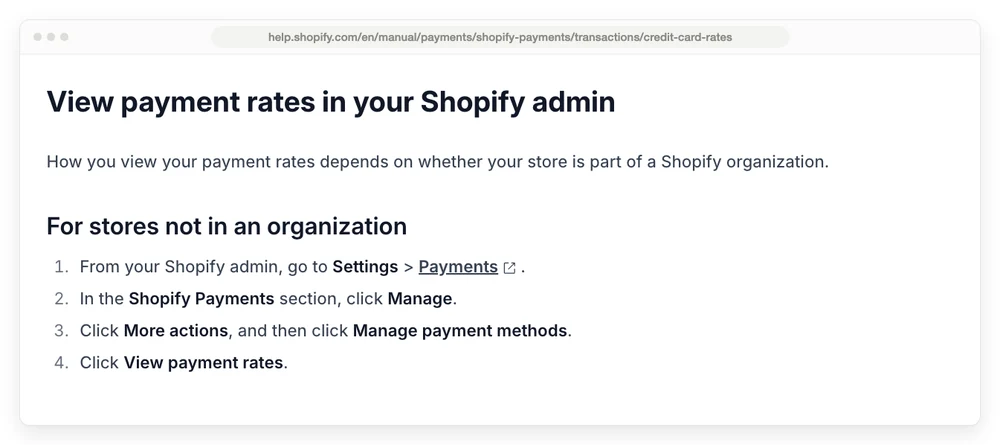
Shopify has a help page titled “Shopify Payments rates in the United States by card type”. It lists no rates at all. Instead it tells you to log into an account you do not have yet and click through 4 screens to see your own.
Then I read the guides ranking for this comparison. Every one of them quotes a Shopify price that is no longer real, and they do not even agree on which wrong number to use.
So this post does the boring thing. Every figure below came from the vendor’s own page, and where a number genuinely is not published anywhere, it says so.
Key Takeaways
- Shopify Basic is $25 a month, or $19 a month billed yearly. 6 guides ranking for this comparison quote a higher, retired price instead.
- Payhip publishes its whole fee schedule on 1 page. Free is $0 plus 5% a sale, Plus is $29 plus 2%, Pro is $99 plus nothing.
- Shopify does not publish its card processing rate anywhere public. You have to open an account and click through 4 screens to see yours.
- Shopify sells digital files through a free app it builds itself, capped at 5 GB a file, with links accepted from 12 named providers only.
- Payhip cannot bill a subscription through PayPal, and recurring payments are limited to bundles, memberships, courses and coaching products.
Before the numbers, if you would rather find your own profit leaks first, the free 5-day Online Selling Mistakes Challenge walks through the 5 mistakes that quietly cost solo sellers the most money.
What each platform is actually built for
Payhip is built for people selling files, courses, coaching and memberships. Payhip hosts your store, delivers the file, and handles EU and UK VAT for you, all on a free plan. There is nothing to install and nothing to configure before your first sale.
If you are weighing Payhip against the other well known digital checkout, we run that head to head in Gumroad vs Payhip.
Shopify is built for a shop with stock in it. Inventory, shipping, a point of sale, a theme, an app store. Shopify sells digital products too, through a free app it builds and maintains itself, currently called Shopify Digital Products.
That app is better than most comparisons give it credit for. It is genuinely free, it is rated 4.7 across more than a thousand reviews, and it delivers either files or links.
It also carries 3 limits worth knowing before you commit. The maximum file size is 5 GB, and downloads are not metered.
The second limit applies if you sell access to a link rather than a file. Shopify accepts links from 12 providers only: Notion, Calendly, Acuity, Kajabi, Teachable, Thinkific, Google Drive and Docs, Dropbox, Canva, YouTube, Vimeo and Figma. Shopify’s own documentation states that links from any other website are not accepted.
The third limit goes unmentioned everywhere else, and it will bite a seller who updates products often. If you edit or delete a digital file, customers who already bought it lose access through their original download link.
What Payhip actually costs
Payhip has 3 plans and they differ only in how the money is split. Every plan carries every feature, unlimited products and unlimited revenue. Payhip says so on its own pricing page, in its own words: no feature gating.
Free Forever is $0 a month and Payhip takes 5% of each sale. Plus is $29 a month and Payhip takes 2%. Pro is $99 a month and Payhip takes nothing.
Stripe or PayPal fees sit on top of all 3. Payhip’s pricing FAQ is explicit that this applies on every plan, and Stripe publishes its own rate openly: 2.9% plus 30 cents per successful domestic card transaction.
Because the plans differ only in the split, the switching points are simple arithmetic. Plus overtakes Free at about $967 a month of sales, and Pro overtakes Plus at $3,500 a month. Under a thousand dollars a month the free plan is the cheaper plan, so paying Payhip $29 to avoid a 5% cut actually costs you money.
For a fuller breakdown of the tiers and what each one changes, we have a dedicated Payhip pricing guide.
What Shopify actually costs today
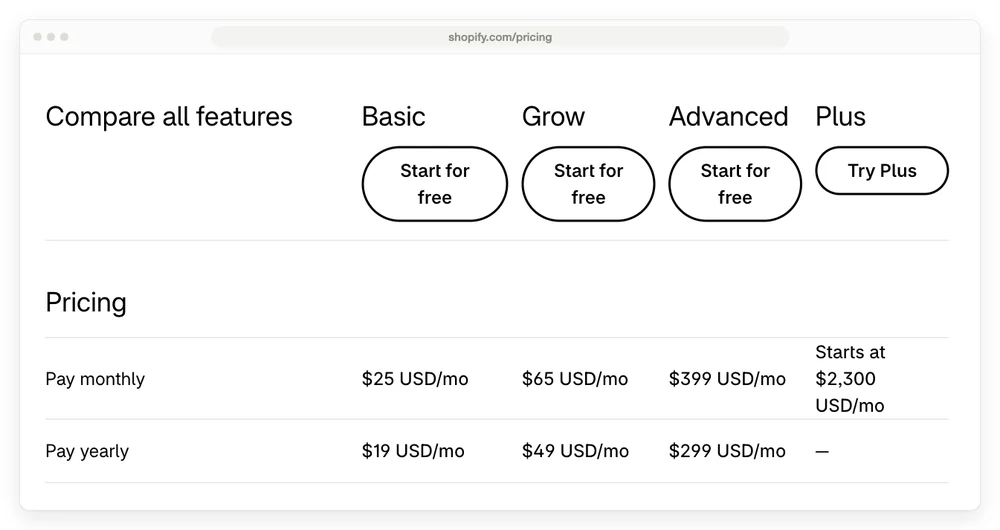
Shopify Basic is $25 a month on monthly billing, or $19 a month if you pay for the year. Grow is $65 or $49. Advanced is $399 or $299. Plus starts at $2,300 a month and is not offered on yearly billing.
2 things make this harder to look up than it should be. Shopify’s pricing page loads on the yearly toggle, so the first number you see is the discounted one. And Shopify renamed its middle tier from Shopify to Grow, so any guide written before that change describes plans that no longer exist under those names.
Shopify also publishes a fee for using someone else’s payment gateway instead of its own: 2% on Basic, 1% on Grow, 0.6% on Advanced and 0.2% on Plus. There is a 3 day free trial, then $1 a month for the first 3 months.
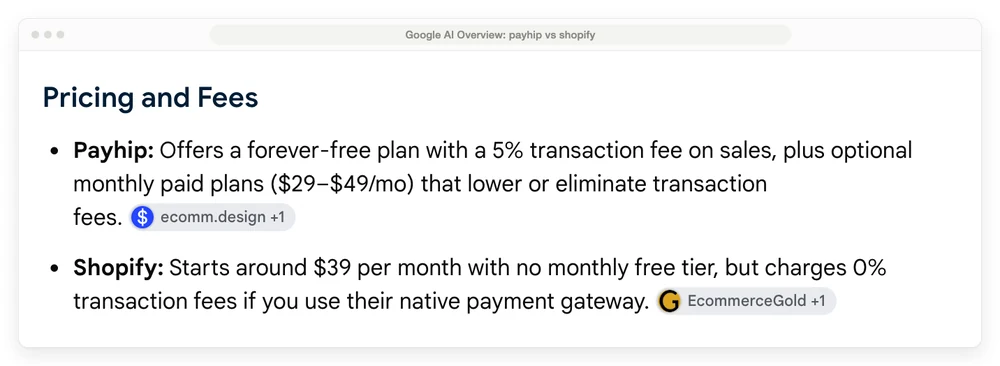
Almost every guide ranking for this comparison is quoting a Shopify price that has been retired, and they do not agree with each other on which one. 7 of the sources a searcher is most likely to land on state a Shopify entry price, 3 different wrong numbers appear between them, and not one of them is right.
| Source | Price it states | Real price |
|---|---|---|
| Google’s AI Overview | around $39 a month | $25 monthly, $19 yearly |
| EcommerceGold | $39 a month | $25 monthly, $19 yearly |
| Checkout Links | $39 a month | $25 monthly, $19 yearly |
| Ecomm.Design | $39 a month | $25 monthly, $19 yearly |
| Payhip’s own comparison page | $29 a month | $25 monthly, $19 yearly |
| SaaSworthy | $29 a month | $25 monthly, $19 yearly |
| Findstack | $32 a month | $25 monthly, $19 yearly |
That same Google summary also states that Payhip’s paid plans run from $29 to $49 a month. Payhip’s paid plans are $29 and $99. No $49 plan exists, and the page Google cites for the claim is Ecomm.Design, which prints $49 as Payhip’s Pro price.
None of this is a scandal. Prices change, guides go stale, and a summariser trained on stale guides repeats them. You are still the one about to pick a platform on one of those numbers.
The Shopify number nobody publishes
Every seller on Shopify pays a card processing fee. Shopify will not tell you what yours is until you have an account.
Shopify’s pricing page does not carry it. The page says only that Shopify charges a small fee to accept major credit cards and that the fees vary by plan. No percentage, no flat rate, no table.
Shopify’s help centre has a page for exactly this. The page is titled “Shopify Payments rates in the United States by card type”, and it contains no percentages and no dollar amounts at all. It explains the difference between a standard card and a premium one, then routes you into your admin.
Guides say Shopify charges a 0% transaction fee if you use Shopify Payments. That is true about Shopify’s own cut, and it is not the whole bill. Card processing is a separate cost, every seller pays it, and it is the number Shopify keeps behind a login.
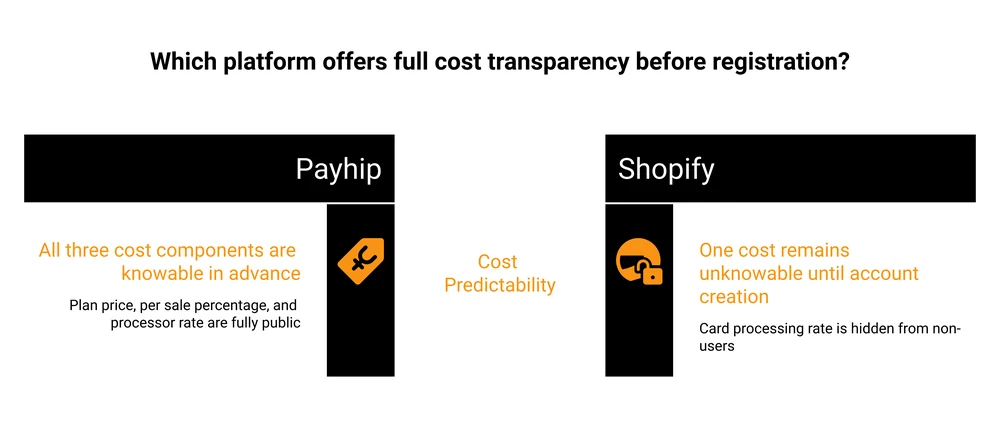
Compare that with what you can look up in 5 minutes. Payhip’s cut is on Payhip’s pricing page, and Stripe’s rate is on Stripe’s pricing page. A Payhip seller can work out their cost per sale before signing up. A Shopify seller planning to use Shopify Payments cannot.
For the same exercise on the other big processor, our guide to what PayPal charges sellers breaks its rates down by transaction type.
Payhip vs Shopify: what each costs at real sales volumes
The table below prices a digital business with a $50 average order. Shopify is quoted on yearly billing throughout, so the comparison sits on 1 billing basis rather than mixing monthly and yearly rates.
Every row includes Stripe’s published 2.9% plus 30 cents, with 1 deliberate exception. The Shopify Payments row cannot include a card fee, because Shopify does not publish one, and that row is the one most Shopify sellers would actually be on.
At a $50 average order, CartMango’s Silver plan is the cheapest row at all 4 volumes below, Payhip’s free plan and Shopify Basic on yearly billing cross over at about $633 a month of sales, and Payhip’s 2 paid plans only pay for themselves past $967 and $3,500.
| Platform and plan | $500 a month | $1,000 a month | $2,500 a month | $5,000 a month |
|---|---|---|---|---|
| Payhip Free | $42.50 | $85.00 | $212.50 | $425.00 |
| Payhip Plus | $56.50 | $84.00 | $166.50 | $304.00 |
| Payhip Pro | $116.50 | $134.00 | $186.50 | $274.00 |
| Shopify Basic, your own Stripe | $46.50 | $74.00 | $156.50 | $294.00 |
| Shopify Basic, Shopify Payments | $19 plus an unpublished card rate | $19 plus an unpublished card rate | $19 plus an unpublished card rate | $19 plus an unpublished card rate |
| CartMango Silver | $18.33 | $35.83 | $88.33 | $175.83 |
To be upfront about it, CartMango is my own platform, which is why its row sits last and why every figure above is one you can check at the source yourself.
3 things fall out of that table.
At $1,000 a month, Shopify on yearly billing with your own Stripe account works out cheaper than either of Payhip’s first 2 plans. That result cuts against the usual story about Shopify being the expensive one. The catch is that this is the path where Shopify charges an extra 2% for not using Shopify Payments, so you pay a penalty in exchange for a rate you can actually read.
At $5,000 a month, Payhip’s 5% has become $250 a month on its own, and every other option beats the free plan.
CartMango is cheapest in every column, and it is worth being blunt about why. It is a narrower product. Payhip’s free plan only costs less below about $17 a month of sales, which is under a single $50 order, and Payhip gives you course hosting and a store that CartMango does not.
CartMango is free for everyone until October 2026, and the Silver plan is $10 a year after that with 0% taken from your sales. The only part of that row which grows is the Stripe fee every row pays. Silver caps you at 10 products and 10 Mini Pages, and upsells, downsells and cart abandonment need the $20 a year Gold plan.
Still deciding what kind of store you need at all? We compare the 3 types in online store for digital products, and if you already have a site, adding a checkout to it covers the 4 ways to do that.
Where Payhip runs out of room
Payhip keeps things simple, and the simplicity has a price in what it will not do. 3 limits are worth knowing before you build a business on it.
Recurring payments only work through Stripe. Payhip’s own documentation states that the recurring option is limited to bundles, memberships, courses and coaching products, and is only available when Stripe is enabled as the payment processor. Buyers who pay by PayPal cannot subscribe at all.
Payhip has no one-click upsell. It has 2 related features and neither is the thing funnel builders mean by the word. Cross selling offers a discount when a buyer adds an item to the cart, so it fires before checkout.
Upgrade discounts fire after checkout completes. But Payhip’s own documentation describes this as prompting the customer to make another transaction, so the buyer goes through a fresh checkout rather than clicking once on the card already on file.
Some integrations are simply absent. In the r/EcommerceWebsite thread that ranks first for this search, a Payhip staff member confirmed there was no timeline for Apple Pay and no way to embed audio hosted on Amazon S3 on a product card, pointing sellers to YouTube instead. A Payhip employee answering questions in public is unusual and worth reading.
If 2 or 3 of those limits land on you, we line up the closest options in Payhip alternatives.
Where Shopify runs out of room for a digital seller
Shopify has no free plan and no free tier. The 3 day trial and the $1 a month introductory period both end, and after that you pay whether you sold anything that month or not.
You are also paying for a machine built around physical goods. Inventory locations, shipping rates, a point of sale system, fulfilment settings. A seller with 4 PDFs is renting all of it and opening none of it.
The app store is the other cost. Anything the core product does not do becomes an app with its own subscription, and several of the things a digital seller wants sit in that category: a course player, membership tiers, an affiliate programme. Shopify’s own Digital Products app covers delivery and stops there.
Reviews on that app are mostly positive and not uniformly so. On the Shopify App Store listing for Digital Products, a US seller who has used it for years wrote in July 2026 that recent changes made it “horrifically cumbersome”, and that the customer data needed to fix an order is now “buried so deep it will takes hours to track it down”. A seller in Canada, writing the same day, said simply that it works flawlessly for them.
Price it against what you already pay
Work out what you pay right now, per month, on whatever you sell through today. Then price both of these platforms against that number rather than against nothing.
Not long ago I swapped the drinking water at home over to a filter subscription. Where I live you buy drinking water every month, so I was already paying that bill without really thinking about it. The subscription costs about the same as the water I was already buying, and it came with whole house filtration for washing and bathing on top.
The comparison I ran was against a bill that was already in my life, which made it a no-brainer.
Almost nobody runs that comparison here. Payhip’s free plan feels like $0 because no invoice ever arrives. A 5% cut is still money leaving your business, collected in a way you never have to approve.
On the numbers in the table above, Payhip’s free plan and Shopify Basic with your own Stripe account cost exactly the same at about $633 a month of sales. That is roughly 13 sales of a $50 product. Below it the percentage wins, and above it the subscription does, and it keeps pulling ahead for as long as you keep selling.
FAQ
What are the disadvantages of Payhip?
3 stand out. Recurring payments need Stripe and are limited to bundles, memberships, courses and coaching, so PayPal buyers cannot subscribe. There is no one-click post purchase upsell, only a cart stage cross sell and an upgrade discount that needs a second checkout. And on the free plan, the 5% cut grows with every sale you make.
How much does Shopify take from a $100 sale?
On the subscription side, nothing extra. Shopify Basic is $25 a month, or $19 billed yearly, no matter how much you sell. On the card side, Shopify does not publish the answer, and its help page on United States card rates lists no rates at all. Use an outside gateway and Shopify adds 2% on Basic, so $2 on that sale, plus whatever your gateway charges.
Is there a better platform than Shopify?
For selling digital files, often yes. Shopify is built around physical stock, and you pay for that machinery whether you use it or not. Payhip, Gumroad and CartMango all handle digital delivery without it. For real inventory, multi location stock and a point of sale, Shopify is genuinely hard to beat and the alternatives are not close.
Is Shopify still worth it in 2026?
For physical products, real inventory and a growing team, yes. Shopify’s entry price came down rather than up, and $19 a month on yearly billing buys a genuinely capable store. For someone selling 4 PDFs, you are renting shipping, inventory and point of sale features you will never open.
Can I sell physical products on Payhip?
Yes. Payhip supports physical products alongside digital ones and has a dedicated help article for adding them. What Payhip does not have is Shopify’s depth: no multi location inventory, no live carrier shipping rates, no point of sale.
Does Shopify have a free plan?
No. Shopify offers a 3 day free trial and then $1 a month for the first 3 months, after which standard pricing applies. Payhip’s free plan is genuinely free with no time limit, funded by the 5% Payhip takes per sale.
A price you can read before you commit
Payhip and Shopify are both honest products and both suit somebody. What Payhip vs Shopify keeps running into is that one of them lets you do the maths before you commit, and the other does not.
Payhip publishes its cut. Stripe publishes its rate. Shopify publishes its subscription and then keeps the fee every single seller pays behind a signup.
Be clear about what CartMango is before you compare it to either. CartMango is a checkout, not a store builder and not a course platform. Payhip hosts courses today and CartMango does not, though a learning management system and a community are planned for October 2026. If hosting a course is what you need this month, Payhip or a dedicated course platform is the honest answer.
If what you need is the checkout, CartMango charges $10 a year on the Silver plan and takes 0% of your sales. Payouts land in your own Stripe or PayPal account directly, and the only fees you pay are the ones those processors publish openly. CartMango is free for everyone until October 2026, and paid plans run $10, $20 and $30 a year after that.
About the Author

👋 I’m Welly, founder of CartMango (the site you’re on), a checkout platform for digital product sellers. We’ve previously processed $179M+. I also run BirdSend (email marketing tool, 3.1B+ emails sent). On the side I show other non-techie digital sellers how I use AI workflows to automate 50%+ of my operations. Find me on LinkedIn.
Related Reading
- Payhip pricing: what the free plan really costs once card processing is counted
- Payhip alternatives: for readers who decide Payhip is the wrong fit
- Online store for digital products: the 3 store types priced on real fees
- Gumroad vs Payhip: the other head to head most digital sellers run
- How to add a shopping cart to a website: 4 methods if you already have a site