

A paid newsletter is an email publication readers subscribe to for a recurring fee, usually around $10 a month or $100 a year. Some issues stay free and the most valuable content sits behind a paywall. Most earn modest money. A tight niche and a clear reason to pay separate the few that do well.
Search around and you get two stories. The newsletter platforms make going paid sound like flipping a switch: turn on payments, watch the money arrive. Then you find the other camp, writers who tried it, earned pocket change, and quit. Both are selling you something. The platforms want your signup. The quitters want you to read their post about quitting. The truth sits between them, and it’s more useful than either side. I’ve sold digital products to creators for years, and a paid newsletter follows the same rules as any product: a specific audience, a clear reason to buy, and a price that fits. I’ll cover what one really is, whether the money is there, and every practical way to run it without handing your business to a platform you can’t leave.
Key Takeaways
- It’s a subscription product. A paid newsletter charges readers a recurring fee, usually near $10 a month or $100 a year, for content they can’t get free.
- Conversion is low. Across thousands of publications the median is under 1% of free readers paying, so the size and trust of your free list matter most.
- Sell different, not more. The ones that work offer something distinct from the free version, not just extra volume.
- You can skip the revenue cut. An email tool plus your own checkout keeps your list and your income, with no platform taking a slice.
- Keep pricing simple. One monthly price, one cheaper annual price, and a founding-member rate at launch.
Quick note before the how-to: if you’re still working out how to sell to your own audience, my free 5-day Online Selling Mistakes Challenge walks through the 5 profit leaks that catch most first-time sellers. Worth doing before you charge anyone for anything.
What a paid newsletter actually is
A paid newsletter is a subscription publication delivered by email. Readers pay a recurring fee, monthly or yearly, and get issues non-paying readers don’t. The format is old, people have paid for mailed market letters for decades, but the tools that let any writer turn on payments in an afternoon are new.
Most run a free tier alongside the paid one. The free issues do the marketing: they build the list and earn trust before anyone pays. The paid issues carry the extra value, whether that’s deeper analysis, private data, a community, or just more frequent sending.
A few common shapes:
- Free with a paid upgrade. Most issues free, a subset paid. The default on Substack, beehiiv, Ghost, and Kit.
- Fully paid. Everything behind the paywall. Rare, and hard unless you already have a reputation.
- Free content, paid extras. The newsletter stays free and readers pay for a linked product: a course, community, or report.
The paywall is just plumbing. What readers actually buy is the promise that the paid tier saves them time, makes them money, or tells them something they can’t find anywhere else. Keep that promise specific and you have a product. Leave it vague and you have a free newsletter with a price tag nobody wants to pay.
Do paid newsletters make money? The honest numbers
Yes, but usually less than the success stories suggest. This is where honesty matters, because the platforms have every reason to show you the top 1%.
Start with conversion, the share of free readers who upgrade to paid. Platforms like Substack tell writers to expect 5 to 10%. The wider market runs lower. In beehiiv’s 2026 report on thousands of paid publications, the median conversion was 0.62%, roughly 6 paying readers for every 1,000 on the list, as reported by Press Gazette. Both figures are real. They measure different groups. Either way, the size and trust of your free list matter more than the paywall.
Price is more predictable. The typical one charges about $10 a month or $100 a year. Do the math on a modest list: 1,000 free readers converting at 1% is 10 paying subscribers, around $1,000 a year before fees. A real example from a r/Substack thread: a fantasy writer who turned on paid 2 months in reported 140 subscribers, 18 of them paying, about $700 a year. That’s normal, not failure.
The numbers grow with reach and focus. At the top end, Emily Sundberg’s Feed Me passed 50,000 readers with more than 10% paying by late 2024, per Semafor, and Forbes later reported the publication on track for seven figures. That is the ceiling, not the average.
One caveat trips people up: the household-name newsletters are often not paid at all. Morning Brew, which sold at around a $75 million valuation, reported by Axios, is free and ad-supported. That’s a different business from charging readers a subscription, and usually a bigger, harder one.
Why most of them fail (and what the winners do differently)
The most common way to fail is predictable. You take your free newsletter and offer paying readers more of the same: extra issues, bonus links, a slightly longer version. Almost nobody wants more of a newsletter, even one they like. Their inbox is already full.
Josh Spector, who writes the For The Interested newsletter, has written openly about this. His first attempt at going paid, an expanded edition at $10 a month, flopped. His takeaway is worth stealing: sell something different, not more of the same. When he later offered paying readers a distinct format instead of extra volume, it worked.
So what does different look like?
- A distinct job. The free issue entertains or informs. The paid tier solves a specific, ongoing problem: a weekly deal sheet, private research, templates, a paid community.
- A niche narrow enough to own. “Marketing tips” is free-newsletter territory. “Cold email benchmarks for B2B SaaS founders” is something a few thousand people will pay to keep current on.
- A reason that renews. Subscriptions have to keep delivering. One great issue doesn’t justify a recurring charge. A reliable stream of something readers can’t get elsewhere does.
A subtler failure is quitting early. Paid subscriptions compound slowly. The first month is humbling, a handful of upgrades from your most loyal readers, and many writers stop there. The ones who make it treat the first year as list-building with a small paid layer, not a launch that either hits or misses.
If your free newsletter isn’t growing, a paywall won’t fix it. Fix the free product first, then charge for the part that’s genuinely worth paying for.
Free vs paid: which model actually fits you
Paid subscriptions are one way to make money from a newsletter, not the only way, and often not the first one you should reach for.
If your list is under a few thousand engaged readers, sponsorships and your own products usually pay better than subscriptions. A single $500 sponsor slot can beat a month of $10 upgrades from a small list. Selling one $50 product to 2% of 2,000 readers is $2,000, more than most small paid tiers make in a quarter.
Paid subscriptions start to make sense when:
- Your free list is growing on its own, without you buying attention.
- Readers already ask for more, or ask how to support you.
- You have a distinct, recurring thing to sell that doesn’t fit a one-time product.
- Your niche is specific enough that a small percentage paying is still real money.
A sequence that works for most creators: grow a free newsletter, monetize it with the odd sponsor and a product or two, then add a paid tier once you have the audience and a clear reason for it. It’s one of the better recurring-revenue models for a solo creator, but only after the audience exists. Going paid on day one, before anyone trusts you, is the version that usually fizzles.
None of this is a rule. Some writers go paid early and it works. But if you’re choosing where to put limited time, a bigger free list is almost always the better bet before a paywall.
Where to run a paid newsletter (and what each option really costs)
You need 2 things to run a paid newsletter: a way to send email, and a way to collect recurring payments. Platforms differ mainly in how much they bundle those jobs and what they charge for it.
The all-in-one platforms do both for you. That’s convenient, and for many writers it’s the right trade. The cost shows up in 2 places: a cut of your revenue, and how much of your business lives on someone else’s system. Here’s how the common options compare, with fees checked on 2026-07-08.
| Option | Platform cut | Base cost | Keep list + income if you leave? | Best for |
|---|---|---|---|---|
| Substack | 10% of revenue | Free | List yes, audience network no | Fastest start, built-in discovery |
| beehiiv | 0% (Stripe only) | $43/mo (Scale) to charge readers | Yes | Growth and referral tools |
| Ghost | 0% (Stripe only) | From $18/mo, or self-host | Yes, fully (open source) | Owning your whole site |
| Kit | 3.5% + $0.30 per sale | Free to 10,000 subs, then from $33/mo | Yes | Creators already emailing on Kit |
| Own email tool + CartMango checkout | 0% beyond Stripe | Email tool + CartMango (free in beta, then $10/year) | Yes, and subscriptions keep paying you if you switch tools | Most control, lowest cut, no lock-in |
I run CartMango, so treat that last row as my own math, not a neutral verdict. It’s the own-stack checkout layer: no cut beyond Stripe’s standard 2.9% + $0.30, and your subscriptions keep running even if you switch email tools.
The number that matters most is the revenue cut. Substack’s 10% sounds small until your newsletter works. At $50,000 a year, that’s $5,000 handed over annually, forever, for payment handling you could run for a flat fee. The 0% platforms like beehiiv and Ghost charge a monthly plan instead, which is cheaper once you pass a few hundred paying subscribers.
The quieter cost is lock-in. Some of the most-shared posts about going paid are creators explaining why they left Substack. When your subscriptions, billing, and audience all live inside one platform, moving is painful, and some platforms tie your recurring revenue to them. That’s the argument for the own-stack route: bring your own email tool (Kit, MailerLite, BirdSend, or others), pair it with your own checkout, and you can swap either piece without your income stopping. If you go that route and want to compare the dedicated checkout options, our roundup of Gumroad alternatives covers the tools built for digital sellers.
For a first paid newsletter with a small list, an all-in-one like Substack is the fastest way to test whether people will pay at all. Once it works and the revenue cut starts to sting, moving to your own stack is the standard upgrade path.
How much to charge
Most land near $10 a month or $100 a year, and that’s a fine place to start. The annual price is usually a discount worth 2 or 3 months free, which nudges people toward the plan that’s harder to cancel.
A few pricing moves that help:
- Offer both monthly and annual. Monthly lowers the barrier to try. Annual improves cash flow and retention.
- Use a founding-member rate at launch. A limited higher tier, say $150 a year, lets your biggest fans pay more to support you early. Some will.
- Don’t underprice to seem fair. A $3 a month newsletter needs 3 times the subscribers of a $9 one to make the same money, and cheap doesn’t read as valuable.
- Raise prices for new subscribers, not existing ones. As the back catalog grows, new readers get more, so they can pay more. Keep faith with the people who joined early.
Price is easier to change than it looks. Start in the normal range, watch how conversion and cancellations move, and adjust. The number on the button matters far less than whether the newsletter is worth paying for at all. For the wider logic, this guide to pricing a digital product goes deeper.
How to start a paid newsletter, step by step
If you’ve decided it fits, here’s the short path from zero to first paying subscriber.
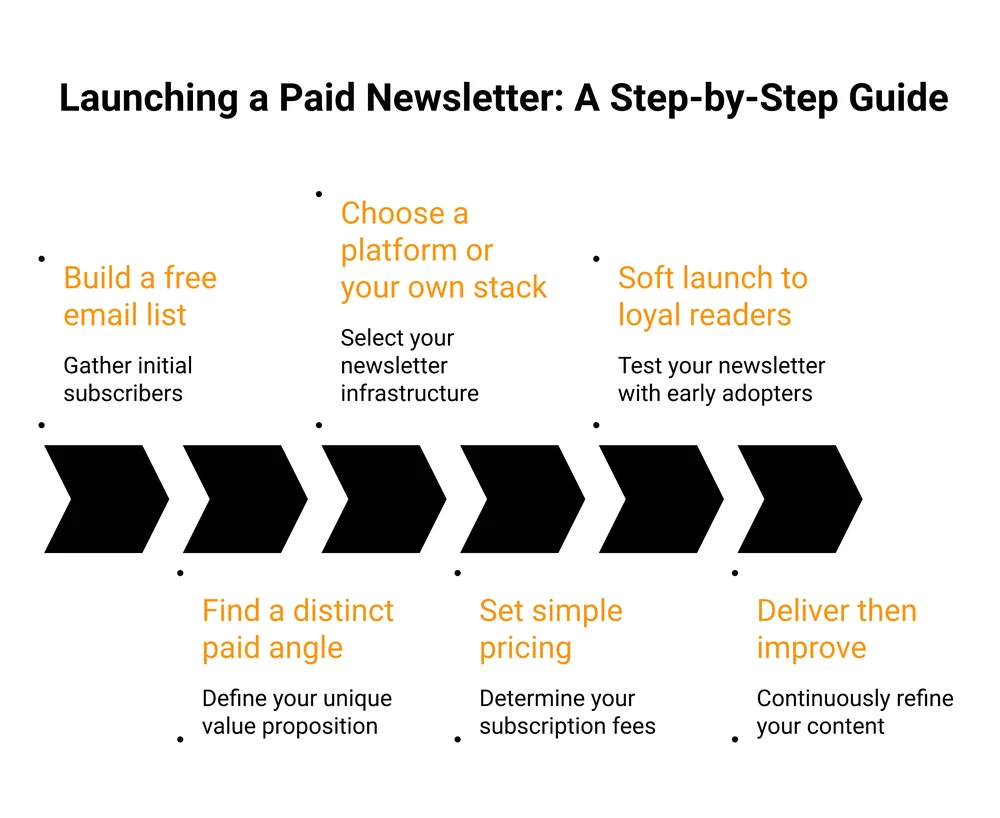
1. Build the free newsletter first. This is 80% of the work and the part people skip. You need a free list that grows and readers who open. Starting from scratch? This guide to starting a newsletter covers picking a focus, choosing a tool, and getting your first subscribers.
2. Find the paid angle. Look at what your free readers ask for, struggle with, or already try to pay you for. The paid tier should answer that with something distinct: a private edition, a database, a community, a weekly briefing they can’t get free. Write down the one sentence a subscriber would use to justify the charge.
3. Choose your stack. Decide between an all-in-one platform and your own email tool plus checkout, using the table above. For a first test, all-in-one is faster. If you already have an email tool and an audience, your own checkout keeps more of the money.
4. Set your price and tiers. One monthly option, one annual option at a discount, and a founding-member rate for launch week. Keep it to those 3.
5. Soft-launch to your warmest readers. Don’t announce to strangers. Tell your free list first, plainly: here’s the paid tier, here’s what’s in it, here’s what it costs. Early paying subscribers almost always come from people who already read you.
6. Deliver, then improve. Ship on a schedule you can keep. Watch which issues get read and which trigger cancellations. Adjust the format based on what paying readers use, not what you assumed.
The whole thing works better as an upgrade to an audience you already have than as a cold start. If you remember one line from this section: earn the free readers first, then give a slice of them something worth paying for.
FAQ
How much can you make from a paid newsletter?
Most make modest money, in the hundreds to low thousands a year. A typical result on a small list is a few hundred dollars annually. Strong niche newsletters with engaged lists reach five and six figures, and a rare few go higher. Your ceiling is set by list size, niche, and how distinct the paid content is, in that order.
How many subscribers do you need before going paid?
There’s no hard number, but a free list of at least a few thousand engaged readers makes the math work better. At a 1% conversion, 3,000 free readers is 30 paying subscribers, around $3,000 a year. Below a thousand, sponsorships or a product usually earn more than a paid tier.
Is going paid worth it?
It’s worth it when you have an audience that trusts you and a specific, recurring thing to sell them. It’s not worth it as a way to make a small newsletter suddenly profitable. Fix growth and value first, then charge.
Should I put everything behind a paywall?
Usually no. A free tier does your marketing and keeps the list growing. Most successful ones keep a steady free stream and reserve their best or most specialized content for subscribers.
What is the best platform for a paid newsletter?
For a fast first test, Substack or beehiiv. For full ownership, Ghost or your own email tool paired with a checkout you control. The right answer depends on how much you value convenience now versus keeping more of the money and avoiding lock-in later.
If your paid newsletter takes off, the last thing you want is your recurring income locked to a platform you’ve outgrown. CartMango is the checkout built for that. It runs your subscriptions and one-time offers, takes no cut beyond Stripe, and if you ever switch email tools your subscriptions keep paying you. Free during the beta, then $10 a year.
About the Author

👋 I’m Welly, founder of CartMango (the site you’re on), a checkout platform for digital product sellers. We’ve previously processed $179M+. I also run BirdSend (email marketing tool, 3.1B+ emails sent). On the side I show other non-techie digital sellers how I use AI workflows to automate 50%+ of my operations. Find me on LinkedIn.
Related Reading
- How to start a newsletter: build the free list first, before any paywall
- Best recurring revenue businesses: where a paid newsletter fits among subscription models
- Lead magnet email sequence: turn free subscribers into buyers
- One person business ideas: running a paid newsletter as a solo business