

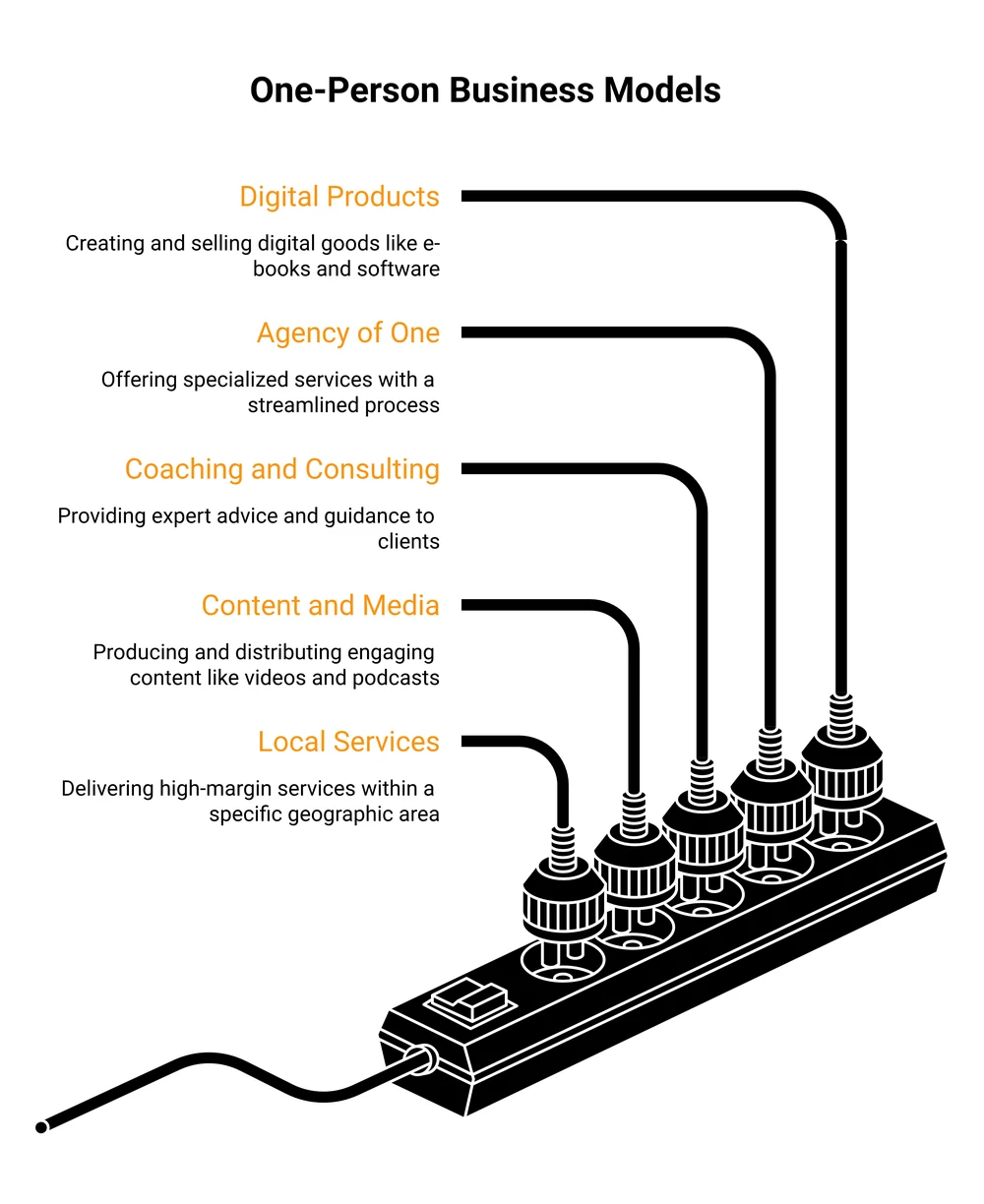
The best one person business ideas fall into five models: digital products, a productized “agency of one” service, coaching or consulting, content and media, and high-margin local services. A one person business runs entirely solo, with no employees and low overhead. Most earn modestly at first, and a growing minority reach six figures.
Search “one person business ideas” and you get the same thing every time. A list of 50 or 100 ideas, ranked by nothing, with a wedding photographer sitting next to a construction company. Half of them need a team the moment they grow. Almost none tell you what you will actually make.
I have spent years around solo digital sellers. I run a checkout platform and an email tool, so I watch people start these businesses every week. There are plenty of ideas out there. What is missing is a straight answer on which ones stay solo, which ones make real money, and which ones quietly turn into a job with staff and stress.
So this list is curated, not dumped. Eighteen ideas, grouped into five models, each with honest startup cost, honest income, and a clear verdict on whether it stays a true one person business.
Key Takeaways
- Stay-solo by design: a one person business has no employees and low overhead, so you keep all the profit and carry all the work.
- Five realistic models: digital products, agency of one, coaching and consulting, content and media, and local high-margin services.
- Judge every idea on four things: startup cost, time to your first dollar, realistic income, and whether it forces you to hire.
- Fast cash vs high ceiling: local services and productized freelancing pay fastest, digital products and consulting have the highest ceilings.
- Six figures is real but rare: 5.6 million US independents clear $100k a year, out of about 72 million working independently.
What counts as a one person business (and how it differs from a “small business”)
A one person business has one founder, one operator, and zero employees. You do the work, or you point software and contractors at the work, but the headcount stays at one. Low overhead is the whole point. Your profit is whatever is left after costs, and there is no payroll eating into it.
This is not the same as a small business, though most lists treat them as one thing. A small business can have ten employees, a lease, and a manager. A one person business is built to stay small on purpose. The goal is not to grow headcount. The goal is to grow income while staying solo. The operating model is what changes: a one person business is organized around independence and margin, whereas a small business is organized around managing other people.
That difference matters more than it sounds. When you read “73 small business ideas” and see a construction company or a restaurant on the list, those are not one person businesses. They are team businesses wearing a beginner-friendly label. Run them solo and you hit a wall fast.
The scale here is bigger than people expect. The US Census Bureau counts 30.4 million nonemployer businesses, meaning businesses with no paid employees. Most of the country’s businesses are one person operations. You are not doing something strange. You are joining the largest category of business in America.
If you already sell something and want to find what is quietly costing you sales before you start a new thing, the free 5-day Online Selling Mistakes Challenge is a useful starting point.
How to pick the right idea: the four things that actually matter
Most idea lists rank by nothing. They just count up to 50. That is useless when you are trying to choose. Here are the four things that actually decide whether an idea fits you.
Startup cost. How much money do you need before you can sell anything? The best one person businesses have a low startup cost. Some start at zero. Some need a few hundred dollars for tools or gear. None of the good ones need a loan.
Time to your first dollar. How long from “I started” to “someone paid me”? A local service can pay this week. A YouTube channel can take a year. Both can work. You just need to know which one you are signing up for.
Realistic income. Not the dream number. The honest middle. What does this make for a normal person who sticks with it, not the one viral outlier?
Does it stay solo? This is the one nobody talks about. Some businesses are happy at one person forever. Others tempt you to hire the moment you get busy, and then you are running a small business, not a one person business. If staying solo is the goal, this matters as much as the money.
Notice what is not on that list: how trendy the idea is. Trends fade, and a trendy idea you cannot run alone is just a faster way to burn out. These four hold up.
Every idea below gets scored on these four. Here is the quick view, by model.
| Model | Startup cost | Time to first dollar | Realistic income (solo) | Stays solo? |
|---|---|---|---|---|
| Digital products and content | Low ($0 to $500) | Slow (weeks to months) | Few hundred to mid four figures a month | Easily |
| Agency of one (productized service) | Very low ($0 to $200) | Fast (days to weeks) | $2k to $10k+ a month at capacity | With discipline |
| Coaching and consulting | Very low ($0 to $200) | Medium (a few weeks) | $3k to $15k+ a month, pipeline-dependent | Easily |
| Content and media | Low ($0 to $500) | Slowest (months to years) | $0 early, then ad, sponsor and product income | With discipline |
| Local high-margin services (+POD) | Low to medium ($100 to $2k) | Fastest (days) | $2k to $8k a month, capped by your hours | Hard |
Note: these income ranges are directional, not guarantees. They vary widely by skill, niche and effort. See the honest income section below for the sourced data behind them.
If you want a wider pool to cross-check against, this pairs well with my bigger list of solopreneur ideas, which uses the same stay-solo logic.
Model 1: Digital products and content
This is the model with the lowest cost per extra sale. You build something once and sell it many times. There are no manufacturing costs and no inventory. People call this passive income, but that oversells it: you do the work upfront, and the audience work never fully stops. That is why it shows up on every serious one person business ideas list, and why it is my favorite for staying solo.
The honest trade-off: income is slow at first and depends on having an audience or a traffic source. You are not getting paid for hours. You are getting paid for attention plus a product. That means the real work is building an audience or learning to drive traffic. The product is the easy half. Here are the strongest digital product ideas.
1. Ebooks and self-published guides. Write once, sell forever. Low cost, slow ramp. Good if you can teach a specific thing clearly. The ceiling is modest unless you build a catalog.
2. Templates (Notion, Canva, printables). Fast to make, easy to deliver, genuinely solo. Planners, resume templates, social media kits, spreadsheets. People pay for a shortcut. See my full breakdown of 100 digital product ideas if you want specific template niches.
3. Digital art, presets and stock assets. Lightroom presets, icon packs, fonts, stock photos, audio loops. You sell the same file to thousands of buyers. Niche down hard or you disappear.
4. Paid newsletter. The recurring-revenue play in this model. Readers pay monthly for your writing or research. Slow to start, but it compounds, and recurring income is the closest a solo business gets to stable. If recurring revenue is your aim, here are 20 recurring revenue business models worth studying.
5. Online course. The highest ceiling in this group and the most work. Record once, sell to many. A good course can earn for years. Start with a small cohort before you build the polished version. My list of online course ideas worth pursuing is a good next stop.
Where do you actually sell these? You have two paths. List on a marketplace like Etsy, which brings built-in traffic but takes a cut and owns the customer. Or run your own checkout, which means you bring the traffic but you keep more of each sale and you own the buyer relationship. Most sellers start on a marketplace and move to their own checkout once they have repeat buyers.
Model 2: Agency of one (productized service)
This is the fastest model to real money, and it is the one I see recommended most right now. Instead of chasing random projects, you package one specialized service into a flat, repeatable offer, often at a recurring monthly price. Clients get predictable work. You get predictable income, and you stop writing endless proposals.
The honest trade-off: this is the model most likely to tempt you to hire. Get busy enough and the obvious move is to bring on help. If staying solo matters, you fight that by productizing tightly and raising your rates instead of adding people. A good rule of thumb: when you are fully booked, double your price before you hire your first contractor. Here are the services that work best solo.
6. SEO and content writing. Businesses always need content that ranks. Package it as a monthly retainer, not a per-article rate.
7. Copywriting. Sales pages, emails, ads. High value, low overhead, all skill. If this fits you, here is how to go from zero to your first client with my guide on starting a copywriting business.
8. Graphic and web design. Logos, brand kits, landing pages. Productize it (“a landing page in five days for one flat price”) and it scales without staff.
9. Bookkeeping and premium virtual assistance. Less glamorous, very sticky. Recurring by nature, and clients rarely leave. A strong stay-solo income once you have three or four retainers.
The pattern across all four: pick one service, package it as a flat or monthly offer, and serve a narrow niche. Generalists compete on price. Specialists set it.
Model 3: Coaching and consulting
Here your experience is the entire product. If you have ten or more years in a field, you can sell advice and outcomes directly, with almost no startup cost. A laptop and a calendar is the whole setup. Margins are high because you are selling time and judgment, not goods.
The honest trade-off: income swings with your reputation and your pipeline. A great month does not guarantee the next one. Build a referral habit and a waitlist early. One signed retainer is worth more than ten one-off calls, so protect the relationships you already have. Here are the three forms it takes.
10. Coaching (life, career, or business). You guide a client toward their goal over weeks or months. Pick a niche with money and urgency. My list of coaching niches that pay shows where the demand actually is.
11. Consulting. You diagnose a problem and hand over a plan, often for a company rather than an individual. Higher rates, shorter engagements, more credibility required.
12. Fractional and advisory roles. The higher-ceiling solo path. You act as a part-time head of marketing, finance, or operations for several companies at once. One person, multiple retainers, real money.
Coaching suits you if you like the long relationship. Consulting and fractional work suit you if you would rather solve the problem and move on. Both stay solo with ease, because the thing being sold is you.
Model 4: Content and media (the creator route)
This is the patient model. You build an audience first, then money follows through ads, sponsors, affiliates, or your own products. Done well, it can fund every other model on this list. Done casually, it pays nothing for a long time.
The honest trade-off I wish more lists admitted: this has the slowest time to your first dollar by far. Most creators earn close to nothing for the first year or two. Treat it as a long game or a feeder for your products, not a quick income. The smartest creators use it to feed the other four models. An audience that trusts you will buy your product, book your service, or join your course. Here are the three main paths.
13. YouTube and faceless content. A channel can earn from ads, sponsors, and your own products. “Faceless” formats (voiceover, screen recordings, compilations) let you build without being on camera. There are also 82 ways to earn from YouTube without AdSense once you have views.
14. Niche blog and affiliate site. Write about a tight topic, rank in search, earn from affiliate links and ads. Slow SEO ramp, but it compounds quietly for years once it catches.
15. Podcast. The hardest to monetize early, the best for building trust. Most solo podcasters make their money from what the show leads to (clients, a product, sponsors), not the show itself.
The creator route rewards consistency over talent. The people who win are usually just the ones who did not quit at month six.
Model 5: Local high-margin services (and one-person e-commerce)
This is the model with the fastest cash and the lowest tech barrier. Local, hands-on services need little more than reliable transport, basic scheduling, and word of mouth. They are recession-resistant and require no degree. You can be paid within days.
The honest trade-off: your income is capped by your own hours. There are only so many lawns or pets in a day. Grow past your capacity and the only way up is to hire, at which point it stops being a one person business. Keep that in mind if staying solo is the goal.
16. Pet care (sitting, walking, boarding). Steady demand, repeat clients, genuinely solo. Easy to start in your own neighborhood.
17. Cleaning and mobile detailing. Homes, offices, or cars. High margin, low startup, immediate cash. Mobile detailing in particular has strong per-job pricing.
18. Print-on-demand and one-person dropshipping. The inventory-free e-commerce option. A supplier prints and ships on your behalf, so you never hold stock. Honest warning: margins are thin and competition is brutal, so this only works with a real niche and good marketing, not as a passive button.
Other strong solo local options worth a look: personal training, handyman work, window washing, and home organizing. They share the same profile, fast to start, capped by your time.
One thing local services are not is location independent. If you would rather run your business from anywhere, the digital and service models above travel better. Here are 30 location independent business ideas if that is your priority.
The honest income reality: what one person businesses actually make
This is the part the idea lists skip, and it is the part you actually care about. The People Also Ask box for this topic is full of “$1,000 a day” and “$10,000 a month” questions. So let me give you the real numbers instead of hype.
Start with the base rate. Across those 30.4 million US nonemployer businesses, total receipts were about $1.8 trillion. That works out to roughly $59,000 in revenue per business per year. And that is revenue, not take-home pay, before any costs. The real average is pulled up by the bigger solo firms, so the typical one person business earns less, partly because millions of these are side businesses, not someone’s main job. The Bureau of Labor Statistics counts only about 10 million people who are self-employed in an unincorporated business as their main work, far fewer than the 30 million tax-filing firms.
Now the good news, and it is genuinely good. Six figures solo is real and rising fast. MBO Partners found in its 2025 report that 5.6 million independent workers now earn more than $100,000 a year, up 19 percent in a single year and nearly double the 2020 number. That is out of about 72 million people working independently. So six figures is the minority, not the median, but the minority is large and growing.
So can a one person business make $10,000 a month? Yes. That is $120,000 a year, inside that growing six-figure group. It is most reachable in consulting, a productized agency at capacity, or a digital product with a real audience. It is not a beginner number.
What about $1,000 a day? That is around $30,000 a month, or $365,000 a year, which puts you in the top few percent of solo earners. It happens in high-ticket consulting, a scaled course, or a productized service running at full capacity. The math only works at premium prices or high volume. Treat it as a ceiling, not a plan.
One more thing on income claims: be skeptical of any list that hands you a number with no source. When a post says an idea “makes $5,000 a month,” ask whose number that is and at what point in their journey. Most of these figures are the best case from one person, not the typical result. A safe way to read any income claim is to halve it, then ask how long it took to get there. The data above is the floor and the spread. Where you land inside it is on you.
The takeaway: most one person businesses start as modest income and a few grow into serious money. The model you pick sets your ceiling. Your consistency decides where you land inside it.
3 mistakes that quietly kill one person businesses
Most one person businesses do not fail because the idea was bad. They fail for a few avoidable reasons. Here are the three I see most. Solo owners feel these firsthand: on Reddit, people who run their business completely alone describe how fast doing everything, client work, admin, and the small tasks, tips into burnout without structure.
| Mistake | Why it happens | The fix |
|---|---|---|
| Picking an idea that cannot stay solo | It only grows by adding people | Choose a model that stays solo, or productize so software does the work |
| Building before anyone has paid | It feels productive and safe | Get one paying customer before you build the polished version |
| Competing as a cheap generalist | Niching down feels risky | Narrow the niche, then raise the price |
Building before validating is the costly one. People sink months into a course or a store before a single person has paid. Flip the order. Sell the promise first, build second. A pre-sale is the only validation that counts.
Underpricing is the slow killer. Compete on price and you need more clients, which means more hours, which pushes you toward hiring. Charge more, serve fewer, stay solo.
The last trap is quieter. People chase the “$1,000 a day” headline, then quit at month three when reality turns out slower. Every model here takes time. The ones who make it treat the slow start as normal, not as a signal to stop. If you only fix one of these, fix the pricing. It is the line between a business that frees you and one that traps you.
Which model fits you? A 30-second self-check
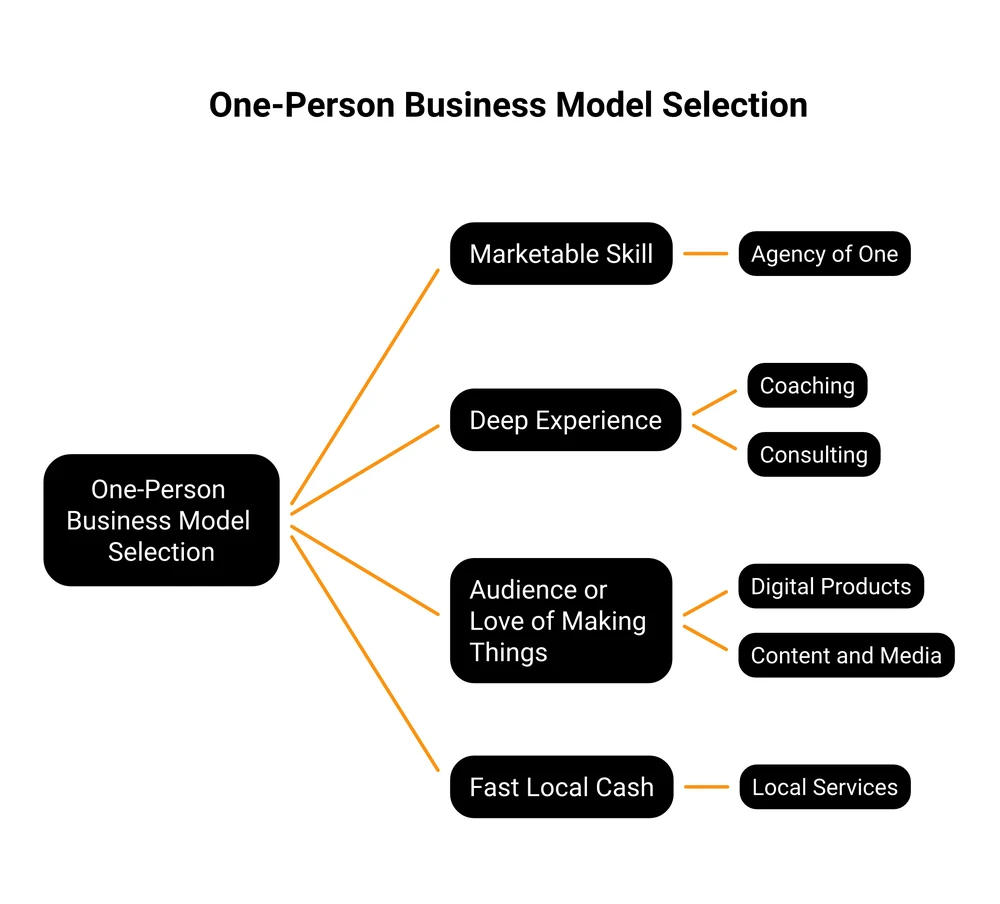
You do not need all five. You need the one that matches what you already have. Match yourself to a starting point.
- You have a skill companies pay for (writing, design, SEO, bookkeeping): start with the agency of one. Fastest path to income.
- You have deep experience in a field: coaching, consulting, or fractional work. Your past is the product.
- You have an audience or you enjoy making things: digital products or the creator route. Higher ceiling, slower ramp.
- You want cash this month and like hands-on work: local high-margin services. Capped, but quick and reliable.
- You want to work from anywhere: anything digital. Skip the local model.
Two honest rules of thumb. If you need money soon, pick a model with a fast time to first dollar (services). If you want the highest ceiling and can wait, pick one with near-zero cost per sale (digital products, courses). Not sure which suits your temperament? The fastest paths to self-employment guide walks through matching a model to your situation.
How to start your one person business (the first 7 days)
You do not need a business plan or an LLC to begin. You need a customer. Here is the compressed version.
- Pick one model and one idea. Not three. One. You can always add later.
- Validate it cheaply. Before you build anything, ask ten people in your target group if they would pay. Pre-sell if you can.
- Set up the simplest way to get paid. A payment link, a marketplace listing, or a checkout page. Do not over-build the tech before you have a buyer.
- Get your first customer. Reach out directly, post where your people already are, or list on a marketplace. The first sale teaches you more than a month of planning.
- Decide the legal stuff later. Sole proprietor is fine to start in most places. Form an LLC once there is real money to protect. Do not let paperwork delay your first dollar.
The whole point of a one person business is speed. No committee, no approvals. You decide on Monday and you are selling by Friday.
FAQ
What is a business that can be run by one person?
Any business with no employees and low enough overhead that one person can handle the whole operation, often with help from software and the occasional contractor. The common types are digital products, productized freelance services, coaching and consulting, content and media, and hands-on local services. The US Census counts more than 30 million such businesses, so it is the most common business type in the country.
What is the most profitable one person business?
By profit margin, digital products and consulting win, because the cost of delivering one more sale is close to zero. By income ceiling, courses, productized agencies, and high-ticket consulting reach the highest numbers solo. Remember that profit is not revenue. A consultant charging $200 an hour with no costs often keeps more than a store doing higher sales with thin margins.
Can a one person business really make $10,000 a month?
Yes, but it is not a starting number. Ten thousand a month is $120,000 a year, which sits inside the group of 5.6 million US independents earning six figures. It is most reachable in consulting, a productized service running at capacity, or a digital product with an established audience. Plan for modest income first and build toward it.
What one person business makes $1,000 a day?
A thousand a day is roughly $365,000 a year, the top few percent of solo earners. It shows up in high-ticket consulting, a scaled online course, or a productized agency at full capacity. The math needs premium prices or high volume. Effort alone does not get you there. It is a real ceiling for a few, not a realistic week-one target.
What is the best one person business for beginners?
The ones with the fastest time to first dollar and the lowest skill barrier: local high-margin services and a simple productized freelance service. Most can start for under $500, and many run entirely from home. If you already have a marketable skill, freelancing pays fastest. If you have spare time and want quick cash, a local service works.
One person business ideas are everywhere. Choosing the right one is the hard part, and now you have a way to do it: pick the model that matches what you already have, check it against the four axes, and get your first customer before you build anything fancy.
I run CartMango, a checkout platform for digital product sellers. If one of these digital ideas is where you are headed, it is built to help you make more on every sale instead of just collecting the payment, with one-click upsells and order bumps. Free while we are in beta, then $10 a year after.
About the Author

👋 I’m Welly, founder of CartMango (the site you’re on), a checkout platform for digital product sellers. We’ve previously processed $179M+. I also run BirdSend (email marketing tool, 3.1B+ emails sent). On the side I show other non-techie digital sellers how I use AI workflows to automate 50%+ of my operations. Find me on LinkedIn.
Related Reading
- 45 solopreneur ideas across 5 models: the wider pool, same stay-solo logic
- 100 digital product ideas: if Model 1 is your pick
- Coaching niches that pay: for the coaching and consulting route
- 20 recurring revenue business models: for income that compounds
- The fastest paths to self-employment: how to actually make the leap