

How to sell 3D models online starts with 1 decision: whether your files are for 3D printers or for games and renders. Then export them in the formats those buyers use (STL or 3MF, FBX or GLB), list them on a marketplace or your own checkout with clean previews, and price them against similar files.
Fab pays sellers 88% of a sale, Cults3D 80%, and CGTrader 55% to a new seller. From your own checkout you pay CartMango, the checkout I built (free right now, from $10 a year once paid plans start in November, 0% per sale), Payhip (5% on its free plan) or Gumroad (10% plus $0.50 per sale), and you bring most of your own buyers.
A 3D model is 2 different products, depending on who opens the file. A hobbyist wants an STL that prints cleanly at home. A game studio wants an FBX with clean topology, textures and a license it can ship.
Several guides ranking for this search list printing sites and game asset stores side by side, as if 1 buyer shopped at all of them. Follow one of those lists and a printable dragon can end up on a store full of game developers.
The money is modest too, going by the 2 sellers I found who posted results. Below, I split the 2 markets, show what each marketplace pays on a real sale, and explain when your own checkout pays better.
Key Takeaways
- Printable files and game assets sell in different places. STL files go to Cults3D, Printables and Etsy. FBX and GLB assets go to Fab and CGTrader.
- Your share swings widely. Fab pays sellers 88% of a sale, Cults3D 80%, CGTrader 55% at first, and TurboSquid 40% unless you sell exclusively there.
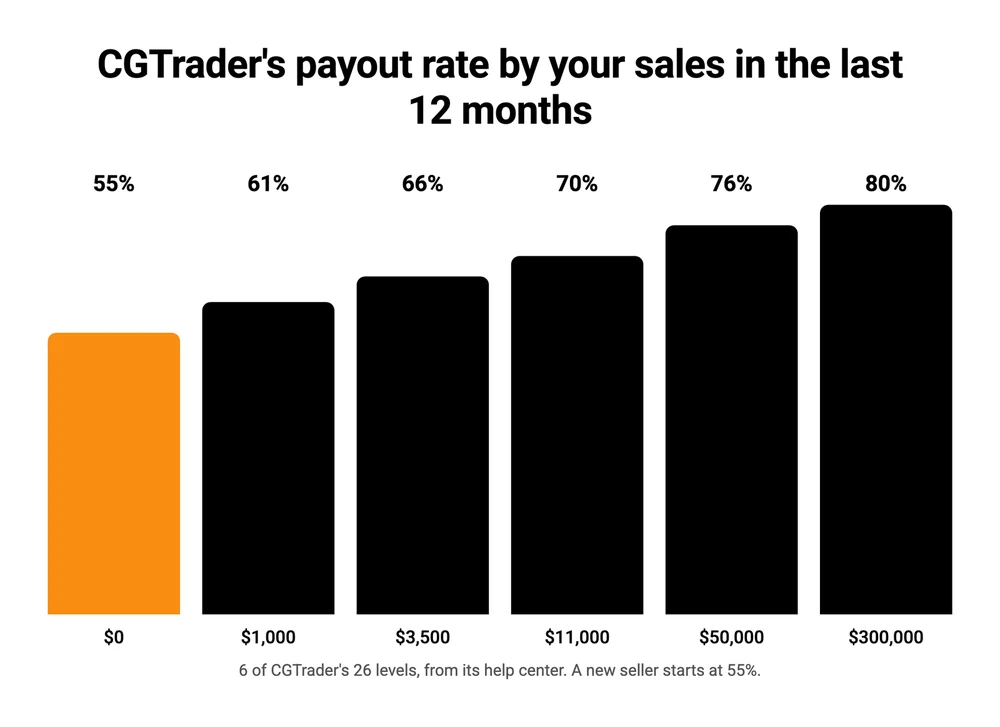
- CGTrader moved new sellers to a 55% payout in September 2026. You reach 70% only after $11,000 in sales over 12 months.
- Etsy caps each digital file at 20MB. Its first page for STL files is also crowded with $5 bundles claiming thousands of files.
- Sellers with followers can skip the marketplace cut. CartMango takes 0% per sale (free right now, from $10 a year once paid plans start in November), Payhip 5% on its free plan, Gumroad 10% plus $0.50.
Who buys 3D models, and why that decides where you sell
2 groups buy 3D models online: people with 3D printers, and studios, game developers and agencies who need assets for a scene.
Picking the wrong store is one of several common selling mistakes. If you want to catch the others before your first upload, the Online Selling Mistakes Challenge walks through 5 of them by email over 5 days.
A commenter in a 2021 r/3DMA thread split the second group further: most sales go “to other content creators working in games OR advertising/film, which are two separate markets with different needs.” Add the printing crowd and you get 3 audiences.
Printable models go to hobbyists on Cults3D and Etsy, game assets go to developers on Fab and the Unity Asset Store, and render assets go to agencies on CGTrader and TurboSquid.
| What you make | Typical buyer | File formats | Where it sells |
|---|---|---|---|
| Printable models | Hobbyists, tabletop players, cosplayers | STL, 3MF, OBJ | Cults3D, Printables, MyMiniFactory, Etsy |
| Game assets | Indie developers, studios | FBX, GLB, engine packages | Fab, Unity Asset Store, CGTrader |
| Render and ad assets | Designers, agencies, film crews | FBX, OBJ, MAX, BLEND | CGTrader, TurboSquid, ArtStation |
A miniature with a hollowed base and a 3MF file is no use to a Unity developer, and a 4K-textured car built for renders is a poor fit for someone with a resin printer.
Be realistic about the money before you start. In that same thread, a seller with “about 3 or 4 asset packs of about 30-60 models each” said “I make about 100 bucks a month off of it.” That is a side income, and it came from roughly 90 to 240 models.
What to export, and what buyers want to see
Export for your buyer before you upload: STL or 3MF for printers, and FBX, OBJ or GLB with textures for games and renders.
- For 3D printers: STL opens in nearly every slicer, and 3MF can also carry colors and print settings. If you design miniatures for resin printers, add a pre-supported version so the buyer can skip placing supports.
- For games and renders: FBX carries a model and its materials into Unity, Unreal and Blender. GLB packs a model and its textures into 1 file for web and AR viewers. List the polygon count and texture size.
- Preview images: for a printable, show a photo of a real print beside the render. For an asset, show renders from several angles plus a wireframe view.
- License: say what the buyer may do. 16 of the 58 Etsy listings in my sample advertise commercial use in the title, which usually means the buyer may sell the prints.
Pick a narrow niche before you build a catalog. The same commenter who split the buyers advised to “focus very narrowly on WHO you’d be selling to and what assets those people would be most willing to pay for.”
If your models are made for 3D printers
Designers of miniatures, terrain, cosplay parts, fidget toys and home organizers sell printable files on 4 main sites: Cults3D, Printables, MyMiniFactory and Etsy. Cults3D and Printables cost nothing to list on, Etsy charges $0.20 a listing, and MyMiniFactory needs a monthly plan before you can open a store.
My pick: start on Cults3D, add Printables when 1 model stands out, and use Etsy only for files under 20MB.
On a $5 file, Etsy leaves you $4.07, Cults3D $4.00, MyMiniFactory $3.59 before its monthly plan, and Printables $3.55 after Stripe’s card fee.
| Marketplace | What it takes | You keep of $5 | The catch |
|---|---|---|---|
| Cults3D | 20%, bank fees included | $4.00 | Your price is set before VAT |
| Printables | 20% plus Stripe’s fee | $3.55 | $5 minimum price, and you start with 1 paid slot |
| MyMiniFactory | 15% plus 3.49% + $0.49 | $3.59 | A store needs a paid creator plan, from $9.99 a month |
| Etsy | $0.20 + 6.5% + 3% + $0.25 | $4.07 | Each file is capped at 20MB |
Cults3D’s upload page says you “receive 80% of the net selling price (excluding VAT)”, and that Cults’ 20% pays bank fees of “about 5%” plus running the site. There is no subscription. That makes it the low-risk first listing for a designer with no audience yet.
Printables, Prusa’s model site, opened its paid store with a 20% fee and a $5 minimum price, per its store launch post. New sellers get 1 paid slot and earn more slots as their models sell, so it suits a designer with 1 strong model to prove first. The $3.55 above assumes Stripe’s standard US card rate of 2.9% plus 30 cents.
MyMiniFactory cuts less per sale on its higher tiers, but you pay to be there. Its creator fee page lists 15%, 12.5% or 10% by tier, plus card processing, and its store setup guide says a store first needs a Premium Creator subscription. The tier FAQ prices those at $9.99, $24.99 and $99.99 a month.
At $5 a file, the $9.99 plan takes most of your first 3 sales every month.
Etsy has 2 problems for printable files. The first is size: its digital listings help page allows “up to five digital files” with a “maximum size for each file” of 20MB. A high-detail model can pass that on its own, so a seller has to split a model across several zip files or put a download link inside a PDF. Etsy’s fee page also charges 15% on any sale that comes through its offsite ads.
The second is the competition. I pulled every listing on Etsy’s first page for “stl file 3d print”, 58 of them.
37 were bundles, 19 of them claiming 1,000 files or more, including a “70,000,000+ STL 3D Models Library”, and 5 were custom design services. The median bundle asked $5.22.
The 16 single designs and small sets on that page asked about the same: half of them were under $5. So an original model sits on the same page, at about the same price, as bundles claiming thousands of files. If Etsy is still on your list, our Etsy fee and lock-in breakdown is worth reading first.
If your models end up in games, renders or AR
Game, film and AR assets sell on Fab, ArtStation, the Unity Asset Store, CGTrader and TurboSquid, and the share each pays a seller without a paid plan runs from 40% to 88%.
Start with Fab if you make game assets. It pays 88% of a sale, the largest share in the table below for a seller without a paid plan, and its publisher guide says Fab is integrated with Unreal Engine. Add the Unity Asset Store if your assets are made for Unity, and CGTrader or TurboSquid for models aimed at renders and product shots.
On a $20 asset, Fab pays $17.60, ArtStation $17.30 without Pro, Unity $14.00, CGTrader $11.00 to a new seller and TurboSquid $8.00.
| Marketplace | Your share | You keep of $20 | The catch |
|---|---|---|---|
| Fab | 88% | $17.60 | Paid monthly once you pass $100 |
| ArtStation | 88%, minus $0.30 an item | $17.30 | Pro members keep 92%, but Pro is paid |
| Unity Asset Store | 70% | $14.00 | Buyers are Unity developers |
| CGTrader | 55% to start | $11.00 | Rises to 70% after $11,000 in a year |
| TurboSquid | 40% | $8.00 | Up to 60% if every model is exclusive to it |
Fab is Epic’s marketplace, and its publisher guide says “You will receive 88% of the revenue generated by your product sales.” Payment comes about 30 days after each month ends, once your balance reaches $100. Below that, it rolls over to the next month.
ArtStation’s earnings page charges a non-Pro seller a 12% selling fee plus $0.30 per item. Pro members pay 5% plus a 3% promotion fee. ArtStation also sells 2D art, brushes and tutorials, so it suits an artist whose portfolio already lives there. If you sell flat illustrations too, our guide on how to sell digital art covers that side.
The Unity Asset Store says “You retain 70% of all revenue earned” and charges nothing to publish. TurboSquid’s publishing agreement starts at a 40% base royalty and adds 10% to 20% only if you publish all of your 3D models exclusively with TurboSquid.
CGTrader is the one that changed. Its payout rate system, effective September 15, 2026, runs 26 levels from 55% to 80%, based on your net sales over a rolling 365 days.
A new seller starts at 55%. You reach 70% at $11,000 in sales and 80% at $300,000.
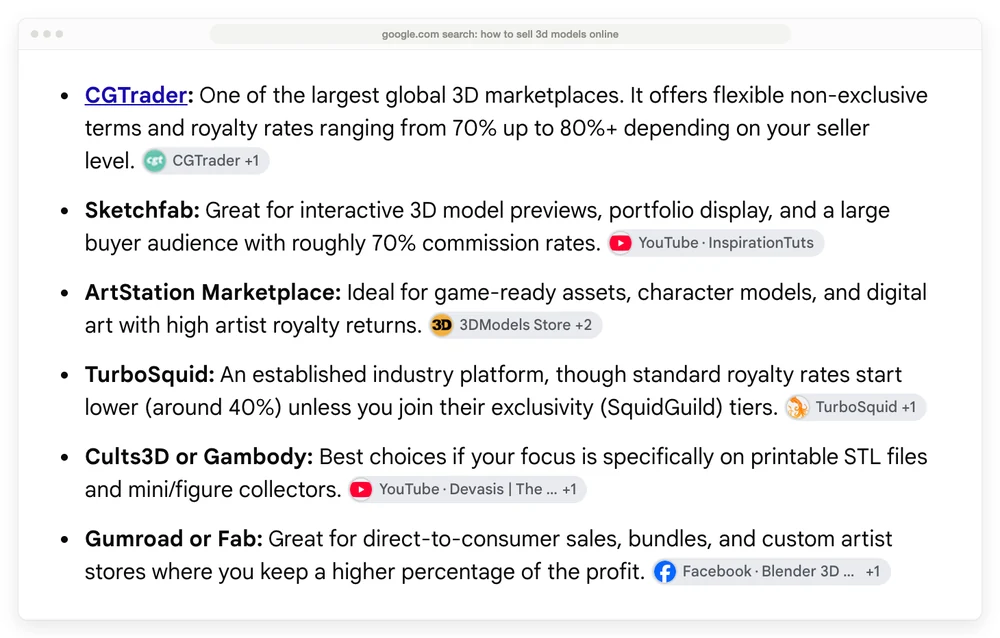
Search this topic and Google’s own summary still quotes CGTrader at “70% up to 80%+”, a rate a new seller reaches only after $11,000 in sales. It also recommends Sketchfab “with roughly 70% commission rates”. Sketchfab’s own store update says “The Sketchfab Store is now closed”, and that has been true since October 22, 2024, the day Fab launched.
Sketchfab still hosts free and view-only models, and pages for products a seller moved to Fab link out to Fab. Epic sold Sketchfab and ArtStation to KitBash in August 2026, per Epic’s announcement, and ArtStation’s marketplace still sells, with over 429,000 digital products listed.
If you release new models on a monthly schedule
A designer who drops a fresh batch of models every month can sell a membership instead of single files, through Patreon, MyMiniFactory’s Tribes or a checkout that bills monthly. Members pay a set amount each month and get that month’s release.
Patreon’s creator fee page puts every page published after August 4, 2025 on its standard 10% plan, plus payment processing of 2.9% plus $0.30 on a US card. On a $10 monthly tier, you keep $8.41 per member. Patreon gives your members a feed for your updates in return.
MyMiniFactory’s Tribes need its $24.99 or $99.99 monthly plan, per its tier FAQ, and the tier’s cut applies “on all revenue generated”.
CartMango bills subscriptions on every plan, including the $10 a year Silver plan, and takes 0% per sale. You keep $9.41 of each $10 monthly payment after Stripe’s card fee, before CartMango’s own yearly plan.
If you move off CartMango later, the subscriptions you created keep billing your customers and paying you. CartMango has no member feed or community space.
If people already follow your work somewhere else
A seller whose buyers already find them through YouTube, Instagram, Discord or a mailing list no longer needs a marketplace to do the finding, so the share a marketplace takes buys them little. What you give up is browsing traffic: nobody stumbles onto your checkout by accident.
On a $20 model paid by card, CartMango leaves you $19.12 before its yearly plan, Payhip $18.12 and Gumroad $16.62.
| Checkout | Per-sale cut | You keep of $20 | The catch |
|---|---|---|---|
| Gumroad | 10% + $0.50, plus card fee | $16.62 | Sales from its Discover marketplace cost 30% |
| Payhip | 5% on the free plan, plus card fee | $18.12 | 5GB limit per file |
| ArtStation website | 5% + $0.30, its page lists no card fee | $18.70 | Built for ArtStation portfolios |
| CartMango | 0%, plus card fee | $19.12 | Yearly plan from November, and Silver holds 10 products |
CartMango is mine, which is why its row uses the same card fee as Gumroad and Payhip and lists its yearly plan in the catch column.
The Gumroad, Payhip and CartMango rows count Stripe’s standard 2.9% plus 30 cents. ArtStation’s own-website option pays $18.70 by its fee page, whose own example shows a $10 item paying the seller $9.20. Gumroad also drops its rate to 5% plus $0.50 for any month your sales pass $20,000, per its help center, and this list of Gumroad alternatives prices 7 other checkouts.
CartMango storage runs 2GB on Silver, 10GB on Gold and 50GB on the $30 a year Platinum plan, and textured 3D models fill storage fast. Only Platinum holds unlimited products, so a catalog of 40 separate products needs that tier. Payhip caps each file at 5GB.
None of these need a website of your own. CartMango’s Mini Pages, Payhip and Gumroad all host a product page for you, and our guide to an online store for digital products compares the 3 kinds of store.
Gumroad’s Discover marketplace can send you some buyers, at 30% of those sales. Plan on sending the rest yourself.
How much to charge for a 3D model
Printable files on Etsy’s first page ask about $5, whether the listing is 1 model or a bundle of thousands. Etsy showed a crossed-out higher price on 45 of the 58, so most were advertised as discounted.
The single designs asked between $0.72 and $15. A Deadpool knife holder sat at the bottom, the kind of listing the section on characters below warns about. The top belonged to items and sets with a clear use, like a construction-themed doll accessory kit at $15 and a cosplay helmet at $12.
Those are asking prices, and my sample has no sales counts, so use them as a guide:
- A small single model: $2 to $5, the range where 6 of the 16 single designs sat, though Printables sets a $5 minimum.
- A themed set or a functional item: $10 to $15, where the top 4 single listings sat.
- Game and render assets: priced per license. Fab lets you set separate Personal and Professional prices on 1 listing, per Sketchfab’s move-to-Fab notes, so a solo developer can pay less than a studio.
CGTrader also advertises a buyer subscription of 25 models a month from $9.99. Its payout FAQ calls subscriptions a separate, opt-in way for sellers to earn from models they have already uploaded, which in my reading means opting in trades some full-price sales for a share of subscription revenue.
Before you settle on a number, our guide to pricing digital products has a section on testing a price first.
Where selling 3D models goes wrong
4 problems came up in the listings and threads I read: old advice, other people’s characters, leaked files and a flood of copies.
Following advice from a store that closed
Sketchfab is the clearest case. 2 of the guides ranking for this search, plus Google’s own summary, still list it as a place to sell, and its store closed in 2024. Check a marketplace’s own help center for its current rate before you upload 50 models, because CGTrader’s rate moved in September 2026 and the old figure still circulates.
Selling characters you do not own
4 of the 58 Etsy listings I checked used Pokémon or Deadpool characters, which belong to other companies. Selling a model of a character or a brand logo you do not own is a copyright and trademark risk that sits with you as the seller.
Files that leak
A seller in an October 2026 r/cults3d thread described buyers “splitting the cost among several people and then sharing the files”, and, much more often, people printing the designs for commercial purposes. “That’s why I stopped selling STL files. Now I only sell printed products.”
A sold file can always be copied, but our guide to protecting digital downloads covers 8 ways to slow sharing down.
Competing with a flood of copies
A Cults3D seller wrote in September 2026 that there are “too many AI-generated models and copied products”, and that they “sold two units of a single product in three months.” Another seller in the same Cults3D discussion said of every marketplace they sell on: “Until 2024 it was fine, last year growth stopped, this year it’s shrinking.” The way through, in my view, is a narrow niche and a following of your own.
How to sell 3D models online: the 4 routes side by side
You keep $4.00 of a $5 printable file on Cults3D, $17.60 of a $20 game asset on Fab, $9.41 of a $10 monthly payment on CartMango and $19.12 of a $20 sale through your own CartMango checkout, before its yearly plan.
| Your situation | The pick | What you keep | The catch |
|---|---|---|---|
| Files for 3D printers | Cults3D, Printables for a standout model, Etsy for small files | $4.00 of $5 on Cults3D | Search is crowded with copies and bundles |
| Game, render or AR assets | Fab, then Unity, CGTrader or TurboSquid | $17.60 of $20 on Fab | Fab pays only once you pass $100 |
| New models every month | Patreon or a checkout that bills monthly | $8.41 of $10 on Patreon, $9.41 on CartMango | CartMango has no member feed, and its yearly plan is extra |
| Followers who already buy | Your own checkout | $19.12 of $20 on CartMango | A yearly plan from November, and no browsing traffic |
FAQ
Can I make money by selling 3D models?
Yes, though the 2 sellers I quote here report modest results. A seller in a 2021 Reddit thread made about $100 a month from 3 or 4 asset packs of 30 to 60 models each. A Cults3D seller in September 2026 sold 2 units of 1 product in 3 months.
What is the best website to sell 3D models?
Cults3D for printable STL files and Fab for game assets, because printable files and game assets sell to different buyers. Cults3D charges no monthly fee, and Fab pays 88% of each sale. If you already have followers, your own checkout skips the marketplace cut, and CartMango takes 0% per sale.
Is AI replacing 3D artists?
Not according to the sellers I read. 1 Cults3D seller cites “too many AI-generated models and copied products”, and ArtStation’s marketplace offers a filter that hides products created with AI. Listing the topology, scale and license helps a buyer compare your model with the rest.
How much should I charge for a 3D model?
On Etsy’s first page, printable files asked a median of about $5, and single designs asked between $0.72 and $15. Those are asking prices, so treat them as a guide: $2 to $5 for small models, $10 to $15 for useful sets, and $5 or more on Printables. For game and render assets, set separate personal and professional license prices, which Fab supports on 1 listing.
When your followers are the ones buying
Marketplaces earn their cut by finding buyers and running the store for you. Once your buyers come from your own YouTube channel, Discord or mailing list, you are paying for the finding part you no longer need.
For a seller with followers, the last step in how to sell 3D models online is moving sales to a checkout you control. CartMango is free right now and from $10 a year once paid plans start in November, takes 0% per sale, and includes order bumps on every plan, so a buyer of your dragon can add the matching base in 1 click.
About the Author

👋 I’m Welly, founder of CartMango (the site you’re on), a checkout platform for digital product sellers. We’ve previously processed $179M+. I also run BirdSend (email marketing tool, 3.1B+ emails sent). On the side I show other non-techie digital sellers how I use AI workflows to automate 50%+ of my operations. Find me on LinkedIn.
Related Reading
- How to sell digital art: downloads, marketplaces and print-on-demand with real fee math
- Etsy for digital products: what Etsy costs at each price point, and the lock-in
- How to sell embroidery designs online: another file-based craft, with an Etsy price study
- Protect digital downloads: 8 ways to slow down sharing and resale
- Gumroad alternatives: 7 checkouts priced for digital sellers