
Gumroad vs Kajabi favors Gumroad for new sellers: $0 a month and 10% plus $0.50 per direct sale. Kajabi Basic suits course sellers who want email and community on 1 bill, at $143 a month billed yearly with no cut on Kajabi Payments, and costs less past 26 sales a month of a $50 product.
That break-even comes from both companies’ live pricing pages, and card fees match on a US card. Basic adds 2% a sale on your own Stripe account. CartMango, the checkout I run, suits sellers who want neither a cut nor a monthly bill: free right now, then from $10 a year in November, at 0% a sale plus Stripe’s card fee.
If you’re about to launch a first course, the platform bill starts before the sales do. Sign up for a subscription too soon and that bill arrives every month, whether anyone buys or not.
Wait too long to switch, and the percentage keeps taking more from every sale than the subscription would have cost. The comparisons on Google’s first page mostly list features and skip that math.
So I priced the 8 setups on the 3 companies’ pricing pages and cut the list down rule by rule, until 3 were left. You’ll see the sales number where Gumroad and Kajabi Basic cost the same, and what each survivor still can’t do.
Key Takeaways
- Gumroad charges $0 a month. It keeps 10% plus $0.50 of each direct sale, card fees come on top, and it files your sales tax.
- Kajabi Basic costs $143 a month billed yearly. It bundles courses, email for 2,500 contacts, a website and a community, capped at 5 products.
- On a $50 product the 2 cost the same at 26 sales a month. Below that, Gumroad’s cut is the smaller bill.
- Kajabi’s “0% revenue share” holds on Kajabi Payments. Connect your own Stripe account and Basic adds 2% to every sale.
- CartMango is free right now, then $10 to $30 a year from November. It takes 0% of each sale on top of Stripe’s card fee.
Gumroad vs Kajabi: the 8 setups on their pricing pages
The 3 companies’ pricing pages list 8 setups between them: Gumroad with its 2 fee routes, Kajabi’s 3 plans and CartMango’s 3 yearly tiers. Still working out what to sell before you pick where to sell it? The Online Selling Mistakes Challenge is 5 short emails on the 5 selling mistakes solo creators make most, and how to fix each one.
Every price below is on yearly billing, shown per month, because CartMango only bills yearly. On a $50 sale, Gumroad’s direct route leaves you $42.75, its Discover marketplace leaves $35.00, and every Kajabi and CartMango plan leaves about $48.25 before the plan’s own price.
| Setup | Plan price | Cut per sale | Keep on $50 | Main limit |
|---|---|---|---|---|
| Gumroad, direct sales | $0 | 10% + $0.50, plus 2.9% + 30¢ card fee | $42.75 | $100 balance before a payout |
| Gumroad, Discover sales | $0 | 30%, card fee included | $35.00 | Opens after $100 in sales and a review |
| Kajabi Basic | $143/mo billed yearly | 0%, card 2.9% + 30¢ | $48.25 | 5 products, 2,500 contacts |
| Kajabi Growth | $199/mo billed yearly | 0%, card 2.8% + 30¢ | $48.30 | 50 products, 25,000 contacts |
| Kajabi Pro | $399/mo billed yearly | 0%, card 2.7% + 30¢ | $48.35 | 100,000 contacts |
| CartMango Silver | about $0.83/mo billed yearly | 0%, plus Stripe’s 2.9% + 30¢ | $48.25 | No upsells, no courses |
| CartMango Gold | about $1.67/mo billed yearly | 0%, plus Stripe’s 2.9% + 30¢ | $48.25 | No courses |
| CartMango Platinum | $2.50/mo billed yearly | 0%, plus Stripe’s 2.9% + 30¢ | $48.25 | No quizzes or certificates |
I run CartMango, so weigh its rows with that in mind. CartMango’s 3 tiers cost $10, $20 and $30 a year once paid plans start in November, and nothing before that. The Kajabi card rates are its US rates on Kajabi Payments, and Stripe’s pricing page lists the same 2.9% plus 30¢ for a US card. Month to month, Kajabi charges $179, $249 and $499.
Kajabi has also sold a Kickstarter plan at $71 a month billed yearly ($89 month to month), with 1 product and 250 contacts, through a direct signup link instead of its pricing page. I couldn’t confirm it still takes new sign-ups, and it isn’t a pricing-page plan, so it stays out of the count.
At the top of this search, Google’s AI summary quotes Kajabi at “$149 to $399/mo”, calls Gumroad’s fee a flat 10%, and lists no course tools for Gumroad. 2 of the first-page articles repeat the $149, and Kajabi’s own Gumroad comparison lists Basic at $119 a month with a 3-product cap. Neither $149 nor $119 appears on Kajabi’s pricing page, on yearly or monthly billing.
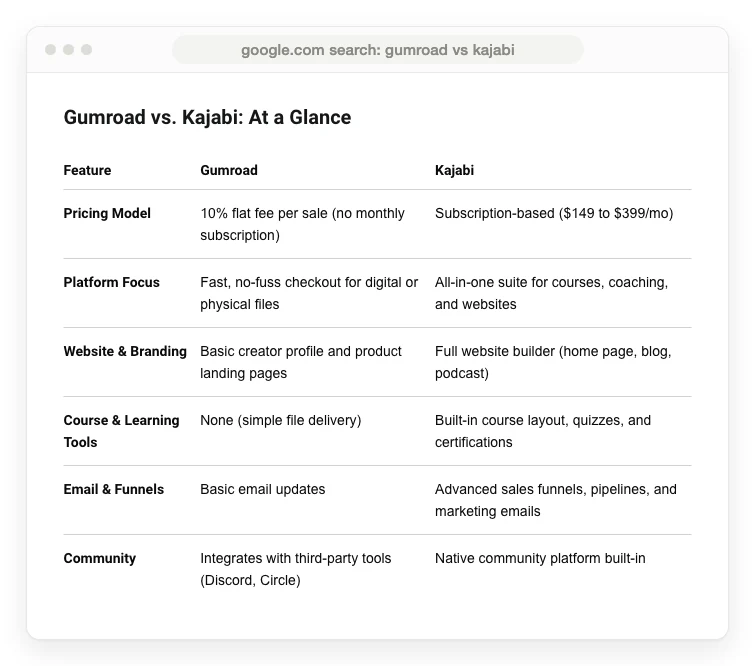
Google’s AI summary for “gumroad vs kajabi”. Read the Pricing Model row: Gumroad also adds $0.50 a sale plus card fees, and Kajabi’s live prices are $143 to $399 billed yearly.
Gumroad’s fees are also bigger than a flat 10%. Its help center says the 10% plus $0.50 “does not include” credit card processing at 2.9% plus $0.30, which is how a $50 sale ends up costing $7.25. Our Gumroad vs Stripe comparison walks through the same math on a $20 sale.
Cut 1: drop Kajabi Growth and Pro until you outgrow 5 products
Kajabi Growth and Pro cost $672 and $3,072 a year more than Basic, and Kajabi’s pricing page aims them at businesses “getting to $50k a year and beyond” and “$200k+ a year”. Anyone still inside Basic’s 5-product and 2,500-contact caps can cut both.
Growth costs $2,388 a year. For the extra $672 you get an affiliate program, 25,000 contacts instead of 2,500, 50 products instead of 5, live cohort courses and no “Powered by Kajabi” footer. Its card rate is 0.1 points lower too, which saves $1 on every $1,000 of sales. At that rate the discount alone only pays back the extra $672 once you sell $672,000 a year. Pro adds a branded app in the App Store and unlimited products, for $4,788 a year.
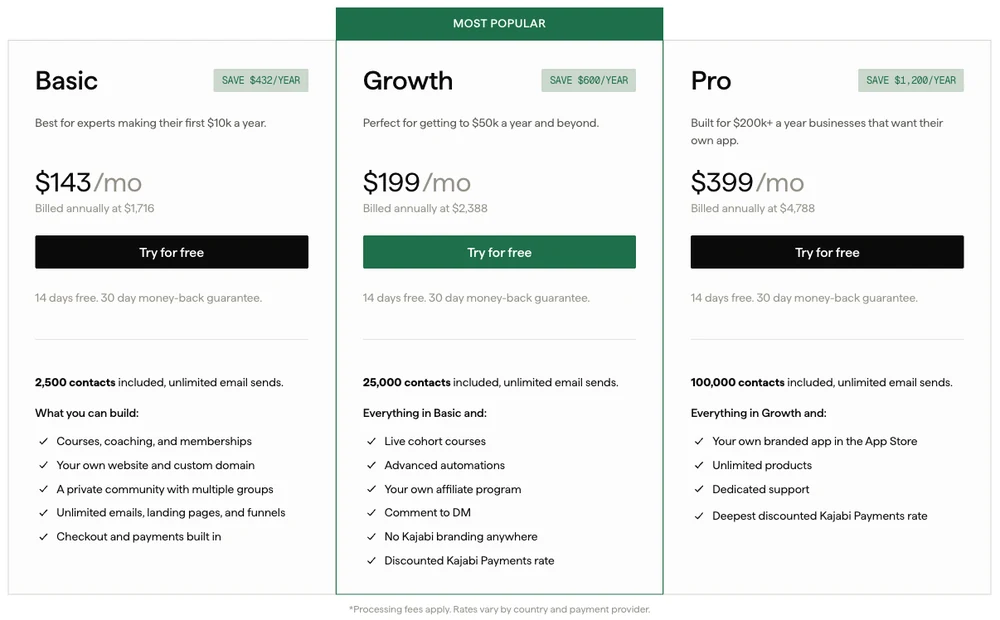
Kajabi pricing on yearly billing, straight from its page. Each plan card names the revenue it is built for, from “first $10k a year” on Basic to “$200k+” on Pro.
If the affiliate program is the reason you were eyeing Growth, there are cheaper routes. Gumroad has affiliates built in, and its help center says the fees on an affiliate sale are split between you and the affiliate in line with their commission. CartMango includes an affiliate system for up to 250 affiliates on its $30 Platinum plan.
That cut kills 2 setups. 6 are left.
Cut 2: drop Gumroad Discover as the place your store lives
Gumroad Discover keeps 30% of every sale its marketplace sends you, and you cannot pick it on day 1, so it works as an extra on top of a direct Gumroad store.
On a $50 product a Discover sale leaves you $35.00, against $42.75 from a direct sale. Gumroad’s help center sets these gates before your products show up there at all:
- Payout settings filled in, plus a $100 balance from genuine sales.
- A pass through a risk review, which it says takes about 3 weeks on average after you cross $100.
- For each product, at least 1 sale, a category and ratings switched on.
Products listed on Discover are also opted into Gumroad’s affiliate program automatically. You only get there by selling directly first, so the direct route is the one to compare. Neither Kajabi’s pricing page nor CartMango’s lists a marketplace that sends you buyers, so on this point Gumroad has something the other 2 do not.
That cut kills 1 setup. 5 are left.
Cut 3: if a course is in the plan, drop CartMango Silver and Gold
CartMango’s $10 Silver and $20 Gold tiers have no course feature, so anyone planning a course can cut them. Gumroad and Kajabi Basic both pass this test, and so does CartMango Platinum.
The 3 survivors run courses in different ways:
- Kajabi Basic includes courses and a community with multiple groups, and you upload your lesson videos straight into Kajabi. Its course builder adds quizzes and completion certificates, and Kajabi’s help articles for both name no plan limit.
- Gumroad streams the videos you upload at up to 1080p, can block downloads so buyers only watch on Gumroad, and takes subtitle files. Its help center lists no quiz or certificate feature.
- CartMango Platinum ($30 a year) holds lessons with text, images, audio, files and a pasted video link, with a progress bar and a “mark complete” button. The videos stay on YouTube or Vimeo, since CartMango does not host video files.
If you only sell ebooks, templates or presets, skip this cut. CartMango Silver at $10 a year covers 10 products with order bumps, and on a $50 file it beats Gumroad’s cut from the 2nd sale of the year.
That cut kills 2 setups. 3 are left: Gumroad direct, Kajabi Basic and CartMango Platinum.
Gumroad, Kajabi Basic or CartMango Platinum: which one to pick
Pick Gumroad while sales are small, and move to Kajabi Basic once Gumroad’s cut passes $143 a month and you want email, community and quizzes on the same bill.
Where Gumroad’s cut passes Kajabi’s bill
At the 4 prices below, Gumroad’s cut passes Kajabi Basic’s $143 a month somewhere between $1,215 and $1,485 of monthly sales.
| Product price | Gumroad’s cut per sale | Gumroad costs more from | Monthly sales then |
|---|---|---|---|
| $27 | $3.20 | sale 45 | $1,215 |
| $50 | $5.50 | sale 27 | $1,350 |
| $97 | $10.20 | sale 15 | $1,455 |
| $297 | $30.20 | sale 5 | $1,485 |
Card fees are left out of that table, since Gumroad, Kajabi Payments and Stripe all charge about 2.9% plus 30¢ on a US card.
On Kajabi’s month-to-month price of $179, the $50 break-even moves out to sale 33.
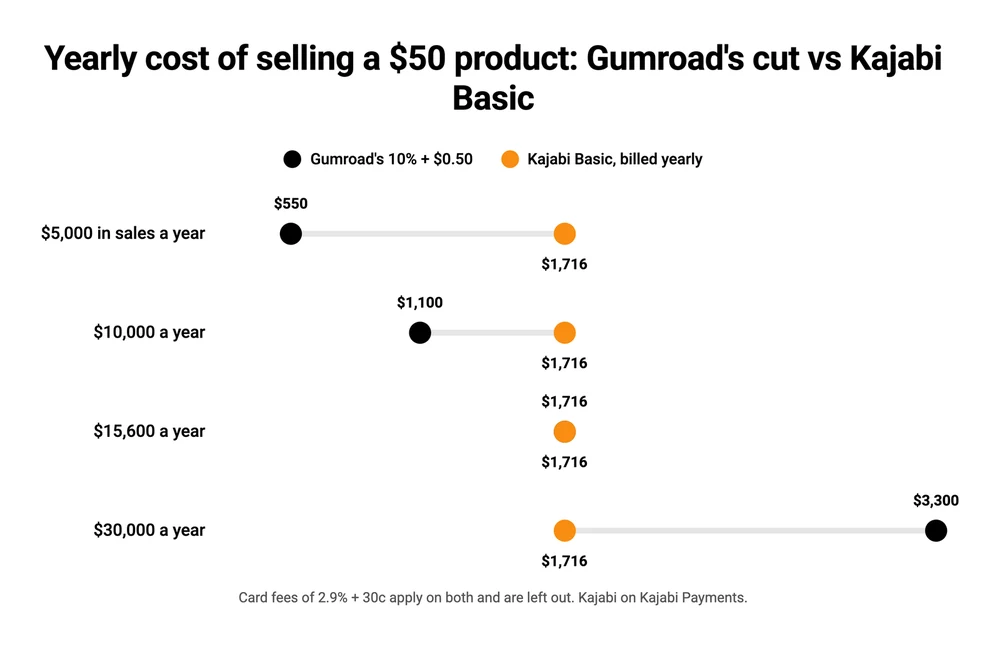
Kajabi’s pricing page calls Basic the plan for “experts making their first $10k a year”. At exactly $10,000 a year of $50 sales, Gumroad’s cut comes to $1,100, which is $616 less than Basic’s $1,716. At $5,000 a year it is $550, and only at $15,600 does it match Basic. By $30,000 a year Gumroad takes $3,300, nearly twice Basic’s bill.
Past $20,000 of sales in a single month, Gumroad’s help center says the direct fee drops to 5% plus $0.50 for the rest of that month.
The same doubt shows up in an older r/elearning thread where someone just starting out asked whether Gumroad would be the smarter start. Their words: “$119 from Kajabi is a bit too much for me to commit too at the moment.” Kajabi Basic is $143 a month on yearly billing now.
What each one sells, and where your sales page lives
Gumroad sells digital products, ebooks, courses, tutorials and memberships. Your profile works as a store, products get their own landing pages, and its features page lists email broadcasts and automated workflows for your buyers and followers.
Kajabi Basic sells courses, coaching, memberships, downloads and podcasts. Its bill also covers your own website and domain, unlimited emails, landing pages and funnels, email for 2,500 contacts and a community with groups, all on 1 subscription. If you were going to pay for those tools anyway, compare Kajabi’s bill against that stack, not just against Gumroad’s cut. Our Kajabi review covers what buyers say once they’re on it.
CartMango sells downloads, coaching packages and subscriptions on every tier, and courses on Platinum. CartMango hosts simple sales pages through Mini Pages, which link straight to its checkout, so you don’t need a website of your own, but it doesn’t send marketing email.
Sales tax, add-on fees and the yearly totals
Gumroad files your sales tax. It has been the merchant of record since January 1, 2025, so it collects and pays the tax for you worldwide.
Kajabi Sales Tax works out the tax and collects it at checkout for $0.15 a transaction, but Kajabi’s sales tax guide says it “does not file or remit sales taxes on your behalf.” Its Kajabi Payments fee page also lists 0.7% on top of every subscription and payment-plan charge.
CartMango leaves sales tax to you too, since you stay the legal seller. CartMango Platinum costs $30 a year with 0% a sale, so on a $50 product it beats Gumroad’s cut from the 6th sale of the year. CartMango syncs buyers into Kit, ActiveCampaign, beehiiv or BirdSend for email, and its community feature is not live yet.
At $10,000 a year of $50 sales, the 3 survivors cost $1,100 on Gumroad, $1,716 on Kajabi Basic and $30 on CartMango Platinum, before card fees that run about $350 on all 3.
| Survivor | Best for | Cost at $10,000 a year | Still doesn’t |
|---|---|---|---|
| Gumroad, direct | A first $50 product, under about $1,300 a month | $1,100 | Keep memberships billing if you leave |
| Kajabi Basic | A course plus email and community on 1 bill | $1,716 | File your sales tax or sell a 6th product |
| CartMango Platinum | A course and checkout with no cut | $30 | Host videos, send marketing email, file your sales tax or run a community (not live yet) |
Gumroad can host a video course, so test your first one there
Gumroad can run a first video course, even though several pages on this search cut it for having no course tools. Google’s AI summary says “None (simple file delivery)”, and Payhip’s comparison table puts a dash in Gumroad’s online courses row and another in its upsell row.
The upsell dash is wrong: Gumroad’s help center has a whole article on its upsells. The courses dash overstates it. Gumroad’s streaming player plays uploaded videos at up to 1080p, with subtitles and a stream-only switch that stops downloads, and its pricing FAQ lists courses and tutorials among the things sellers put there. What it lacks is quizzes and certificates, and plenty of first courses don’t need either.
Years ago I built a course, spent a long time making it, and fewer than 5 people bought it. I nearly quit selling online over it.
Since then I want someone to pay before I build the full thing, and a store that costs $0 a month while nothing sells is a cheap place to find out. So run the first version on Gumroad. CartMango Platinum is another low-cost test bed, free right now and $30 a year from November, at 0% a sale plus Stripe’s card fee. If the course sells past about $1,300 a month on a $50 price, Kajabi Basic costs less than Gumroad’s cut, and the move becomes a decision made on real sales.
FAQ
Why are people leaving Gumroad?
The loudest seller complaints are suspended accounts and held payouts. Our Gumroad review found that 46 of 68 recent seller reviews on Trustpilot describe a suspended account, a held payout or the payout minimum. Gumroad’s help center sets a $100 minimum balance before any payout, with a 7-day hold on weekly payouts. Gumroad fees add up too: $7.25 of a $50 sale once card processing is included.
Is there anything better than Kajabi?
For a checkout alone, yes. Gumroad costs less than Kajabi Basic until about $1,300 a month on a $50 product, and CartMango Silver costs less than Basic at any sales level, though neither has Kajabi’s quizzes or certificates. For courses, email and community on 1 bill, compare whole bundles. Our Kajabi alternatives guide prices 8 of them, and Payhip vs Kajabi covers the closest cheaper course option.
What’s better than Gumroad?
For lower fees on files, Payhip’s free plan takes 5% a sale with no 50-cent charge, and CartMango takes 0% for $10 to $30 a year. Both leave card fees on top, and CartMango leaves sales tax to you, where Gumroad files it. Our Gumroad alternatives roundup and Gumroad vs Payhip go further.
Is Gumroad worth it in 2026?
Yes, while your sales are small. With no monthly fee, Gumroad costs less than Kajabi Basic until about $1,300 a month on a $50 product, and it handles sales tax as merchant of record. Past that point a flat-fee platform keeps more of each sale.
Can you move from Gumroad to Kajabi later?
You can move your products and export your buyer list, but memberships are the catch. Gumroad memberships don’t move with you: leave Gumroad and those recurring payments end, so members have to sign up again on the new platform. If you already sell a membership, plan the move before your member count grows.
Before you pay $1,716 a year for a course platform
Gumroad vs Kajabi turns on 1 number: how much you sell each month. Under about $1,300 a month on a $50 product, Gumroad’s cut is the smaller bill. Above it, Kajabi Basic is, and that bill also covers email, community and quizzes.
If neither side of the Gumroad vs Kajabi trade suits you, there is a 3rd route with no cut and no monthly software bill. CartMango keeps 0% of every sale, sends each buyer into Kit, ActiveCampaign, beehiiv or BirdSend, and adds upsells and order bumps to your checkout. It is free right now, and from November it costs $10 to $30 a year, with courses on the $30 plan.
About the Author

👋 I’m Welly, founder of CartMango (the site you’re on), a checkout platform for digital product sellers. We’ve previously processed $179M+. I also run BirdSend (email marketing tool, 3.1B+ emails sent). On the side I show other non-techie digital sellers how I use AI workflows to automate 50%+ of my operations. Find me on LinkedIn.
Related Reading
- Gumroad review: what 68 recent Gumroad sellers say about payouts, holds and fees
- Kajabi review: what recent Kajabi buyers say about the plans and the own-processor fee
- Payhip vs Kajabi: a cheaper course seller’s checkout set against Kajabi’s bundle
- Gumroad alternatives: 7 places to sell files for a smaller cut