

Sellfy is a good fit for a creator who wants 1 simple store for downloads, subscriptions and print-on-demand merch. It takes 0% of each sale and pays you straight into your own Stripe or PayPal. The catches are a sales cap on every plan, no free plan, and a trial with no live checkout.
This Sellfy review draws on all 71 visible Trustpilot reviews, 2 Reddit threads, Sellfy’s help center and the 4 review articles ranking on Google. Plans cost $22, $59 or $119 a month billed yearly, or $29, $79 or $159 month to month. They cover $10,000, $50,000 or $200,000 of sales in any 12 months, with a 2% fee past that until you upgrade.
You want a simple place to sell a file, a few t-shirts or a monthly pack. Before you pay $264 for a year, you want to know how Sellfy holds up once real money moves through it.
The reviews on page 1 of Google make that hard to judge. 3 of the 4 review articles there never mention the 2% fee for passing your sales cap.
3 of the 4 also say they earn commissions from their links, or carry a coupon set up with Sellfy.
A store has 5 jobs: take the first payment, pay you, deliver the files, stay affordable as you grow, and stay switched on. This review checks Sellfy against each one.
Key Takeaways
- No free plan, and no sales during the trial. Sellfy’s 14-day trial has no live checkout, so your first real sale comes after you pay.
- 0% of each sale, paid instantly. Sellfy takes no cut, and money lands in your Stripe or PayPal at once, minus the card fee.
- The cap sets the real price. Starter covers $10,000 of sales in any 12 months, then Sellfy charges a 2% fee until you upgrade.
- Starter leaves out the selling tools. Upselling, cart abandonment emails and affiliates start on Business, at $59 a month billed yearly.
- 5 of the 11 genuine 1-star reviews describe a store, its files or the account switched off or deleted, 3 of them after billing trouble.
- At $12,000 a year in $25 sales, Sellfy costs $304 to $504, Payhip $588, Gumroad $1,440 and CartMango $10 a year from November (free right now).
Taking your first real payment
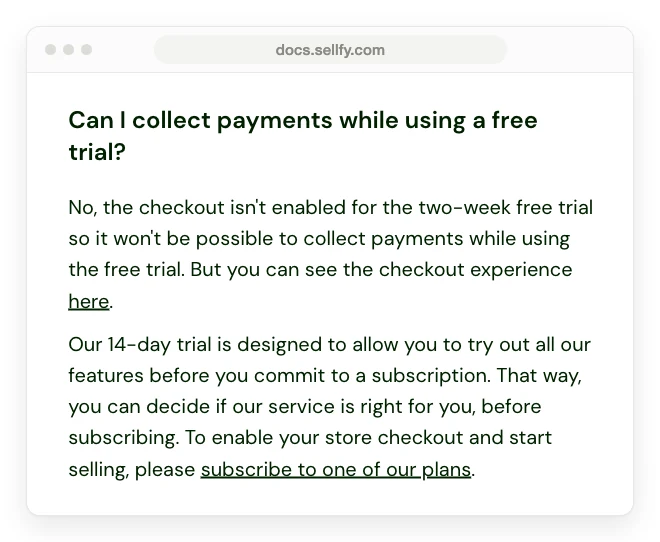
Sellfy’s 14-day free trial lets you set up your store, but you cannot sell anything until you pay. Its help center says: “the checkout isn’t enabled for the two-week free trial so it won’t be possible to collect payments while using the free trial.”
Use the trial weeks to fix the basics before buyers arrive, starting with the 5 selling mistakes in the free Online Selling Mistakes Challenge, sent 1 email a day.
2 of the 11 genuine 1-star reviews on Trustpilot are about the trial, and a seller in Estonia put it in 7 words: “In trial period, noone can buy anything.” Only 2 of the 4 ranking review articles mention it at all.
There is no free plan to fall back on either. Sellfy closed its free plan to new sellers in November 2022, and only sellers who joined before then still have one. So your real starting price is $22 a month, paid as $264 up front for a year, or $29 if you pay month to month.
The safety net is a 30-day money-back guarantee that starts when you subscribe. That window, more than the trial, is when you find out whether buyers will actually pay. And if you never subscribe, Sellfy removes the account and store 30 days after the trial ends.
Getting paid, and paying the tax
Sellfy pays you the moment a buyer pays. The money goes straight into your own Stripe or PayPal account, and the help center says: “Sellfy does not hold your funds or payments from customers.” Sellfy itself takes 0% of each sale, while Stripe or PayPal take their usual fee, which at Stripe is 2.9% plus 30 cents on a US card. 4 of the positive Trustpilot reviews single out the fast money, one of them simply: “immediate payment to paypal account, that’s great”.
Stripe and PayPal are the only 2 options, though Stripe brings Apple Pay and Google Pay with it. A 4-star reviewer in Ukraine wanted Payoneer or a bank transfer and could not have either, and selling subscriptions through PayPal needs a PayPal Business account.
Gumroad is the one that holds money back. It keeps card sales behind a $100 minimum and a 7-day hold, which our Gumroad review covers in detail. Payhip pays straight into your account, and so does CartMango, the checkout I run.
Tax falls to you, because Sellfy is not the merchant of record, the business legally selling to your buyer.
Sellfy does give you tools. It works out EU VAT, Europe’s version of sales tax, from the buyer’s country and exports a VAT report that it still calls a “VAT MOSS” report, after the EU’s older scheme. The EU’s current version is the One-Stop Shop. You add the UK rate yourself and any US state sales tax by hand, or you block EU and UK buyers with 1 setting.
Reviews blur this. EXPERTE writes that “VAT is handled automatically for US, Canada, UK, EU”, while Sellfy’s own tax page says “Sellfy won’t be able to file taxes for you”. Gumroad does file, as the merchant of record on every sale since January 2025, and Payhip collects and pays EU and UK VAT plus US and Canadian sales tax, except Quebec’s.
Delivering the files
Sellfy hosts your file and emails the buyer a download link, and none of the 1-star reviews is about digital file delivery. Each product holds up to 50 files, at up to 10GB on Starter, 15GB on Business and 20GB on Premium. Buyers get 5 download or streaming attempts per file, and video can stream instead of download.
For PDFs, Sellfy can stamp the buyer’s email address along the bottom of every page, which Sellfy says discourages sharing. The stamp does not work on zipped files, password-protected PDFs or files over 400MB.
A Sellfy subscription is 1 product whose files you swap by hand each week, month or year. It cannot sell access to your whole store, it has no free trial or setup fee option, and a buyer who cancels loses the download links straight away. That suits a monthly pack of presets or sheet music, while a membership with a community or a course library needs a different tool.
Paying the right plan as your sales grow
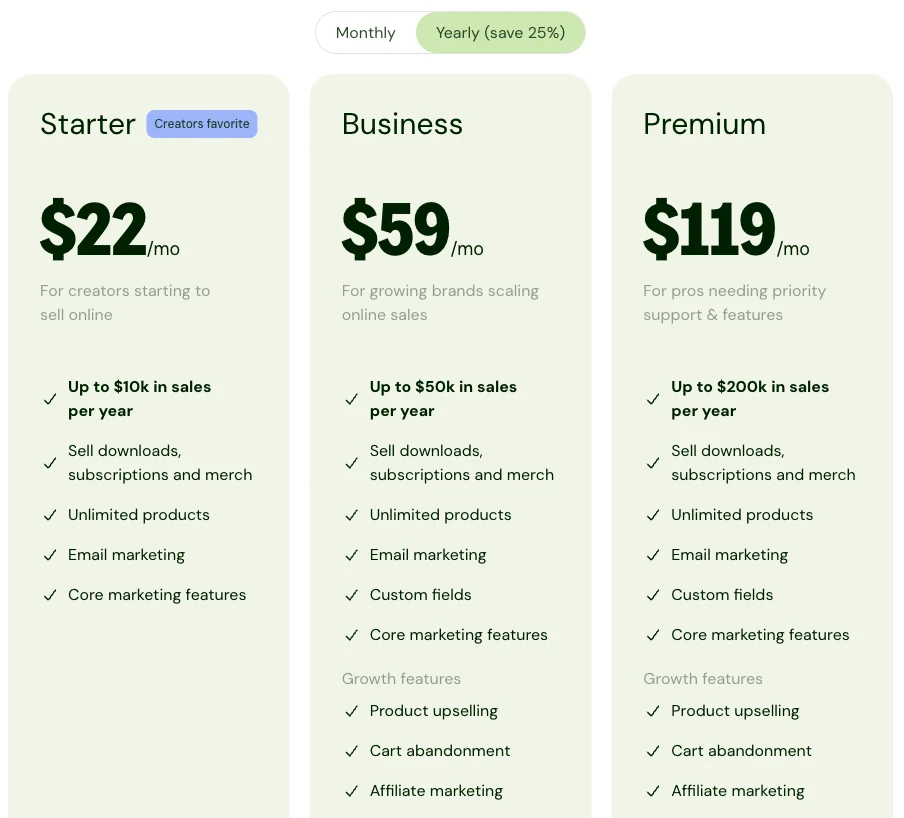
Sellfy’s 3 plans set how much you can sell in 12 months and which selling tools you get, from $10,000 on Starter at $264 a year to $200,000 on Premium at $1,428 a year.
| Plan | Billed yearly | Month to month | Sales cap | Upsells, cart emails | Marketing emails |
|---|---|---|---|---|---|
| Starter | $22 a month ($264 a year) | $29 a month | $10,000 | No | 2,000 a month |
| Business | $59 a month ($708 a year) | $79 a month | $50,000 | Yes | 10,000 a month |
| Premium | $119 a month ($1,428 a year) | $159 a month | $200,000 | Yes | 50,000 a month |
The cap counts your sales over a moving 12-month window, so it never resets when your plan renews. Cross it and the store keeps selling, but Sellfy charges an overage fee, an extra charge for selling past your plan’s limit, after notifying you. Moving the other way is slow: a downgrade only starts with your next billing cycle, so on a yearly plan you can wait up to a year.
Sellfy’s own pages describe that fee 2 ways. Its help page on the limit says you’ll be “charged a 2% overage fee” on “every individual order placed in your store after you’ve exceeded the yearly revenue limit.” Its pricing page says it “may start to charge a 2% overage fee for the amount of revenue that has gone over the subscription plan limits.”
Say your sales hold steady at $12,000 a year. Under the first wording, once your last 12 months pass $10,000, every order carries 2%, about $240 a year. Under the second, you pay 2% on the $2,000 over the line, about $40. Starter plus the fee comes to $304 to $504, both below Business at $708.
So paying the 2% stays cheaper than moving up to Business until somewhere between $22,200 and $32,200 a year in sales, depending on which page Sellfy follows.
Starter leaves out upselling, cart abandonment emails (reminders to shoppers who left without paying), an affiliate program, custom checkout fields and removal of the Sellfy branding. All of them start on Business. Sellfy’s help page describes its upsell as a pop-up discount that appears when a buyer adds an item to the cart. And Starter’s 2,000 marketing emails a month cover 1 send to a list of 2,000, with extra emails at $2 per 1,000.
The ranking reviews handle the cap badly. EXPERTE calls it “a hard cap on how much you can earn per year”, which Sellfy’s own help page contradicts, since the store keeps selling. Emailvendorselection describes passing $10,000 as the point where bigger plans add features, and never mentions a fee. ecomm.design explains the 2% well, then prices a $1,000-a-month seller at about $58 a month on Sellfy. $1,000 a month is $12,000 a year, past Starter’s cap, so that seller also owes the 2% or a bigger plan.
CartMango plans cap products and storage, and none of them caps sales. Order bumps come with CartMango’s $10-a-year Silver plan, and upsells, downsells and cart abandonment with the $20 Gold plan, once paid plans start in November.
Keeping your store switched on
None of the 4 ranking reviews explains this job, and it accounts for the biggest single group of Sellfy’s worst reviews. EXPERTE comes closest, with 1 line about users reporting “locked accounts or data loss” around plan and payment changes.
If a payment for your plan fails, Sellfy’s billing pages say it keeps trying for 14 days. On day 14, in the help center’s words, “your subscription expires, your store is disabled”. Your files stay 30 more days and are then deleted for good. Sellfy’s help pages say cancelling ends in the same place: the store runs to the end of the paid period, and the files are deleted 30 days after the plan ends.
5 of the 11 genuine 1-star reviews describe a store, its files or the whole account switched off or deleted, and 3 of those came after billing trouble. A seller in Germany wrote that changing plans after 3 years “cause me to loose my shop”. A US seller wrote that they had “Never heard of a grace period, just turn your site off and make customers think you’ve exit scammed.” A UK seller found products deleted after Sellfy moved to new pricing at the end of 2021.
The product rules can end a store too. Sellfy bans third-party resale and “money-making schemes where the buyer has to re-sell your product”, and its rules state that “Account suspension is permanent”, with no refund of prepaid time. On r/printondemand, a seller wrote in 2023 that Sellfy “closed my shop” over “fraudulent behavior” and said the decision was final. Their own account: “I was just selling t-shirts”. That is 1 side of the story, and Sellfy’s side is not public.
A few cheap habits protect you whichever platform you pick:
- Keep a copy of every product file on your own computer.
- Export your orders and customer emails every month or so.
- Put the plan on a card that will not expire mid-year.
Leaving has 1 more cost, and it only hits subscription sellers. When a Sellfy store closes, the subscription payments it set up stop, while the money had been running through your own Stripe or PayPal all along. Our page on Sellfy alternatives looks at that lock-in in more depth.
Sellfy reviews on Trustpilot, sorted by what they say
Sellfy’s TrustScore on Trustpilot is 3.9 from 72 reviews, 71 of them visible. Of the 12 one-star reviews, 1 is about a different company, and 5 of the 11 genuine ones describe a store switched off or deleted.
| Complaint | Reviews | Years | Quote |
|---|---|---|---|
| Store, files or account switched off or deleted | 5 | 2022 to 2025 | “it cause me to loose my shop” |
| Free trial with no working checkout | 2 | 2021, 2023 | “noone can buy anything” |
| Support or data handling | 2 | 2023, 2025 | “No response to my support ticket in over a month” |
| A print-on-demand order that never arrived | 1 | 2026 | “the customer doesn’t have their order” |
| A store web address they could not change | 1 | 2025 | “assigned a random URL to my store” |
| A mobile-phone sale in India, not Sellfy | 1 | 2026 | Sellfy’s reply: “you may have reviewed the wrong Sellfy” |
The plain average of the 71 visible reviews is higher, at 4.1, because 49 of them give 5 stars. Of the 47 five-star reviews that are about Sellfy, 31 use words like easy, simple or user-friendly, and 21 mention support. 3 of those thank the same staff member by name. Only 8 reviews have arrived since November 2025, 3 of them 1-star. Sellfy replied to 6 of its 12 one-star reviews.
2 German 5-star reviews praise an agency’s project work, and 1 of them names the agency “Sellerfy”, so they read like reviews of a different business.
A seller of digital products for music creators, choosing a platform on r/ecommerce wrote that “the reviews I see online seem be paid sponsors”. 3 of the 4 review articles ranking for this search say they earn commissions from links, or carry a coupon set up with Sellfy. If your worry is whether Sellfy is a real, safe company at all, our is Sellfy legit guide covers that question.
Sellfy next to Gumroad, Payhip and CartMango
On $12,000 a year of $25 sales, Sellfy costs $304 to $504 on Starter plus its 2% fee, Payhip $588 on its Plus plan (billed monthly, the only way Payhip bills), Gumroad $1,440, and CartMango $10 a year once paid plans start in November, before card fees on all 4.
| Tool | First sale | Getting paid | Tax | Cost at $12k | If you leave |
|---|---|---|---|---|---|
| Sellfy | Only after you subscribe | Instantly, into your Stripe or PayPal | Works out EU VAT, you file | $304 to $504 on Starter plus 2%, or $708 on Business | Subscription payments stop |
| Gumroad | Right away, no monthly fee | Weekly for cards, after a $100 minimum and a 7-day hold | Collects and pays it for you | $1,440 (10% plus 50 cents a sale) | Subscription payments stop |
| Payhip | Right away on the free plan | Instantly, into your own account | Collects and pays EU and UK VAT plus US and Canadian sales tax | $588 on Plus, $600 on the free plan | Subscription payments stop |
| CartMango | Right away, free right now | Instantly, into your Stripe or PayPal | You file, as the seller of record | $10 a year on Silver (10 products, 2 GB), from November | Subscriptions keep paying you |
CartMango is mine. CartMango loses the tax row to Gumroad and Payhip. CartMango’s $10 plan holds 10 products and 2 GB of files.
Is Sellfy worth it for you?
Sellfy is worth it when these fit you:
- You sell merch next to your downloads and want 1 store for both, with print-on-demand built in.
- Your sales sit under $10,000 a year, or you are happy to pay the 2% fee rather than jump to Business.
- You want every sale in your own Stripe or PayPal the moment it happens.
Pick something else when these fit you:
- You want real buyers paying you before you spend anything. Payhip’s free plan, Gumroad and CartMango all let you sell from day 1.
- You sell a membership or course access rather than files. Sellfy’s subscriptions are file drops.
- You want the platform to handle your sales tax. Gumroad collects and pays it worldwide as the merchant of record, and Payhip does it for EU, UK, US and Canadian buyers, except in Quebec.
Merch is where I would point you away from CartMango. CartMango sells no merch, while Sellfy handles t-shirts and mugs beside your downloads in 1 store, so if merch is half your store, pick Sellfy.
Sellfy questions sellers ask
How much does it cost to sell on Sellfy?
Sellfy costs $22, $59 or $119 a month on a yearly plan, or $29, $79 or $159 month to month. Each plan covers a set amount of sales in any 12 months: $10,000, $50,000 or $200,000. Sellfy takes 0% of each sale, so your other cost is Stripe’s or PayPal’s fee, about 2.9% plus 30 cents on a US card. Past your cap, Sellfy charges a 2% fee until you upgrade.
How does Sellfy pay you?
Sellfy pays you instantly. Buyers pay through Stripe or PayPal, and the money lands in your own Stripe or PayPal account the moment the sale goes through. Sellfy never holds the balance, so there is no payout schedule or minimum. Sellfy notes that a brand-new PayPal account can slow your very first deposits, and that delay comes from PayPal.
Is Sellfy free to use?
No. Sellfy has no free plan for new sellers, and its 14-day trial has no live checkout, so you cannot take a payment until you subscribe. The cheapest plan is Starter at $22 a month billed yearly or $29 month to month. Sellfy does offer a full refund within 30 days of your first payment.
Does Sellfy take a percentage of your sales?
No, Sellfy charges 0% per sale on every plan. The only percentage it can add is a 2% overage fee once your sales over the last 12 months pass your plan’s cap and you have not upgraded. Its pages word that fee 2 ways, as 2% on every order after you pass the cap or 2% on the revenue above it.
Is Sellfy legit?
Yes. Sellfy is an established store builder that says more than 75,000 creators have used it, and its TrustScore on Trustpilot is 3.9 from 72 reviews. The complaints worth reading before you sign up are about stores switched off after billing trouble or rule breaks, and the trial with no live checkout.
Can you keep your subscribers if you leave Sellfy?
No. When a Sellfy store closes, the subscription payments it set up stop, though buyers paid through your own Stripe or PayPal. You would need to ask each subscriber to sign up again on your new platform, so check what happens on exit before you start if recurring income is a big part of your store.
Selling without a sales cap
Sellfy suits a seller who wants 1 simple store and instant payouts, and is fine with a price that steps up as sales grow. If the cap, the trial or the subscription lock-in put you off after reading this Sellfy review, CartMango is a checkout with no sales cap.
CartMango is free right now and costs from $10 a year once paid plans start in November, with 0% of each sale. If you sell subscriptions, CartMango keeps them paying you after you leave.
About the Author

👋 I’m Welly, founder of CartMango (the site you’re on), a checkout platform for digital product sellers. We’ve previously processed $179M+. I also run BirdSend (email marketing tool, 3.1B+ emails sent). On the side I show other non-techie digital sellers how I use AI workflows to automate 50%+ of my operations. Find me on LinkedIn.
Related Reading
- Is Sellfy legit?: the scam question, trust signals and how Sellfy pays out
- Sellfy alternatives: 7 options compared, starting with the subscription lock-in
- Gumroad vs Sellfy: a percentage fee against a flat monthly plan
- Gumroad review: 118 recent Trustpilot reviews sorted, and why card payouts wait
- Payhip review: 553 Trustpilot reviews and the 5% free plan