

You can sell AI prompts on PromptBase, Etsy, Gumroad, or your own checkout using a tool like CartMango. Prices are lower than most guides claim: across 188 live PromptBase listings I sampled myself, the median was $5.99 and 91% were priced at $10 or under. Platform fees run from 0% to 30%.
Most guides about selling prompts were written when prompts were new and AI models were bad at following plain instructions. Both of those things have changed.
Ask Claude or ChatGPT for a decent marketing email today and you get one, with no purchased prompt involved. That has pushed prices down and made buyers far more suspicious about what a prompt pack is worth.
So I went and looked instead of guessing. I sampled 188 live listings, read PromptBase’s own payout rules, and checked the current fee everywhere you can list.
Below is what a prompt actually sells for, what each platform keeps, the payout rule that stops most beginners from ever getting paid, and the one corner of this market that is still not crowded.
Key Takeaways
- Real prices are low. Across 188 live PromptBase listings I sampled myself, the median was $5.99 and 91% sat at $10 or under.
- Your fee depends on who found the buyer. PromptBase takes 20% through its marketplace and 0% when you send the buyer yourself.
- Payouts have a floor. PromptBase needs a $30 balance before Stripe pays out, which is 7 sales at the median price.
- Agent skills are far less crowded. PromptBase lists 43,500+ text prompts against 4,400+ SKILL.md agent skills, at a higher median price.
- Nobody owns the output. The US Copyright Office says prompts alone do not make you the author of what a model generates.
What AI prompts actually sell for
The guides that bother with pricing hand you a range. None of them show you what is actually on the shelf.
So I counted. I sampled 188 live PromptBase listings across 3 pages of the site.
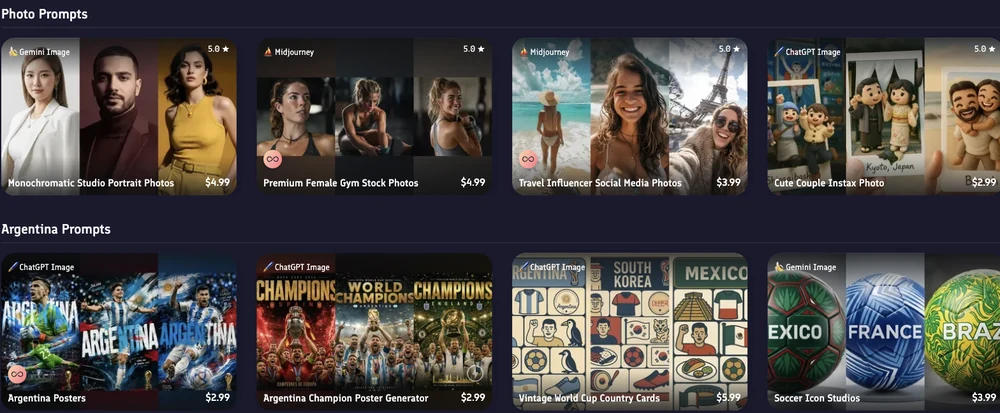
Real PromptBase listings. Look at the price in the bottom-right of each tile.
| Page sampled | Listings | Median price | Range |
|---|---|---|---|
| Trending marketplace | 67 | $3.99 | $2.99 to $9.99 |
| Text prompts | 60 | $6.99 | $2.99 to $29.99 |
| Agent skills | 61 | $9.99 | $2.99 to $19.99 |
Pooled, the median across all 188 was $5.99, and 172 of them (91%) were priced at $10 or under. The spread runs $2.99 to $29.99, but the top end is thin.
The cheap end is very cheap. On the trending page, 58 of the 67 listings sat at exactly $2.99, $3.99 or $4.99, and nothing there broke $10.
Compare that to the advice elsewhere. One of the guides ranking for this term puts tested single prompts at $5 to $15, themed bundles at $19 to $49, and prompt libraries at $99 to $199 and up.
The single-prompt band is about right. The bigger numbers are where it comes apart: nothing in my sample of 188 reached even $30. To be fair to that guide, I sampled individual listings rather than bundles, so treat its bundle figures as untested here.
Still, a single prompt priced at $49 next to a wall of $3.99 competitors needs a reason the buyer can see in about 4 seconds.
Proof is what buys you that reason. Show the actual output. Run 3 different inputs through the same prompt and show all 3.
Want to catch the pricing and positioning mistakes before they cost you sales? Grab the free 5-day Online Selling Mistakes Challenge, which walks through the 5 that hit solo sellers hardest.
What people still pay for
Back in 2023 I had ChatGPT draft about 95% of one of my daily emails, and I said so openly at the time. It came out fine. The part it could not do was decide what the email should be about.
That gap is where the money sits. Buyers pay for the judgement about what to ask for. Reproducing the sentence itself takes seconds once someone has seen it.
Buyers have worked this out. On r/PromptEngineering in May 2026, someone building a prompt and skill marketplace asked whether people would actually pay $5 to $50 for proven listings. The replies are worth reading before you build anything.
The top response argued most buyers could simply ask Claude to build the same thing for them, and that there is “no intellectual property or infrastructure in the offering to warrant a price tag”.
Another pointed out you cannot really protect a prompt. One buyer posts it publicly and your product is free forever. A third said sample outputs are easy to cherry-pick, so screenshots alone do not prove much.
But one reply named exactly what does sell. That commenter said they would pay for a pipeline: a specific prompt, run on a named model, with the output shown. People already sell those, and they do fine.
Compare 2 listings:
- A prompt that writes product descriptions. A buyer gets that by asking the model directly, for free, in about 10 seconds.
- A tested workflow that turns a photo and 3 fields into 12 finished listings, with the outputs shown. That one takes real work to reproduce.
As for what categories exist, PromptBase sorts its catalogue into art and illustration, logo and icon, graphic and design, productivity and writing, marketing and business, photography, and games and 3D. Pick whichever you actually know something about. Then put real distance between your listing and a question the buyer could type themselves.
If you are selling files rather than access, the same rules apply as for any download. Our guide on protecting digital downloads covers what actually slows copying and what only looks like it does.
Agent skills are the least crowded lane
The surprise in my sample was agent skills. PromptBase now sells them as a category of their own, meaning SKILL.md files that plug into Claude, ChatGPT and Cursor and hand the model a repeatable job.
The supply gap is large. PromptBase’s own text-prompt page advertises 43,500+ text prompts. Its agent-skills page advertises 4,400+ skills.
That is roughly 10 times fewer listings to fight through. The median price in my sample was also higher, at $9.99 against $6.99 for text prompts, with half the sampled skills sitting at exactly $9.99.
A skill is closer to what buyers said they wanted. It carries instructions, structure and a defined output, so what lands in the buyer’s hands is already finished.
I checked all 4 guides on page 1 for this search. Not one of them mentions agent skills. That will not last, which is rather the point of moving now.
Fewer listings means less noise. Nobody is guaranteed sales, and you still have to bring people, which is the next problem.
Where to sell AI prompts, and what each route costs
Your fee is decided by one thing more than any other: who found the buyer.
Send someone to a listing yourself and most platforms charge you little or nothing. Let the platform’s own search find them and you pay for that introduction.
PromptBase now prices exactly along that line. Its seller page says you pay 0% when the buyer arrives through your own link, and 20% when the marketplace sends them.
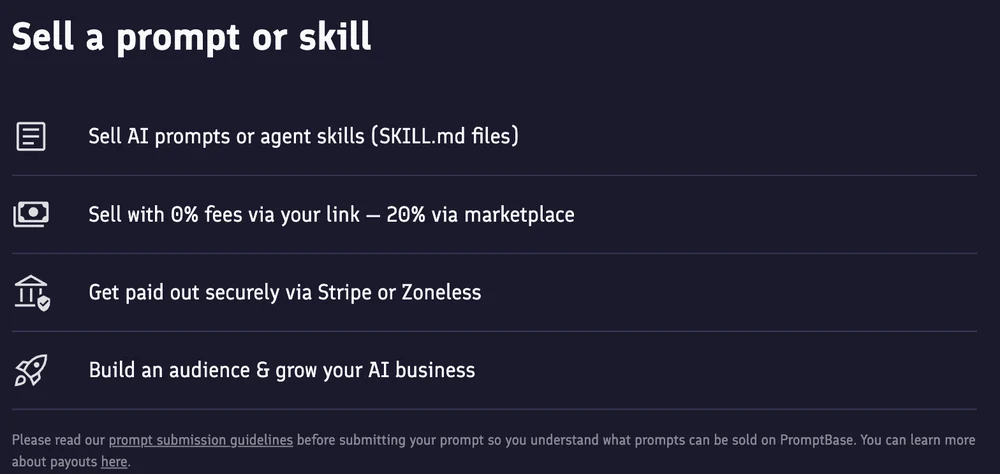
PromptBase’s seller page. Read the second line.
Of the 4 guides currently on page 1 for this search, only 1 quotes PromptBase’s fee at all, and it describes the platform as taking 20% on every sale. Half of that sentence is now optional.
Here is what a single sale at the $5.99 median looks like on each route, with every fee read off the platform’s own page.
| Route | Platform fee | Keep on $5.99 | Buyer comes from |
|---|---|---|---|
| PromptBase, your own link | 0% | $5.99 | You |
| Etsy | $0.20 listing + 6.5% | $5.40 | Etsy search |
| Gumroad, your own link | 10% + $0.50 | $4.89 | You |
| PromptBase marketplace | 20% | $4.79 | PromptBase |
| Gumroad Discover | 30% | $4.19 | Gumroad |
| CartMango | 0% commission, free until October 2026, then from $10/year | $5.99 | You |
I should be upfront that CartMango is my own platform, so treat that last row as a disclosed interest rather than a neutral recommendation.
Every row above is the platform’s own cut, with card processing left out so the rows compare like for like. One exception worth naming: Gumroad’s 30% Discover rate already includes processing, so it is the only all-in number in the table.
Gumroad’s own help centre is explicit that the 10% + $0.50 does not include card processing, so a direct sale actually costs 10% + $0.50 plus 2.9% + $0.30. On a $5.99 sale that is $1.57 all-in, leaving you $4.42.
Two things in that table deserve saying out loud.
First, PromptBase’s own-link route pays exactly the same as CartMango. Both take nothing. Anyone telling you an own-checkout tool always beats a marketplace on fees is skipping that row.
Second, the difference shows up after the sale rather than during it. On PromptBase the customer is theirs, the payout runs on their schedule, and you cannot bolt a second offer onto the checkout. That is the gap my platform is built for, and it is worth weighing against the discovery a marketplace gives you.
For a fuller breakdown of one of these, we went through Gumroad’s pricing in a post of its own.
And if you have no site to send people to, that is not a blocker. See selling without a website for the routes that work.
The payout rule nobody mentions
This is the part that decides whether you actually see money, and I could not find it in a single guide ranking for this term.
PromptBase does not pay you per sale. Sales land in a pending balance, move to an available balance after 72 hours, and then wait for a payout window.
To get paid through Stripe, their knowledge base lists 3 conditions: your account has to be at least 30 days old, your available balance has to reach $30.00, and it has to be your payout day, the 1st of the month or a Monday depending on your schedule.
Do the arithmetic on the median. A $5.99 listing sold through the marketplace nets you $4.79 after the 20% cut. Reaching $30 takes 7 sales.
Down at the trending page’s $3.99 level it takes 10. Up at the $9.99 agent-skill median it takes 4. That is another quiet argument for the higher-priced end of the market.
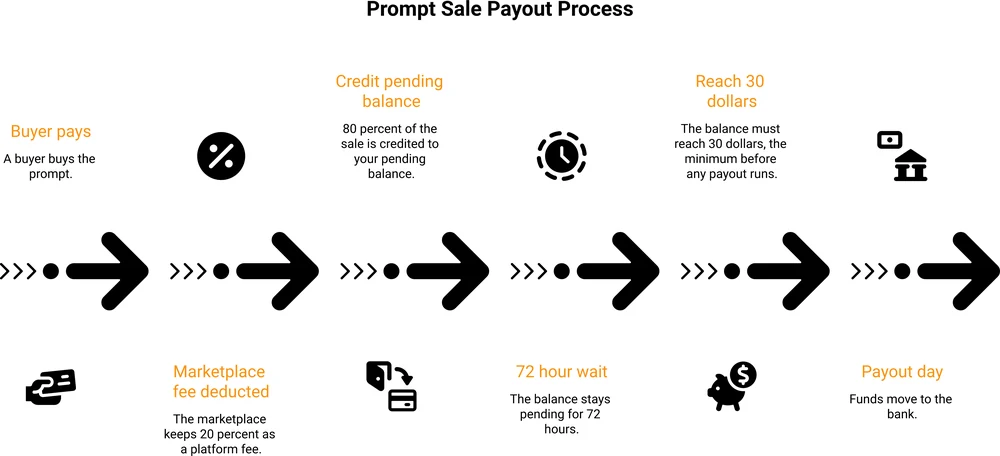
The 6 steps between a buyer paying and the money reaching your bank, built from PromptBase’s own payout rules.
Impatient? There is an early payout. It costs $3.99, takes 7 days, and needs an account over 30 days old.
That fee eats 83% of what a median sale earns you. Paying it to release your first few dollars is a losing trade.
There is a second route: PromptBase also pays daily in USDC through Zoneless with no minimum, if crypto payouts suit you.
PromptBase is still a reasonable place to list. Just plan for a discovery channel with a delay attached, so the first payout does not catch you out.
Is it legal to sell AI prompts?
Selling the prompt itself is fine. You wrote that text, so it is your writing, and there is no rule against selling instructions.
The murkier question is who owns what the prompt produces, and the US Copyright Office has answered it directly. In its January 2025 report Copyright and Artificial Intelligence, Part 2: Copyrightability, the Office concluded that prompts alone do not give a user enough control to count as the author of the output.
Its reasoning is that a prompt conveys an idea, and ideas are not protected. Where a human genuinely shapes the expressive detail, the report says the result can be copyrightable case by case.
Two practical consequences for you:
- Your prompt text is yours. Sell it, license it, set terms.
- Neither you nor your buyer owns the generated output by virtue of the prompt alone. Do not promise buyers exclusive rights to what the model makes.
Marketplaces add their own rules on top. Check the submission guidelines wherever you list, since some restrict prompts that reproduce a living artist’s style or a trademarked character.
Your first launch, start to finish
- Pick a job, not a topic. “ChatGPT prompt for emails” is a commodity. A prompt that turns 3 product photos into a full Etsy listing is a job.
- Run it 10 times on different inputs. Keep the failures. A prompt that only works on your example is not a product.
- Screenshot the outputs. This is your listing, more than the copy is. Show varied inputs so it does not read as cherry-picked.
- Write the file properly. Include the prompt, what to swap, which model it was tested on, and 2 or 3 worked examples.
- Consider shipping it as a skill instead. If the job takes several steps, package it as a SKILL.md with the instructions, the structure and the expected output. That drops you into the 4,400-listing pool instead of the 43,500 one.
- List where the buyers already are first. PromptBase or Etsy get you discovery while you have no audience.
- Send your own traffic to your own link. The moment you have anywhere to post, that switch takes your fee to 0% on PromptBase and on your own checkout.
- Price at the shelf, then climb. Start near the median, add proof, raise it.
Once a listing sells consistently, the next lever is average order value. Pairing a prompt with a related skill, or adding a second offer at checkout, moves revenue faster than doubling your visitors does.
FAQ
Can I make money selling AI prompts?
Yes, though at a smaller scale than most posts suggest. At the $5.99 median, a marketplace sale nets you $4.79, so 100 sales is $479. Based on what buyers say they will pay for, packaging a system and bringing your own traffic looks like the better bet, though I have not measured which sellers actually earn most.
How much does 1 AI prompt cost?
Across 188 live PromptBase listings I sampled myself, the median was $5.99 and 91% were priced at $10 or under. The trending page ran cheapest at a $3.99 median, text prompts sat at $6.99, and agent skills at $9.99.
Is it legal to sell AI prompts?
Selling the prompt text is legal. What you cannot do is promise ownership of the output. The US Copyright Office concluded in January 2025 that prompts alone do not make the user the author of what the AI generates. Individual marketplaces also apply their own content rules.
Where can I sell my prompts?
PromptBase is the largest dedicated marketplace. Etsy suits prompts aimed at its craft and small-business crowd. Gumroad and your own checkout work once you have traffic. The common pattern is listing on a marketplace for discovery, then selling through your own link for margin.
Are AI prompts still worth selling now that models are better?
Bare prompts have been squeezed hard, because a buyer can ask the model to write one. What buyers in that r/PromptEngineering thread said they would still pay for is a packaged workflow with the output shown. Agent skills are also the least crowded corner right now, at roughly 4,400 listings against 43,500+ text prompts.
Selling prompts is a small-ticket game. The fee, the payout floor and the format you pick decide whether it adds up to anything. If you would rather pay no platform commission and own the buyer, that is what your own checkout is for.
CartMango is my checkout platform for solo digital sellers. Every buyer syncs straight into your email tool, so the person who bought one prompt is someone you can sell the next thing to, and order bumps let you raise what each sale is worth without finding more traffic.
About the Author

👋 I’m Welly, founder of CartMango (the site you’re on), a checkout platform for digital product sellers. We’ve previously processed $179M+. I also run BirdSend (email marketing tool, 3.1B+ emails sent). On the side I show other non-techie digital sellers how I use AI workflows to automate 50%+ of my operations. Find me on LinkedIn.
Related Reading
- How to sell PDFs: the delivery and pricing side, for prompt packs shipped as files
- How to price digital products: a method for setting a number you can defend
- Selling digital products on Etsy: honest fee math before you list there
- How to sell digital products without a website: where to send buyers when you have no site yet