

SamCart reviews split hard: 204 of SamCart’s 353 Trustpilot reviews give 5 stars and 100 give 1 star, for a 3.7 TrustScore, while G2 shows 4.3 from 101 reviews. SamCart’s $79 a month Core plan has no order bumps or 1-click upsells, which start on Pro at $199.
Most 1-star reviews are about billing: 59 of 100 describe a renewal or a charge after canceling. SamCart Pro suits sellers sending paid traffic to a funnel. A seller with a few sales a month pays less than on SamCart with CartMango (free right now, from $10 a year once paid plans start in November, 0% per sale) or Gumroad (10% + $0.50 per sale).
SamCart’s pricing page leads with “Plans Starting at $79/mo”. Before you pay it, you want to know what reviewers found and what that $79 actually buys.
The review articles in Google’s top 10 are out of date on what the $79 buys. 5 of the 7 I read list plan names SamCart has retired. The other 2 describe a plan whose price rose with your sales, now gone too.
So this review starts from SamCart’s own pricing page and help center, then sorts all 100 of its 1-star Trustpilot reviews by what went wrong. After that come 5 situations, and which plan, if any, fits each one.
Key Takeaways
- The $79 plan has no order bumps. Core leaves out bumps and 1-click upsells. Both start on Pro, $199 a month or $149 billed yearly.
- Billing drives the 1-star reviews. 59 of 100 describe a renewal or a charge after canceling, and 24 involve Creator U, SamCart’s course brand.
- Few 1-star reviewers were sellers. Only 8 of the 100 clearly sold their own products through SamCart. 6 complain about the software.
- Gumroad and Payhip beat Core at low volume. On a $47 ebook, Core’s $79 only wins from 16 sales a month against Gumroad, 34 against Payhip.
- CartMango costs less than Core at any volume. CartMango, which I run, is free right now, then from $10 a year in November, with order bumps and 0% per sale.
- Leaving has rules. Stripe subscriptions keep billing after you close SamCart. Payment plans and PayPal subscriptions stop right away.
SamCart review basics: what $79 buys today, and what moved to $199
SamCart is a hosted checkout and sales page builder for digital products, courses and subscriptions. It sells 3 plans: Core at $79 a month, Pro at $199 a month and a custom Enterprise tier, shown as “Done For You” on the pricing page.
Want to spot the costly selling mistakes before you choose any platform? The Online Selling Mistakes Challenge walks through 5 of them by email.
You build the sales page and checkout in SamCart and connect a payment processor. The processor is the company that actually charges the card.
Core connects to 3 of them: SamPay, Stripe or PayPal. SamPay is SamCart’s own processor, and SamCart’s help center notes that choosing it opens a brand new Stripe account rather than linking yours. Pro adds Braintree, Authorize.net and Easy Pay Direct.
On monthly billing Core costs $79 and Pro $199. On yearly billing they drop to about $59 and $149 a month, and of those 2, only Pro carries order bumps, 1-click upsells and the affiliate center.
| Plan | Monthly | Billed yearly | Bumps and upsells | Processors | Tax fee |
|---|---|---|---|---|---|
| Core | $79 | $59 a month ($711 a year) | No | SamPay, Stripe, PayPal | 0.5% |
| Pro | $199 | $149 a month ($1,791 a year) | Yes | Core’s 3, plus Braintree, Authorize.net, Easy Pay Direct | 0.35% |
| Enterprise (Done For You) | Custom quote | Custom quote | Yes | Everything on Pro | Not on the pricing page |
What you pay on top of the plan
Card fees come on top of every plan. SamCart adds no platform fee on SamPay, Stripe or PayPal, and SamPay and Stripe run at 2.9% + 30 cents a sale, the same headline rate on Stripe’s pricing page. SamCart’s plan table also lists a “Tax Collection” rate of 0.5% on Core and 0.35% on Pro. It does not say whether that applies to every sale or only to sales where SamCart collects tax.
Both plans include email and chat support. Dedicated live support, with a person in the app on weekdays from 9 to 5 Central Time, costs $19 a month extra. Every new account starts with a 7-day free trial, and billing begins on its own when the trial ends.
There is a mismatch on the pricing page itself. Its FAQ says “Core is $199/year”, while the price card bills $711 a year. Trust the card: $711 is 12 months of $79 with the 25% yearly discount taken off, which the card rounds to $59 a month. Pro’s $1,791 works the same way from $199.
Our SamCart pricing breakdown goes through each plan in more detail.
Why other reviews quote prices you cannot buy
SamCart has changed its pricing structure twice, which is why other reviews quote numbers you cannot buy. Its help center article on legacy plans lists the original Launch, Grow and Scale tiers first. Next came a single plan called Scaler, where “Pricing started at $79/mo and increased based on your monthly sales volume”. Then came today’s Core, Pro and Enterprise.
The same article says Scaler “is a different plan from the new Core”, which is a flat $79 with “a specific feature set”.
The reviews ranking on Google have not caught up. Of the 7 review articles I read from the top 10 results for “samcart review”, 5 still list Launch, Grow and Scale. The other 2 describe Scaler, including the Search Logistics review that says SamCart “starts at $79 per month for every feature that they offer”. None of the 7 names Core or Pro.
The AI summary Google shows above those results repeats an old range, monthly plans from “$59 to $319 depending on the tier”. Today’s monthly prices run $79 to $199, and no published plan costs $319. It also says SamCart works as a checkout “rather than a full website, landing page, or course-hosting platform”, yet both current plans list a page builder and a Courses App with a members area.
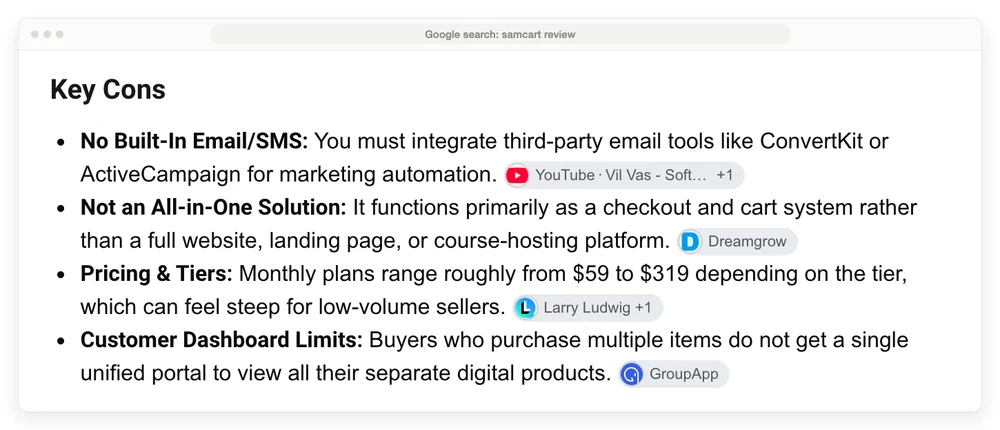
On yearly billing those plans run $59 to $149 a month, and Enterprise is quoted case by case. If you already sit on an old plan, SamCart’s help center warns that canceling it is permanent. Come back later and Launch or Scaler accounts land on Core at $79, while Grow and Scale accounts land on Pro at $199.
What 353 Trustpilot reviews say about SamCart
The 353 reviews on SamCart’s Trustpilot page add up to a 3.7 TrustScore, but only 18 of them sit at 3 stars. 204 give 5 stars and 100 give 1 star, so 86% of the reviews are either 5 stars or 1 star.
Trustpilot marks SamCart as a company that “invites their customers to review, whether positive or negative”, and says it “Replied to 100% of negative reviews”. On SamCart’s G2 page, SamCart shows 4.3 from 101 reviews. Capterra shows 4.4 from 45.
The most common praise is for support. Of the 200 5-star reviews Trustpilot loads without a login, 84 mention support or customer service, and 16 name the same support agent. 29 mention the checkout itself, upsells, order bumps, funnels or conversions.
So what went wrong for the 100 who gave 1 star? I run CartMango, a SamCart competitor, and sorted every one of them using the same method as the Payhip review.
59 of the 100 one-star reviews are about billing, 8 are about charges the reviewer did not recognize, and only 6 are about the checkout software itself.
| What the 1-star review is about | Reviews | In the reviewer’s words |
|---|---|---|
| A renewal after a low-priced course, challenge or download | 23 | “one year later charged $144” |
| A renewal on a SamCart plan, or a charge after canceling | 36 | “Cancelled the auto renew and they still took out the annual payment.” |
| A charge the reviewer did not recognize | 8 | “I got a $239 charge, no idea who this company is” |
| Support that was slow or missing | 8 | “after two weeks I have yet to get a response.” |
| A coaching or done-for-you program | 6 | “Think twice before joining their coaching program” |
| The checkout software itself | 6 | “The checkout pages are horrendous in every way” |
| Too short to place | 13 | “didnt help at all” |
Creator U shows up in the billing complaints. 24 of the 100 involve it, named either by the reviewer or in SamCart’s reply.
Creator U is SamCart’s course and training brand, and SamCart’s replies have drawn a line between the 2. In a reply to a 2023 review, SamCart wrote that “Creator U is a separate business than SamCart” and that “SamCart is a Software as a Service provider, Creator U is an education platform”.
Another reply explains the renewals: “Typically our CreatorU subscriptions rebill one year from the original purchase date for the standard list price instead of the discounted initial price you paid.” So a $19 starter offer can come back a year later as a full-price yearly charge, which is the story behind most of the 23 starter-offer complaints in the table. The line between the 2 businesses is blurrier today, though, because SamCart’s current pricing page lists the CreatorU Learning Library and CreatorU Community on both Core and Pro.
The starter-offer complaints peaked in 2024: 11 of the 23 were posted that year, against 1 in 2025 and 1 in 2026.
Complaints about the checkout software are a small share of the low ratings, 13 of the 113 reviews at 1 or 2 stars, but they are specific. A 2-star review from a seller of physical subscriptions says “SamCart charges shipping per product on every rebill, rather than once per order.” Another 2-star review names “the lack of customization”.
A 1-star review about support says “When I reached tech support, all I got is generic AI message and putting in queue.”
Only 8 of the 100 one-star reviewers clearly sold their own products through SamCart. So the 3.7 says more about SamCart’s billing and course offers than about how its checkout performs for sellers.
If you sell 1 ebook and earn a few hundred dollars a month
A seller with 1 low-priced product and a few hundred dollars a month in sales pays more on SamCart than on a per-sale tool such as Gumroad. The flat fee only wins once sales climb.
In a March 2023 post on r/passive_income, a seller shared 3 months of selling a $47 ebook through SamCart, with YouTube traffic and no ad spend. They paid $59 a month for 3 months, $177, against $935 in sales, so SamCart took about 19% before card fees. “I agree that $59 is quite high, I’m actually transferring off of them because of this,” the poster added in the comments.
That $59 was SamCart’s cheapest plan at the time, as another commenter in the thread notes. Today’s cheapest plan, Core, is $79 a month, or $59 billed yearly.
On a $47 ebook, Gumroad’s cut passes Core’s $79 at 16 sales a month, while Payhip’s 5% stays under it until 34.
| Sales a month | Gumroad (10% + $0.50) | Payhip free plan (5%) | Core, monthly | Core, billed yearly |
|---|---|---|---|---|
| 7 | $36.40 | $16.45 | $79 | $59 |
| 12 | $62.40 | $28.20 | $79 | $59 |
| 16 | $83.20 | $37.60 | $79 | $59 |
| 34 | $176.80 | $79.90 | $79 | $59 |
Card processing applies to all 3, so it cancels out. Gumroad’s fees pass Core at 16 sales a month on monthly billing, or 12 against yearly billing. Payhip’s free plan stays cheaper until 34 sales, or 26 against yearly billing.
The Reddit seller’s $935 works out to roughly 20 copies in 3 months, about 7 a month. That is under every one of those lines.
- Pick: a per-sale tool while sales are low: Gumroad until about 16 sales a month, or Payhip’s free plan until about 34, measured against Core’s monthly price.
- What you give up: a flat bill. Per-sale fees rise with every sale, so a strong month costs more.
If order bumps and 1-click upsells are why SamCart is on your list
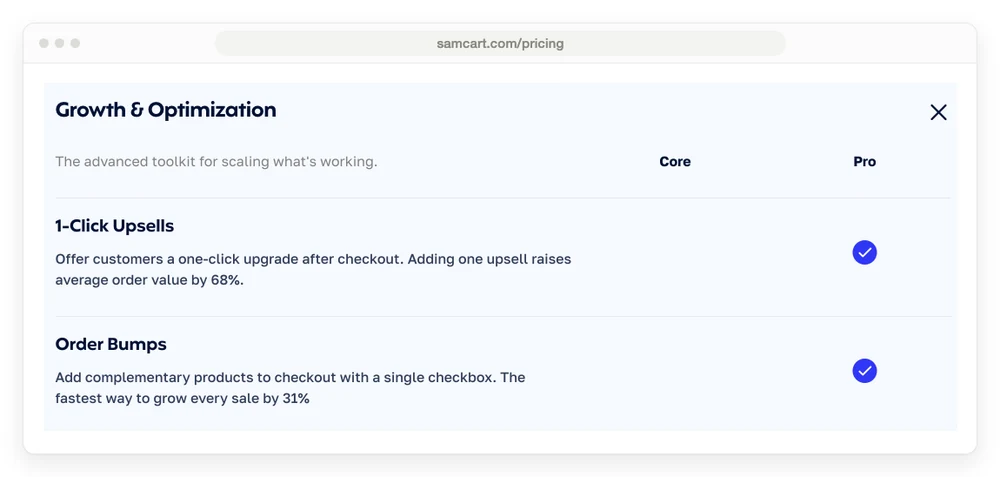
SamCart Pro is the plan to price if order bumps and 1-click upsells are why you are looking, because Core has neither. Pro costs $199 a month, or $149 a month billed yearly ($1,791 a year).
Moving from Core to Pro costs $120 more a month on monthly billing, or $1,080 more a year on yearly billing, about $90 a month. Will the bump pay for that? Say your bump is a $9 add-on. Before card fees, you need 14 bump sales a month to cover the gap on monthly billing, or 10 on yearly billing.
SamCart’s pricing page claims an order bump is “The fastest way to grow every sale by 31%” and that one upsell “raises average order value by 68%”. Those are SamCart’s own figures, with no study named.
Pro also brings A/B testing, the Affiliate Center, Subscription Saver for failed payments, advanced reporting and 10 team seats instead of 1. For a seller running paid traffic into a funnel, those tools sit together on 1 bill. The SamCart vs Shopify comparison runs the same bump math against Shopify, where the checkout bump sits on Shopify Plus.
Other checkouts put the bump on a cheaper plan. CartMango, the checkout I run, has order bumps on every plan, from $10 a year (about $0.83 a month) once paid plans start in November, against SamCart Pro’s $149 a month on yearly billing. Pro also includes A/B testing, the affiliate center and more, so this is not a like-for-like price. Upsells and downsells sit on CartMango’s $20 a year plan. CartMango does not host courses yet, and course hosting is planned for October 2026 on its $30 a year plan.
- Pick: SamCart Pro, if A/B testing and an affiliate center matter to you as much as the bump.
- What you give up: $90 a month more than Core on yearly billing, or $120 month to month, before a single bump sells.
If you want your email list and your checkout in 1 tool
SamCart is a weak pick if you want newsletters, email sequences and the checkout in 1 tool, because its pricing page lists no email marketing feature. What it does include is cart abandonment emails on both plans, plus built-in connections that pass each buyer to the email tool you already use, so you can keep that tool and connect it.
- Pick: SamCart plus the email tool you already use.
- What you give up: 1 login. You pay 2 bills, SamCart’s $59 to $149 a month billed yearly plus the email tool’s own price.
If a $7 course or a Creator U challenge is how you found SamCart
If SamCart reached you through a $7 course, a $19 download or a 5-day Creator U challenge, check what the receipt says will renew before you judge the software.
That route sits behind 23 of the 100 one-star reviews. A buyer of a $7 course wrote that a year later SamCart “tried to take out of my card $239”, and says no reminder of the renewal came first. Others describe $10 or $19 turning into $120, $144 or $169.
SamCart’s reply quoted above gives its side: the starter price is a discount, and the renewal comes at list price.
- Pick: treat the starter offer as its own subscription. Put the renewal date in your calendar on the day you buy, and cancel it separately if you only wanted the course.
- What you give up: the course library, which also comes with both SamCart plans if you later buy the software.
If you sell memberships and might move carts later
If you sell memberships or payment plans, check SamCart’s exit rules, because they depend on your payment processor.
SamCart’s help center spells it out. On Stripe, active recurring subscriptions “continue to bill normally even when the SamCart account is closed”, and you manage them from your Stripe account afterwards. Payment plans with a set number of payments “are stopped immediately and will not continue to bill”.
On PayPal or any processor other than Stripe, “charges for recurring and limited subscriptions are stopped right away upon the cancellation of your account”. The article names Stripe, and SamPay opens its own new Stripe account, so ask SamCart support how SamPay subscriptions behave on exit before you build a membership on it.
Pro adds Subscription Saver, which retries failed payments automatically. That pulls a membership seller toward the $149 or $199 plan.
If keeping subscribers on exit is the priority, CartMango, which I run, lets you keep your recurring payments if you ever leave CartMango.
- Pick: SamCart on Stripe, not PayPal, if you might switch platforms someday.
- What you give up: PayPal subscribers and payment plans, which you would need to sign up again elsewhere.
Which SamCart situation is yours
On yearly billing SamCart costs $59 to $149 a month, per-sale tools charge nothing until you sell, and CartMango’s plan with order bumps is about $0.83 a month.
| Your situation | Pick | Cost, billed yearly | The catch |
|---|---|---|---|
| A few sales a month of 1 ebook | Gumroad or Payhip’s free plan | No plan fee. 10% + $0.50 a sale, or 5% a sale | Core costs less from 12 sales a month (Gumroad) or 26 (Payhip) on yearly billing, 16 or 34 month to month |
| Bumps and 1-click upsells are the plan | SamCart Pro | $149 a month ($1,791 a year) | $90 a month more than Core |
| Email and checkout in 1 login | SamCart plus an email tool | From $59 a month, plus the email tool | No email marketing inside SamCart |
| Came in through a $7 course | Decide on the course and the software separately | Renewals reviewers report: $120 to $239 a year | SamCart says renewals come at list price |
| Memberships you may move later | SamCart on Stripe | $59 or $149 a month | Payment plans and PayPal subscriptions stop when you leave |
| Order bumps on a flat yearly fee, no cut per sale | CartMango | Free right now. About $0.83 a month ($10 a year) from November, about $1.67 ($20) with upsells | Courses: not yet, planned for October 2026 |
That last row is the checkout I run, so weigh it with that in mind and see CartMango’s plans.
SamCart review FAQ
Is SamCart legit?
Yes. SamCart’s Trustpilot page lists an office in Austin, Texas, and its pricing page says more than 75,000 businesses sell on it. It shows 3.7 on Trustpilot from 353 reviews and 4.3 on G2 from 101. Most of its 1-star reviews describe renewal charges, especially after low-priced Creator U offers.
Does SamCart really work?
Users who review it on G2 rate it 4.3 out of 5, and 29 of its 200 5-star Trustpilot reviews mention the checkout, upsells, bumps or funnels. Whether it pays off is a volume question: Core’s $79 a month only costs less than Gumroad’s 10% plus $0.50 from 16 sales a month of a $47 product.
How much does SamCart cost per month?
Core is $79 a month and Pro $199, or about $59 and $149 a month billed yearly ($711 and $1,791 a year). Enterprise is quoted. Card processing applies on top, 2.9% + 30 cents a sale on SamPay or Stripe, and SamCart’s plan table lists a “Tax Collection” rate of 0.5% (Core) or 0.35% (Pro) without saying when it applies.
Does SamCart have a free trial or refunds?
Every new SamCart account starts with a 7-day free trial, and billing begins automatically when it ends. On its reviews page, SamCart answers “Do you offer a money-back guarantee?” with: “For annual plans paid upfront, we can provide a full refund, at our discretion, if you cancel within the first 30 days.” That line covers annual plans only.
What are good alternatives to SamCart?
Pick by the reason you are leaving. For lower costs at low volume, Gumroad (10% + $0.50 a sale) or Payhip’s free plan (5% a sale) charge nothing until you sell. For order bumps on a flat fee, CartMango (free right now, from $10 a year once paid plans start in November, 0% per sale) is the checkout I run.
Does SamCart take a percentage of sales?
SamCart adds no platform percentage on SamPay, Stripe or PayPal, so you pay the processor’s fees. Its pricing FAQ says there “may be small added fees” for third-party processors such as Braintree and Authorize.net, and its plan table lists the 0.5% or 0.35% “Tax Collection” rate without saying when it applies.
Order bumps without the $199 plan
In this SamCart review, order bumps start on SamCart Pro, at $149 a month billed yearly ($1,791 a year) or $199 month to month.
CartMango puts order bumps on every plan. CartMango is free right now, then from $10 a year once paid plans start in November, takes 0% of your sales, and pays out directly to your own Stripe or PayPal account.
About the Author

👋 I’m Welly, founder of CartMango (the site you’re on), a checkout platform for digital product sellers. We’ve previously processed $179M+. I also run BirdSend (email marketing tool, 3.1B+ emails sent). On the side I show other non-techie digital sellers how I use AI workflows to automate 50%+ of my operations. Find me on LinkedIn.
Related Reading
- SamCart pricing: every current plan and the fees on top
- SamCart vs Shopify: what the order bump costs on each
- Payhip review: the same method, applied to Payhip
- Gumroad pricing: why its 10% is really 12.9%