

SamCart pricing starts at $79 a month for Core and $199 a month for Pro, with custom Enterprise pricing on request. Annual billing saves 25%, there is no free plan, and you pay 2.9% + 30¢ processing on top, though SamCart takes no per-sale cut on SamPay. Sellers wanting a lower fixed cost weigh Gumroad (no monthly fee, 10% + $0.50 per sale), Payhip (free plan, 5% per sale), or CartMango (free right now, from $10 a year once paid plans start in November, 0% per sale).
SamCart’s homepage says plans start at $79 a month. That number is real. It is also the floor, not what most sellers end up paying.
The plan you land on depends on whether you need 1-click upsells, A/B testing, or your own payment processor. On top of the monthly fee sits standard card processing on every sale. And SamCart quietly overhauled its plans in 2026, so many pricing articles still quote tiers that no longer exist.
By the end you will know the current Core, Pro, and Enterprise prices and the fees that stack on top. You will also know which plan fits your stage, and where to look if $79 a month feels steep for what you sell.
Key Takeaways
- SamCart is one of the pricier checkout tools. Core runs $79 a month, Pro $199 a month, Enterprise on request. Annual billing saves 25%.
- There is no free plan, only a trial. SamCart takes no per-sale cut on SamPay, but 2.9% + 30¢ processing still applies.
- The plans changed in 2026. Launch, Grow, and Scale became Core, Pro, and Enterprise. Many reviews still show the retired tiers.
- SamCart’s cost is fixed, not per-sale. That favors higher-volume sellers. At low volume, a $79 to $199 monthly bill is hard to justify.
- Cheaper options exist. Gumroad, Payhip, and CartMango carry little or no monthly fee, so beginners keep more while sales are small.
How much does SamCart cost in 2026?
SamCart runs on three paid plans. Here is what each one costs, billed monthly or annually, as of 2026-07-21.
| Plan | Monthly | Annual (25% off) | Best for |
|---|---|---|---|
| Core | $79/mo | $59/mo ($711/yr) | Launching your first products |
| Pro | $199/mo | $149/mo ($1,791/yr) | Scaling with upsells & A/B tests |
| Enterprise | Custom | Custom | High volume, negotiated rates |
Core is the entry point. You get unlimited products, checkout pages, and a built-in courses app, plus SamCart’s 1-click page design.
Pro adds the tools SamCart is really known for: 1-click upsells, order bumps, A/B testing, advanced reporting, an affiliate program, and support for third-party payment processors. Enterprise is a custom quote for high-volume sellers who want negotiated processing rates and hands-on support.
Two things the headline price hides. First, there is no free tier, only a trial. Second, SamCart does not take a percentage of your sales, but you still pay the payment processor on every order. More on that math below.
Before you lock in any platform, it helps to know where sellers quietly lose money on fees, delivery, and pricing. The free 5-day Online Selling Mistakes Challenge walks through the top 5, drawn from processing $179M+ in sales.
What changed: SamCart’s new Core, Pro & Enterprise plans
If you have read other SamCart pricing articles, you may have seen three different plan names: Launch, Grow, and Scale, at $79, $159, and $319 a month. Those are gone.
SamCart consolidated its lineup into Core, Pro, and Enterprise. The change matters for your wallet:
- The middle tier went up. The old Grow plan was $159 a month. Its replacement, Pro, is $199 a month. That is $40 more for the plan most growing sellers land on.
- The top tier lost its public price. The old Scale plan listed at $319 a month. Enterprise now hides behind a “contact sales” button, which usually means the number is higher and negotiable.
Core held steady at $79. So the entry price is unchanged, but the step up to real upsell and A/B testing tools now costs more than it used to.
Why flag this? Because most of the pricing breakdowns ranking today still quote Launch, Grow, and Scale. If you budget off a stale article, you will plan around a $159 middle tier that no longer exists.
What you actually pay: subscription plus processing
SamCart’s fee model is simple to describe and easy to underestimate. You pay two things:
- The monthly subscription ($79, $199, or a custom Enterprise rate).
- Payment processing on every sale.
SamCart has its own processor, SamPay. On SamPay it charges no added platform fee, just the standard 2.9% + 30¢ that Stripe and most processors charge.
On Pro and Enterprise you can connect your own Stripe or PayPal instead. Using a third-party processor or SamCart’s tax service can add a small fee, but on SamPay, SamCart takes no percentage of your revenue. For a tool at this price, that flat-fee model is a real point in its favor.
The catch is the fixed cost. A $79 to $199 monthly bill lands whether you sell 5 products or 500. So one number decides everything here: at what sales volume does a flat subscription beat a per-sale cut?
Here is that math, using a $50 product and comparing SamCart Core against Gumroad, a popular no-monthly-fee platform that charges 10% + $0.50 per sale plus the same processing:
| Monthly sales (@ $50) | SamCart Core | Gumroad direct |
|---|---|---|
| $500 (10 sales) | ~$97 | ~$73 |
| $2,000 (40 sales) | ~$149 | ~$290 |
| $5,000 (100 sales) | ~$254 | ~$725 |
This assumes SamPay at 2.9% + 30¢ and Gumroad’s direct rate, not its 30% marketplace. The crossover sits around $700 a month in sales.
Below that, a per-sale platform is cheaper. Above it, SamCart’s flat fee wins, and the gap grows fast. At $5,000 a month, SamCart costs a third of what Gumroad’s cut would take.
SamCart is built for sellers doing real volume, where a fixed fee is a rounding error and the upsell tools pay for themselves. Those upsell tools matter more than they sound. About 70% of shopping carts get abandoned, so squeezing more from the buyers who do check out is where the money is.
Which SamCart plan should you choose?
Match the plan to your stage, not your ambition.
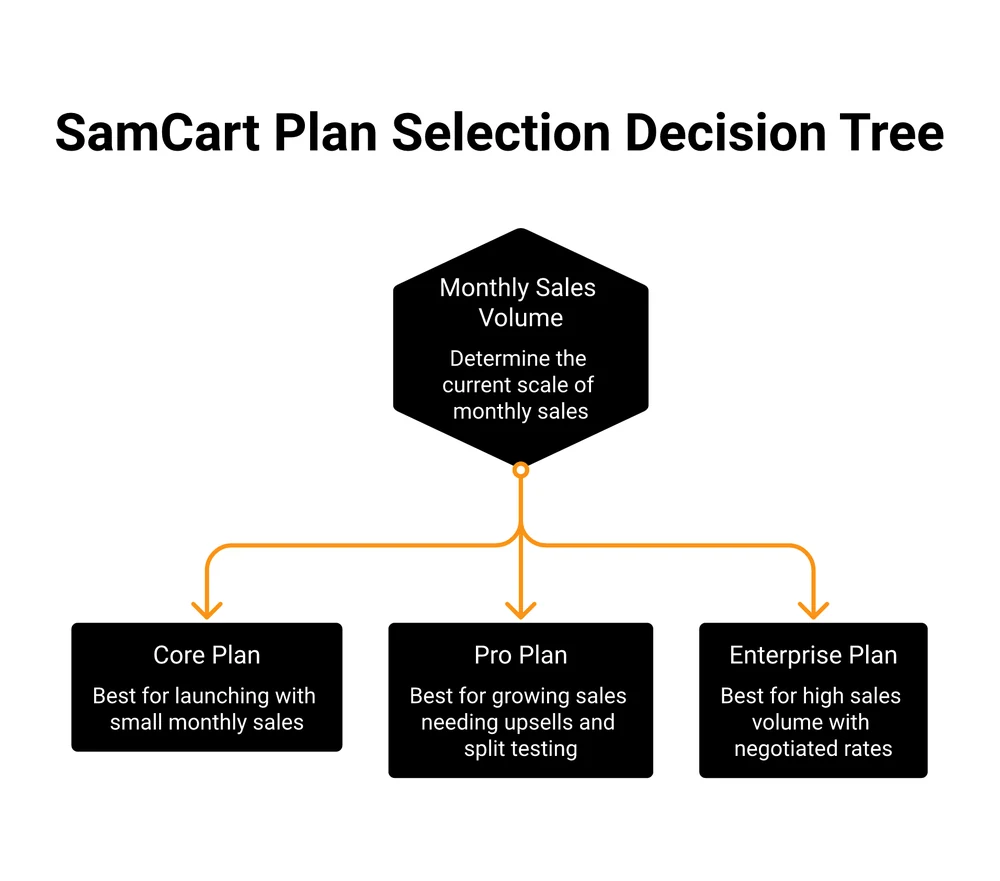
- Core ($79/mo) fits sellers launching a first product or two who want reliable checkout and a courses app, and who are earning under roughly $5,000 a month. You will not get 1-click upsells or A/B testing here.
- Pro ($199/mo) is the plan most serious sellers actually need. If you want to raise average order value with order bumps and upsells, split-test your checkout, or run an affiliate program, this is the floor. It is the SamCart most reviews are really describing.
- Enterprise (custom) is for high-volume businesses that want negotiated processing rates and priority support. If you are asking whether you need it, you do not.
One note for beginners. SamCart hosts your checkout and can build a full sales page, but it does not send you traffic.
A seller in r/passive_income documented 3 months of results selling a $47 ebook through SamCart, with $0 ad spend and YouTube for promotion. A commenter flagged the trade-off: SamCart’s hosted pages carry no built-in SEO. You bring every visitor yourself.
Does SamCart have a free plan?
No. SamCart offers a free trial, then a paid subscription starting at $79 a month. There is no free version of SamCart the way Gumroad and Payhip keep permanent free plans, or the way CartMango is free until paid plans start in November 2026.
If a free or near-free start matters more to you than SamCart’s upsell tools, that is a signal to look at the alternatives below rather than force a $79 bill you are not ready for.
Cheaper alternatives to SamCart
SamCart earns its price for high-volume sellers. If you are not there yet, a platform with little or no monthly fee keeps more money in your pocket while sales are small. Here are three options worth a look, with fees verified as of 2026-07-21.
| Platform | Monthly fee | Per-sale platform fee | Best for |
|---|---|---|---|
| SamCart Core | $79 | None (2.9% + 30¢ processing) | Sellers who want built-in funnels |
| Gumroad | $0 | 10% + $0.50 (plus processing) | Absolute beginners, low volume |
| Payhip (free plan) | $0 | 5% (plus processing) | A free start with room to grow |
| CartMango | Free until paid plans start in November 2026, then $10 to $30/yr | None (bring your own processor) | Low fixed cost plus upsells |
Full disclosure: CartMango is my own platform. I built it for sellers who want SamCart-style order bumps and upsells without a $948 to $2,388 yearly bill. It is free until paid plans start in November 2026, then $10 to $30 a year, with no cut of your sales.
Gumroad and Payhip trade a per-sale cut for zero monthly fee, which is the right deal when volume is low. Payhip also lets you drop the cut with a paid plan later ($29 a month for a 2% fee, $99 a month for none). For more ways to sell without a monthly bill, see how to sell online for free or a fuller list of SamCart alternatives.
Is SamCart worth it?
The answer comes down to your monthly sales volume.
SamCart is worth it if you are moving real money, want 1-click upsells and A/B testing baked into a polished checkout, and would rather pay a flat fee than watch a platform take a slice of every sale. Above about $2,000 a month in sales, the Pro plan’s fixed cost starts looking cheap next to percentage-based rivals.
SamCart is hard to justify if you are just starting, selling occasionally, or testing an idea. A $79 to $199 monthly bill before you have proven the product is a fast way to go underwater.
At that stage a free or low-fee platform does the same core job: take payment, deliver the file. You can move up once the sales are there. Switching checkout tools later means rebuilding pages and re-pointing links, so it pays to read buyer complaints and review patterns before you commit either way.
FAQ
How much does SamCart cost?
SamCart costs $79 a month for Core and $199 a month for Pro, with Enterprise priced on request. Annual billing lowers those to about $59 and $149 a month. There is no free plan, and payment processing of 2.9% + 30¢ applies to every sale on top of the subscription.
Does SamCart take a percentage of sales?
No. SamCart does not take a cut of your revenue on SamPay, its built-in processor. You pay the flat monthly subscription plus standard payment processing (2.9% + 30¢). That is different from platforms like Gumroad, which charge a percentage of each sale.
What is the difference between Core and Pro?
Core ($79/mo) covers the basics: unlimited products, checkout pages, and a courses app. Pro ($199/mo) adds the growth tools, 1-click upsells, order bumps, A/B testing, advanced reporting, an affiliate program, and third-party payment processors. Most sellers who want to raise average order value need Pro.
What happened to SamCart’s Launch, Grow, and Scale plans?
SamCart retired them in 2026 and replaced them with Core, Pro, and Enterprise. Core stayed at $79, the middle tier rose from $159 to $199, and the old $319 Scale plan became a custom-quoted Enterprise plan. Older articles still quoting the retired names get SamCart pricing wrong.
Is there a free alternative to SamCart?
There is no free version of SamCart, but there are free-to-start alternatives. Gumroad and Payhip both have free plans that charge a per-sale fee instead of a monthly one. CartMango is free until paid plans start in November 2026, then $10 to $30 a year. Each keeps more money in your pocket than SamCart while your sales are small.
If SamCart’s price is the thing giving you pause, that is exactly why I built CartMango. You get the same order bumps and 1-click upsells that raise average order value, without a four-figure yearly bill. Every buyer also syncs into your email tool automatically, so you can sell to them again. It is free until paid plans start in November 2026, then $10 to $30 a year.
About the Author

👋 I’m Welly, founder of CartMango (the site you’re on), a checkout platform for digital product sellers. We’ve previously processed $179M+. I also run BirdSend (email marketing tool, 3.1B+ emails sent). On the side I show other non-techie digital sellers how I use AI workflows to automate 50%+ of my operations. Find me on LinkedIn.
Related Reading
- Order Bumps Explained: the 1-click add-on SamCart charges Pro for
- How to Create a Sales Page: build the page SamCart hosts, on any budget
- SamCart Alternatives: a fuller list of options if the price is too steep
- How to Sell Online for Free: what selling really costs across 7 platforms