

The best Rewardful alternatives are Partnero for a program you expect to grow, PromoteKit for a Stripe-only setup on a budget, Rekomi if you want someone else handling payouts and tax forms, and Cello’s free plan if you have 5 partners or fewer. Their feature checklists look almost identical.
Where they diverge is what each one meters before it makes you upgrade. Rewardful counts revenue from affiliates and charges $49 a month up to $7,500. Rivals count commissions paid out, partner headcount, clicks, or nothing at all. Every price below was read off the vendor’s own pricing page and then re-priced at a single fixed level.
I run a checkout platform, so I read pricing pages for a living. This category still caught me out.
Every guide ranking for this search hands you a list. Almost none hands you a number you can compare, because the tools are not measuring the same thing.
One counts the money your affiliates bring in. Another counts the money you pay them. Another counts how many affiliates are active, and 2 more will not give you a number at all until you sit through a demo.
Below is the whole field with live prices, then 4 cuts that narrow it, and the one cut nearly everybody makes that costs the most.
Key Takeaways
- 17 tools compete with Rewardful, and 3 of them will not publish a price. G2 still calls one of those 3 the best overall alternative.
- Entry prices are not comparable. Affonso’s $15 plan caps at $1,000 a month of affiliate revenue. Rewardful’s $49 runs to $7,500.
- Rewardful reads only Stripe and Paddle. Its own pricing FAQ says so in 2 sentences, and that limit is why most people search this.
- 3% sounds small next to a $49 flat fee. Refersion charges $39 a month plus 3% of affiliate sales, so it passes $49 once affiliates bring in about $333 a month.
- Switching keeps your affiliates and loses your attribution. Page 1 tells you the first half only.
Start here: the 17 Rewardful alternatives, priced live
17 tools get named as Rewardful replacements across the pages ranking for this search, and every one of them is real and currently sold. What follows is each one’s advertised entry price next to the thing it actually counts.
Paying for capacity you will never use is a quiet leak, and it is not the only one in a digital business. If you want the common ones laid out in order, the Online Selling Mistakes Challenge is a free email course covering a different one each day.
Affonso’s $15 plan stops at $1,000 a month of affiliate revenue, Rewardful’s $49 plan runs to $7,500, and Partnero’s $49 plan has no revenue ceiling at all.
| Tool | Advertised entry | What it counts | Cap at that price |
|---|---|---|---|
| Rewardful (the yardstick) | $49/mo | Revenue from affiliates | $7,500 a month |
| PromoteKit | Free, then $29/mo | Referrals, then revenue | 3 referrals, then $10,000 a month |
| Rekomi | $29/mo | Commissions you pay out | $2,500 a month in payouts |
| Affonso | $15/mo billed yearly | Revenue from affiliates | $1,000 a month |
| Refersion | $39/mo plus 3% of sales | Nothing, it takes a share | No cap |
| Partnero | $49/mo billed annually | Nothing | No revenue cap on any plan |
| FirstPromoter | $49/mo | Revenue from affiliates | $5,000 a month |
| LeadDyno | $49/mo | Active affiliates | 50 |
| Tolt | $69/mo | Revenue from affiliates | $10,000 a month |
| Cello | Free, then $80/mth | Transacting partners | 5 free, 25 paid |
| Tapfiliate | $89/mo | Clicks, conversions, affiliates | 5,000 clicks, 500 conversions, 50 affiliates |
| Post Affiliate Pro | $89/mo | Tracking requests | 10,000 a month |
| Reditus | $99/mo billed annually | Annual recurring revenue | $60,000, about $5,000 a month |
| Trackdesk | $299/mo on annual billing | Seats and offers | 5 seats, 10 offers |
| GoAffPro | Free | Nothing stated | Built for store platforms |
| PalDock | Free, then a share of payouts | Approved payouts | Rate not published |
| impact.com | Not published | Not published | Demo required |
| PartnerStack | Not published | Not published | Demo required |
Read the third column before the second. 2 tools at the same sticker price can bill very differently, and the reason is always sitting in that column rather than in the feature list. For the wider cost picture across this category, including how the bill behaves once a program starts working, we have a fuller breakdown of what affiliate software costs.
Cut 1: drop anything that will not show you a price
3 of the 17 refuse to name a number.
impact.com and PartnerStack publish no figure whatsoever. PartnerStack shows 3 tiers called Launch, Growth and Enterprise, and every one says “Book your demo” where the price should be. impact.com sends a seller to a demo request instead.
PalDock is the third, in a gentler way. Its model is a share of your approved payouts, and its pricing page promises “the more you make, the LESS you pay” without printing the rate anywhere. You run their calculator to find out.
All 3 are real products and plenty of companies need them. But G2 currently names impact.com the best overall alternative to Rewardful, ranked on stars from more than 2,350 reviewers, which is the recommendation a solo seller is most likely to act on first.
A sales call is not an answer to your question.
3 gone, 14 left.
One more thing about that G2 list, since it drives so many of these rankings. It also includes NiceJob, which is review-management software rather than affiliate software. Aggregator lists are built from review categories, not from whether a tool does the job you arrived with.
Cut 2: drop anything that cannot see the way you get paid
A tracker that cannot see your payment cannot pay a commission on it, and the tools differ more here than anywhere else.
Rewardful answers the question plainly on its own pricing page. The FAQ asks “I don’t use Stripe or Paddle. Can I still use Rewardful?” and the answer runs 2 sentences: “Not at this time. We currently support only Stripe or Paddle.” You can read that on Rewardful’s pricing page yourself.
Most of the field is built the same way. Tolt reads Stripe, Paddle and Chargebee. Affonso covers Stripe and Paddle plus a couple of the newer billing tools. PromoteKit works commissions out from your Stripe payments and nothing else. Rekomi lists Stripe, Paddle, Braintree and 10 more.
GoAffPro sits on the other side of that line. It plugs into Shopify, WooCommerce, BigCommerce, Wix, Magento and 7 more, which are store platforms rather than subscription billing. It is the free option people recommend in forums, and it is a genuinely good free option, for a shop. If your money arrives as a Stripe subscription, it was not built for you.
1 gone, 13 left.
Refersion survives this cut, with a catch worth knowing first. It listens for a single Stripe webhook, invoice.payment_succeeded, and Refersion’s own Stripe help doc says it is “only set up to track recurring subscriptions (not one-time charges)”.
Sell a one-off product through Stripe and Refersion will not see the sale at all.
So ask what each tool watches, rather than which logos sit on its website. The same question decides things over on WordPress, where affiliate plugins split on whether they can send money rather than count it.
If a slice of your buyers pay by PayPal, confirm the tool sees PayPal too, because several here track the card processor and quietly miss the rest. What PayPal charges sellers covers why so many keep it switched on regardless.
Cut 3: drop anything that costs more than the tool you are leaving
Rewardful’s own top published price starts at $149 a month. If a rival wants more than that to cover what Rewardful covers for $49, you are paying more for the same job.
Take Rewardful’s Starter plan as the yardstick: $49 a month, covering up to $7,500 a month of revenue brought in by affiliates. Now price the rivals at that same level rather than at their shop window.
Priced at the same $7,500 a month of affiliate revenue, PromoteKit and Affonso both land on $29, Rewardful and Partnero on $49, Tolt on $69, FirstPromoter on $99, and 3 tools jump past $250.
| Tool | Advertised entry | Cost at $7,500/mo from affiliates | What changed |
|---|---|---|---|
| PromoteKit | Free | $29/mo | Free stops after 3 referrals, ever |
| Affonso | $15/mo | From $29/mo | Launch stops at $1,000 a month |
| Rekomi | $29/mo | $49/mo | Starter stops at $2,500 of payouts |
| Rewardful | $49/mo | $49/mo | Nothing, the cap is exactly $7,500 |
| Partnero | $49/mo | $49/mo | Nothing, there is no revenue cap |
| Tolt | $69/mo | $69/mo | Nothing, its cap is $10,000 |
| FirstPromoter | $49/mo | $99/mo | Starter stops at $5,000 a month |
| Refersion | $39/mo | $264/mo | The 3% on $7,500 is $225 |
| Trackdesk | $299/mo | $299/mo | No cheap tier exists |
| Reditus | $99/mo | $399/mo | Growth stops at $60,000 a year |
Refersion, Trackdesk and Reditus all clear $149 at this level. 3 gone, 10 left.
2 things fall out of that table. Affonso and PromoteKit are still the cheap end, but at $29 rather than the $15 and the free plan the roundups quote. And FirstPromoter, which publishes Rewardful’s exact price list of $49, $99 and $149, doubles to $99 where Rewardful is still charging $49, because its entry plan stops at $5,000 instead of $7,500.
Then there is the percentage group, which does not fit a cap at all.
Refersion charges $39 a month plus 3% of affiliate-driven sales. Rekomi adds a 3% fee on payouts on every plan. Tolt charges 2% on automated payouts. Partnero charges 7%, but only if you let Partnero run the payouts, and nothing at all if you connect your own PayPal or Wise account.
Those percentages deserve the arithmetic, because a cap steps up once at a plan boundary and then sits still. A percentage climbs with every sale.
Refersion’s $39 undercuts Rewardful’s $49 by $10, so the 3% has $10 of room before it eats the saving. That $10 is 3% of $333. So once your affiliates bring in more than about $333 a month, Refersion costs more than Rewardful, and the gap widens with every sale after that.
Run it at $10,000 a month in affiliate-driven sales. The 3% is $300, so Refersion is $339 a month against the $99 Growth plan that covers the same $10,000 at Rewardful. That is $240 a month, or $2,880 a year, on the tool whose entry price looked cheaper.
Refersion hides none of this. The 3% is printed on the pricing card right beside the $39. A percentage simply does not sit next to a monthly fee in your head the way it sits in your bank account.
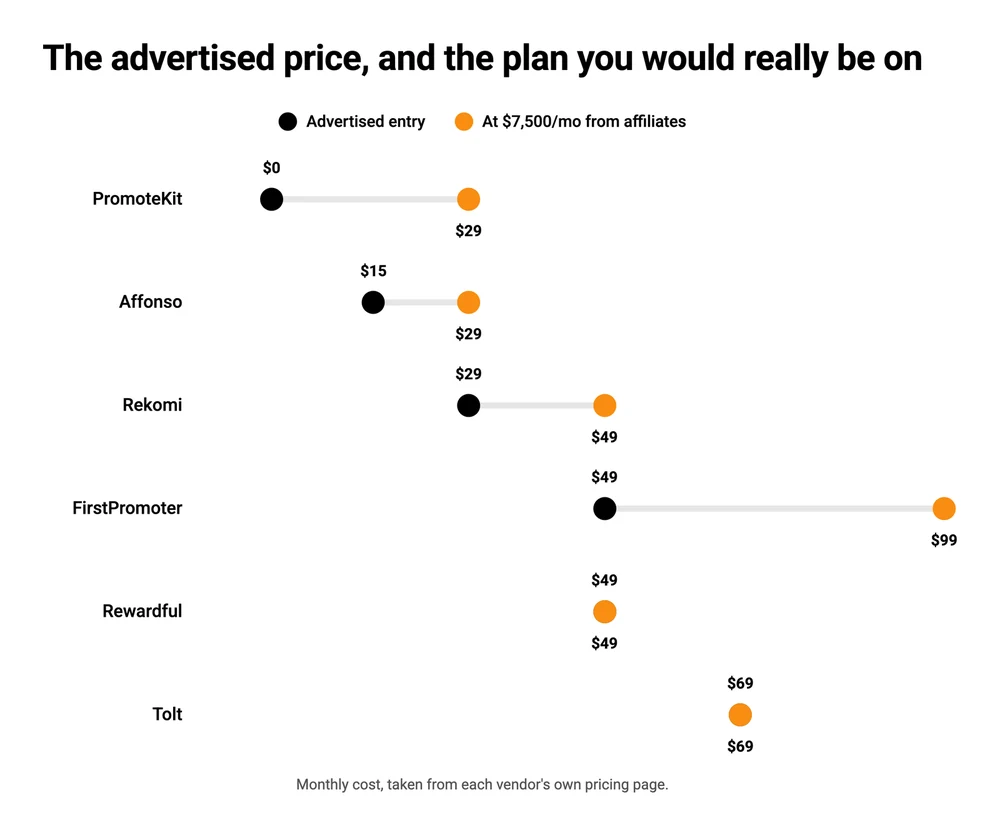
Same tools, 2 numbers each. The left dot is what the roundups quote. The right dot is what you would pay.
A note on billing basis, because half these vendors quote a monthly-equivalent yearly rate and half quote a true monthly. FirstPromoter publishes real annual totals of $490, $990 and $1,490. Tapfiliate publishes $890 and $1,790, Reditus $1,188. Rewardful offers 2 months free on annual billing and publishes no total anywhere, so its yearly figure is arithmetic you do yourself. Affonso’s $15 is the yearly rate and $19 the monthly one, which is why roundups quoting “$15” are quoting a discounted basis without saying so.
Cut 4: drop anything that meters your activity instead of your money
An affiliate program that works produces more clicks, more affiliates and more sales together. A tool that charges on the first 2 bills you for activity rather than for income, so the bill arrives before the revenue does.
3 tools meter that way.
LeadDyno’s $49 Lite plan caps at 50 active affiliates, with no revenue cap at all. Post Affiliate Pro’s $89 Starter caps at 10,000 tracking requests a month, and a tracking request includes a click. Tapfiliate’s $89 Launch plan caps at 50 affiliates, 5,000 clicks and 500 conversions a month, and then charges $1.50 per extra 1,000 clicks.
Cross the 50-affiliate line that LeadDyno and Tapfiliate both draw, with each one sending only a trickle, and you have outgrown them without earning much.
3 gone, 7 left.
Cello meters partners too, so by this rule its paid plans go the same way: $80 a month buys 25 transacting partners and $280 buys 100. Its free plan survives, because 5 partners for nothing is a test rather than a purchase, and a test is exactly what you want at this stage.
There is a second thing worth checking on whatever is left, though it kills nothing on its own. Paying affiliates is a separate job from tracking them, across currencies and tax jurisdictions, and these tools price it separately too.
Rewardful includes PayPal mass payouts and Wise bulk payouts on the $49 Starter. Tolt’s $69 Basic is manual payouts only, and automated payouts start on the $99 Growth plan with a 2% processing fee on top. Affonso’s Launch plan has no managed payouts either. PromoteKit includes PayPal and Wise payouts even on its free plan, and Rekomi runs payouts in 165 countries, collects W-9 and W-8 forms and preps 1099s, taking 3% of the payouts for it.
Somebody has to move the money and handle the tax paperwork. You either pay a percentage to have it done or you keep the percentage and do it yourself, and both are defensible answers. What you should not do is buy on the monthly price and find out in month 2 that paying people is a manual export.
What is left
Of the 17, 7 survive all 4 cuts, and one of those 7 is Cello on its free plan only, capped at 5 transacting partners.
| Tool | Cost at $7,500/mo from affiliates | Strongest reason to pick it | What it still does not do |
|---|---|---|---|
| Rewardful (staying put) | $49/mo | The incumbent, mass payouts on the entry plan | Reads Stripe and Paddle only, no free plan |
| PromoteKit | $29/mo | Joint-cheapest paid plan, payouts on every tier | Stripe only, and the free tier is 3 referrals |
| Affonso | From $29/mo | Joint-cheapest paid plan | No managed payouts until the Growth plan |
| Partnero | $49/mo billed annually | No revenue cap and no affiliate cap, ever | 1 program and 1 seat on Starter, extra seats $29 each |
| Rekomi | $49/mo | Payouts and tax paperwork in 165 countries | Takes 3% of every payout, on every plan |
| Tolt | $69/mo | Revenue cap of $10,000 a month, the joint-highest here | Basic will not pay affiliates automatically |
| FirstPromoter | $99/mo | Tracks the full subscription lifecycle, publishes real annual totals | Dearest survivor here, and its $49 plan stops at $5,000 |
| Cello | Free only | Costs nothing up to 5 transacting partners | Paid plans meter partners, so growth gets dear |
Partnero is the one I would trial first if you expect the program to work. Of the 7 alternatives above it is the only one that caps neither your revenue nor your affiliate headcount, so a program that doubles does not move you up a tier. Cello comes close on revenue, but it counts partners instead. Partnero’s constraint is seats and programs, which is a far easier one for a solo seller to live inside.
Cello needs a note, because its pricing page is easy to misread. It opens on a tab called User Referrals, a different product for in-app customer referrals, priced from $200 a month. The affiliate side is the second tab, Partner Referrals, and that one starts free with 5 transacting partners and unlimited referral revenue. If you clicked away thinking Cello was a $200 tool, that is why.
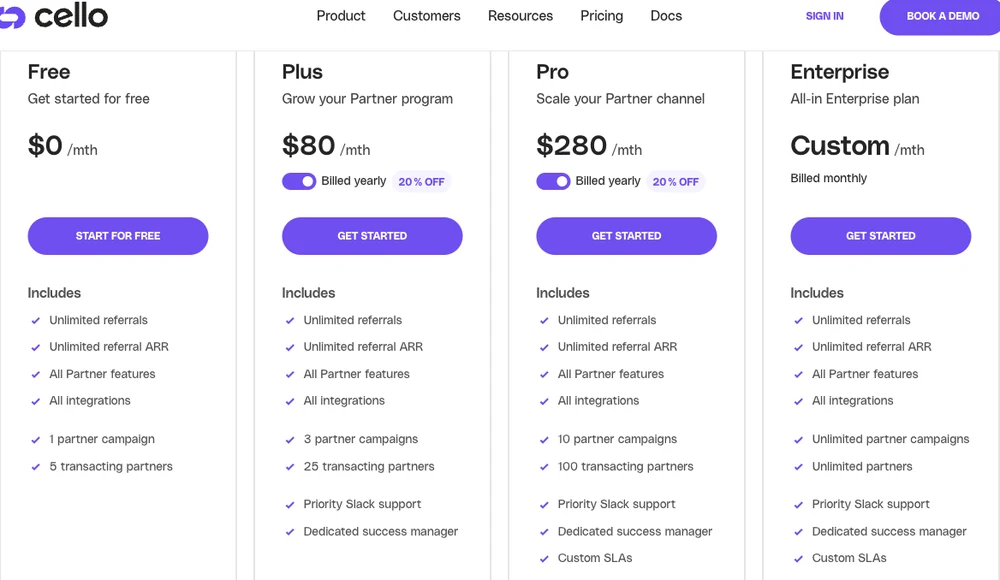
Cello’s affiliate side, on the second tab of its pricing page. Read the last line of each plan: the meter is transacting partners, not revenue.
Subscription billing sits underneath all of this, and your choice of recurring billing software often decides which trackers you can use at all.
The cut most people get wrong
Every comparison of these tools, this one included, is built on the monthly fee. The cost of moving barely gets a number put on it.
Search this term and you land on a Reddit thread titled “Best Alternative to Rewardful, but Without Fixed Monthly Costs”. The person asking runs a consultancy and would rather pay a percentage than a monthly fee, in their words, “because I want to see results with affiliate first, before I commit to fixed monthly payments.”
The most useful reply comes from a Rewardful employee, who opens by saying he works there and to take his answer with a grain of salt. Then he makes a point worth more than the rest of the thread put together:
Switching affiliate software providers is really difficult, and will typically result in having to restart your program and losing all your referral tracking.
He is talking his own book. He is also right, and that thread is a few years old now with the mechanic unchanged.
Now hold that against the one guide on page 1 that does cover switching. Rekomi walks it through in 6 steps: export your affiliates as a CSV, start a trial, import them, reconnect Stripe or Paddle, notify everyone, run both in parallel for a bit. Its conclusion is that “the whole move can often be done in an afternoon, and you keep your existing affiliates.”
Both statements are true, and they describe different things. You do keep your affiliates, because a list of names, emails and commission rates exports cleanly. What does not export is the attribution: the cookies, the historical credit, the record of which affiliate brought which customer and when.
The only person I found saying that out loud on page 1 works for the tool you would be leaving.
That is worth real money. If an affiliate has earned recurring commission for 2 years on customers they referred, your new tool has no idea those customers exist. Settle how you will honour that before you move, not after.
Which raises a fair question about who is doing the recommending here.
Of the 9 results on page 1, 7 belong to a company that sells affiliate software. 3 publish a numbered ranking and put themselves at number 1: Rekomi’s “9 best Rewardful alternatives” opens with Rekomi, Partnero’s top 10 opens with Partnero, and FirstPromoter’s list of 5 opens with FirstPromoter.
Cello skips the ranking and simply runs the heading “What makes Cello the #1 Rewardful alternative?” across a page of 729 words containing no prices at all. PalDock and PromoteKit run head-to-head pages arguing their own case. The seventh is Rewardful’s own, holding position 1 for its own alternatives keyword. The remaining 2 results are G2 and Reddit.
The summary Google prints above all of it has the same problem underneath. It names FirstPromoter, Tolt, Cello and Affonso, and the 2 sources it shows are cello.so and sirenaffiliates.com. Cello is one of the tools being recommended. Siren sells a competing WordPress affiliate plugin. Neither is a review site.
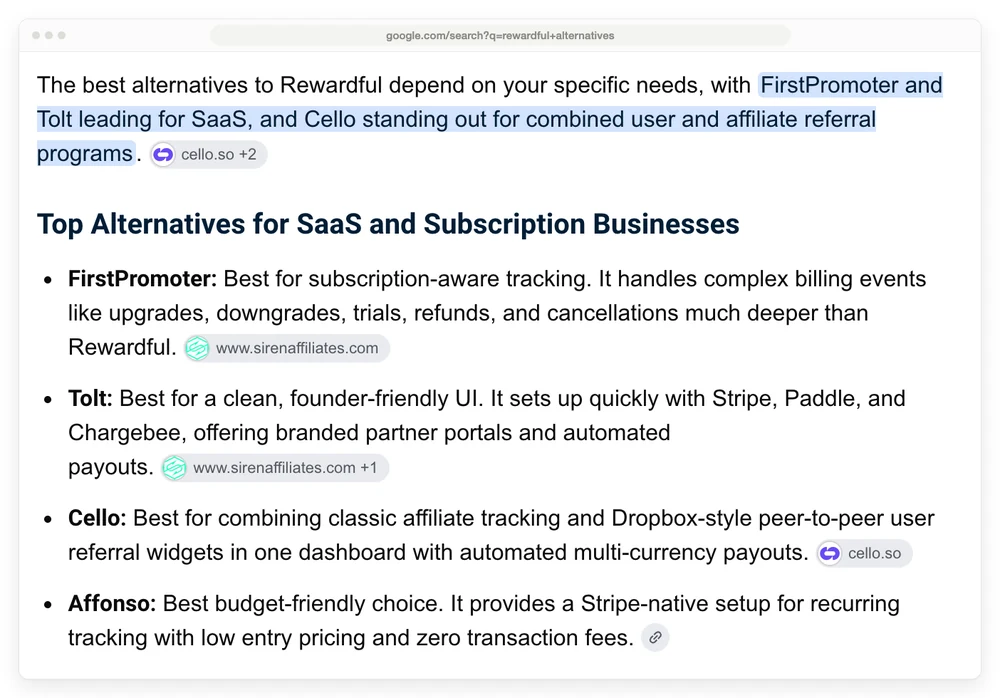
The 2 grey chips are the sources. Both belong to companies that sell affiliate software of their own.
None of that makes the recommendations wrong. FirstPromoter really is built around subscription tracking, and in its own words treats each subscription as a lifecycle rather than a single transaction. Cello really is free for a small partner program. It does mean the ranking you are reading was written by a company with a preferred answer, so trust the numbers and check the ordering.
FAQ
Is there a genuinely free Rewardful alternative?
4, each with a real limit. Cello’s Partner Referrals plan is free up to 5 transacting partners with no revenue cap. PromoteKit is free for your first 3 referrals ever, which is a trial in everything but name. GoAffPro’s Hobby plan is unlimited on affiliates, sales and revenue, but connects to store platforms like Shopify rather than Stripe subscriptions. PalDock is free and takes a share of your payouts instead, at a rate it does not publish. Everything else runs a time-limited trial.
Does Rewardful work without Stripe or Paddle?
No. Its own pricing FAQ answers this directly: “Not at this time. We currently support only Stripe or Paddle.” If your money arrives another way, Rewardful is not a candidate, and neither are several of the tools sold as its replacement.
What happens to my affiliate data if I switch?
Expect to lose the tracking history. New links, new cookies, and no record of who referred whom before the move. Some tools sell assisted migration and will import your affiliate list, which is not the same as importing attribution. Plan the switch for a quiet month and warn your affiliates before their dashboards reset.
What is the difference between Rewardful and PartnerStack or impact.com?
Size of customer, mostly. Rewardful and its direct rivals are self-serve tools you install yourself for a published monthly fee. PartnerStack and impact.com are partnership platforms sold through a sales team, priced on your payout volume, and built for companies with somebody whose actual job is running partnerships. Neither category is better, they serve different businesses.
I want affiliate programs to join, not software to run one. Where do I go?
Different question, and this post will not help. Everything above is for the person paying the commissions. If you want the numbers behind the industry from the other side, our affiliate marketing data roundup collects them.
What no Rewardful alternative can fix
An affiliate tool counts whatever your checkout tells it. If the checkout leaks, a better tracker just gives you a tidier record of a smaller number.
Order value, order bumps and whether an abandoning buyer ever comes back are all decided at the checkout itself. That is what I work on, so treat what follows as coming from an interested party.
CartMango is the checkout I built for solo digital sellers. Order bumps, protected file delivery and coupons are on every plan, upsells, downsells and abandoned-cart recovery start on the $20 a year plan, and CartMango takes 0% of your sales on all of them. CartMango is free until October 2026, then from $10 a year.
On affiliates it has nothing for you today. An affiliate system is being built and is planned for September 2026, arriving on the $30 a year Platinum plan. If affiliates are why you are shopping right now, one of the Rewardful alternatives above is your answer rather than CartMango.
About the Author

👋 I’m Welly, founder of CartMango (the site you’re on), a checkout platform for digital product sellers. We’ve previously processed $179M+. I also run BirdSend (email marketing tool, 3.1B+ emails sent). On the side I show other non-techie digital sellers how I use AI workflows to automate 50%+ of my operations. Find me on LinkedIn.
Related Reading
- Affiliate management software: the cost side of the same decision, with live prices for 8 tools and the break-even against a bundled option
- WordPress affiliate plugin: the plugin route, and which ones can genuinely send affiliates their money
- Recurring billing software: the billing layer underneath, which decides what a tracker can even see
- Cart abandonment software: the buyers who never finish, and what recovering them is worth