

Priced from each vendor’s pages, Payhip vs Thinkific favors Payhip: with US buyers and videos on YouTube, the cheapest Payhip plan for your sales never costs more than Thinkific Start. Its plans: $0 plus 5% a sale, $29 a month plus 2%, or $99 a month. Thinkific Start is $82 a month billed yearly.
Thinkific adds live group classes and hosted video. At $3,500 a month in US sales, Payhip Plus, Payhip Pro and Thinkific Start all cost $1,188 a year before card fees. Payhip files EU and UK VAT and US and Canadian sales tax. CartMango (free right now, about $2.50 a month billed yearly for courses from November, 0% a sale) suits text and file lessons.
Search Payhip vs Thinkific and 4 of the 5 comparison pages I checked on Google’s first page still price Thinkific at $36 to $54 a month. Those are old prices for Thinkific’s Basic plan, which is gone.
3 of the 5 also say Thinkific takes no fee from any sale. On your own Stripe account, Thinkific Start keeps 2%. On Thinkific’s own payment system, a 0.5% tax fee lands on each sale to a US buyer.
So I priced both from their own pages and judged them on the 5 jobs a course seller needs done. By the end you will know which plan costs less at your sales level, and who files your tax.
Key Takeaways
- Thinkific’s cheapest plan is now $82 a month. Start costs $978 a year billed yearly, or $109 month to month, after the Basic plan left.
- Payhip’s free plan wins at low sales. Its 5% cut costs less than Thinkific Start until about $1,800 a month in sales to US buyers.
- 3 plans tie at $3,500 a month. With US buyers, Payhip Plus, Payhip Pro and Thinkific Start each cost $1,188 a year before card fees.
- Payhip files EU and UK VAT and US sales tax on every plan. Thinkific leaves EU and UK VAT filing to you.
- Thinkific’s price buys course tools. Live group classes, Zoom sessions, a community and hosted video all come with its Start plan.
- CartMango, which I run, hosts courses for $30 a year. It takes 0% a sale but has no quizzes, certificates or video file hosting.
Payhip vs Thinkific prices: 6 plans side by side
Payhip sells 3 plans from $0 to $99 a month, and Thinkific’s public plans start at $82 a month billed yearly and climb to $374. Thinkific has no free plan and dropped its Basic plan ($54 month to month) in October 2026, so a free 30-day trial is now the only way to test it without paying.
Cheap hosting does not bring buyers, though. The Online Selling Mistakes Challenge covers the 5 selling mistakes that cost solo sellers most, in 5 free emails.
Payhip takes a cut on 2 of its 3 plans, Thinkific adds a 0.5% tax fee to its 0% cut on its own payments, and only Payhip files EU and UK VAT for you.
| Plan | Price | Cut per sale | Video hosting | Tax filed for you |
|---|---|---|---|---|
| Payhip Free | $0 | 5% | $5 a month per 16 hours, or embed free | EU and UK VAT, US and Canadian sales tax |
| Payhip Plus | $29 a month | 2% | $5 a month per 16 hours, or embed free | EU and UK VAT, US and Canadian sales tax |
| Payhip Pro | $99 a month | 0% | $5 a month per 16 hours, or embed free | EU and UK VAT, US and Canadian sales tax |
| Thinkific Start | $82 a month, billed yearly | 0% plus a 0.5% tax fee on Thinkific Payments, 2% on your own Stripe | 200 GB a month of streaming | US and Canadian sales tax, on Thinkific Payments only |
| Thinkific Grow | $164 a month, billed yearly | 0% plus a 0.5% tax fee on Thinkific Payments, 1% on your own Stripe | 400 GB a month of streaming | US and Canadian sales tax, on Thinkific Payments only |
| CartMango Platinum | About $2.50 a month, billed yearly ($30 a year) | 0% | None, paste a YouTube or Vimeo link | None, you file it |
Payhip publishes monthly prices only, so its plans appear at the monthly rate. Thinkific is shown on yearly billing, which saves $330 a year on Start against paying month to month, and CartMango bills yearly only. Card fees sit on top of every row: Stripe’s standard rate is 2.9% plus 30 cents per US card payment, and Thinkific Payments charges the same.
I built CartMango as a checkout first, and its course tool is brand new, so the course section below spells out what it lacks.
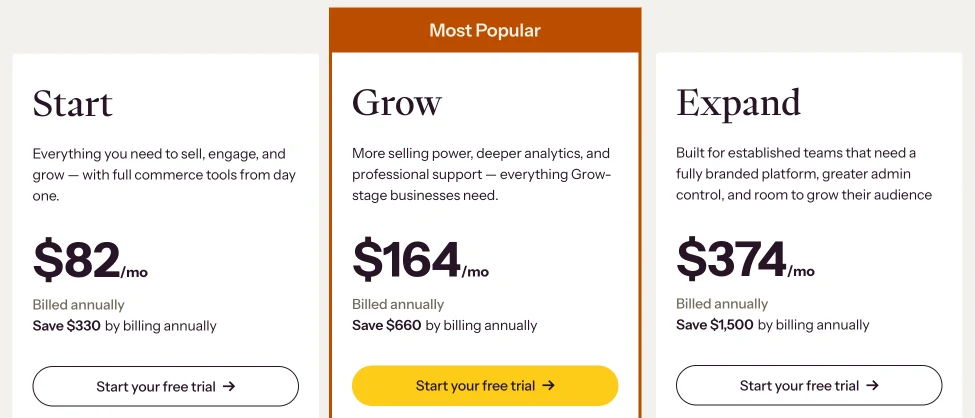
Thinkific’s own pricing page. Start is the cheapest plan on it, at $82 a month billed yearly.
Building the course: both have quizzes, only Thinkific includes video hosting
Payhip and Thinkific both build courses with quizzes, certificates and drip release, meaning lessons that open on a schedule, so this job comes down to video and live teaching.
Payhip puts every course feature on every plan, including the free plan. A lesson can hold video, text, a quiz, a download, a survey, an assignment or an embed. Students get their own login, can comment on lessons, and earn a certificate when they finish. You can also offer a free preview lesson, or take preorders before launch day, and the same store sells downloads, coaching, memberships and physical products.
Video is where Payhip charges extra. Its video add-on costs $5 a month for 16 hours of uploads, then $10 for 32 hours, billed monthly in US dollars only. Cancel it and Payhip deletes those videos within 3 days. Embedding from YouTube or Vimeo costs nothing.
Thinkific Start includes unlimited courses, video lessons, quizzes, assignments and certificates. It adds live cohorts, which are group classes you run on a schedule, with unlimited Zoom sessions and bookable calendars. You also get 1 community with 10 spaces, and 200 GB a month of video your students can stream.
That live teaching is the clearest thing $978 a year buys over Payhip. Start does leave out a few things you might expect at that price: removing Thinkific’s branding, revenue reports and bulk email to students all start on Grow, at $164 a month billed yearly. A branded mobile app is a $199 a month add-on.
CartMango added courses to its $30 a year Platinum plan. A CartMango lesson holds text, images, audio files, downloads and a pasted video link from YouTube, Vimeo or Loom, and students see a progress bar with a mark-complete button. CartMango has no quizzes, no certificates and no video file hosting, and its community feature is not live yet. Thinkific and Payhip both beat it on this job.
Taking the money: Thinkific’s 0% comes with a 0.5% tax fee
Payhip’s transaction fee is 5%, 2% or 0% depending on the plan. Thinkific takes 0% on Thinkific Payments, its own payment system, plus a 0.5% tax fee on taxed sales, and 2% on Start if you use your own Stripe account instead.
On Thinkific Payments, a US seller also pays 2.9% plus 30 cents per card payment, the same as Stripe. Subscriptions and payment plans add 0.7%, and a foreign card adds 1.5%.
The 0.5% tax fee covers every sale to a buyer in the US or Canada, even when the tax works out to 0%. For UK, EU and Swiss buyers it applies only where you have registered for tax. Money reaches your bank in 2 business days, per Thinkific’s payment fees page. Thinkific Payments is only open to sellers in 36 countries, including the US, Canada, the UK, the EU, Australia and Singapore.
Payhip sends each sale to your own PayPal or Stripe account the moment it clears, and those processors take their normal card fees.
Over 12 months of sales to US buyers, Payhip Plus, Payhip Pro and Thinkific Start all cost $1,188 at $3,500 a month in sales. Below that level Payhip’s free plan or Plus costs less, and above it Payhip Pro does.
| Plan | At $500 a month | At $1,000 a month | At $3,500 a month | At $5,000 a month |
|---|---|---|---|---|
| Payhip Free | $300 | $600 | $2,100 | $3,000 |
| Payhip Plus | $468 | $588 | $1,188 | $1,548 |
| Payhip Pro | $1,188 | $1,188 | $1,188 | $1,188 |
| Thinkific Start, Thinkific Payments, plus 0.5% tax fee | $1,008 | $1,038 | $1,188 | $1,278 |
| Thinkific Start, your own Stripe, plus 2% | $1,098 | $1,218 | $1,818 | $2,178 |
| CartMango Platinum | $30 | $30 | $30 | $30 |
Figures are yearly platform costs before card fees, with video embedded from YouTube or Vimeo. Payhip’s free plan stays cheaper than Thinkific Start until about $1,800 a month, and Payhip Plus takes over from the free plan at about $970.
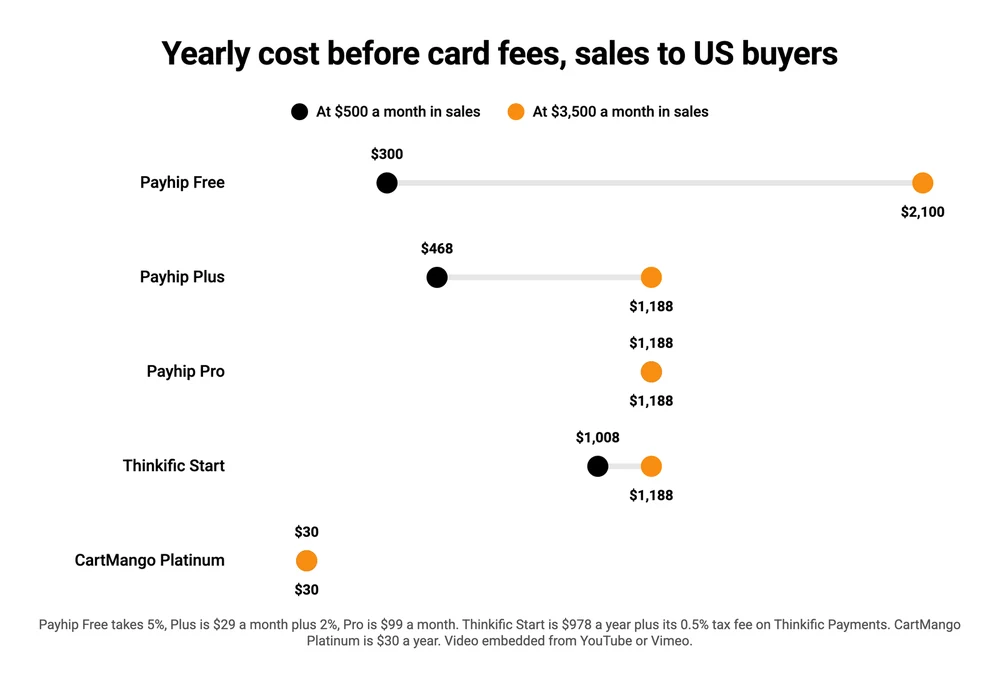
2 things change that $3,500 tie point. If you host 16 hours of video on Payhip instead of embedding it, Thinkific Start becomes the cheapest of those 3 plans between about $3,170 and $4,500 a month.
If most of your buyers sit outside the US and Canada, and you hold no VAT registration where they live, the 0.5% tax fee drops away. Then Thinkific Start beats Payhip Plus above about $2,625 a month, and Payhip Pro at any level.
At low sales the gap is wide. A seller on an r/elearning thread planned a mini course priced under $30 and pointed out that platform subscriptions “must stay active for students to review content.” A reply suggested Payhip’s free plan at 5% a sale. That seller would need at least 652 sales of a $30 course before Payhip’s 5% added up to a year of Thinkific Start.
CartMango‘s $30 a year sits under both at every level in the table, because it takes no cut at all. If Teachable is also on your list, our Payhip vs Teachable breakdown runs the same yearly math on Teachable’s plans.
Selling to the same buyer again: Payhip keeps its tools on any processor
Payhip keeps order bumps, abandoned-cart emails and buyer emails on every plan, whichever processor you use. Thinkific Start’s order bumps and abandoned-cart emails need Thinkific Payments, so moving to your own Stripe switches them off and raises Start’s cut to 2%.
Payhip offers order bumps, coupons, abandoned-cart emails and an affiliate program on every plan. After a purchase it can show an upgrade discount, a special price on another product, but buying it means a second checkout instead of a one-click upsell. Payhip also lets you email updates to past buyers and connects to mail tools such as MailChimp and ConvertKit. Its recurring payments for memberships, courses and coaching only run through Stripe, not PayPal.
Thinkific puts upsell offers on a custom thank-you page after checkout, plus bundles, coupons, free trials and affiliate tracking, on every plan. Bulk email to your students and revenue reports wait for Grow, which matters if you plan to email past buyers about your next course. On that one point Payhip’s free plan gives you more than Thinkific Start.
CartMango has order bumps on every plan, and upsells, downsells and abandoned-cart recovery from its $20 Gold plan. So the $30 Platinum plan that holds courses carries all of them, plus affiliate management for up to 250 affiliates.
Leaving later: what happens to your subscribers
Thinkific’s cancel guide says students keep what they already bought when you leave, but you lose your admin, your courses and your landing pages at the end of the billing cycle. Subscribers are the catch: “If the recurring subscriptions are active, students will continue to get charged but will lose access to their product at their next billing cycle.” So you cancel each one by hand before you go.
Payhip’s recurring payments stop if you close your account, even when you connected your own Stripe account. Anyone paying you monthly has to sign up again wherever you go next.
On CartMango, subscriptions you create keep billing your customers after you leave, so that recurring income keeps coming in after you switch.
Paying the tax: Payhip files it on every plan, Thinkific only on its own payments
Payhip collects and pays digital EU and UK VAT, Europe’s version of sales tax, plus US and Canadian sales tax, on every plan including the free one. Quebec’s provincial tax, the QST, is the 1 exception, so Quebec sellers who owe it still pay it themselves. Payhip beats Thinkific outright on this job, and the comparison pages I checked either skip it or give it a single line.
Thinkific handles tax only when you use Thinkific Payments. For US and Canadian buyers it calculates, collects and pays the sales tax for you, and that part is switched on by default.
For UK, EU and Swiss buyers, Thinkific’s VAT collection is optional, and it passes the money to you. Its tax help page is blunt about the rest: “you will remit VAT in the UK, the EU, and Switzerland yourself, under your own company tax return.” On your own Stripe account, Thinkific does none of this.
Payhip files both kinds of tax on any processor, while Thinkific files only US and Canadian sales tax, and only on Thinkific Payments.
| Tax | Payhip | Thinkific Payments | Thinkific on your own Stripe | CartMango |
|---|---|---|---|---|
| US and Canadian sales tax | Collected and paid for you, except Quebec’s QST | Collected and paid for you | You handle it | You handle it |
| EU, UK and Swiss VAT | Collected and paid for you | Collected, then you file it | You handle it | You handle it |
| Fee for the service | None listed | 0.5% of each taxed sale | No service | No service |
CartMango loses this job outright: you stay the seller of record, the legal seller on each sale, so the tax stays with you.
Payhip, Thinkific and CartMango, job by job
Thinkific wins course building, Payhip wins tax and beats Thinkific on price at most levels, and CartMango costs least.
| Tool | Building the course | Taking the money | Selling again | Leaving | Tax |
|---|---|---|---|---|---|
| Payhip | Quizzes and certificates, video $5 a month per 16 hours | $0 plus 5%, up to $99 a month at 0% | Bumps, cart emails, buyer emails, upgrade discounts | Recurring payments stop | Files EU and UK VAT, US and Canadian sales tax |
| Thinkific Start | Quizzes, certificates, live cohorts, 200 GB of streaming | $978 a year, 0% plus 0.5% tax fee on Thinkific Payments | Thank-you page upsells, bumps on Thinkific Payments | Subscriptions need cancelling by hand | Files US and Canadian sales tax, on Thinkific Payments only |
| CartMango Platinum | Text, audio, files and video links, no quizzes or certificates | $30 a year, 0% | Bumps, upsells, downsells | Subscriptions keep paying you | You file it |
FAQ
What are the disadvantages of Payhip?
Payhip’s free plan takes 5% of every sale, and Plus still takes 2% on top of $29 a month. It has no one-click upsell after checkout, its recurring payments only run through Stripe, and hosting video costs $5 a month per 16 hours. Our Payhip review covers what its users complain about most.
What is better than Thinkific?
For a solo seller watching costs, Payhip is the better pick at most sales levels, and it files EU and UK VAT for you, as the tables above show. Teachable and Kajabi are 2 other course platforms worth pricing against Thinkific. Thinkific stays the stronger pick for live cohorts and communities.
Does Thinkific take a percentage of sales?
Thinkific takes no percentage on Thinkific Payments, but card fees of 2.9% plus 30 cents apply, plus a 0.5% tax fee on sales to US and Canadian buyers, and to UK, EU and Swiss buyers where you are registered for tax. On your own Stripe account, Thinkific adds 2% on Start, 1% on Grow and 0.5% on Expand.
How does Thinkific pay me?
Thinkific Payments pays US sellers 2 business days after each sale, minus fees. Payhip pays at once, to your own PayPal or Stripe.
Which is better, Payhip or Etsy?
Etsy is better when you need strangers to find your product through its search, and Payhip is better when you bring your own buyers. On a $10 download, Etsy takes $1.40 and Payhip’s free plan $1.09, card fees included, per our Payhip vs Etsy comparison.
Pick by your monthly sales and where your buyers live
Under about $970 a month in sales, Payhip’s free plan costs less than any other Payhip or Thinkific plan. From there to $3,500 a month, Payhip Plus does. Past $3,500, Payhip Pro and Thinkific Start sit within $90 a year of each other at $5,000 a month, so if you need live cohorts, that gap buys them. If your buyers live in Europe or the UK, Payhip files the VAT for you, though Thinkific Start can cost less above about $2,625 a month when you hold no VAT registration there.
A course built from text, audio, downloads and videos you already keep on YouTube or Vimeo, with no quizzes or certificates, can sit outside the Payhip vs Thinkific choice altogether. CartMango holds that course on its $30 a year plan with no cut of any sale, keeps your subscribers paying you if you ever move, and is free to use right now while paid plans start in November.
About the Author

👋 I’m Welly, founder of CartMango (the site you’re on), a checkout platform for digital product sellers. We’ve previously processed $179M+. I also run BirdSend (email marketing tool, 3.1B+ emails sent). On the side I show other non-techie digital sellers how I use AI workflows to automate 50%+ of my operations. Find me on LinkedIn.
Related Reading
- Payhip review: what Payhip’s 1-star reviews keep complaining about, and who it suits
- Payhip vs Teachable: 9 course plans cut to 3 on live prices
- Payhip vs Ko-fi: both take 5% on free plans, only Payhip handles the tax
- Payhip vs Etsy: a lower cut on Payhip against Etsy’s built-in buyers