

To sell beats online, upload your catalog to a beat marketplace like BeatStars, Airbit, or Traktrain, then sell non-exclusive licenses so the same beat sells many times. All 3 charge 0% seller commission and bill a flat subscription instead. Airbit and Traktrain have free tiers. Getting traffic to your beats is the hard part.
I don’t make beats. I run a checkout platform, so I spend an unreasonable amount of time reading other companies’ pricing pages.
When I went looking for what it actually costs to sell beats online, I expected the guides to tell me. Most of them don’t.
The top-ranked guide, updated 9 months ago, still says Airbit takes 20% and BeatStars charges free members 30%. Airbit cut its commission to 0% in September 2023. BeatStars no longer lists a free seller plan at all.
Those numbers describe a business model that stopped existing about 3 years ago, and producers are still planning around them.
This post gives you the current numbers instead. What each platform charges today, checked against their own pricing pages this week. How many beats you need to sell to cover that cost. And where the fine print hides.
Key Takeaways
- All 3 major beat platforms now charge 0% seller commission. BeatStars, Airbit, and Traktrain each bill a flat subscription rather than a percentage of every sale.
- 0% commission still is not free. BeatStars adds 12% to the buyer’s total on Marketplace sales, and Traktrain charges 25% on beats past 100.
- 2 platforms still let you sell for free. Airbit gives you 20 beats, Traktrain gives you unlimited MP3s, and both break even at zero sales.
- The fee is small, but it’s due whether you sell or not. At the $30 median beat price, plans cost 1 to 6 sales a year.
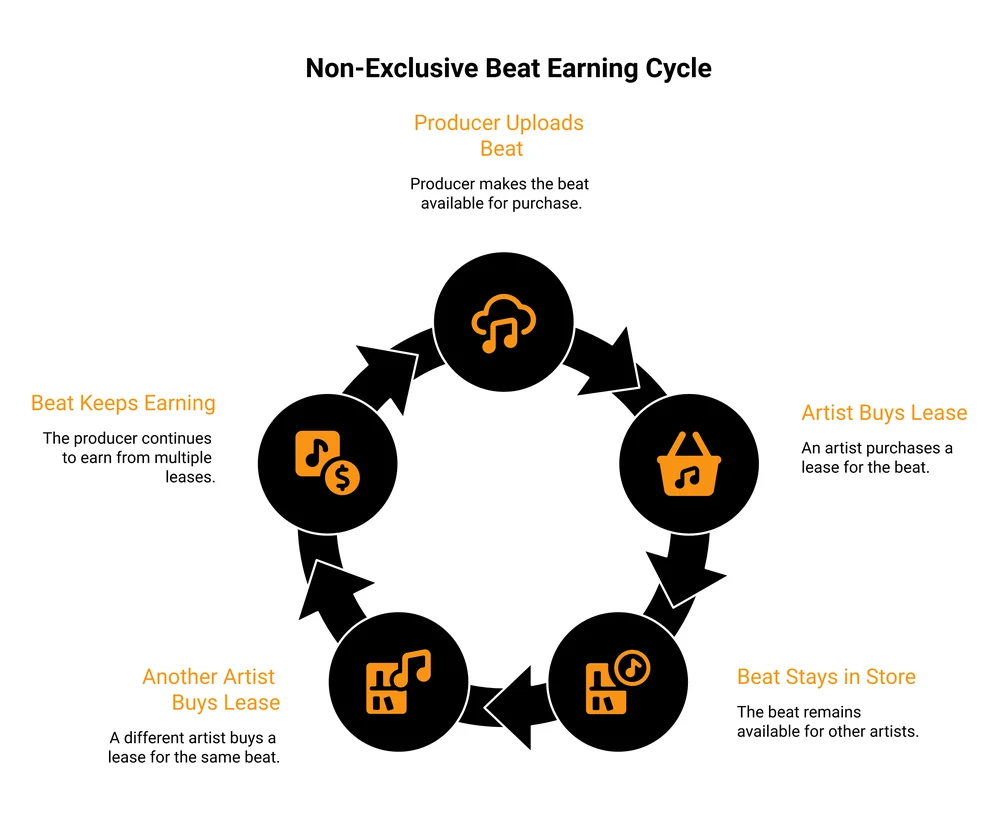
- Non-exclusive licensing is what makes the math work. The same beat gets leased over and over, on several platforms at once.
- Traffic is the real constraint. Forbes did the math on 300,000 Airbit producers and got an average of roughly $66 earned per producer.
New to selling files online? The free 5-day Online Selling Mistakes Challenge walks through the 5 mistakes that quietly cost solo sellers money, beats included.
What it actually costs to sell beats online
The beat business quietly changed its pricing model and most guides never noticed.
It used to work like any marketplace: you uploaded beats, the platform took a percentage of every sale, and if you sold nothing you paid nothing. Airbit took up to 40%.
Then on 20 September 2023, Airbit announced it was dropping marketplace commission to 0% and doubled its free plan from 10 beats to 20. BeatStars and Traktrain run 0% seller commission today too. Commission is gone. A flat annual fee took its place, so the platforms now rent you shelf space.
That’s mostly a win for producers, but “0% commission” is doing a lot of work in that sentence, because 2 of the 3 platforms still take money out of a sale. They just take it somewhere you aren’t looking.
BeatStars adds a 12% service fee to the buyer’s subtotal on Marketplace purchases, though not on Pro Pages or Blaze Players. Sellers can choose to absorb it instead of passing it to the buyer, so either way it comes out of the transaction.
Traktrain’s version is better hidden. Its membership page advertises 0% fees, but hover the little info icon on the 100 Plan and you get this: “The 100 plan includes 100 uploads with no fees. To avoid the 25% fee on additional uploads, upgrade to ‘unlimited plan’.” A 25% cut, living in a tooltip.
| Platform | Cheapest way in | Seller commission | The fine print |
|---|---|---|---|
| BeatStars | $19.99/year (Starter) | 0% | No free seller plan listed. 12% added to the buyer’s total on Marketplace sales |
| Airbit | Free (Basic) | 0% | Free tier caps you at 20 beats, marketplace only. No buyer fees |
| Traktrain | Free | 0% on MP3 sales | Free tier is MP3-only, 10GB. 25% on beats past 100 on the $89.88/year plan |
| CartMango (Mini Pages + checkout) | Free during beta, then $10/year (Base) | 0% | No built-in audience. Every visitor is one you bring yourself |
Prices verified against each platform’s own pricing page. Traktrain runs frequent first-year promos, so check the renewal price, not the sticker.
I’ll be upfront: CartMango is my platform, built for keeping more of each sale rather than for getting you discovered. It’s in the table because it’s a real option here, not because it wins the row.
One thing no row above escapes: card processing. Stripe and PayPal take their cut on every platform here, so factor PayPal fees in before you treat 0% as 100%.
How many beats you have to sell to cover the rent
If a platform charges rent instead of commission, the only question that matters is how many sales it takes to cover the rent. Nobody publishes that math, so here it is.
I priced it against the real market rather than a guess. Pulling the live listing prices off Traktrain’s marketplace on 17 July 2026, beats ran from $5 to $50 and clustered around $30, which lines up with what producers say they charge.
| Plan | Cost per year | Sales to break even at $30 | At $5 |
|---|---|---|---|
| Airbit Basic or Traktrain Free | $0 | 0 | 0 |
| BeatStars Starter | $19.99 | 1 | 4 |
| Traktrain 100 Plan (renewal) | $89.88 | 3 | 18 |
| Airbit Platinum | $95.88 | 4 | 20 |
| BeatStars Professional | $179.88 | 6 | 36 |
Before payment processing. Rounded up to whole sales.
Look at how small those numbers are. The most expensive plan on the board asks for 6 sales a year, which is a beat every 2 months.
But the risk flipped. Under the old commission model, the platform only made money when you made money. Under a flat fee, it gets paid whether you sell or not. A producer who pays $95.88 a year and never sells a beat is now a better customer than one who sells nothing on the free tier.
Producers worked this out before the pricing pages did. The most upvoted reply in a r/makinghiphop thread on selling beats, sitting at 135 points, tells every beginner the same thing: “Don’t pay for any of the upgrades or ‘Pro’ features. You probably won’t get any use out of it until you’ve got a couple sales under your belt.”
That’s break-even logic without the arithmetic. Start on a free rung and let the sales pay for the upgrade.
The other thing that makes the math kinder than it looks: non-exclusive licenses let the same beat lease to different artists over and over, and you can list it on all 3 platforms at once. Break-even is counted in sales rather than beats, so 1 popular beat can cover a whole year of rent by itself.
Where to sell beats online: marketplace or sell direct
This is the real fork, and the honest answer isn’t the one either side sells you.
A marketplace gives you something you cannot build on your own, which is people already browsing for beats. BeatStars’ CEO told Music Business Worldwide in November 2025 the platform has paid creators over $400 million, while Airbit’s own site claims $50 million+ earned by producers across 800,000+ users.
Those are the platforms’ own numbers rather than audited ones, but the direction is real. That’s where the buyers are.
What you don’t get is the buyer. The marketplace keeps the relationship, the email address, and the next sale.
Selling direct flips both: you keep the customer and more of the money, and in exchange nobody is browsing. Every visitor is one you brought yourself, off YouTube or Instagram or a DM.
So don’t pick between them, sequence them.
Start on a free marketplace rung, since 0 sales cost you 0, and let the marketplace handle discovery while you have no audience. Once artists start coming back for your beats by name, add your own checkout so repeat buyers stop paying a middleman’s toll.
Selling direct does not mean building a website, which is the part most producers get stuck on. The checkout tools host the page for you: CartMango has Mini Pages, a simple sales page editor that links straight through to its checkout, and Payhip and Gumroad both host product pages of their own. All 3 handle the file delivery and the license agreement, so the link in your YouTube description can go straight to something that sells. There are other ways of selling without a website too.
Producers hit this fork in the same order that people selling Lightroom presets or fonts do, and it resolves the same way: marketplace for discovery, your own checkout for the people who already know your name.
How to sell beats online in 5 steps
Step 1: Build a catalog before you build a store
A store with 5 beats doesn’t convert, because buyers browse before they buy.
How many is enough is genuinely contested. Google’s AI Overview says 20 to 30, while that same 135-point Reddit reply says to wait for “at LEAST 50” before paying for anything: “You’ll get alot more use out of a page with 50 beats on it than a page with 5.”
I’d trust the producers over the AI here, for a boring reason. They’re describing what it took, not what sounds reasonable.
That thread also has the best advice on this whole page, and it runs 4 words: “Make beats, not posts.” The point being that producers burn their hours on tags, artwork, and visualizers instead of on the music.
Step 2: Set your license tiers
Licensing is the machine that makes beat selling work. The same beat gets rented out repeatedly, at different prices, to different artists.
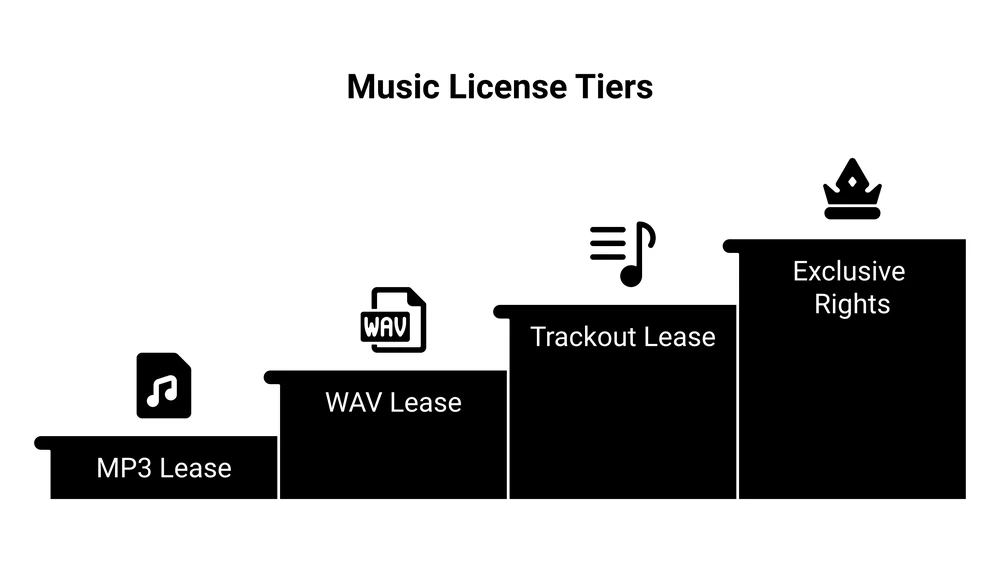
The standard ladder runs 4 rungs:
- MP3 lease. Tagged or untagged MP3, capped streams and sales. Your volume product.
- WAV lease. Higher quality file, higher caps. The most common upgrade.
- Trackout or premium lease. The stems, meaning every element as its own file, so the artist’s engineer can mix properly.
- Exclusive rights. The beat comes off your store for good. One buyer, one time.
Non-exclusive licensing pays the bills, because the same beat can be leased to 50 different artists while sitting on BeatStars, Airbit, and Traktrain at once. Exclusives pay more per sale and kill the asset.
Whatever you sell, the beat is a file that leaves your hands, so think about protecting digital downloads before a tagged MP3 turns into a free re-upload.
Step 3: Price for the market you’re actually in
Take the live market over any suggested price list. On Traktrain’s marketplace on 17 July 2026, real listed beats sat at $5, $10, $14, $19.99, $25, $30, $35, $40, $48, and $50, with plenty listed free.
The median is about $30, and Google’s AI Overview puts an MP3 lease at $20 to $30, which matches what’s actually on the shelf.
Producers in the Reddit thread describe the same spread from the inside: “Some folks sell as low as $5, others START at $70 for MP3 licenses.” Another suggests waiting “till you get better and can respectably charge around $30.”
The published advice gets aspirational at the top rung. A $300 to $1,000+ exclusive is real money for established producers, but pricing your first exclusive there mostly means never selling one. The same digital product pricing logic applies here: price each tier for whoever is actually buying it.
Step 4: Name your beats the way artists search
Artists search by the name of the artist they want to sound like, which is why the type-beat convention exists. Follow it exactly:
Artist Name Type Beat - "Song Title" | BPM, Key
Real listings on Traktrain right now read “playboi carti type beat ‘obsession'”, “METRO BOOMIN X TRAVIS SCOTT TYPE BEAT”, and “[FREE] Westside Gunn Type Beat ‘Orange Diesel'”. That’s the format working.
Go narrow with the reference artist. A beat tagged for a huge artist competes with 10,000 others, while a beat tagged for a rising artist with a hungry fanbase actually gets found.
Step 5: Get traffic, which is the whole game
Everything above is the minimum. This step is what separates producers who earn from producers who upload.
A producer in that thread put it better than I can. Without marketing, “it’s like setting up shop in a ghost town.”
The channels that work are boring and well established. YouTube type-beat videos do the heavy lifting, which is a whole way to monetize YouTube without AdSense, plus Instagram and TikTok clips of the beat playing. Then there’s direct outreach, which most producers skip: find artists whose sound matches yours and message them. As one producer in the thread put it, “dont try to sell dancehall beats to lyrical rappers, match the beats to the right niche.”
Expect this to be slow. The honest line from the thread: “You probably won’t make any real amount of money for the first year or two, that’s ok. Again, marathon not a sprint.”
What producers actually make
3 sourced numbers tell you what this actually looks like.
The lottery ticket is real. In November 2018 Lil Nas X bought a beat from Dutch producer YoungKio on BeatStars for $30, and it became “Old Town Road.” Both ABC News and Variety confirm the $30 price. YoungKio was 19, signed a contract with Universal Music in June 2019, and kept 50% of the publishing on the song. Variety notes he was paying a $180 BeatStars membership at the time.
The grind is real. CNBC profiled beat producer Robin Wesley in August 2019. In 2013, his first year, he made $500, and 2 years later his annual revenue passed $30,000. In September 2017 a Vietnamese songwriter bought a non-exclusive license to one of his beats for around $100, the song went to number 1 in Vietnam, and Wesley negotiated publishing royalties after the fact.
The median is brutal. In 2017 Forbes reported that Airbit’s 300,000 producers had collectively earned about $20 million, then did the division itself: an average of roughly $66 per producer. Forbes never said over what period that piled up, so read it as a rough order of magnitude rather than a yearly wage.
Both things are true at once. A $30 beat can turn into the biggest song of the decade, while the typical producer on the platform earns less than a nice dinner. Plan for the second and stay ready for the first, because the same reality check applies to starting a digital product side hustle in any niche.
FAQ
Where can I sell my beats for money?
The 3 established beat marketplaces are BeatStars, Airbit, and Traktrain. Airbit and Traktrain both have free tiers, so you can start with no money down. You can also sell direct through a checkout tool, no website needed, which keeps the customer relationship but gives you no built-in audience. Most producers do both, marketplace first.
How much do you sell your beats for?
MP3 leases cluster around $20 to $30. On Traktrain’s live marketplace in July 2026, listed prices ran from $5 to $50 with a median near $30. Google’s AI Overview puts the rest of the ladder at $30 to $50 for a WAV lease, $75 to $150 for a trackout, and $300 upward for exclusives. Beginners realistically sell at the lower end of each rung.
Do I need an LLC to sell beats online?
No platform requires one to start selling, and you can sell beats as an individual. Whether you should form one is a tax and liability question that depends on where you live and how much you earn, and it’s worth 30 minutes with an accountant once you have real revenue. Don’t let it block you from uploading your first beat.
What happens if I sell a beat and the song blows up?
That comes down to the license you sold. A non-exclusive lease usually caps streams and sales, so a song that outgrows those caps needs a new agreement, and that’s your chance to renegotiate. Robin Wesley negotiated publishing royalties after his $100 lease became a number 1 record in Vietnam. Read your own contract before you need it.
Start on the free rung
What it costs to sell beats online in 2026 comes down to this. The platforms now charge a flat yearly fee rather than a percentage of sales, and that fee is cheap enough that break-even runs 1 to 6 sales a year.
So don’t pay it yet. Start free on Airbit or Traktrain, build 30 or 50 beats, and let actual sales tell you which platform deserves a subscription. Then upgrade with their money instead of yours.
When artists start coming back for your third and fourth beat, that’s your signal to own the checkout, because a repeat buyer shouldn’t cost you a middleman.
Traffic is the hard part, so when someone finally does buy, that sale should be worth as much as it can be. That’s the reason I built CartMango. An artist taking the MP3 lease gets offered the WAV or the trackout right there at checkout, as an order bump, and a good number of them say yes. Same beat, same visitor, more per sale.
About the Author

👋 I’m Welly, founder of CartMango (the site you’re on), a checkout platform for digital product sellers. We’ve previously processed $179M+. I also run BirdSend (email marketing tool, 3.1B+ emails sent). On the side I show other non-techie digital sellers how I use AI workflows to automate 50%+ of my operations. Find me on LinkedIn.
Related Reading
- How to sell Lightroom presets: the same marketplace-versus-own-checkout math, run on a different digital product
- How to price digital products: a pricing method for when the $30 median stops fitting your catalog
- 8 ways to protect digital downloads: keeping your tagged MP3s off the re-upload channels
- Payhip alternatives: for when you’re ready to compare your own checkout options