

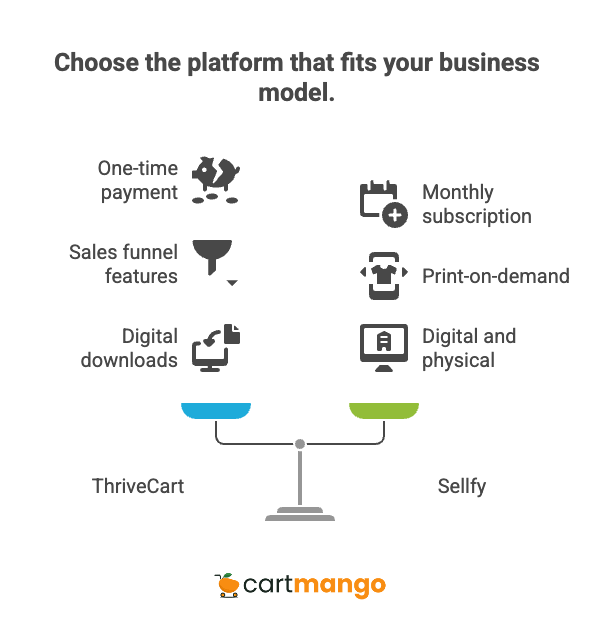
ThriveCart is a one-time payment cart with sales funnel features, while Sellfy is a monthly subscription e-commerce platform offering print-on-demand alongside digital downloads. Both connect to Stripe and PayPal, making them popular platforms to sell digital products.
The Revenue Captivity
You spend months, maybe years, building up a base of paying customers. They trust you. They pay you every month for your membership, your online course updates, your ongoing coaching. That recurring revenue feels like stability. It’s the foundation of your digital product business.
Then you decide to switch platforms.
With Sellfy, here’s what happens: you lose those recurring payments. Every single one. Even if you connected your own Stripe or PayPal account, those subscription relationships belong to Sellfy, not you. The moment you leave, your customers stop paying you through that system. Sellfy handles recurring billing in a way that ties those payments to their platform.
This isn’t a technical glitch. It’s how the ecommerce platform works.
I want to be fair here. ThriveCart handles this differently. If you build recurring revenue on ThriveCart and later decide to move, those payment relationships stay with you. Your customers keep paying. Your income continues. ThriveCart offers a one-time payment model that doesn’t lock you in.
The contrast between these two platforms on this single issue is stark. One lets you own what you built. The other holds it hostage.
Think about what that means in practice. You might be perfectly happy with a platform like Sellfy today. But businesses change. Needs evolve. What happens two years from now when you want different features, better pricing, or a solution for selling digital products that fits your growth?
If you’ve built substantial recurring income on Sellfy, you’re stuck. Not because switching is technically hard, but because switching means starting over with every single recurring customer. You’d have to email them, explain the situation, ask them to re-enter their payment details on a new platform. Some will. Many won’t. You’ll lose revenue you earned from selling your digital products.
This creates a dynamic where you’re not really choosing to stay with Sellfy. You’re trapped into staying because leaving costs too much.
When you’re evaluating platforms, this question matters: if I leave, do I keep what I built? With ThriveCart, yes. With Sellfy, no. If you want to sell digital products and keep your recurring customers, choose carefully.
What to Look for in a Selling Platform
Choosing between platforms comes down to a few core questions. Get these right, and the decision becomes clearer. When you compare ThriveCart to similar products, the differences become obvious.
The first question: can you take your recurring customers with you if you leave?
This should be non-negotiable. Platforms that hold your subscription products hostage create dependency, not partnership. You earned those customers. They should stay yours regardless of which software you use for delivering digital products.
The second question: are your digital files protected?
Some platforms generate download links that anyone can share. Once a customer forwards that link to a friend, your digital content spreads for free. Other platforms expire links, limit downloads, or add other protections. If you sell digital downloads, piracy protection matters.
The third question: what happens when something breaks?
Can you reach a real person who actually helps? Or do you get stuck in support ticket queues, chatbot loops, or community forums where your urgent problem sits unanswered?
The fourth question: what’s the real cost?
Monthly fees look small until you add them up over years. Transaction fees and percentage cuts can quietly drain your margins. Some platforms charge for features that others include free. A $79/month platform fee costs $948/year. Over five years, that’s nearly $5,000 just for the privilege of using the software.
The fifth question: does the platform match your business model?
If you sell subscription products, you need trial support and setup fee capability. If you want to sell physical products alongside digital ones, you need inventory and shipping options. If funnels drive your revenue, you need post-purchase upsells and downsells. Not every platform does everything.
ThriveCart lets you keep your recurring revenue. That’s a point in its favor. But user reports consistently mention poor customer support. People describe feedback getting deleted in the official Facebook group. When you hit a real problem, getting help can be frustrating. ThriveCart doesn’t offer the responsive support some sellers need.
Sellfy offers friendly support for everyday questions. But if you leave, your recurring revenue stays behind. And if you want to sell your products with post-purchase upsells or downsells, Sellfy doesn’t support those marketing features. This limits your ability to maximize each customer transaction.
CartMango takes a different approach. No recurring payment hostage:
- Your customers stay yours
- Download links are protected against sharing
- Support comes directly from the founder, with an average response time of 2 hours 16 minutes
- No chatbots, no ticket queues. It’s a solution for digital creators who value real help.
- CartMango is also free until 2027
Zero monthly fees, zero commission on sales. All features included. That’s not “free forever” but it’s enough time to test whether the platform works for your online business without financial risk.
If you’re selling digital products online and want to keep what you build, these criteria help narrow down your options quickly. The best platforms to sell digital products let you own your customer relationships.
ThriveCart vs Sellfy vs CartMango: Feature Comparison
Here’s how these three platforms compare across the features that matter most for digital sellers:
| Feature | ThriveCart | Sellfy | CartMango |
|---|---|---|---|
| Keep recurring payments if you leave? | ✅ Your recurring revenue stays with you | ❌ Recurring income disappears when you leave, even with your own Stripe/PayPal connected | ✅ Your recurring revenue stays with you |
| Completely free? (Stripe/PayPal fees apply to all platforms) | ❌ No. $495 for the standard plan. $295/year additional for expanded features. $195 more for the course hosting system. | ❌ $29/month up to $833/month in sales. $79/month up to $4,166/month in sales. $159/month up to $16,666/month in sales. | ✅ Yes. Zero monthly cost, zero percentage taken. Every feature available (until 2027). |
| Course hosting system (LMS) | ✅ Available for an additional $195 | ❌ Not available | ❌ Planned for future release |
| Post-purchase upsells and downsells | ✅ Fully supported | ❌ No upsell or downsell capability | ✅ Fully supported |
| Customer support quality | Multiple users report unhelpful support and removed criticism in their Facebook community | Usually quick and helpful for basic questions, though no live chat option. Feedback gets mixed when issues become technical or time-sensitive. | Direct access to the founder. No automated responses, no live chat. Typical reply time runs about 1 hour or more. |
| Buy now, pay later for customers | ✅ Supported | ⚠️ PayPal Pay Later only. Missing popular options such as Klarna, Affirm, and Afterpay. | ✅ Supported |
| Order bumps at checkout | ✅ Supported | ⚠️ Restricted to Business and Premium tiers only. | ✅ Supported |
| Subscription trials and setup fees | ✅ Supported | ⚠️ Trials and setup charges not available. Standard recurring billing only. | ✅ Supported |
| Flexible coupons and discounts | ✅ Supported | ✅ Supported | ✅ Supported |
| Fast, optimized checkout | ✅ Supported | ✅ Supported | ✅ Supported |
| Guest checkout (no login required) | ✅ Supported | ✅ Supported | ✅ Supported |
| Immediate payout to Stripe/PayPal | ✅ Supported | ✅ Supported | ✅ Supported |
| Download link protection | ❌ Links can be shared and reused. Digital files vulnerable to unauthorized distribution. | ✅ Links secured against sharing | ✅ Links secured against sharing |
| Third-party integrations | ✅ Extensive options: email platforms, membership sites, fulfillment services, analytics tools, webinar software, payment systems, plus Zapier connectivity. | ⚠️ Fewer native connections: primarily analytics and advertising pixels (Google Analytics, Facebook/X tracking, Google Merchant Center). Zapier available for extended functionality. | ⚠️ Fewer native connections, but Make.com opens access to 3,000+ applications. Direct integrations include Kit, ActiveCampaign, Beehiiv, and BirdSend. More coming. |
| Built-in affiliate program | ⚠️ Available for $295/year extra | ✅ Included | ❌ In development |
| Ideal user | Sellers who prefer paying once rather than monthly to access most capabilities (not all), and who can work around limited support quality. | Sellers wanting a complete storefront for digital items, recurring billing, and merchandise printing, who can live without post-purchase sales tools. | Independent digital sellers who refuse to let platforms hold their recurring income, who want instant setup, real human help, and zero platform costs (free until 2027). |
| Free migration assistance | ❌ Not offered | ⚠️ Complete migration help only on the highest-priced Premium tier. Lower plans receive partial assistance. | ✅ Included at no charge |
These are the links for each platform: ThriveCart, Sellfy, CartMango.
CartMango Is Built for Independent Digital Creators
CartMango isn’t trying to be everything for everyone. It’s built specifically for solo digital creators who want to sell their digital products without platform complications.
The core idea is simple: you shouldn’t pay monthly fees when you’re not making sales, and you shouldn’t lose your customers if you decide to leave.
If you’re a coach selling a course, a consultant with downloadable templates, or a creator with digital products to sell like ebooks, CartMango handles the basics well. Checkout pages, payment processing through Stripe and PayPal, digital delivery, upsells after purchase, order bumps pre-purchase, subscription billing with trials and setup fees. The platform allows you to sell digital products directly to your audience.
What CartMango doesn’t have yet:
1/ A learning management system for hosting courses with video lessons and progress tracking. That’s coming later. If you need full course hosting today, you’ll need to pair CartMango with a separate LMS or choose a different platform.
2/ The native integrations are also limited compared to ThriveCart’s extensive list. CartMango connects directly to Kit, ActiveCampaign, Beehiiv, and BirdSend. For anything else, you use Make.com to connect to thousands of other apps. It works, but it’s an extra step if you need tools like advanced email marketing automation.
3/ Affiliate management is also still in development. If running an affiliate program is central to your digital product business right now, CartMango isn’t ready for that use case.
Who is CartMango actually for? Digital product sellers who value:
- Keeping their recurring revenue if they ever switch platforms
- Protected download links that can’t be shared
- Talking to a real person when something goes wrong
- Not paying platform fees while building their business
- Being able to sell courses, digital art, templates, and other digital assets
The free-until-2027 model means you can test everything without financial commitment. If it works for your business, great. If not, you haven’t lost anything trying. Unlike ThriveCart alternatives that charge monthly, CartMango lets you start selling without upfront costs.
For creators who want to sell digital products and services without the overhead, CartMango offers a straightforward path. No complicated pricing tiers. No hidden fees. Just a platform that does what you need and stays out of your way.
ThriveCart: The One-Time Payment Shopping Cart
ThriveCart stands as a shopping cart platform you buy once and own forever. No monthly subscriptions eating into your margins. Pay upfront, use it indefinitely. This is the lifetime access to ThriveCart model that attracts many sellers.
The pitch appeals to sellers who’ve calculated how much monthly platform fees add up over years. At $29 to $159 per month for alternatives like Sellfy, a one-time $495 payment can look attractive if you plan to sell online courses and digital goods for the long term.
What ThriveCart offers
ThriveCart offers features like checkout optimization and sales funnels:
- High-converting checkout page templates
- One-click upsells and downsells after purchase
- Order bumps during checkout
- Subscription billing with trial periods and setup fees
- A/B testing for checkout pages to improve conversion rate
- Buy now, pay later options for customers
- Coupon and discount code management
- Affiliate tracking (with paid upgrade)
- Course hosting through ThriveCart Learn (with paid upgrade)
The platform integrates with most major tools: email marketing services, membership platforms, webinar software, fulfillment services. Zapier extends connectivity to thousands more applications. This makes ThriveCart appealing for sellers who already have a stack of tools and need their cart to connect.
For those who want to sell online courses, ThriveCart Learn provides a built-in learning management system. You can host video lessons, drip content over time, and track student progress. It’s not as full-featured as dedicated course platforms, but it keeps everything under one roof.
ThriveCart pricing structure
The base ThriveCart plan costs $495 one-time. This gets you the core shopping cart and checkout features with unlimited products.
To access advanced features like affiliate management, you pay an additional $295 per year. That’s not one-time. It’s recurring. This is something ThriveCart doesn’t offer in the base plan.
For course hosting through ThriveCart Learn, add another $195 one-time.
So the “one-time payment” story has some asterisks. The base cart is one-time. Affiliate tracking is annual. Course hosting is one-time but separate.
A fully-loaded ThriveCart setup with affiliates and courses costs $495 + $195 upfront, then $295 every year after that. No transaction fee from ThriveCart itself, but Stripe and PayPal still take their cut.
The limitations
Download protection is the notable gap. ThriveCart generates download links that customers can share freely. If someone forwards your PDF or video link to friends, those friends can download your digital product without paying. For digital sellers, this creates piracy exposure. ThriveCart doesn’t offer link protection.
Customer support generates consistent complaints. Users describe slow responses, unhelpful answers, and feedback getting removed from the official community. When you hit a technical problem, getting resolution can be frustrating. For sellers who need responsive help, this is a real concern.
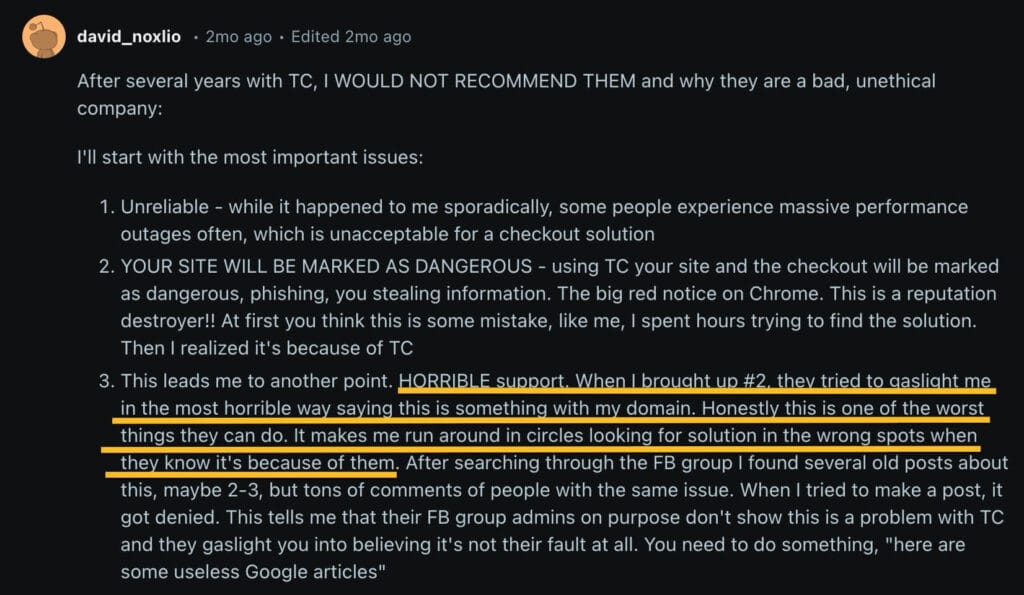
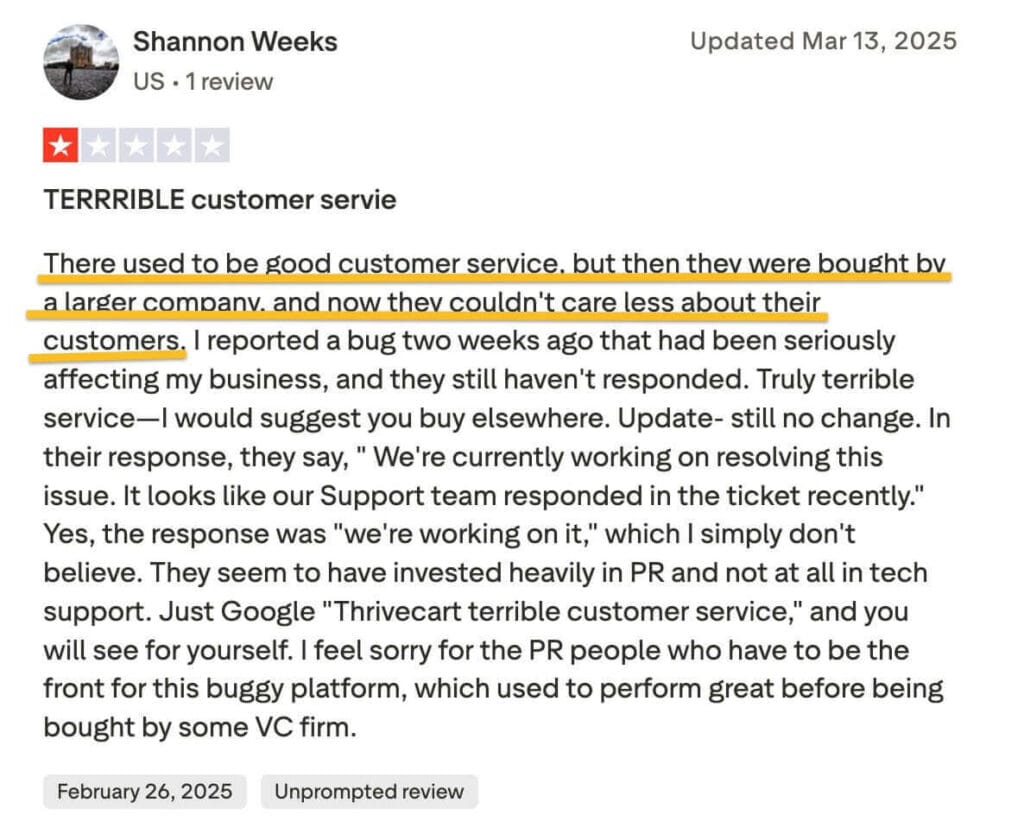
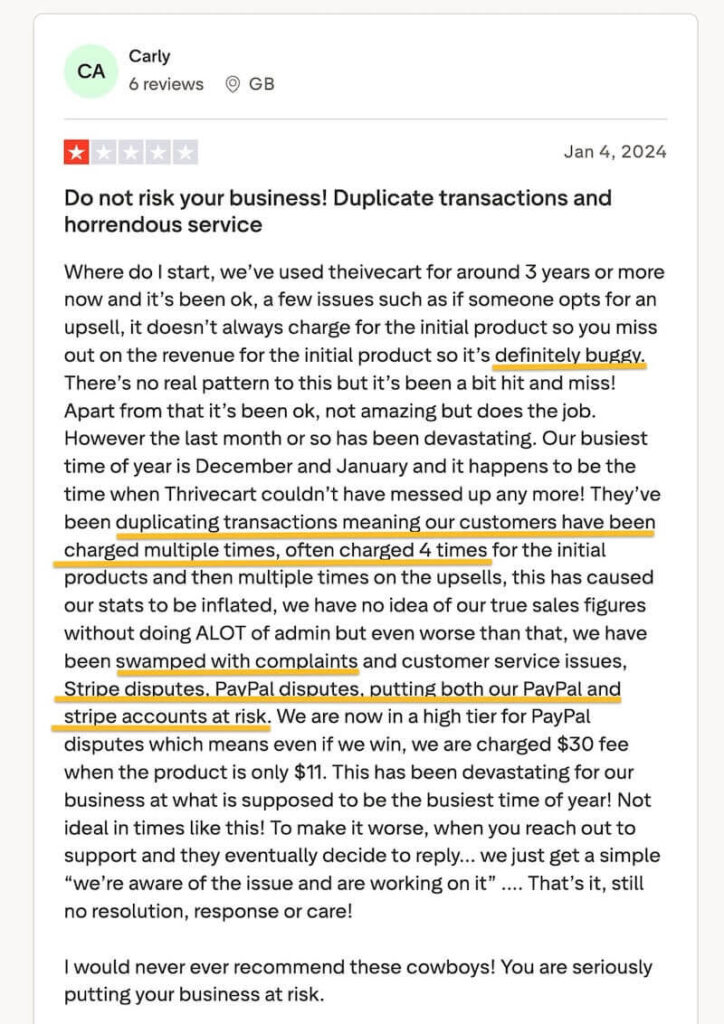
The one-time pricing also means ThriveCart has less incentive to continuously improve the product. They’ve already collected your payment. Monthly subscription platforms have financial motivation to keep customers happy. One-time purchase platforms have different incentive structures.
If you want to sell physical products alongside digital ones, ThriveCart can handle both physical and digital products, but it’s primarily designed for digital product sales. The platform works for physical product sales, but that’s not its strength.
Best for
ThriveCart fits sellers who:
- Want to avoid monthly platform fees
- Need strong upsell and downsell capabilities for product sales
- Can handle support frustrations when they arise
- Aren’t concerned about download link sharing
- Plan to use the platform long enough to justify $495+ upfront
- Want to create and sell courses with advanced features
- Already have an audience and want to sell digital content
This is the link for ThriveCart. When looking at the best ThriveCart alternatives, consider what features matter most for selling online.
Sellfy: The All-in-One Store with Print-on-Demand
Sellfy takes a different approach than ThriveCart. Instead of just a shopping cart, Sellfy gives you a complete online store with product pages and everything you need to start selling. Upload your products, customize your storefront, and begin selling digital products. No separate website needed.
The platform also includes print-on-demand, letting you sell physical merchandise without inventory. Design a t-shirt, connect to Sellfy’s print partners, and they handle production and shipping when orders come in. This makes Sellfy popular for sellers who want to sell digital and physical products from one place.
What Sellfy offers
Sellfy offers simplicity and breadth for selling online:
- Complete storefront with a product page for each item
- Digital download delivery with protected download links
- Subscription and membership billing
- Print-on-demand merchandise
- Built-in affiliate program (no extra charge)
- Basic email marketing tools as a marketing tool
- Coupon codes and discounts
- Embeddable buy buttons for existing websites
- Mobile-optimized checkout
- Sales page templates
The protected download links stand out. Unlike ThriveCart, Sellfy secures your digital files so customers can’t simply share links with others. For ebook sellers, template creators, and anyone worried about piracy of their digital content, this matters. Sellfy gives you peace of mind about digital assets being shared.
The print-on-demand feature deserves attention if you want to sell physical products alongside your digital goods. You can design merchandise, add it to your store, and Sellfy’s partners handle printing and shipping. No inventory to manage, no upfront costs for physical product. This appeals to creators who want to sell branded merchandise without the logistics headache.
Sellfy pricing structure
Sellfy charges monthly based on how much you sell:
- Starter: $29/month for up to $833/month in revenue
- Business: $79/month for up to $4,166/month in revenue
- Premium: $159/month for up to $16,666/month in revenue
Notice the revenue caps. If you exceed them, you either upgrade to a higher tier or Sellfy may restrict your account. The pricing scales with your success, which sounds fair until you realize you’re paying more specifically because you’re doing well with your products or services.
There are no one-time purchase options. You pay monthly as long as you use the ecommerce platform.
Annual billing discounts exist, but you’re still committing to ongoing payments rather than owning the software outright. Unlike ThriveCart, you never stop paying.
The limitations
The recurring revenue hostage situation is the biggest concern. Build up monthly paying customers on Sellfy, and those relationships belong to Sellfy’s billing system. Leave the platform, and you leave those payments behind. Sellfy doesn’t let you take subscription customers with you.
No post-purchase upsells or downsells. Once a customer completes checkout, you can’t offer them a complementary product at a discount. This limits revenue optimization strategies that work well on other platforms. If you want to sell your digital products with a proper sales funnel, Sellfy falls short.
Subscription features are basic. You can charge recurring payments, but trials and setup fees aren’t supported. If your business model includes “first month free” or one-time enrollment charges plus monthly fees, Sellfy can’t handle that structure for subscription products.
Buy now, pay later is limited to PayPal Pay Later only. No Klarna, Affirm, or Afterpay integration. Depending on your audience, this may or may not matter.
Native integrations are sparse. You get analytics pixels and basic connections. Zapier fills the gaps, but that’s an additional marketing tool to manage and potentially pay for.
Best for
Sellfy fits sellers who:
- Want an all-in-one store without building a separate website or landing page
- Want to sell products online including print-on-demand merchandise
- Don’t rely heavily on recurring subscription revenue
- Don’t need post-purchase upsell funnels
- Value protected download links over advanced sales features
- Want to sell their digital products without technical complexity
Like Sellfy, CartMango also protects download links, but CartMango lets you keep recurring customers if you leave.
This is the link for Sellfy.
What You’ll Actually Pay: A Cost Breakdown
Platform fees tell only part of the story. Every sale also includes payment processing costs through Stripe or PayPal, typically 2.9% plus $0.30 per transaction. Let’s see what you’d actually pay at different revenue levels for your digital product sales.
Assumptions: $50 average order value, using each platform’s cheapest qualifying plan. Products without unnecessary add-ons.
| Monthly Revenue | ThriveCart Cost (per month) | Sellfy Cost (per month) | CartMango Cost (per month) | Savings vs ThriveCart (Year 1) | Savings vs Sellfy (per year) |
|---|---|---|---|---|---|
| $1,000 (20 orders) | $0 platform + $35 processing = $35 | $29 platform + $35 processing = $64 | $0 platform + $35 processing = $35 | $495 | $348 |
| $5,000 (100 orders) | $0 platform + $175 processing = $175 | $79 platform + $175 processing = $254 | $0 platform + $175 processing = $175 | $495 | $948 |
| $10,000 (200 orders) | $0 platform + $349 processing = $349 | $79 platform + $349 processing = $428 | $0 platform + $349 processing = $349 | $495 | $948 |
| $50,000 (1000 orders) | $0 platform + $1,745 processing = $1,745 | $159 platform + $1,745 processing = $1,904 | $0 platform + $1,745 processing = $1,745 | $495 | $1,908 |
Note: ThriveCart requires a $495 upfront payment. CartMango has no upfront cost, so you save $495 in Year 1. After Year 1, both platforms have $0 monthly fees. Against Sellfy, CartMango saves $348 to $1,908 every year since Sellfy charges monthly fees indefinitely.
CartMango matches ThriveCart’s zero platform fees but without the $495 upfront cost. Against Sellfy, CartMango saves $348 to $1,908 per year depending on your revenue level.
The real cost difference becomes clear over time. A seller making $5,000/month on Sellfy pays $948/year in platform fees alone. Over three years, that’s $2,844. ThriveCart costs $495 once (plus $295/year if you want affiliates). CartMango costs nothing until 2027.
For sellers focused on keeping costs low while building their digital product business, the math favors platforms without monthly revenue-based pricing. If you want to sell digital products directly without giving up a percentage, the choice matters.
The hidden cost with Sellfy is the subscription hostage risk. If you ever want to leave after building recurring revenue, you’ll face a revenue hit that isn’t captured in these monthly numbers.
When choosing between these platforms, think about where you’ll be in two or three years. Will you still be happy with the same features? Will the pricing still make sense at your revenue level? Will you want to switch? The answers shape which platform makes sense today.
ThriveCart vs Sellfy vs CartMango: Making Your Choice
These are the links for each platform: ThriveCart, Sellfy, CartMango.
Each platform serves different priorities. Your choice depends on what matters most for selling your digital products and services.
Choose ThriveCart if:
- You prefer paying once rather than monthly fees
- Upsells and downsells are central to your sales strategy
- You need extensive third-party integrations
- You can work around inconsistent customer support
- Download link protection isn’t critical for your products
- You plan to use the platform long enough to justify $495+ upfront
- You want to sell physical and digital products with advanced checkout features
Choose Sellfy if:
- You want a complete storefront without building a website
- Print-on-demand merchandise is part of your product mix
- You don’t plan to switch platforms (recurring revenue stays locked in)
- Basic subscription billing meets your needs
- Protected downloads matter more than advanced funnel features
- You prefer monthly payments over large upfront costs
- You want to sell digital goods with minimal setup
Choose CartMango if:
- You refuse to let any platform hold your recurring revenue hostage
- Protected download links are important for your digital products
- You want direct access to human support without chatbots
- Zero platform fees appeals to you while building your business
- You sell digital products and don’t need a full LMS yet
- You’re willing to use Make.com for integrations beyond the native options
- You want a solution for digital product sellers who value ownership
The subscription hostage issue deserves special attention. If you’re building recurring revenue through memberships or ongoing subscriptions, think carefully about what happens when you eventually want to change platforms. With Sellfy, you start over. With ThriveCart or CartMango, your customers come with you.
Each platform has clear trade-offs. ThriveCart offers funnel power but poor support and piracy risk. Sellfy offers simplicity and download protection but holds your recurring revenue hostage. CartMango offers ownership and support but lacks an LMS and has fewer native integrations.
Your decision comes down to which trade-offs you can live with. There’s no perfect platform, just the one that fits your specific situation best.
If you’re just starting out and want to test what works, CartMango’s free model lets you experiment without financial pressure. If you’ve already built an audience and know exactly what features you need, the upfront investment in ThriveCart might pay off over time. If you want everything in one place including print-on-demand and don’t plan to leave, Sellfy simplifies your tech stack.
The right choice depends on your business stage, your revenue model, and how much you value flexibility versus convenience.
For solo digital creators selling courses, ebooks, templates, coaching packages, or subscription content, CartMango’s combination of zero fees, protected downloads, and portable recurring payments addresses the most common pain points for those who want to sell digital products online.
Try CartMango free until 2027 and see if it fits your business. You risk nothing but a few minutes of setup time.
Related Reading
- How to cancel Payhip (2026)
- Cancel SendOwl: 3 scenarios, 3 different processes (2026)
- Is Gumroad a scam? (2026)
- How to cancel ThriveCart (seller & buyer steps) (2026)
- ThriveCart reviews complaints: a competitor’s take (2026)
- Is ThriveCart legit? (2026)
- ThriveCart lifetime deal: $495 base vs $985 reality (2026)
- Cancel SamCart subscription: no refunds for monthly plans (2026)
- SamCart complaints: billing, upsells & the exit trap (2026)
- Ejunkie vs SureCart: No Subscriptions vs No Ownership (2026)