

ThriveCart reviews and complaints come down to this: strong checkout features, but real problems with bugs, hidden costs, and support that disappears when you need it most.
Full disclosure: I’m the founder of CartMango, a competing checkout platform for solo creators.
The “lifetime deal” that keeps charging you
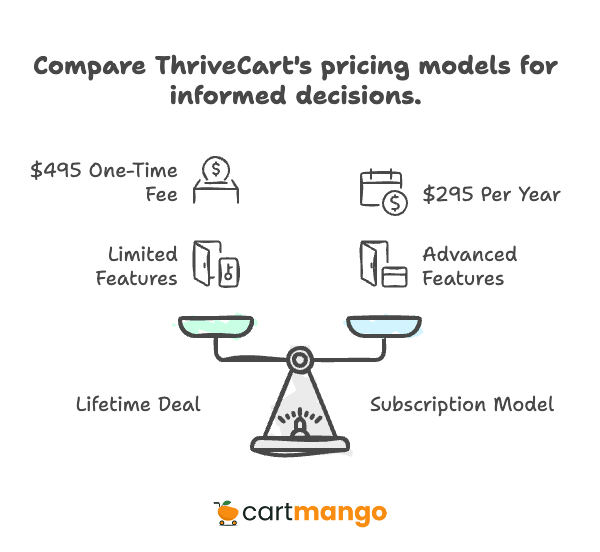
Every ThriveCart review leads with the same selling point. Pay $495 once, use it forever. No monthly fees.
That was the pitch. Then April 2025 happened.
ThriveCart rebranded their Pro plan to “Pro+” and switched it to $295 per year. That’s the plan you need for affiliate management, advanced sales tax features, and most of the tools serious sellers rely on. Want the Learn LMS system? That’s another $195.
So your one-time fee of $495 becomes $495 + $295/yr + $195 if you need courses.
Over 3 years, that’s $495 + $885 in Pro+ fees alone. $1,380 total. Whether you frame it as monthly or annual, that’s more than many subscription shopping cart platforms over the same period. Not exactly what people picture when they hear “lifetime deal.”
And ThriveCart makes the upselling obvious. Users report persistent banners inside the dashboard pushing the Pro+ upgrade. It feels less like an optional add-on and more like a toll booth you can’t drive around.
What nobody talks about though: the one-time payment model removes ThriveCart’s incentive to keep you happy. Monthly platforms lose revenue when you cancel. ThriveCart already has your $495. There’s no recurring revenue pressure to fix bugs quickly, ship updates on time, or invest in better support.
That’s the pattern you’ll see in every complaint section below. Slow bug fixes. Silent support. Features locked behind paywalls that didn’t exist when you decided to purchase ThriveCart.
Think about it. If a platform has no monthly churn to worry about, what’s the rush to fix anything? You already paid.
I built CartMango with a different model. Free during the beta (until 2027), then starting at $9.99 per year. No Pro+ tiers. No feature gating. The kind of pricing where we actually lose you if we stop earning it.
What ThriveCart does well
ThriveCart is a checkout platform at its core. A shopping cart for selling digital products, courses, and subscriptions. And it gets some things right. Would be unfair to skip that. Here’s what I like about ThriveCart when it works.
The checkout pages load fast. One user reported a 37.7% conversion rate on their ThriveCart checkout page. That’s strong by any standard.
The cart supports multiple payment gateways. Stripe, PayPal, Authorize.net, Google Pay, Apple Pay. You pick the payment processor, ThriveCart takes zero commission on top of it. Just the standard processor fees.
Post-purchase funnels work well for most users. Inside of ThriveCart, you can set up one-click upsells after someone buys, add order bumps on the checkout page, and offer buy-now-pay-later options. ThriveCart handles subscription management with trials and setup fees. For a one-time purchase, the funnel features are better than what most monthly carts include at their base tier.
The integration lineup is big. ThriveCart connects to most email platforms, membership sites, webinar tools, and analytics services. If you use Zapier, you can connect to thousands of additional apps. It integrates with the stuff most online business owners already use.
And if you ever leave ThriveCart, you keep your recurring payments. That’s worth noting because some competitors (Gumroad, Podia, SamCart with certain payment types) will kill your subscriptions if you migrate away.
ThriveCart integrates with most email service providers, membership tools, webinar services, and analytics apps. Zapier fills the gaps. If you use thrivecart to sell products and want to connect it to your existing tool stack, you’ll find a way.
Is ThriveCart worth it for the checkout alone? Probably. But the ThriveCart features that matter most to growing businesses, affiliate tools, sales tax handling, advanced reporting, come with ThriveCart pricing that goes well beyond $495. The problems start when you look past the checkout page and into the day-to-day experience of running your business on it.
The bugs ThriveCart users keep reporting
This is where thrivecart reviews and complaints get real. And where the “lifetime deal” pricing model starts to explain a lot.
A Trustpilot reviewer posted in March 2026 about a billing bug that was charging his customers EUR 199 instead of EUR 39. Not once. Over 20 times per month. Every transaction was wrong. His customers were getting overcharged and he had to manually process refunds for each one.
Another reviewer documented 6 months of critical failures that resulted in EUR 0 revenue. They reported 50+ open support tickets and were considering legal action. Six months of a checkout cart not working. That’s not a minor inconvenience.
Another user reported duplicate transaction recording that had been unfixed since July 2023. Over two years of a known billing bug just… sitting there. No fix. No timeline. Just a bug that makes your books wrong every single day.
Other documented bugs from Trustpilot and user reports:
- Checkout fields randomly disappearing from live pages mid-sale
- Order bumps swapping products and prices without warning
- Customers charged twice on single purchases
- Editor changes not saving, with users losing 30-40 minutes of work
- The Learn platform introducing new bugs since August 2025
- Platform-wide 504 errors in March 2026
- Subscriptions auto-cancelling paying customers without explanation
The infrastructure side is concerning too. One reviewer documented “countless bugs, cart downtime and Google security takedowns.” The same reviewer noted ThriveCart appears to have “no redundancy” in their systems. When things go down, everything goes down together.
In December 2025, ThriveCart had two separate downtime events: 9 minutes and then 1 hour 27 minutes. In October 2025, users reported 503 bad gateway errors when trying to log in. For a platform that handles your money, these aren’t small things.
A billing bug that charges the wrong amount 20 times a month can destroy customer trust overnight. When your ThriveCart checkout is buggy, you lose sales you’ll never know about. The customer just… closes the tab.
What makes this worse is the pattern. These aren’t new complaints. ThriveCart users have documented the same categories of bugs for years. Duplicate charges, broken checkout fields, subscription errors. If ThriveCart isn’t fixing these after two-plus years of reports, the question isn’t whether ThriveCart is buggy. It’s whether ThriveCart has the engineering capacity to fix what’s broken. And that goes back to the lifetime deal model. When there’s no recurring revenue tied to customer satisfaction, the incentive to invest in stability just isn’t the same.
ThriveCart support: helpful or ghost town?
ThriveCart customer support is a coin flip. Maybe the most frustrating kind of problem, because you can’t predict which experience you’ll get.
Some users love it. They mention specific support reps by name, report 7-minute response times, and praise the team. If you have a simple question about setting up a checkout page or connecting your Stripe account, you’ll probably get a helpful answer fast.
But when things go wrong, really wrong, the story changes completely.
One Trustpilot reviewer reported sending 34+ support emails about a database corruption that deleted 15 hours of design work. Support went silent. 34 emails. No resolution.
Another ThriveCart user had their entire account disappear and it took over a week to restore. During that time, they couldn’t process any sales. Their online business just stopped. No checkout, no revenue, no explanation for days.
The SweetSea Digital review mentions 3+ week response times for complex issues and 50+ open tickets that went unresolved.
One reviewer reported being denied a refund within 2 hours of purchasing, despite ThriveCart advertising a 7-day refund window. The support team allegedly kept extending troubleshooting steps to run out the clock on the return period.
Simple question? Quick answer. Complex bug affecting your revenue? You might wait weeks. Or hear nothing at all. You won’t know which version of ThriveCart customer support you’re getting until you actually need it. That’s a gamble when your ThriveCart checkout is processing real money from real people.
The Facebook group problem
ThriveCart’s official Facebook group has its own reputation. And not a good one.
Multiple users report that critical feedback posts get deleted and users get blocked for raising issues. Not spam. Not abuse. Legitimate complaints about bugs and billing that just… vanish.
The team goes long periods without posting updates. There’s no ThriveCart email newsletter about known issues either. When bugs are affecting live checkouts and the only official communication channel is removing the complaints, that tells you something.
This connects back to the lifetime deal structure. When there’s no monthly revenue at stake, there’s less pressure to acknowledge problems publicly. No cancellation wave to worry about. People who started using ThriveCart years ago and have their whole business on it aren’t going to leave over a deleted Facebook post. And ThriveCart knows that.
Download links aren’t protected
This one surprises a lot of people looking at thrivecart reviews and complaints. And it’s a big deal if you sell digital products.
ThriveCart doesn’t protect your download links. At all.
If you want to sell digital products through ThriveCart, an ebook, a template pack, a course download, your customer gets a link after they pay. They can share that link with anyone. And anyone who clicks it gets your product for free. No expiration. No access control. Nothing.
ThriveCart does not host digital products either. You need third-party hosting like Amazon S3 or Google Drive, then link to it from ThriveCart. So you’re paying for a shopping cart that can’t actually protect the thing you’re selling through it. If you’re running a digital product business, that’s a problem.
For solo creators selling digital products like courses, templates, or downloads, this is a serious risk. One shared link on a forum or social media post and your paid product becomes free. You’d never know it was happening until you noticed your sales dropping and couldn’t figure out why.
CartMango protects download links by default. Shared links don’t work for unauthorized buyers. If you sell digital products, this is the kind of thing worth checking before you commit $495 to a platform that can’t protect what you’re selling.
ThriveCart’s affiliate program: worth $295 per year?
Want to use ThriveCart affiliate management? You’ll need to upgrade to ThriveCart Pro+. That’s $295 per year on top of your $495 when you purchase ThriveCart.
The affiliate program has some fine print most reviews skip over.
Your affiliates need a Business PayPal account, not a personal one. That limits who can actually promote your products through affiliate links. Affiliate payments are also restricted in certain countries including India, Israel, and Japan.
Commission tracking requires exact URL matching. If an affiliate link has any variation, the attribution fails and your affiliate doesn’t get credit. That creates frustration for your partners and support requests for you. Not exactly the kind of experience that makes affiliates want to keep promoting your stuff.
Several other cart platforms include affiliate management in their base price. Paying $295 per year for affiliate features that other tools bundle in is a tough sell, especially when the tracking has known issues. If you recommend ThriveCart to someone who needs affiliate tools, make them aware of this cost upfront.
ThriveCart Learn: worth the extra $195?
ThriveCart Learn is their course hosting add-on. It costs $195 on top of your base purchase. For that price, you get a basic LMS to sell digital products like courses, host video lessons, and drip content to students. Sounds reasonable until you look at the Trustpilot complaints from people actually using it.
The access control system is broken in both directions. Students who should have access lose it. Students who shouldn’t have access keep it.
One Trustpilot reviewer reported over 1,000 customers simultaneously lost course access. Everyone got error pages. Support couldn’t fix it. He had to manually re-enable thousands of accounts one by one.
On the flip side, another reviewer found 83 students still had access despite canceled subscriptions, some going back months. One customer paid $199 through Stripe but ThriveCart never registered the transaction, so the student got charged but received nothing. The payment went through. ThriveCart just didn’t know about it.
The content editor has its own problems. One reviewer described Learn setup as “agony” because the editor deletes all formatting when you paste content into it. Not just special formatting. Paragraph breaks. Basic line returns. Gone. You can’t even copy between Learn modules without losing everything. What should take 15 minutes to set up takes hours.
Another reviewer reported the tag-based access system was “unreliable from the start.” Refunded users randomly regained access to courses they no longer paid for. Trying to download a student list triggered 504 Gateway Timeout errors. She couldn’t even see who was enrolled.
That last point matters for anyone running a digital product business. If you can’t reliably control who has access to your courses, you’re giving away content you should be selling. And if your ThriveCart account can’t even tell you which students are active, how do you manage your course business?
Since August 2025, ThriveCart users report they can’t see who’s participating in their courses at all. That’s a dashboard visibility bug that’s been sitting there for months. You’re paying $195 for course hosting where the platform can’t show you your own students.
The 504 errors aren’t limited to student lists either. One user hit gateway timeouts within 10 days of using ThriveCart and Learn to host courses. Ten days. That’s barely enough time to finish setting up your first course.
If you want to sell courses, a platform like Kajabi includes course hosting, email marketing, and a website builder in one package. Podia does the same at a lower price point. Both handle student access without the bugs documented above. ThriveCart Learn saves money on paper, but if your students lose access or your refunded customers keep watching for free, the savings evaporate fast.
What ThriveCart Pro+ locks behind the paywall
The $295 per year Pro+ upgrade isn’t just about affiliates. Here’s the full list of ThriveCart features you don’t get without it.
No affiliate center. No JV contracts or revenue sharing. No automated sales tax calculation. No dunning (failed payment recovery for subscriptions). No custom domain on your checkout pages. Only one order bump per product instead of multiple. No business projections. No advanced reporting like funnel comparison or subscription metrics. No multi-user access. No crypto payments. No bulk invoice downloads.
That’s not a minor upgrade. That’s most of the tools a growing online business actually needs.
The sales tax part deserves its own callout. If you sell digital products in the US, you’re responsible for collecting and remitting sales tax in states where you have economic nexus. ThriveCart can calculate this for you, but only on the Pro+ plan. On the standard $495 plan, you’re handling sales tax manually or paying for a third-party service like TaxJar ($19-99/mo). So your “lifetime deal” just got another recurring cost bolted on.
Dunning is another big one. When a customer’s credit card fails on a subscription payment, dunning automatically retries the charge and sends recovery emails. Without it, failed payments mean lost subscribers. Most cart tools include dunning as a basic feature. ThriveCart makes you pay $295 per year for it.
The subscription saver alone could pay for the Pro+ upgrade if you have enough subscribers. But that’s the point. ThriveCart prices the standard plan just low enough to get you in, then gates the features you’ll need as you grow. By the time you realize you need Pro+, you’ve already built your entire checkout flow on ThriveCart. Switching to a different cart tool means rebuilding everything. So you pay the $295.
This is the part that frustrates ThriveCart users the most. The dashboard shows you what Pro+ features exist. Banners remind you they’re available. But using them requires upgrading to ThriveCart Pro+. It’s a checkout cart that upsells you inside your own dashboard after you’ve already purchased it.
One ThriveCart user described it as buying a car and finding out the mirrors cost extra. You can technically drive without them. But you probably shouldn’t.
Here’s what the upgrade to ThriveCart Pro+ actually costs over time. Year one: $495 (base) + $295 (Pro+) = $790. Year two: another $295. Year three: another $295. After 3 years, you’ve spent $1,380 on a “one-time” purchase. Add Learn+ at $195 and you’re at $1,575 over 3 years.
Compare that to SamCart’s Launch plan at $59/mo ($708/year, $2,124 over 3 years). ThriveCart is still cheaper over 3 years if you need Pro+. But the gap is smaller than the “lifetime deal” marketing suggests. And SamCart includes affiliate management, advanced reporting, and subscription management in their higher tiers without a separate annual charge.
For anyone evaluating whether to purchase ThriveCart, factor in the Pro+ cost from day one. The $495 standard plan is the entry point. The $790 first year (with Pro+) is closer to what most sellers actually spend. If you’re comparing ThriveCart pricing to SamCart or other monthly carts, compare against $790, not $495. That’s the real ThriveCart pricing for anyone running a serious online business.
One more thing worth knowing. If you purchased ThriveCart Pro before April 2025, you were grandfathered into the old pricing. But new users buying ThriveCart today get the Pro+ annual model. The lifetime deal that launched ThriveCart’s reputation isn’t the deal you’re getting anymore.
ThriveCart’s refund policy: 7 days to evaluate a $495 purchase
ThriveCart gives you 7 days to request a refund after buying. Seven days to set up your ThriveCart account, connect your payment processor, build your checkout page, test your funnel, integrate your email service provider, and decide if it works for your online business. For a $495+ purchase, that’s tight.
Setting up a ThriveCart account isn’t the hard part. You can have a basic checkout page live within an hour. The problems show up after that. Connecting Stripe or PayPal, testing subscription flows, building out upsell sequences, configuring your email service provider integration. That takes longer than a week for most people, especially if you’re a solo creator doing this between other work.
And if something goes wrong during that window, getting the refund isn’t guaranteed.
One Trustpilot reviewer reported being denied a refund within 2 hours of purchasing ThriveCart. Two hours. She reported that the support team kept extending troubleshooting steps, asking her to try this, then try that, until the 7-day window passed. She called it “the strategy.”
ThriveCart’s official refund policy requires you to submit a form with specific information, have no prior refunds on the account, and not have initiated a chargeback. If you miss any requirement, the refund is denied. For a one-time payment of $495, that’s a lot of fine print.
Compare that to monthly cart tools. SamCart, Kajabi, Podia. If the tool doesn’t work for you, cancel and you’re out one month’s payment. $59 to $99 depending on the platform. Not $495 with a 7-day clock ticking.
This is where the one-time fee model creates real risk for buyers. When you purchase ThriveCart, you’re betting $495 that you’ll like it, that the bugs won’t hit your specific use case, and that ThriveCart customer support will show up if something breaks. If any of those bets lose, you’re out the money.
Most thrivecart reviews skip the refund policy entirely. They focus on the checkout features, the funnel builder, the affiliate program. Nobody talks about what happens when you want out. And for a platform like ThriveCart with the documented bugs and support issues in this post, knowing the exit terms matters.
Who should still use ThriveCart (and who shouldn’t)
ThriveCart still works for a specific type of seller. The complaints in this post don’t apply equally to everyone.
Good fit: – Established businesses already invested in the platform with workflows built around it – High-volume sellers who benefit from zero transaction fees and can absorb the $495+ upfront – Sellers who don’t sell downloadable digital products (no piracy risk)
Bad fit: – Solo creators who sell digital products like ebooks, templates, or course files (unprotected download links) – Anyone who needs affiliate management without paying $295 per year extra – Sellers who need responsive support when complex issues hit their revenue – Budget-conscious creators who can’t risk a $495+ upfront purchase on a platform with documented bugs – Course creators who need a reliable LMS (ThriveCart Learn costs $195 extra and launched with notable stability issues)
Setting up a ThriveCart account is super easy. ThriveCart is easy enough to get started with. You can have a checkout page live within an hour. That part is painless. Using the ThriveCart dashboard feels straightforward at first. The issues show up later, when something breaks, when you need customer support, when you realize features you assumed were included cost extra. ThriveCart’s customer hub looks clean but doesn’t tell you much about the ongoing costs you’ll face as your business grows.
Would I highly recommend ThriveCart to someone starting fresh today? No. Is ThriveCart worth the risk? That depends on your tolerance for bugs, your need for support, and whether you can live with unprotected download links. The bugs, the support lottery, the hidden costs when it comes to ThriveCart… there are tools like ThriveCart that handle checkout without the baggage. And for creators who want to sell digital products without worrying about piracy, buying ThriveCart when it doesn’t protect downloads is a hard sell.
If you’re coming back to ThriveCart after reading other reviews that paint a rosy picture, consider the source. Most ThriveCart review sites use affiliate links. They earn a commission when you purchase ThriveCart through their link. That doesn’t make their reviews wrong. But it means the people writing them have a financial incentive to recommend ThriveCart, not to warn you about what might go wrong. At least I’m being upfront about my bias. I sell a competing product. I have my own agenda. But I’m also not earning anything if you buy ThriveCart, so I have no reason to sugarcoat the problems.
If you’re already using ThriveCart and it works for your specific setup, switching might not be worth the hassle. Moving between carts is painful. Sunk cost is real, and so is migration effort.
But if you’re evaluating whether to purchase ThriveCart fresh and the thrivecart reviews and complaints in this post concern you, it’s worth knowing what else is out there. Anyone who switched to thrivecart from another cart tool will tell you: migration is painful in both directions. That’s why the decision matters before you commit.
ThriveCart alternatives that fix these complaints
A few options depending on what matters most to you. Each one fixes at least one of the major ThriveCart complaints above.
SamCart is the most direct competitor. Monthly pricing ($79-$319/mo) is more expensive long-term, but you get better ThriveCart customer support, more modern checkout page templates, and a cleaner interface. It’s super easy to set up. SamCart includes affiliate management in their Grow plan without a separate annual fee. But SamCart doesn’t protect download links. If piracy of your digital products is your main concern, this cart tool doesn’t solve that problem either. SamCart is worth considering if you want a similar checkout and funnel experience without the one-time payment gamble.
CartMango is what I built for solo digital product creators who want something simpler. Protected download links, zero platform fees. Free during the beta period (until 2027), then starting at $9.99 per year. No Pro+ tiers, no feature gating, no $495 buy-in. If the thrivecart reviews complaints in this post hit close to home, take a look. It won’t replace ThriveCart for physical products. But if you sell digital products like ebooks, templates, or courses and want a checkout that actually protects what you’re selling, that’s what it does.
Payhip charges 5% per transaction on the free plan but drops to 0% on their $99/year plan. It handles digital products, courses, and subscriptions in one place. Protected downloads included. The downside: no real funnel features. No upsells after purchase. If your sales page converts well and you don’t need post-checkout funnels, Payhip is a simple option.
Gumroad takes 10% of revenue plus a flat fee per sale. Their customer support has its own bad reputation. But Gumroad is dead simple to use. If you want to sell digital products and don’t care about checkout customization, Gumroad gets you selling in minutes. The 10% cut hurts at scale though. On $10,000 in sales, Gumroad takes $1,000. ThriveCart takes $0 in platform fees. That math changes the conversation fast.
Easy Digital Downloads is a WordPress plugin, not a hosted platform. If you already run WordPress and want to sell digital products without a separate cart tool, EDD handles it natively. Free version covers basic sales. Extensions for subscriptions, recurring payments, and advanced reporting cost extra. It’s a different approach. You’re managing WordPress hosting and plugins instead of logging into a dashboard like ThriveCart’s. More control, more responsibility.
The right shopping cart depends on what you sell and what you can tolerate. But “pay $495 and hope the bugs don’t hit you” shouldn’t be the only option on the table. If you want to sell digital products without worrying about piracy, or need a cart tool that doesn’t gate half its features behind annual fees, look beyond ThriveCart.
Related reading
- How to cancel Payhip (2026)
- Cancel SendOwl: 3 scenarios, 3 different processes (2026)
- Is Gumroad a scam? (2026)
- How to cancel ThriveCart (seller & buyer steps) (2026)
- ThriveCart reviews complaints: a competitor’s take (2026)
- Is ThriveCart legit? (2026)
- ThriveCart lifetime deal: $495 base vs $985 reality (2026)
- Cancel SamCart subscription: no refunds for monthly plans (2026)
- SamCart complaints: billing, upsells & the exit trap (2026)
- Ejunkie vs SureCart: No Subscriptions vs No Ownership (2026)