

SendOwl charges monthly fees based on your revenue, while Payhip takes a percentage of each transaction unless you’re on its highest plan. Both platforms hold your recurring payments hostage if you leave. If you’re researching Payhip vs SendOwl, this comparison chart covers what matters most.
SendOwl vs Payhip: The “You-Leave-You-Lose-Revenue” Model
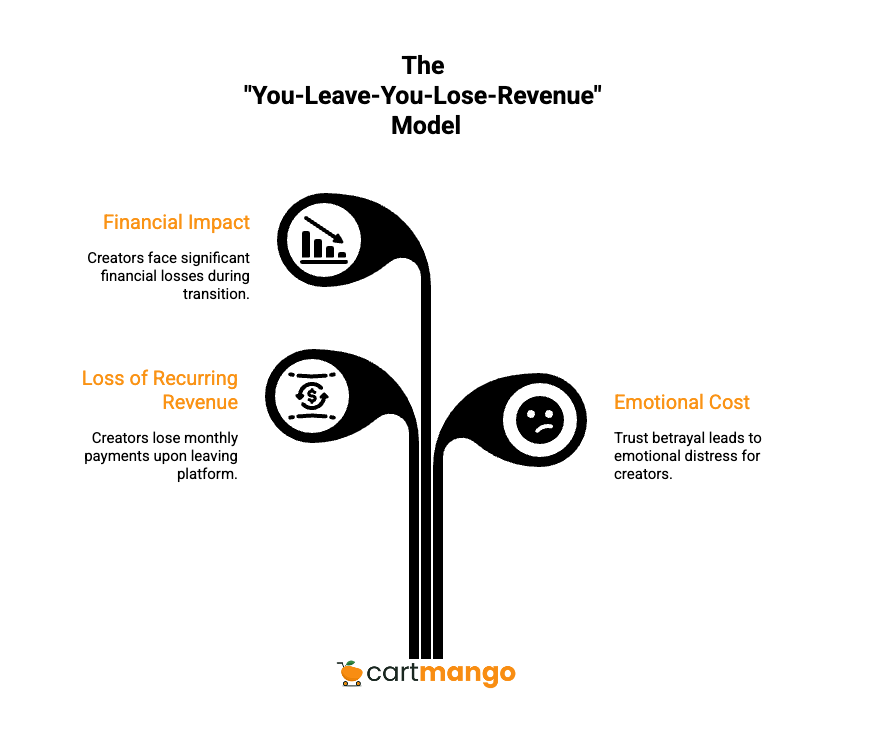
You spend months building a membership. You nurture those subscribers. You show up for them week after week, selling digital products like ebooks, courses, and design assets.
Then you realize the selling platform owns your recurring revenue, not you.
This is the subscription hostage trap.
You built the audience. You created the product. You earned every subscriber through your own effort. But the moment you want to switch platforms, you discover the truth: those recurring payments were never really yours.
Some creators don’t find this out until it’s too late. They try to migrate and realize they have to start from zero. Every subscription needs to be re-sold. Every customer needs to sign up again.
The financial hit is real. But the emotional cost might be worse. You trusted a platform with your business, and now you’re stuck.
This isn’t unique to SendOwl vs Payhip. Many digital selling platforms work this way. The subscription model that’s supposed to give you predictable income, the dream of making money while you sleep, becomes the very thing that locks you in.
How to Escape the Subscription Trap
The fix is simple in principle: use a platform that lets you keep your recurring payments if you ever leave.
Your customers signed up because of you. They trust you, not the checkout page. The relationship belongs to you, and so should the revenue that comes from it.
I built CartMango around this idea. When you connect your Stripe and PayPal account, the subscription lives there, not inside CartMango. If you decide to leave someday, your recurring revenue comes with you. No hostage situation. No starting over.
This isn’t about CartMango being better than SendOwl or Payhip. It’s about a different philosophy. Some platforms treat your customers as their asset. Others recognize that you earned those relationships.
The question worth asking: does your current platform let you leave with what you built?
If the answer is no, that’s worth knowing before you’re three years deep with hundreds of subscribers locked inside a system you can’t escape.
SendOwl vs Payhip vs CartMango
Here’s how these 3 platforms compare across the features that matter most when selling digital products. Whether you sell digital goods like PDFs, ebooks, courses, or other types of digital products, this breakdown covers the entire sales process.
| Feature | SendOwl | Payhip | CartMango |
|---|---|---|---|
| Do you keep recurring payments if you leave? | ❌ Your recurring subscriptions vanish when you leave, even if you’ve connected your own Stripe/PayPal account | ❌ Your recurring subscriptions vanish when you leave, even if you’ve connected your own Stripe/PayPal account | ✅ You keep your recurring payments |
| Completely free? (Stripe/PayPal fees apply on all platforms) | ❌ $39/mo if you earn under $833/mo. $87/mo if you earn under $3,000/mo. $159/mo if you earn under $8,333/mo. | ❌ 5% cut on every sale (base plan). $29/mo plus 2% (Plus plan). $99/mo flat (Pro plan). | ✅ Yes, $0 monthly fees, 0% commission. Every feature unlocked (free until 2027). |
| Learning management system (LMS) | ❌ No | ✅ Yes | 🔜 Coming soon |
| Funnels (upsells & downsells) after customers purchase the main product | ⚠️ Limited to just 1 upsell, and enabling order bumps turns it off. You have to pick one or the other. No downsells available. | ❌ No upsell or downsell support | ✅ Yes |
| Customer support | ⚠️ Support is generally solid, but there’s no live chat. In 2025, a wave of customers pushed back hard after prices jumped 3x – 10x overnight. (source 1, source 2) | ✅ Email support is responsive and reviews are mostly positive, though live chat isn’t offered. | ✅ Direct support from the founder, no bots, no live chat. Typical response time is under 1 hour. |
| Buy now, pay later (BNPL) to help boost your sales | ✅ | ❌ Not real BNPL: Payhip’s payment plans send you money as customers pay each installment. If a buyer quits halfway, you absorb the loss. | ✅ |
| Order bumps to increase revenue | ⚠️ Turning on order bumps automatically disables upsells | ✅ | ✅ |
| Subscriptions (with trials & setup fees) | ✅ | ⚠️ Recurring billing requires Stripe. PayPal users can’t subscribe. If a customer wants to pay via PayPal, subscriptions aren’t an option. | ✅ |
| Dynamic coupons & discounts | ✅ | ✅ | ✅ |
| Optimized & fast checkouts | ✅ | ✅ | ✅ |
| Customers can buy without logging in (quick checkout) | ✅ | ✅ | ✅ |
| Direct, instant payout to Stripe/PayPal (no payment holds) | ✅ | ✅ | ✅ |
| Are download links protected from sharing? | ✅ Links are protected | ✅ Links are protected | ✅ Links are protected |
| Integrations | ✅ Connects with Shopify and Square natively, plus direct email links to Mailchimp, Kit, and ActiveCampaign. Works with Zapier, Make, Pabbly, and webhooks too. | ✅ Works with WordPress, Squarespace, Wix, Weebly, Shopify, Calendly, Zoom, Bookvault, AdSense, chat widgets, mailing lists, and Zapier. | ⚠️ Fewer native integrations, but Make.com opens the door to 3,000+ apps. Native connections today: Kit, ActiveCampaign, Beehiiv, and BirdSend. More rolling out soon. |
| Affiliate management | ✅ Yes | ✅ Yes | 🔜 Coming soon |
| Best for | Creators focused on securing their digital files who can live without advanced funnels. The pricing feels steep for what’s included (revenue caps, single upsell, and you can’t run upsells with order bumps). | Creators who value simple VAT compliance and quick setup, but should keep an eye on transaction fees that stack up as revenue grows. | Independent digital sellers who refuse to let their recurring income be held hostage, plus quick setup, real human support, and zero platform fees (free until 2027). |
| Free migration | ❌ No free migration | ❌ No free migration | ✅ Free migration included |
These are the links for each platform: SendOwl, Payhip, CartMango.
CartMango Isn’t for Everyone. Here’s Who It’s For.
CartMango works best for solo creators, coaches, and consultants who want to sell digital products directly to their audience without monthly costs eating into profits.
If you want to own your customer relationships and keep your recurring revenue portable, this matters to you. If you’re tired of monthly fees eating into your profits before you’ve made a single sale, CartMango removes that pressure. You can sell your own digital products and keep everything you need to sell in one place.
But it’s not for everyone.
If you need a built-in learning management system right now, Payhip has one and CartMango doesn’t (yet). Payhip also works well if you want something similar to Teachable but with more flexibility on product types. If you need an affiliate program today, both SendOwl and Payhip offer affiliate management while CartMango is still building that feature.
If you’re running a large operation with a team and need enterprise-level support with live chat, CartMango’s founder-led support model might feel too small for your needs.
CartMango is built for independent creators who value ownership over everything. You get full funnel control with upsells and downsells. You pay nothing in platform fees. And if you ever want to leave, your business comes with you.
That trade-off makes sense for some sellers. Not all.
SendOwl
SendOwl focuses on secure delivery for digital downloads. If protecting your files from piracy is your top concern, SendOwl takes this seriously.
What SendOwl offers:
- Strong file protection and PDF stamping
- Direct integration with Shopify and Square for your online store
- Built-in affiliate program management
- Buy now, pay later support for your customers
- Connections to Mailchimp, Kit, and ActiveCampaign for your email list
SendOwl handles payment processing through your own payment processor like Stripe or PayPal. This isn’t an all-in-one solution where they hold your funds. The payment gateway connects directly to your accounts.
Pricing structure:
SendOwl uses revenue-based monthly plans. You pay $39/mo if your revenue stays under $833/mo. Jump to $87/mo for up to $3,000/mo in revenue. The $159/mo plan covers up to $8,333/mo.
If your revenue exceeds $8,333/mo, you may need to contact them for custom pricing or look elsewhere.
The 2025 price hike:
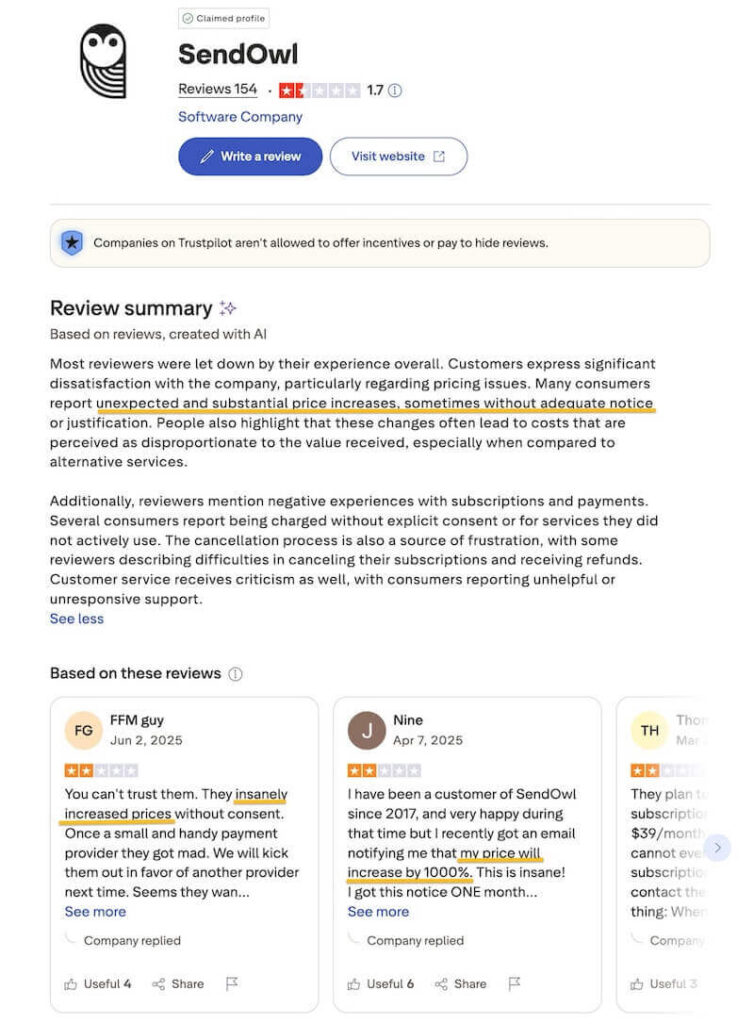
In 2025, SendOwl increased prices by 3x to 10x for many users. Hundreds of customers voiced frustration online. If you’re considering SendOwl, factor in that pricing may change again.
The limitations:
SendOwl has no learning management system. If you sell courses and want built-in student progress tracking, you’ll need a separate tool.
The funnel options are limited. You get one upsell, no downsells. And here’s the catch: if you turn on order bumps, your upsell gets disabled. You can’t use both at the same time. If you’re comparing Gumroad vs Payhip or other e-commerce platforms, SendOwl sits somewhere in between on funnel capabilities.
Best for:
Creators who prioritize file protection and don’t need advanced sales funnels. The Shopify integration makes it useful if you already sell physical products there alongside your digital sales.
This is the link for SendOwl.
Payhip
Payhip positions itself as an easy way to start selling digital products with no upfront costs. The free plan lets you test the waters, though the 5% transaction fee adds up as you grow.
What Payhip offers:
- Built-in learning management system for courses
- Automatic EU VAT handling for selling internationally
- Order bumps to increase average order value
- Integrations with WordPress, Squarespace, Wix, and Weebly
- Connections to Calendly, Zoom, and Bookvault for print-on-demand
Payhip works as both an ecommerce platform and a place to sell digital goods. You can sell ebooks, courses, memberships, and even some type of digital service products.
Pricing structure:
The free version takes 5% of every sale per transaction. No monthly fee, but that percentage hits hard at volume.
The Plus plan costs $29/mo plus 2% per transaction. The Pro plan is $99/mo with no transaction fee.
At higher revenue, Pro becomes the obvious choice. Once you’re making more than roughly $3,500/mo, the flat $99 beats the percentage cuts. Your monthly costs become predictable.
The limitations:
Payhip has no upsells or downsells. You can add order bumps, but that’s where the funnel options end. If post-purchase upsells matter to your strategy, Payhip won’t support that. Some marketing tools are also limited compared to dedicated marketing platforms.
The buy now, pay later option isn’t true BNPL. Payhip’s installment plans pay you over time as the customer pays. If a customer stops paying halfway through, you eat the loss.
Subscriptions only work with Stripe. If your customers prefer PayPal, they can’t subscribe. One-time purchases work fine with both, but recurring billing needs Stripe. You’ll need a PayPal account connected for one-time sales only.
Best for:
Creators who want simple setup, global VAT handling, and a built-in LMS. Works well at lower volumes. Watch your fees carefully as sales grow.
This is the link for Payhip.
Pricing Breakdown: What You Actually Pay
Note: Assumes average order value of $50. Stripe/PayPal fees calculated at 2.9% + $0.30 per transaction.
| Monthly Revenue | SendOwl | Payhip | CartMango | You Save with CartMango |
|---|---|---|---|---|
| $1,000/mo | $122/mo ($87 platform + $35 processing) | $84/mo (Plus: $29 + $20 Payhip fee + $35 processing) | $35/mo (processing only) | $49 – $87/mo |
| $5,000/mo | $334/mo ($159 platform + $175 processing) | $274/mo (Pro: $99 + $175 processing) | $175/mo (processing only) | $99 – $159/mo |
| $10,000/mo | N/A (exceeds $8,333 revenue cap) | $449/mo (Pro: $99 + $350 processing) | $350/mo (processing only) | $99/mo |
| $50,000/mo | N/A (exceeds $8,333 revenue cap) | $1,849/mo (Pro: $99 + $1,750 processing) | $1,750/mo (processing only) | $99/mo |
Pricing takeaways:
At $1,000/mo revenue, SendOwl costs $122 total because the $39 plan only covers up to $833, pushing you to the $87 tier. Payhip’s Plus plan at $84 ($29 monthly + $20 Payhip fee + $35 processing) beats the free plan’s $85 (5% Payhip + processing).
At $5,000/mo, SendOwl jumps to $334 total. Payhip Pro at $274 is cheaper than Plus ($304) and much cheaper than the free plan ($425). Processing fees become the larger cost at this level.
At $10,000/mo and above, SendOwl’s pricing tiers max out at $8,333/mo revenue. You’d need custom arrangements or look elsewhere. Payhip Pro stays at $99 regardless of volume, so your total cost is $99 plus processing.
CartMango charges $0 in platform fees across all scenarios until 2027. At $50,000/mo revenue, you pay only $1,750 in processing fees, saving $99/mo compared to Payhip Pro. That’s $1,188/year back in your pocket.
SendOwl vs Payhip vs CartMango: Which One Fits You?
These are the links for each platform: SendOwl, Payhip, CartMango.
Choose SendOwl if:
You care deeply about file protection and PDF stamping for selling ebooks and digital downloads. You already use Shopify or Square and want direct integration. Your revenue stays under $8,333/mo, and you don’t need upsell funnels or a learning management system.
Choose Payhip if:
You want a built-in LMS for courses. You need automatic VAT handling for international sales. You’re okay with $99/mo at scale (Pro plan), and you don’t need upsells or downsells in your sales process.
Choose CartMango if:
You want to own your recurring revenue and take it with you if you ever leave. You want $0 platform fees. You need full upsell and downsell support. You’re fine with limited native integrations (Make.com covers most needs). And you don’t need built-in affiliate management or LMS right now.
The bottom line:
SendOwl and Payhip both do the job for selling digital products. SendOwl protects files well. Payhip keeps things simple with good VAT handling.
But both hold your subscriptions hostage. Both charge fees that grow with your business.
CartMango takes a different approach. Your revenue stays yours. Your customers stay yours. And your monthly cost stays at zero.
That’s the trade-off worth considering.
Related Reading
- SamCart complaints: billing, upsells & the exit trap (2026)
- Ejunkie vs SureCart: No Subscriptions vs No Ownership (2026)
- Ejunkie vs Easy Digital Downloads: too simple or complex (2026)
- Ejunkie vs Sellfy: your recurring revenue has no future (2026)
- Ejunkie vs ThriveCart: budget cart or big upfront bet? (2026)
- Ejunkie vs SendOwl: the recurring revenue problem (2026)
- Ejunkie vs Samcart: the case with the recurring revenue (2026)
- Ejunkie vs Payhip: 0 recurring revenue safety (2026)
- Ejunkie vs Gumroad: no subscriptions vs no ownership (2026)
- Gumroad vs SureCart: the “catch” (2026)