

Sellfy and Payhip let you sell digital products, but neither lets you keep recurring revenue if you leave. Sellfy focuses on storefronts, while Payhip trades low entry cost for ongoing fees. The risk shows up later.
The Recurring Revenue Prison
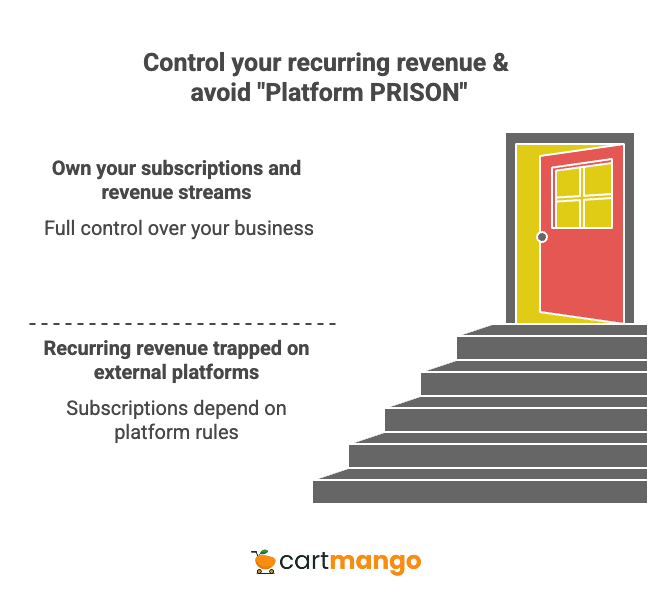
The risk shows up later though.
You build recurring revenue on a platform you do not control.
Payments, customer access, and billing rules sit outside your account. If you leave, those systems do not follow you.
Subscriptions stop. Creators never recover that lost income.
This is where the danger hides.
- Your recurring revenue depends on platform rules, not your business.
- Pricing or policy changes can affect payouts overnight.
- Leaving often means starting over with subscriptions.
I have seen creators ignore this until it happens. By then, switching feels risky and slow. You stay put, even when the fit is off.
This is the problem behind many platform comparisons.
It is not about features first. It is about control over money that already belongs to you.
Once you see it, you cannot unsee it. This shapes every decision that follows.
We Built CartMango to Stop “Subscription Hostage”
I did not set out to build another selling platform. The idea came from watching creators hit the same wall again and again as their businesses grew.
They sold subscriptions and digital products. Revenue looked stable on dashboards, but control was thin once you looked closer.
When platforms changed rules or pricing, creators had little room to react. Moving away often meant broken subscriptions or asking customers to reenter payment details.
Some stayed even when the fit was clearly off. Not because they wanted to, but because leaving felt risky and slow.
That friction kept coming up in conversations. I kept asking a simple question: why should recurring revenue disappear just because you change tools?
CartMango came from that gap. The goal was not to win on feature lists or copy what others were doing.
I wanted checkout, payments, and recurring revenue to feel less fragile. Something that respected the fact that creators earn their customers, not platforms.
This context matters before any comparison. It explains why the next section focuses on trade-offs, not hype.
Sellfy vs Payhip vs CartMango
| Feature | Sellfy | Payhip | CartMango |
| Do your recurring payments stop if you leave the platform? | ❌ Subscription revenue does not carry over once you leave, even if connect your own Stripe / PayPal | ❌ Subscription revenue does not carry over, even if you connect your own Stripe / PayPal | ✅ Your subscription revenue continues |
| Completely FREE to use? (Stripe / PayPal fees apply everywhere) | ❌ $29/mo up to $833 monthly revenue $79/mo up to $4,166 monthly revenue $159/mo up to $16,666 monthly revenue | ❌ 5% fee on each sale (base plan) $29/mo + 2% (Plus plan) $99/mo (Pro plan) | ✅ Yes, 0 monthly fees, 0% commission. All features included (until 2027). |
| Built-in learning platform (LMS) | ❌ Not available | ✅ Included | ❌ Future |
| Post-purchase funnels (upsells & downsells) | ❌ Not supported after the main purchase | ❌ Not available after checkout | ✅ Supported |
| Customer support experience | Generally quick and helpful for common issues. No live chat. Feedback is mixed for complex or urgent problems. | Email support is responsive with mostly positive feedback. Live chat is not offered. | Founder-run support. No bots. No live chat. Typical response time is around 1 hr+ |
| Buy now, pay later options for customers | ⚠️ Limited to PayPal Pay Later. No Klarna, Affirm, or Afterpay | ❌ No real BNPL. Installment plans pay you gradually, not upfront, which can lead to unpaid balances | ✅ |
| Order bumps at checkout | ⚠️ Available only on Business & Premium plans | ✅ | ✅ |
| Subscriptions with trials & setup fees | ⚠️ Subscriptions only. Trials and setup fees are not supported | ⚠️ Subscriptions require Stripe. PayPal payments cannot be used for subscriptions | ✅ |
| Dynamic coupons & discounts | ✅ | ✅ | ✅ |
| Fast, performance-focused checkout | ✅ | ✅ | ✅ |
| No login required before purchase | ✅ | ✅ | ✅ |
| Instant payouts to Stripe / PayPal | ✅ | ✅ | ✅ |
| Protection against piracy (shared download links) | ✅ Download links are restricted | ✅ Download links are restricted | ✅ Download links are restricted |
| Integrations | ⚠️ Limited native integrations: mainly analytics & ad pixels (Google Analytics, Facebook/X ads, Google Merchant Center). But its Zapier integration gives you access to thousands of external apps. | ✅ Connects with WordPress, Squarespace, Wix, Weebly, Shopify, Calendly, Zoom, Bookvault, AdSense, email tools, chat tools, and Zapier. | ⚠️ Limited native integrations. Make.com opens access to 3,000+ apps. Current native integrations: Kit, ActiveCampaign, Beehiiv, and BirdSend, with more coming soon. |
| Affiliate management | ✅ | ✅ | ❌ Coming soon |
| Best suited for | Creators who want an all-in-one storefront for digital products, subscriptions, and print-on-demand, and are fine without post-purchase funnels | Creators who want fast setup and built-in VAT handling, but need to monitor transaction fees as sales grow | Solo digital sellers who want a fast, simple checkout that converts and do not need extra features |
| Free migration | ⚠️ Full migration only included on the highest plan. Other plans get limited migration. | ❌ No free migration | ✅ Free migration included |
These are the links for each platform: Sellfy, Payhip, CartMango.
CartMango Isn’t “Better”. It’s Built for a Different Kind of Seller.
CartMango wasn’t built to replace every selling platform. It was built for creators who care most about checkout control and long-term ownership.
Some tools focus on storefronts. Others focus on content delivery. CartMango starts at the moment a buyer decides to pay.
That choice shapes everything.
If you want a hosted store with pages, themes, and browsing, CartMango may feel narrow. If you want a full LMS today, it may feel incomplete.
That is intentional.
CartMango centers on checkout flows. Order bumps, post-purchase steps, and subscriptions live close to payment, not buried behind account logic.
This matters if your business relies on direct traffic. Email clicks, social links, or sales pages all point to one place where conversion happens.
We built it for sellers who already know what they sell. They do not need a platform to define their business. They need a tool that stays out of the way.
That also means fewer assumptions. You are not forced into a store layout or a content structure.
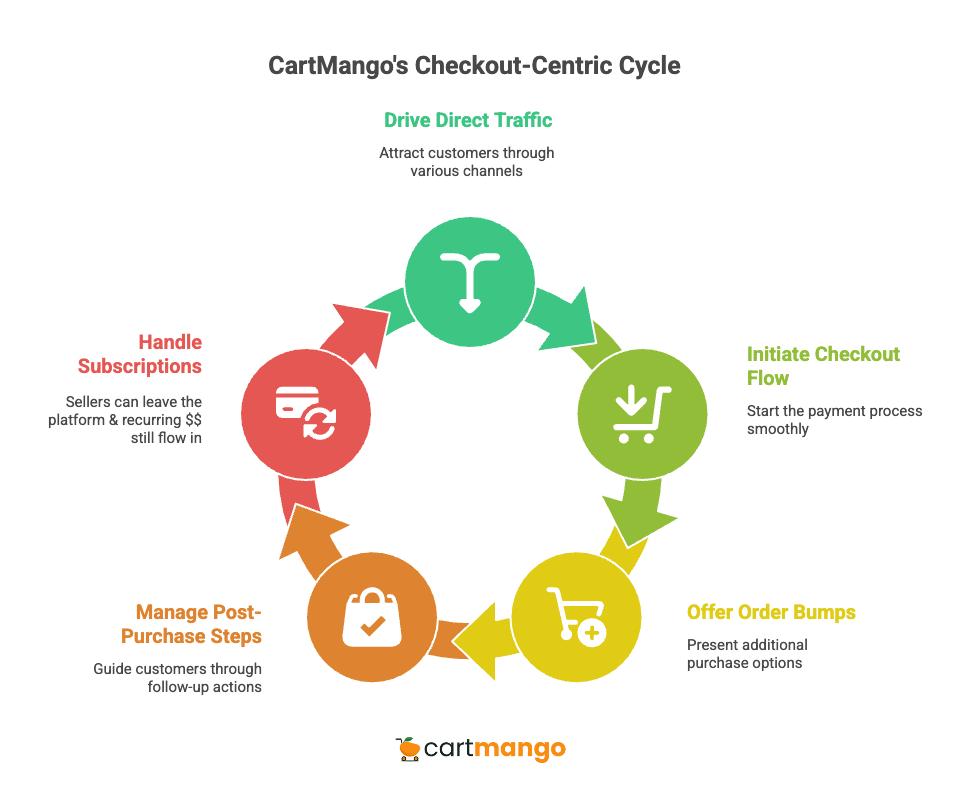
Neither approach is right for everyone. CartMango exists for the group that values control over comfort and clarity over extras.
This context makes the next two sections easier to read. Sellfy and Payhip take different paths, for different reasons.
Sellfy
Sellfy is built around the idea of an all-in-one storefront. You get a hosted store, product pages, and basic marketing tools in one place.
That setup works well if you want structure. You can list products, apply discounts, and send buyers through a familiar store flow without much setup.
Sellfy also supports physical products and print-on-demand. For creators who sell merch alongside digital items, that matters.
The trade-off shows up once you look past the surface. Subscriptions and recurring payments live fully inside the platform, even if you connect to your own Stripe and PayPal account. If you ever leave, your predictable recurring revenue stops.
Post-purchase funnels are another gap. Upsells and downsells after checkout are not supported, which limits how much you can increase order value.
It can feel restrictive for sellers who care about checkout control or advanced revenue flows.
This makes it a good starting point for some businesses, and a ceiling for others.
This is the link for Sellfy.
Payhip
Payhip is often chosen because it feels light and accessible. You can start without a monthly fee and test ideas before committing to anything.
It supports more product types out of the box. Courses, memberships, coaching, and downloads can all live under one account.
That flexibility helps early on. You can experiment without rebuilding your setup every time you add a new offer.
The cost shows up as you grow. Payhip transaction fees stack up with every sale, and the math changes once volume increases. This can be offset by signing up for the $99/mo plan though.
Subscriptions also come with limits. They rely on Stripe, which means PayPal buyers cannot subscribe, even if they prefer that payment method.
Payhip works well for creators who value a low barrier to entry. It can feel less comfortable for sellers who want tighter control over pricing, payments, and long-term margins.
This makes Payhip appealing early and harder to evaluate later. The next section looks at how those costs play out over time.
This is the link for Payhip.
Pricing Simulation
Assumptions
- Payment processor fee: 2.9% + $0.30 per order
- Orders per month (@ $20):
- $1,000 → 50 orders
- $5,000 → 250 orders
- $10,000 → 500 orders
Payhip plans considered
- Free: 5% per transaction
- Plus: $29/month + 2%
- Pro: $99/month, 0% transaction fee
For each revenue tier below, I choose the cheapest Payhip option.
$1,000 / month (50 orders)
Cheapest Payhip plan: Plus ($29 + 2%)
| Platform | Platform fees | Processor fees (2.9% + $0.30) | Total monthly fees | SAVINGS vs Sellfy | SAVINGS vs Payhip |
| Sellfy | Plan: $29 | 2.9% of $1,000 = $29 $0.30 x 50 = $15 Total: $44 | $73 | – | – |
| Payhip (Plus) | $29 + 2% of $1,000 = $49 | Same $44 | $93 | – | – |
| CartMango | $0 | Same $44 | $44 | $29 / mo | $49 / mo |
$5,000 / month (250 orders)
Cheapest Payhip plan: Pro ($99, 0%)
| Platform | Platform fees | Processor fees (2.9% + $0.30) | Total monthly fees | SAVINGS vs Sellfy | SAVINGS vs Payhip |
| Sellfy | Plan: $79 | 2.9% of $5,000 = $145 $0.30 x 250 = $75 Total: $220 | $299 | – | – |
| Payhip (Pro) | $99 | Same $220 | $319 | – | – |
| CartMango | $0 | Same $220 | $220 | $79 / mo | $99 / mo |
$10,000 / month (500 orders)
Cheapest Payhip plan: Pro ($99, 0%)
| Platform | Platform fees | Processor fees (2.9% + $0.30) | Total monthly fees | SAVINGS vs Sellfy | SAVINGS vs Payhip |
| Sellfy | Plan: $159 | 2.9% of $10,000 = $290 $0.30 x 500 = $150 Total: $440 | $599 | – | – |
| Payhip (Pro) | $99 | Same $440 | $539 | – | – |
| CartMango | $0 | Same $440 | $440 | $159 / mo | $99 / mo |
The Practical Checklist
This section zooms out from numbers and looks at day-to-day reality. Not features in isolation, but how tools actually support selling digital work over time.
Storefront vs checkout-first thinking
When people search Sellfy or Payhip, they often start with design. They want a storefront that looks good and feels complete.
Both Sellfy and Payhip lean toward an all-in-one platform approach. You get pages, products, and a basic online store out of the box.
That works for some creators. Others care less about browsing and more about conversion at checkout.
If your online business depends on traffic from email or social, a heavy store builder can feel unnecessary. A focused platform for selling sometimes fits better.
Email, ownership, and follow-up
For selling digital products, email matters early. A creator needs control over their mailing list, not just access to it.
Sellfy includes built-in email marketing, though limits apply. Email marketing credits can cap how often you reach buyers.
This matters once you sell digital downloads, online courses, or coaching services repeatedly.
Ask yourself:
- Do I want built-in marketing, or tight control over email marketing tools?
- Is this for a one-time launch, or ongoing monetization?
Product types and flexibility
A common reason people choose Payhip is variety. Payhip allows membership, digital goods, pay-what-you-want pricing, and drip delivery. That makes Payhip another solid option for creators who sell mixed formats.
Sellfy offers a simpler setup. Both are user-friendly, but they suit different workflows.
Built-in tools vs long-term fit
An all-in-one setup sounds appealing. One e-commerce platform designed to handle everything you need.
Look closely at pricing plans, monthly subscription costs, and how each platform offers value as you grow.
For small businesses, the right platform to sell depends on what you want to control long term.
Customization, branding, and growth
Brand matters once sales are consistent. Customizable pages, customization options, and a clean template affect trust.
If you plan to customize heavily, check what each tool supports:
- Integration with Stripe
- Coupon codes and discount codes
- Marketing features beyond basics
This is where people start to compare Payhip, look at Sellfy vs, and ask how Sellfy and Payhip offer different paths.
Sellfy vs Payhip vs CartMango: Which Fits Your Business?
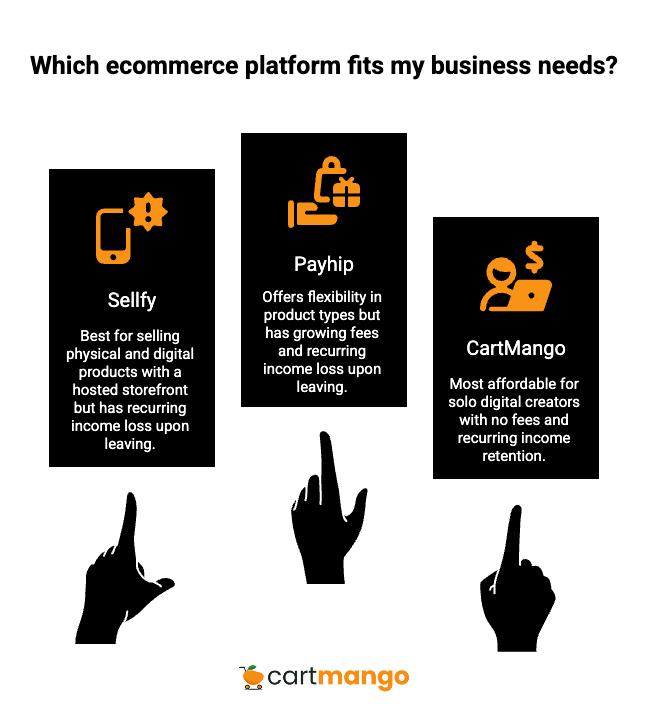
These are the links for each platform: Sellfy, Payhip, CartMango.
At some point, you have to decide which platform fits your workflow. Not which one has more features.
But which one makes it easy to work, makes it easy to sell, and suits your ecommerce needs.
At this stage, the decision should feel grounded. Not because one platform wins, but because the trade-offs line up with how you sell.
If you want a hosted storefront that also sells physical products apart from digital products, Sellfy fits that path. You get familiarity, with limits once you want more control. I’m talking about lost recurring income if you leave.
Payhip works if you want flexibility in product types. Courses, memberships, and downloads can live together. The upfront cost can feel low, but fees grow as revenue grows. And again – lost recurring income when you leave the platform.
This “subscription hostage” is about creators realizing the revenue was never fully theirs.
CartMango is the most affordable option for solo digital creators. It’s totally free: 0 monthly fees (till 2027). 0 platform cut (ever). And of course, if you leave CartMango, your predictable recurring income stays with you.
And It only takes 1 minute to set up a product for sale.
Related Reading
- ThriveCart vs Sellfy: the revenue captivity (2026)
- SendOwl vs Sellfy: the recurring income handcuffs (2026)
- SamCart vs Sellfy: the customer cash hostage (2026)
- Payhip vs ThriveCart: losing what you built (2026)
- ThriveCart vs Gumroad: the recurring revenue trap (2026)
- Where to Buy Digital Products to Resell: 6 Top Places in 2026 (+ a glaring problem)
- SamCart vs Gumroad: who actually owns your customers? (2026)
- Is Gumroad Safe in 2026? Uncovering the Hidden Pros and Cons
- Payhip vs Podia: The Recurring Income Hostage (2026)
- Payhip vs SamCart: The Recurring Revenue Handcuffs (2026)