

SamCart complaints fall into three buckets: billing and cancellation problems, the Creator U upsell experience, and recurring revenue you cannot take with you if you switch platforms.

Most samcart reviews focus on the obvious stuff. Pricing. Customer support. Missing integration options. Ease of use complaints.
But the complaint that should concern you most is one that barely gets mentioned. And you won’t notice it until you try to leave.
SamCart Complaint: The Recurring Revenue Hostage
Most people don’t realize this about SamCart until it’s too late.
If you build subscription revenue on SamCart and decide to leave, your recurring payments don’t come with you. Stripe fixed-term subscriptions, all PayPal subscriptions, and non-Stripe recurring billing stay locked inside SamCart’s system. Your subscription products, your customer purchases, the payment information tied to those recurring cycles… all of it stays on their platform.
Every month you stay and grow your subscription base, you’re building income on a platform that holds it. The longer you wait, the more it costs to walk away.
This isn’t a pricing complaint. It’s a business risk that gets bigger over time.
And the numbers from review sites tell a story. SamCart has a 4.0 out of 5 on Trustpilot across 335 reviews. On Sitejabber, it’s 1.7 out of 5 from 23 reviews.
That’s a big gap. Why?
Trustpilot is where SamCart actively asks customers to leave reviews. Sitejabber is where people go on their own when they’re frustrated. The difference between a prompted review and an unprompted one is telling.
The recurring revenue lock-in is the complaint that ties everything together. Billing problems are annoying. But losing your subscription income because you want to switch platforms? That’s a different level.
I wonder sometimes if people even read the fine print before they sign up. Probably not. I wouldn’t have either, honestly.
With CartMango, your recurring payments keep flowing even if you cancel your account. You built that revenue. It stays yours.
(Disclosure: you’re on the CartMango blog. I’m the founder of CartMango.)
The SamCart Complaints Everyone Already Knows
You probably came here expecting to read about these. So let’s cover them.
SamCart Pricing: $79/Month Minimum Is Steep for Beginners
SamCart now has one plan with all features included. That part is good. No choosing between tiers, no feature gating. You get the full SamCart experience from day one, whether you’re selling a $27 template or a $2,000 online course.
But it starts at $79 per month, and pricing scales up based on your revenue. At $10,000 per month in revenue, you’re paying $219/month. At $100,000, it’s $849/month. The current model ties your cost directly to how much you earn, no separate scale plan or tier structure anymore.
For a solo creator just starting out selling a $27 ebook or online course, $79/month means you need to sell about 3 copies per month just to break even on the platform cost. Before you’ve paid yourself anything. If you’re selling products online through Shopify or another e-commerce platform, you might be used to lower monthly costs for your shopping cart.
SamCart charges 0% transaction fees on their preferred processors, which is nice. But you still pay standard Stripe or PayPal processing fees (around 2.9% + 30 cents per sale). So “0% transaction fees” doesn’t mean zero cost per sale. You can test payments before going live to make sure everything works, which is a nice touch.
That said, SamCart does include upsells, order bumps, cross-sell options, and cart abandonment recovery on every plan. You also get their funnel builder, sales pages, landing page templates, and a conversion-optimized checkout. For an all-in-one platform, the feature set is real. SamCart makes it easy to set up your main product with upsell funnels and automation, and many users say the checkout is proven to convert. The question is whether the average order value you generate justifies the monthly cost.
Some people also wonder about physical product support. SamCart can sell physical products, but multiple Trustpilot reviews mention issues with shipping charges on subscription orders being applied per item instead of per order. If you only sell digital products, this won’t matter to you.
CartMango is free during beta right now. After beta (estimated 2027), the price is $9.99 per year.
Yes, per year.
No per-transaction fees beyond standard Stripe and PayPal processing. Same processing fees as SamCart, but $9.99/year instead of $948+/year for the platform itself.
Billing, Cancellation, and Customer Support Issues
This one comes up a lot in the reviews. The support team gets mentioned frequently, and not in a good way. Some users say they got an email confirming cancellation, then still got charged. Others mention that live chat support response times vary.
SamCart has no money-back guarantee. If you want to cancel your samcart account, you need to do it at least 5 days before your next billing date. Miss that window and you’re charged for another cycle. No full refund, no exceptions.
Refunds are discretionary. Annual plans can get a refund within 30 days, maybe. Monthly plans? No refund at all.
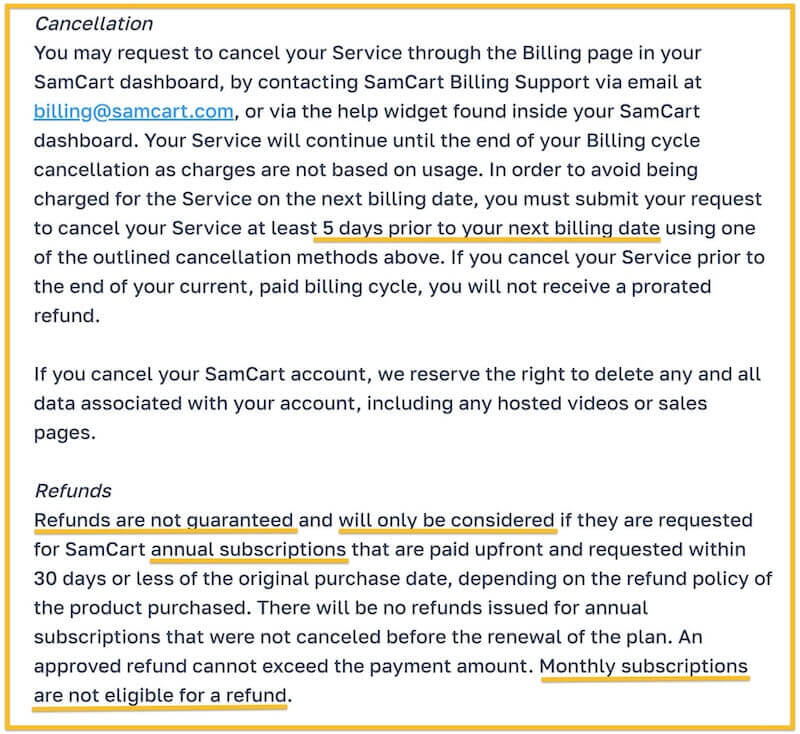
Multiple users on Trustpilot report being charged after they thought they’d cancelled. One recent review from March 2026 mentions a $239 charge with “no idea who this company is.”
Whether that’s a billing system issue or user error, the pattern shows up enough times to pay attention. And when people try to reach customer support about it, the responses are slow. Some mention getting stuck in an AI chatbot loop before reaching an actual person.
The Creator U Upsell Pipeline
This is a specific complaint pattern worth knowing about.
Creator U (sometimes written as CreatorU) is SamCart’s education arm. You sign up for what looks like a $10 course or resource. During the process, you get upsold into a SamCart free trial.
The problem? Multiple users report getting charged roughly $200 a year later for a samcart account they thought they’d cancelled. The billing for Creator U and SamCart gets tangled together, and cancelling one doesn’t always cancel the other.
Then there’s the Creator U Accelerator program at $7,000. Some users report it didn’t deliver on its promises, with AI-generated landing pages and group sessions instead of the personalized support they expected.
Not everyone has this experience. Some testimonial posts from Creator U users are positive. But the complaints are specific enough and recent enough (2025-2026) that it’s worth flagging. Course sales through Creator U seem fine for some people. For others, the upsell automation catches them off guard.
SamCart Pros and Cons: Is SamCart Even Worth It?
Let’s be fair about this. SamCart isn’t all bad. If you use SamCart and it works for your online business, that matters more than what any review says. SamCart will help you sell if you commit to the platform.
What SamCart does well:
- All features included from day one (upsells, order bumps, 1-click cart abandonment recovery, subscription saver)
- High-converting checkout page templates designed for conversion
- 0% platform transaction fees on preferred processors
- One plan, no confusing tier decisions
- Affiliate center and dashboard included for tracking affiliate performance
- CRM and email list integration through third parties like Mailchimp and API connections
- Samcart is the best option for creators who want a dedicated checkout platform without building a full online store
What gives people problems:
- Recurring revenue stays locked in if you leave
- $79/month minimum, scaling up with your revenue
- Billing and cancellation complaints are a pattern
- Creator U upsell flow catches people off guard
Is SamCart legit?
Yes. It’s a real company with real customers and a working product.
Is SamCart safe?
Your data and payments are processed through Stripe and PayPal, so the payment information side is secure. The concern isn’t safety, it’s what happens to your subscription revenue if you decide to leave.
Is SamCart worth it?
That depends on one question. Are you planning to stay on the platform long-term?
If you’re selling one-time products and don’t plan to build subscription revenue, the lock-in issue doesn’t apply to you. SamCart’s checkout pages work well and the conversion features are solid for selling digital products. The user experience for buyers is clean, and the checkout is designed to reduce abandonment.
But if you’re building a subscription-based business (online courses, memberships, coaching), you need to think about what happens to those payments if you ever want to switch. Because on SamCart, they stay behind. That’s the samcart vs other platforms difference that nobody talks about.
And look, I’m not saying SamCart is a scam or that it doesn’t work. It does. The checkout converts. The funnel tools work. But “does it work?” and “can I leave when I want?” are two different questions.
What to Look for in a Checkout Platform if You’re Leaving SamCart
If the SamCart complaints above concern you, here’s what to check before picking any checkout platform for your online stores or digital product business.
Will your recurring payments keep coming in if you leave?
This is the big one. Most people don’t ask this question until it’s too late. With SamCart, the answer is no for most subscription types.
With CartMango, your recurring payments continue flowing into your account even after you cancel. You built that income. It doesn’t stop because you stopped using the platform. The user experience of leaving should be as clean as the experience of signing up.
Are payouts going directly to your account?
You want funds going straight to your own Stripe or PayPal account. Not held by the platform, not delayed, not controlled by someone else’s billing system. This matters whether you sell physical products or digital ones.
What does the platform actually cost?
SamCart: $79-$849/month depending on your revenue. That’s $948 to $10,188 per year.
CartMango: Free during beta right now. After beta (estimated 2027), $9.99 per year. Per year. No per-transaction fees. Same Stripe and PayPal processing fees you’d pay anywhere.
We also offer free migration if you’re coming from another platform. And the team behind CartMango has 15 years of experience and $179M+ in processed sales through previous platforms.
Does the platform work for what you’re selling?
If you’re a solo creator selling digital products, courses, coaching, or memberships, you don’t need a complex ecommerce setup. You need a checkout that works, payments that go to your account, and the freedom to leave if something better comes along.
You don’t need a full Shopify store or a complicated e-commerce stack. A clean checkout page, a way to handle one-time and subscription payments, and good integration with your email list is enough for most creators.
SamCart complaints keep coming back to the same core issues. The billing headaches are frustrating. The Creator U upsell experience catches people off guard. But the recurring revenue lock-in is the one that actually costs you money long-term.
Before you commit to any checkout platform, ask what happens to your subscription payments if you leave. If you don’t like the answer, keep looking.
CartMango is free until 2027, then $9.99/year. Worth checking out before you lock yourself in anywhere.
Related reading
- How to cancel Payhip (2026)
- Cancel SendOwl: 3 scenarios, 3 different processes (2026)
- Is Gumroad a scam? (2026)
- How to cancel ThriveCart (seller & buyer steps) (2026)
- ThriveCart reviews complaints: a competitor’s take (2026)
- Is ThriveCart legit? (2026)
- ThriveCart lifetime deal: $495 base vs $985 reality (2026)
- Cancel SamCart subscription: no refunds for monthly plans (2026)
- SamCart complaints: billing, upsells & the exit trap (2026)
- Ejunkie vs SureCart: No Subscriptions vs No Ownership (2026)