

Gumroad has no monthly fee, but you pay 10% + $0.50 per sale. If you ever leave, all your recurring payments die on the spot. Sellfy charges a flat monthly fee with 0% commission, but same deal: walk away, lose every recurring payment.
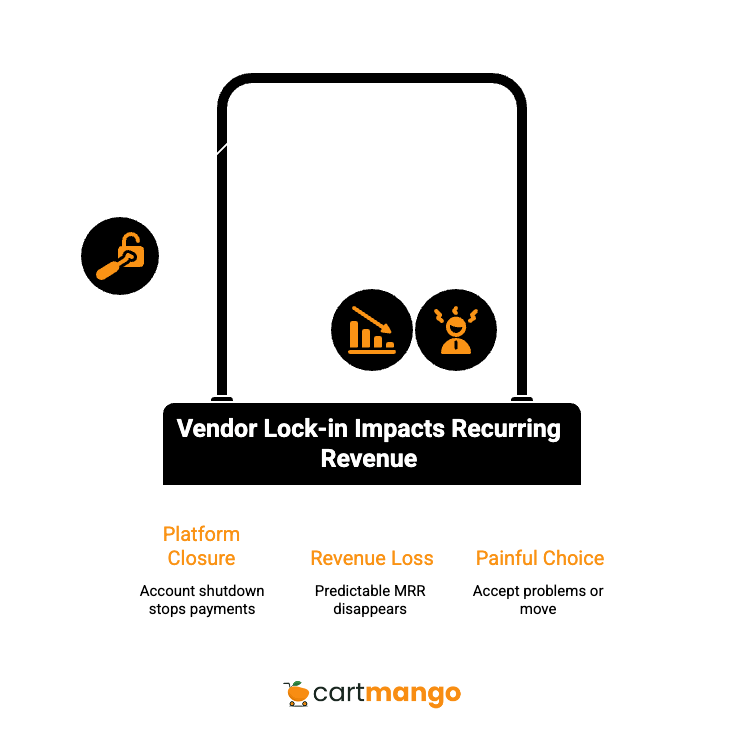
The Vendor Lock-in Cage
A.k.a. The Subscription Hostage.
With both Gumroad and Sellfy, leaving the platform means your customers’ recurring payments stop.
You spend years turning followers into paying members. Recurring revenue finally covers your rent. Then you try to leave the platform and every subscription stops the moment you close your account.
Even though Sellfy processes payments through your Stripe or PayPal, it still controls the subscription billing logic. When you shut down your Sellfy store, those recurring charges end.
When something breaks or support goes quiet and you want to move?
You face a painful choice:
- Stay and accept the problems or
- Move and lose predictable MRR (monthly recurring revenue)
This is the real risk.
The platform can take away the recurring revenue that was supposed to make your business safer and more stable.
Why We Built CartMango
Together with my small team, we built CartMango after watching creators lose years of recurring revenue the moment they tried to leave platforms that owned their subscriptions.
The same story kept repeating:
- someone wants to switch tools
- realizes their monthly income will vanish overnight
- so they stay trapped
The solution is simple.
Your Stripe or PayPal account should be the home of your business. CartMango is just a checkout layer on top.
You can switch tools later without killing the recurring payments you worked so hard to build. That’s the whole point.
Gumroad vs Sellfy vs CartMango
| Feature | Gumroad | Sellfy | CartMango |
|---|---|---|---|
| Your recurring payments vanish when you leave the platform? | ❌ Recurring payments lost if you leave. | ❌ Recurring payments lost if you leave. | ✅ You keep recurring payments. |
| TOTALLY free for cart fees? (Stripe/PayPal fees are standard no matter what cart you use) | ❌ 10% + $0.50 per transaction | ❌ $29/mo for up to $833/mo revenue (Starter plan). $79/mo for up to $4,166/mo revenue (Business plan). $159/mo for up to $16,666/mo revenue (Premium plan). | ✅ Yes, 0 monthly fees, 0% commission. All features included (until 2027). |
| Funnels (upsells & downsells) | ⚠️ Upsells are supported, but no true conditional downsells. You can’t trigger a different offer when someone declines the upsells. | ❌ Does not support upsells / downsells. | ❌ Coming soon. |
| Customer support | ❌ Bad customer support & AI chatbots. Deleted feedback posts, ignored emails (source). | ⚠️ Generally fast & friendly for everyday issues, not tech. Mixed reviews when problems get more technical or urgent. | ✅ Founder-led personal support. We don’t use chatbots or live chat. Average reply time is 1+ hour. |
| Buy now, pay later (BNPL) support for your customers (boost your sales) | ❌ No real BNPL. Gumroad pays you in installments, not upfront. If a customer bails mid-way, you eat the loss. | ⚠️ Only via PayPal Pay Later. No popular BNPL services like Klarna, Affirm, Afterpay. | ✅ |
| Order bumps for fast revenue boosts | ✅ | ⚠️ Only on Business & Premium plans. | ✅ |
| Subscriptions (support trials & set up fees) | ✅ | ⚠️ Doesn’t support trials & set up fees, only regular subscriptions. | ✅ |
| Dynamic coupons & discounts | ✅ | ✅ | ✅ |
| Optimized & fast checkouts | ✅ | ✅ | ✅ |
| Customers need NOT log in before buying (quick checkout experience) | ✅ | ✅ | ✅ |
| Direct, instant payouts to your Stripe/PayPal. No holding your money. | ❌ 7-day hold, but many sellers face much longer payout holds without clear explanation (source). | ✅ | ✅ |
| If download links are shared by rogue customers, will they work? | ✅ Links are protected. | ✅ Links are protected. | ✅ Links are protected. |
| Integrations | ⚠️ Native integrations: Only Discord & Circle for instant community / membership access. For everything else, you’ll need Zapier. | ⚠️ Limited native integrations: mainly analytics & ad pixels (Google Analytics, Facebook/X ads, Google Merchant Center). But its Zapier integration gives you access to thousands of external apps. | ⚠️ Limited native integrations, but its Make.com integration gives you access to 3,000+ apps. Current native integrations: Kit, ActiveCampaign, Beehiiv, and BirdSend, with more coming soon. |
| Affiliate management | ✅ | ✅ | ❌ Coming soon. |
| Best for | Creators who want a simple, no-monthly-fee way to start selling and don’t mind giving up a big 10% cut or skipping advanced funnels & deep customization. | Creators who want an all-in-one store for digital products, subscriptions, and print-on-demand merch, and who don’t mind not having true funnel tools like post-purchase upsells & downsells. | Solo digital creators who want a clean, fast, conversion-focused checkout and currently don’t need bells & whistles. |
| Free migration | ❌ No free migration. | ⚠️ Full migration only on the most expensive Premium plan. The other plans get limited migration. | ✅ Free migration included. |
These are the links for each platform: Gumroad, Sellfy, CartMango.
CartMango: Not Better. Just Different.
I did not design CartMango to cover every possible use case. My goal is to help solo digital creators who want a clear, low-friction way to charge buyers and get paid without juggling a big stack of tools. If you just want reliable checkouts that support your income, CartMango focuses on that part.
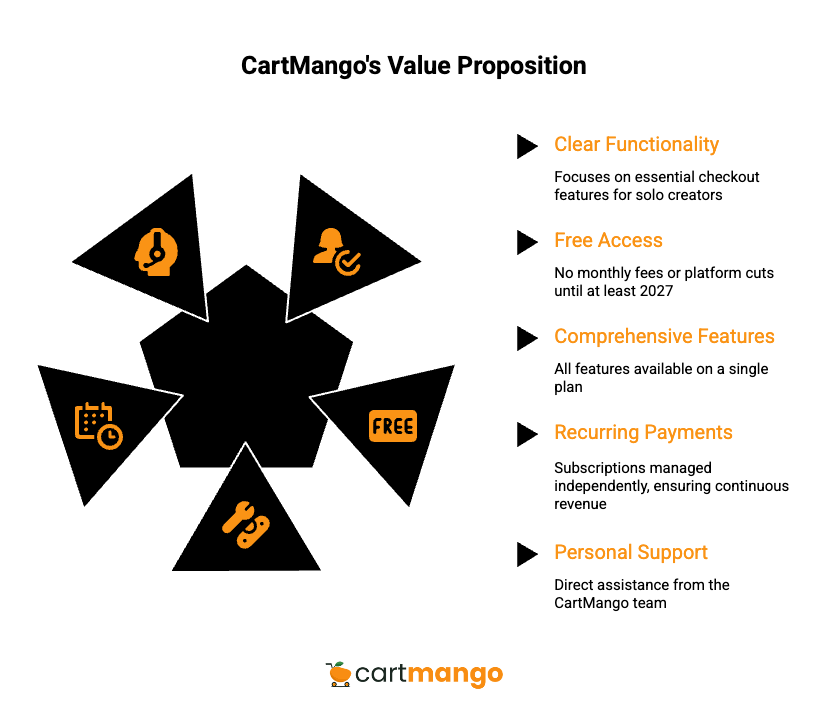
CartMango is free until at least 2027. You do not pay a monthly fee and you do not pay a platform cut on each sale. You still pay Stripe or PayPal fees directly to them, just like with other carts.
All current features are available on this single plan. There is no “starter” tier where you outgrow half the feature set after your first decent month.
The key difference is what happens to your recurring payments. Subscriptions are created inside your own Stripe or PayPal accounts, so if you ever leave CartMango, your existing recurring charges keep running. You keep that monthly revenue instead of watching it vanish when you close an account.
Support is personal. My small team and I answer questions ourselves, with no bots in front of you. Most solo creators find that direct contact more helpful than a large but distant support system.
CartMango fits micro teams and solo digital creators best. If you also want fancy marketing tools like deep page design or AI video creation or social media management, other tools will definitely suit you more. If you care about fast setup, simple controls, and keeping what you earn, CartMango is likely a better match.
Pricing & Real Costs
The table below shows exactly what you’ll pay at different revenue levels. This assumes an average order value of $20, so orders per month equals revenue divided by 20. Payment processing runs through Stripe or PayPal at about 2.9% + $0.30 per card transaction.
| Monthly revenue | Platform | Platform fees | Processor fees (2.9% + $0.30) | Total monthly fees | SAVINGS vs Gumroad | SAVINGS vs Sellfy |
|---|---|---|---|---|---|---|
| $1,000 (50 orders) | Gumroad | 10% of $1,000 = $100 $0.50 × 50 = $25 | 2.9% of $1,000 = $29 $0.30 × 50 = $15 | $169 | – | – |
| Sellfy | Plan: $79 (Business tier at this level) | Same $29 + $15 = $44 | $123 | $46/mo vs Gumroad | – | |
| CartMango | $0 | Same $44 | $44 | $125/mo vs Gumroad | $79/mo vs Sellfy | |
| $5,000 (250 orders) | Gumroad | 10% of $5,000 = $500 $0.50 × 250 = $125 | 2.9% of $5,000 = $145 $0.30 × 250 = $75 | $845 | – | – |
| Sellfy | Plan: $159 (Premium) | Same $145 + $75 = $220 | $379 | $466/mo vs Gumroad | – | |
| CartMango | $0 | Same $220 | $220 | $625/mo vs Gumroad | $159/mo vs Sellfy | |
| $10,000 (500 orders) | Gumroad | 10% of $10,000 = $1,000 $0.50 × 500 = $250 | 2.9% of $10,000 = $290 $0.30 × 500 = $150 | $1,690 | – | – |
| Sellfy | Plan: $159 (Premium still sufficient) | Same $290 + $150 = $440 | $599 | $1,091/mo vs Gumroad | – | |
| CartMango | $0 | Same $440 | $440 | $1,250/mo vs Gumroad | $159/mo vs Sellfy |
Payout Speed
Gumroad uses scheduled payouts with holds. Many sellers report waiting longer than the stated seven days without clear explanation.
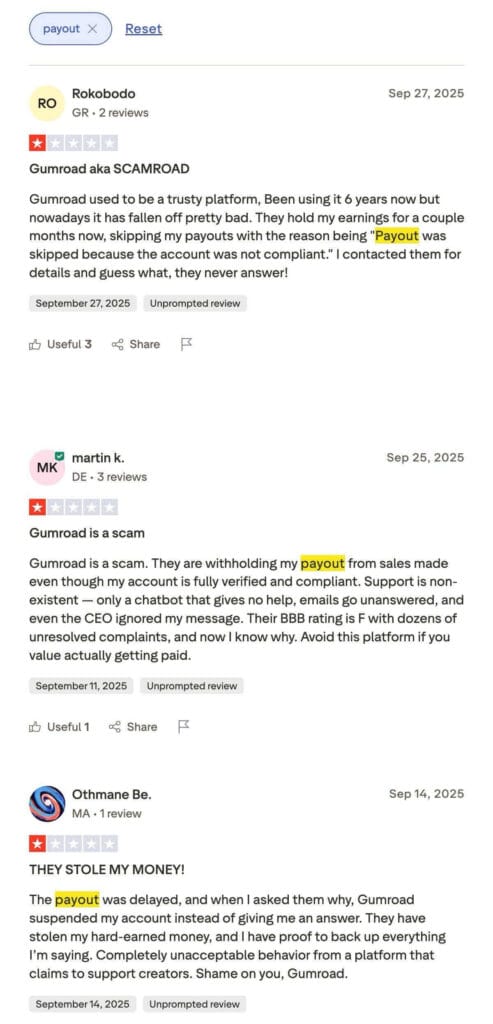
Sellfy and CartMango pay out to your Stripe or PayPal as transactions occur. This gives instant access to funds since you control the processor account directly.
Support & Ease of Use
Setup Speed
Gumroad is minimal and link-first. You can list a product and start selling the same day with almost no configuration. Just upload, set a price, and share the link.
Sellfy takes longer because you’re configuring a full store. You need to set up store design, navigation, and product categories. Still friendly for non-technical users, but more steps before you’re live.
CartMango is built for solo digital creators and focuses on fast product setup with a simple, uncluttered dashboard. Less time configuring features you won’t use, more time getting your first sale.
Support Quality
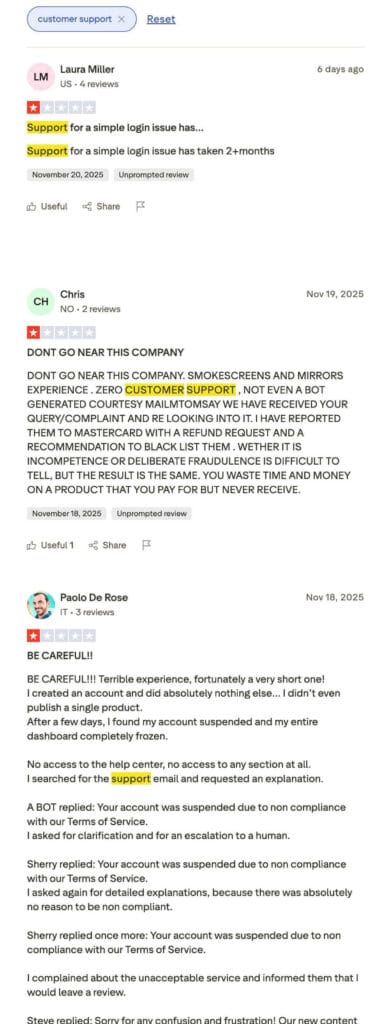
Gumroad is frequently criticized for slow or unhelpful replies. Some creators report ignored emails, deleted feedback posts, and difficulty getting human help when payments stall or accounts are flagged.
Sellfy gets good marks for general support. Response times are reasonable and documentation is clear for everyday tasks.
CartMango leans on direct, founder-involved help instead of chatbots. When you have a migration question or payment issue, you’re talking to someone who actually builds and understands the product.
.
These are the links for each platform: Gumroad, Sellfy, CartMango.
Real-World Impact
For solo digital creators, a simple user interface plus responsive support often matters more than having 50 extra features you never use.
Beginner Choices & Store Setup
If you are a beginner
If you are a beginner at selling digital products, your first real choice is simple: do you want a quick checkout or a full ecommerce setup.
In a sellfy vs gumroad comparison, both let you create and sell fast, but the feel is different. Gumroad’s flow is closer to sharing links and simple product pages, while a store with sellfy feels more like running a small online store with a proper storefront.
CartMango sits closer to the Gumroad side for new users who just want to sell your digital offers without building a full site with a heavy builder on day one.
How your store looks and feels
Sellfy gives you a branded store where you can customize the layout, colors, and sections, then add product blocks for merchandise, print on demand, or files. You get more controls if you’re on the higher level plans.
A store with sellfy can act as an all-in-one ecommerce hub, which is closer to a classic ecommerce platform or ecommerce solution if you want everything in one place.
Gumroad is more straightforward. You get simpler pages and a profile, and gumroad takes its fee on each sale instead of charging a standard SaaS style monthly free plan tier.
CartMango focuses on simple product setup (1 minute) and fast checkout pages for sales conversions.
Gumroad vs Sellfy vs CartMango: Choose Which?
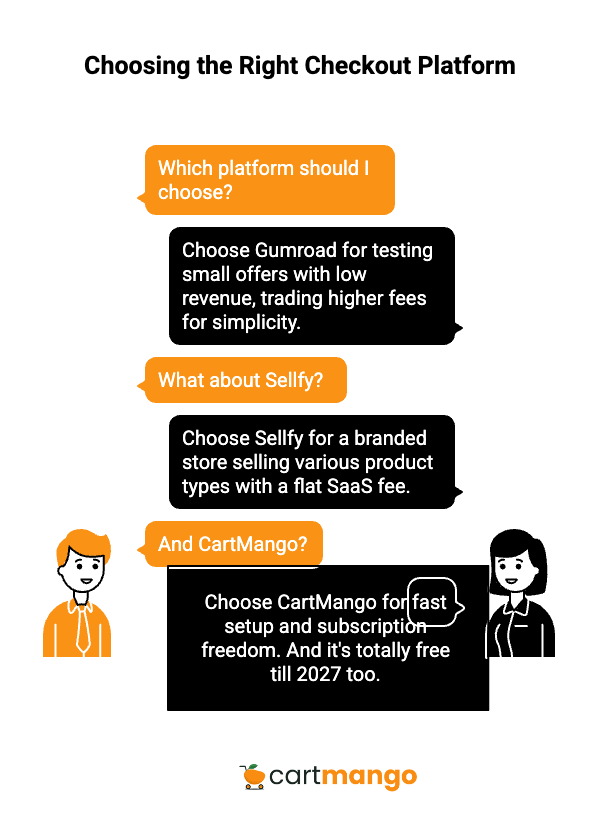
Choose Gumroad if:
You’re testing a small offer and expect low monthly revenue. You’re okay trading higher percentage fees and subscription lock-in for the simplicity of no monthly plan. Good for quick experiments where you’re not sure if the product will sell.
Choose Sellfy if:
You want a branded hosted store and sell multiple product types like digital, physical, and print-on-demand under one roof. You prefer a flat SaaS fee with 0% platform transaction fees.
Choose CartMango if:
Recurring revenue is core to your business and you refuse to let a platform hold your subscriptions hostage. You want to save the most money, get fast setup, and give customers a smooth checkout experience. You care about keeping fees as low and predictable as possible over the long term, and you want the freedom to switch tools later without losing MRR.
.
Test each platform with a small offer, run the numbers, and choose the one that protects your income, not just your convenience.
These are the links for each platform: Gumroad, Sellfy, CartMango.
Related Reading
- Ejunkie vs SureCart: No Subscriptions vs No Ownership (2026)
- Ejunkie vs Easy Digital Downloads: too simple or complex (2026)
- Ejunkie vs Sellfy: your recurring revenue has no future (2026)
- Ejunkie vs ThriveCart: budget cart or big upfront bet? (2026)
- Ejunkie vs SendOwl: the recurring revenue problem (2026)
- Ejunkie vs Samcart: the case with the recurring revenue (2026)
- Ejunkie vs Payhip: 0 recurring revenue safety (2026)
- Ejunkie vs Gumroad: no subscriptions vs no ownership (2026)
- Gumroad vs SureCart: the “catch” (2026)
- Payhip vs SureCart: the hidden catch nobody talks about (2026)